Although representatives of the Danish school consider themselves custodians of Chaldean numerology (IPA: kælˈdiːən ˌnuːməˈrɑːlədʒi) this school developed only in recent decades and differs in many respects from the “Chaldean” or Hebrew tradition. Its approach has an almost mathematical appearance, with clearly defined structures and relationships between them. This makes it particularly well suited to the development of computer applications. Over the past decade, despite the unusually high tuition fees charged for its courses, the school has experienced a veritable stampede of interest. Well-known representatives of this numerological system include Millicent Rosamunde, Novalee Wilder, August Darius Danielsson (August Martin Mogensen), also Johannes Ehwas, and Estel Ehwas.
The influence of this school is growing very rapidly, and Chaldean numerologists cannot afford to overlook its presence. We are increasingly being asked about it by people who visit the school’s websites and use its calculators to generate numeroscopes. Naturally, these people then see that representatives of the Danish school call themselves Chaldean numerologists, and confusion quickly arises. “Why did you calculate a different number for my surname than the one calculated by the online numeroscope? Why didn’t you mention my ‘aura’ numbers? Where did you get that number when examining my time chart, when my annual rank indicates the presence of entirely different numbers?” Such questions can become rather annoying.
Sometimes a concrete example can explain more than lengthy discussions. Let us examine the numeroscope of Jan Kefer, a Czech astrologer, Kabbalist, magus, alchemist, publicist, librarian, and Hermeticist.
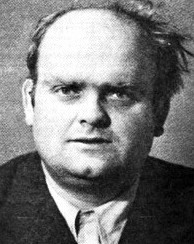
The Nazis imprisoned him in a concentration camp, where he died at the age of 35. He was born on January 31, 1906. Many twentieth-century Chaldean numerologists like Cheiro would have calculated only the basic name vibrations, 7 and 22, followed by the Total Name Number (TNN), 11 (or 29 or 74). They would, of course, also have included the significance of his birthday, which is 31. Montrose, who was active in 1940, would have added the Life Path number and the vowel and consonant levels as well. The basic numeroscope for Jan Kefer looks like this:
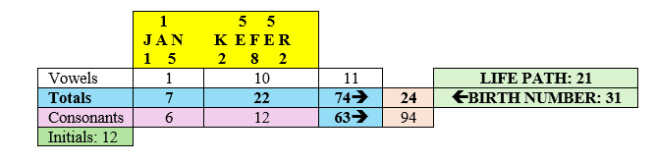
The combination of the numbers 7, 4 (31, 94, 22), and 74 directed him toward the occult. The numbers 11 and 74 are Moon numbers which, under certain conditions, can govern the public and communication. Later in life, sometime after the age of 32, the vibrational key 3 becomes more strongly activated, although it is not compatible with his name chart. One of his Goal numbers is 94, a variant of 13, the number of “Death,” while his initials produce the number 12, which can function as the number of the “Victim/Sacrifice.” The number 12 also appears among the consonants of his surname. His chart indicates that wartime could threaten his life. The relationship between 63 and 94 is one between physical existence and death/transformation; the relationship between 63 and 31 can cause accidents and violence; and the relationship between 12 and 22 in his surname, together with 12 in his initials, points toward some form of victimhood. Practicing black magic can bring karmic consequences and make the whole situation even worse. It is said that Jan Kefer attempted to kill Hitler through black magic. In the end, it was the Nazis who caused Kefer’s own death, while Hitler lived for some more years.
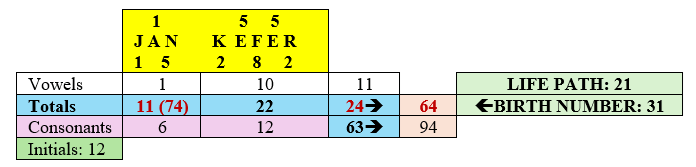
We can introduce the Danish school’s concept of hybrid numbers into the numerological chart. These numbers serve as substitutes for personal first names and surnames whose letter totals are below 10. The method consists of adding the vibrational key of the birth-day number to the number of the first name or surname when that name total is below 10. In Kefer’s case, we obtain a first-name number of 11 (J, 1 + A, 1 + N, 5= 7; vibratory key of 31 is 4; 7 + 4 = 11) and a TNN of 24. The number 24 is hardly a number associated with occultists. Its connection with numbers whose vibrational keys are 3 and 9 suggests that the later part of his life, sometime after the age of 32, should generally have been more successful than the earlier part. However, dying in a concentration camp can hardly be regarded as a sign of success in life.
Danish numerologists would also calculate a special numeroscope in the form of a diamond chart:
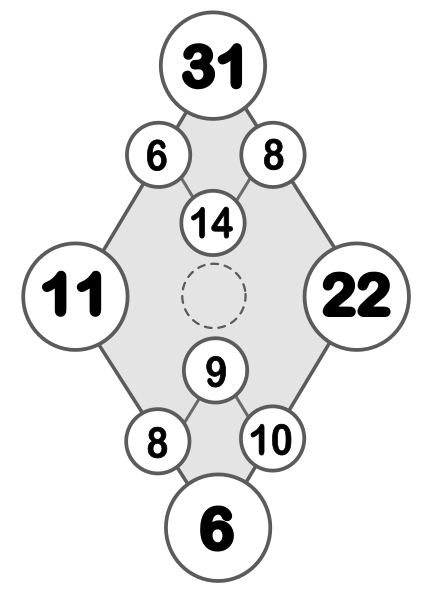
In this chart, they would obtain the “aura” numbers 6, 8, 8, and 10. “Auras” are special numbers characteristic of the Danish school. They would also obtain two additional numbers for the upper and lower centers, which in this case are 14 and 9. I have no objection to using and researching these numbers, along with several others. However, numerology, like many other approaches, requires us always to return to its traditional foundations. The life and fate of Jan Kefer are already described reasonably well by traditional Chaldean numerology. The same is true of many other numeroscopes. I therefore see no need to replace the traditional approach with that of the Danish numerology school.
Another distinctive feature of the Danish school is its considerable relativity in the interpretation of numbers. The school is rather “psychologically oriented” and looks for both positive and negative aspects in almost every number. According to its numerologists, only the relationships between numbers can indicate whether a particular number operates more fortunately or less fortunately.
I should also mention another awkward aspect of Danish Kabala. When the letters of a first name or surname do not add up to 10 or more, and the birthday is unknown, it is practically impossible to construct any numeroscope at all. Another famous Czech whose name was Jan was Jan Hus. We do not know his birthday, and the Danish school is therefore unable to interpret his numeroscope.


