SHÍ Mantra

The SHÍ mantra (十), also pronounced “SHER” or “SHƏ,” literally means the number ten in Chinese. This mantra may be used to activate energy in the following areas:

  • any part of the legs
  • any part of the arms
  • the genitals
  • the perineum
  • the anus
  • the navel

The mantra is practiced in combination with the SHAO and T’AI mantras. First, choose one of the body areas listed above on which you wish to focus. Direct your attention and loving intention toward that area.

Mentally or aloud, repeat T’AI SHÍ (汰十) at least six times to activate the cleansing of Qi (prana) from the selected area. If the condition is more serious, the mantra may be repeated additional times. However, stop the practice when you feel that it is sufficient or after reaching 30 repetitions, whichever comes first.

Next, energize the same body area by repeating SHAO SHÍ (捎十) the same number of times. The combination of the sounds SHAO and SHÍ signifies bringing fresh Qi, or prana, into the body part that is the focus of your attention.

Important! Before using SHAO SHÍ to bring fresh energy into the body, you must first remove the old energy with T’AI SHÍ. Introducing fresh energy without first clearing stagnant energy may produce undesirable physical reactions.

When practicing mentally, SHAO SHÍ may, if desired, be repeated during inhalation. When spoken aloud, however, it is always pronounced during exhalation of course. T’AI SHÍ, whether practiced mentally or aloud, should always be repeated only during exhalation.

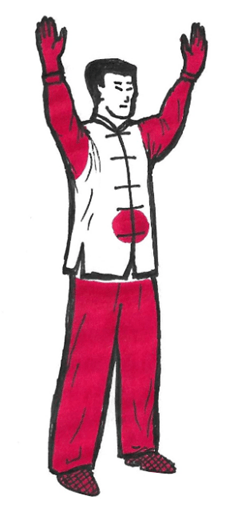
The effects of the practice may be enhanced by briefly holding the breath after inhalation and again after exhalation. The practice may also be strengthened by using hand movements to remove or direct energy. There are several methods for doing this. One of the best-known approaches comes from Pranic Healing, in which circular movements of the hands are used to draw stagnant energy outward and then direct fresh energy inward. The complete procedure is described in the basic Pranic Healing manual.

Disclaimer: You assume full responsibility for practicing this purported healing sound. Practicing this healing sound should never be used as a substitute for appropriate professional medical care. If you feel unwell during the practice, discontinue it immediately. Mild reactions during or after the practice are possible and are generally considered normal.

Mantra SHAO T’AI

The Chinese mantra SHAO T’AI (汰捎) consists of the words SHAO (捎; pronounced shāo), which in Qigong means “to bring” or “to lead” something (the word literally means !to take along something for someone else, to bring, or to deliver on the side«), and T’AI (汰; pronounced tài), which in Qigong means “to get rid of” or “to eliminate” something (the word literally means »to discard, eliminate, wash out, or weed out«).

In Qigong, the mantra SHAO T’AI, or the individual words SHAO and T’AI, can be used to regulate the so-called Microcosmic Orbit (Xiao Zhou Tian). The sound SHAO directs the movement of qi, or vital energy, down the front midline of the body and up the back midline. This circulation strengthens the body’s energy, its jing essence, and the subtle energy or qi. Excessive practice of this circulation, however, may lead to spiritual stagnation. The sound T’AI directs qi upward along the front midline and downward along the back midline, thereby reversing the direction of the energy circuit. This reversed circulation strengthens the spiritual energy or shen/ shen qi but tends to weaken ordinary qi, the jing essence, and the physical body. When SHAO and T’AI are practiced separately, the ratio of practice should be at least 2:1, favoring the bodily circulation over the spiritual one.

The sounds T’AI and SHAO represent a more radical approach to breath regulation. A more commonly used breathing mantra is the Indian mantra SO HAM, which is an example of onomatopoeia—a word or expression that imitates the natural sound it describes. In this case, it imitates the sound of breathing. SO (Soh) imitates the barely perceptible sound of inhalation, while HAM imitates the barely perceptible sound of exhalation. The Chinese equivalent of this mantra is HONG SAU (Chinese: 洪蘇), where HONG most likely derives from the Indian AHAM, and SAU from the Indian SO in SO HAM.

The Chinese also developed a similar form of onomatopoeia by imitating the sounds produced when breathing through a partially obstructed airway. In this case, SHAO imitates the sound of inhaling through a congested nose, while T’AI imitates the sound of exhaling through the mouth, with the force of the exhalation causing the mouth to open. In this way, SHAO and T’AI function as breathing mantras that are coarser but energetically more powerful than SO and HAM. SO HAM (or SO HENG) is particularly suitable for silent practice, whereas SHAO T’AI may be used in either vocal or silent practice. During vocal practice, the sound SHAO is also pronounced during exhalation. During silent practice, however, SHAO is used during inhalation.

Some practitioners also combine the sounds SHAO and T’AI with the specific tones/sounds associated with the five principal organs and, correspondingly, the Five Elements: GONG and the spleen, SHANG and the lungs, JUE and the kidneys, ZHI and the liver, and YU and the heart. For example: we can use mantra T’AI SHANG and then SHAO SHANG. This is one method used in healing Qigong. In another system, different organ correspondences are assigned to some of these sounds: JUE corresponds to the liver, ZHI to the heart, and YU to the kidneys.