Hybrid Numbers: The Difference Between Chaldean Numerology and the Danish Numerology School, Illustrated by the Example of Jan Kefer

Although representatives of the Danish school consider themselves custodians of Chaldean numerology (IPA: kælˈdiːən ˌnuːməˈrɑːlədʒi) this school developed only in recent decades and differs in many respects from the “Chaldean” or Hebrew tradition. Its approach has an almost mathematical appearance, with clearly defined structures and relationships between them. This makes it particularly well suited to the development of computer applications. Over the past decade, despite the unusually high tuition fees charged for its courses, the school has experienced a veritable stampede of interest. Well-known representatives of this numerological system include Millicent Rosamunde, Novalee Wilder, August Darius Danielsson (August Martin Mogensen), also Johannes Ehwas, and Estel Ehwas.

The influence of this school is growing very rapidly, and Chaldean numerologists cannot afford to overlook its presence. We are increasingly being asked about it by people who visit the school’s websites and use its calculators to generate numeroscopes. Naturally, these people then see that representatives of the Danish school call themselves Chaldean numerologists, and confusion quickly arises. “Why did you calculate a different number for my surname than the one calculated by the online numeroscope? Why didn’t you mention my ‘aura’ numbers? Where did you get that number when examining my time chart, when my annual rank indicates the presence of entirely different numbers?” Such questions can become rather annoying.

Sometimes a concrete example can explain more than lengthy discussions. Let us examine the numeroscope of Jan Kefer, a Czech astrologer, Kabbalist, magus, alchemist, publicist, librarian, and Hermeticist.
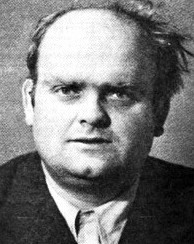
Jan Kefer (1906-1941). From: Wikimedia Commons. File:Jan Kefer (1909-1941).jpg

The Nazis imprisoned him in a concentration camp, where he died at the age of 35. He was born on January 31, 1906. Many twentieth-century Chaldean numerologists like Cheiro would have calculated only the basic name vibrations, 7 and 22, followed by the Total Name Number (TNN), 11 (or 29 or 74). They would, of course, also have included the significance of his birthday, which is 31. Montrose, who was active in 1940, would have added the Life Path number and the vowel and consonant levels as well. The basic numeroscope for Jan Kefer looks like this:
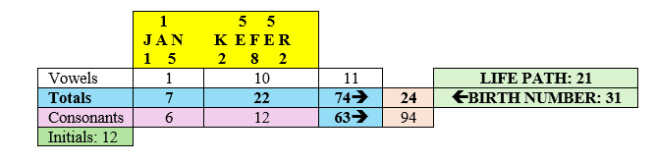
The combination of the numbers 7, 4 (31, 94, 22), and 74 directed him toward the occult. The numbers 11 and 74 are Moon numbers which, under certain conditions, can govern the public and communication. Later in life, sometime after the age of 32, the vibrational key 3 becomes more strongly activated, although it is not compatible with his name chart. One of his Goal numbers is 94, a variant of 13, the number of “Death,” while his initials produce the number 12, which can function as the number of the “Victim/Sacrifice.” The number 12 also appears among the consonants of his surname. His chart indicates that wartime could threaten his life. The relationship between 63 and 94 is one between physical existence and death/transformation; the relationship between 63 and 31 can cause accidents and violence; and the relationship between 12 and 22 in his surname, together with 12 in his initials, points toward some form of victimhood. Practicing black magic can bring karmic consequences and make the whole situation even worse. It is said that Jan Kefer attempted to kill Hitler through black magic. In the end, it was the Nazis who caused Kefer’s own death, while Hitler lived for some more years.
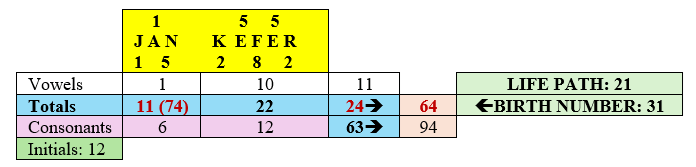
We can introduce the Danish school’s concept of hybrid numbers into the numerological chart. These numbers serve as substitutes for personal first names and surnames whose letter totals are below 10. The method consists of adding the vibrational key of the birth-day number to the number of the first name or surname when that name total is below 10. In Kefer’s case, we obtain a first-name number of 11 (J, 1 + A, 1 + N, 5= 7; vibratory key of 31 is 4; 7 + 4 = 11) and a TNN of 24. The number 24 is hardly a number associated with occultists. Its connection with numbers whose vibrational keys are 3 and 9 suggests that the later part of his life, sometime after the age of 32, should generally have been more successful than the earlier part. However, dying in a concentration camp can hardly be regarded as a sign of success in life.

Danish numerologists would also calculate a special numeroscope in the form of a diamond chart:
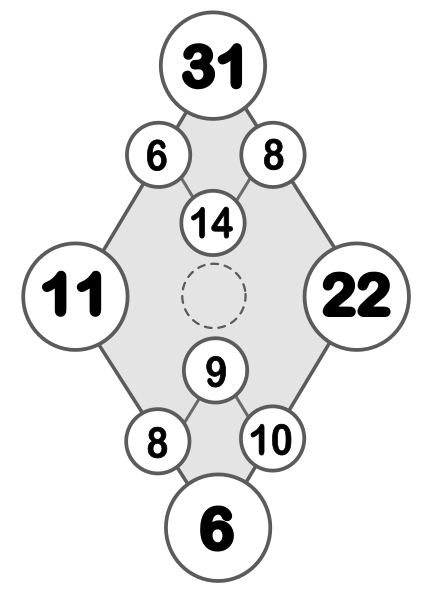
In this chart, they would obtain the “aura” numbers 6, 8, 8, and 10. “Auras” are special numbers characteristic of the Danish school. They would also obtain two additional numbers for the upper and lower centers, which in this case are 14 and 9. I have no objection to using and researching these numbers, along with several others. However, numerology, like many other approaches, requires us always to return to its traditional foundations. The life and fate of Jan Kefer are already described reasonably well by traditional Chaldean numerology. The same is true of many other numeroscopes. I therefore see no need to replace the traditional approach with that of the Danish numerology school.

Another distinctive feature of the Danish school is its considerable relativity in the interpretation of numbers. The school is rather “psychologically oriented” and looks for both positive and negative aspects in almost every number. According to its numerologists, only the relationships between numbers can indicate whether a particular number operates more fortunately or less fortunately.

I should also mention another awkward aspect of Danish Kabala. When the letters of a first name or surname do not add up to 10 or more, and the birthday is unknown, it is practically impossible to construct any numeroscope at all. Another famous Czech whose name was Jan was Jan Hus. We do not know his birthday, and the Danish school is therefore unable to interpret his numeroscope.

Pythagoreans, Chaldeans, and Danes: What Is the Connection Between Modern Western and Ancient Numerological Systems?

In this article, I focus on the continuity of three major numerological schools in the West. I am therefore interested in the historical framework within which these approaches developed. The article does not address which of the systems described is better or worse, which is more suitable for use in the modern world, or which produces more valid results.

A. THE WESTERN SYSTEM

Original Pythagorean numerology emerged no later than the fifth century BCE, certainly by the time of Philolaus, a successor of Pythagoras. The subjects studied included:

  • The use of the Greek alphabet and its alphanumeric coding (at least among the Neopythagoreans).
  • Even and odd numbers.
  • Triangular, square, and oblong numbers.
  • Specific meanings of numbers: for some, 5 was considered the number of marriage, while 7 was the number of infertility and virginity. Particular emphasis was placed on the number 10, which was regarded as a special number—the (principal) tetractys.

Modern Pythagorean numerology is a system based on assigning numbers to letters according to their order in the Latin alphabet. In the nineteenth century, this system began to be called Pythagorean. Its modern version emerged between 1903 and 1908 through the work of L. Dow Balliett and Aso-Neith Cochran. The system acquired a reasonably systematic form in 1931 with the publication of Florence Campbell‘s book. Juno Jordan was also an important numerologist in this school.

Some refer to this numerological approach as the Western system or Western Kabbalah. Within this system:

  • The Greek alphabet is not used for coding. Instead, the system is based on the Milesian system of numerical coding, adapted to the contemporary Latin alphabets. There is therefore a departure from ancient Pythagorean numerology. In addition, modern numerologists adapting the Greek alphabet should explain the vibrations assigned to the Latin letters E and O.
  • A distinction between even and odd numbers is maintained, preserving continuity with ancient Pythagorean numerology.
  • Special numbers such as triangular, square, and oblong numbers are generally not used, representing a break with ancient Pythagorean numerology.
  • The meanings of numbers sometimes correspond to ancient meanings (for example, the association between justice and the number 8) and sometimes diverge from them (7 is sometimes treated as the number of marriage). The emphasis on the number 10 has been largely abandoned, while attention has shifted to the “master” numbers 11 and 22, which did not interest the ancient Pythagoreans. We can therefore speak of considerable discontinuity with ancient Pythagorean numerology.

By my rough estimate, modern Pythagorean numerology or Western system/Western kabala departs so extensively from the ancient system in at least 70% of its approach that the use of the name “Pythagorean” is certainly unjustified. It is a new numerological system that has managed to spread widely throughout the world over the past century.

B. THE CHALDEAN OR HEBREW/JEWISH SYSTEM

So-called Chaldean numerology (IPA: kælˈdiːən ˌnuːməˈrɑːlədʒi), also referred to as older Hebrew/Jewish numerology, emerged no later than the fourth or third century BCE. In Judea, practitioners studied:

  • The use of two local variants of the Aramaic alphabet and their alphanumeric coding. One of these two scripts is the square script. The other is the so-called “Chaldean” script, which Jews supposedly began using in Chaldea/Babylonia.
  • Specific meanings of numbers.
  • Specific relationships between numbers.
  • At least two systems for associating numbers with planets.

Modern Chaldean numerology, sometimes also called the Hebrew system or Hebrew Kabala, began to develop through the tarot tradition in the fifteenth century and, above all, through the work of French numerologists in the second half of the twentieth century. It reached its peak with Cheiro in the 1920s and 1930s. Interest in it subsequently declined considerably around the world. During this difficult period, Gerun Moore and Linda Goodman developed their respective approaches. To understand modern Chaldean numerology correctly, it is necessary to examine the numerological systems of all three of these authors. Only in recent years has the system of older Hebrew numerology begun to regain recognition.

There are historical exceptions in certain places. In India, for example, this numerological system has been popular for decades. The system has also been popular in Slovenia for more than three decades. In the 1990s, books were published there by Lorena Leonardos (formerly known as Naca Jermanj), who represents Gerun Moore’s school, and Bono Baršek, who builds on Linda Goodman’s school. In this millennium, several other Chaldean numerologists have also been active in the Slovenian numerology market, including Emily Enveritas (formerly known as Taja Veroti- Tjaša), Dan Sovina, Darja Bohiinc, Romana Pogorelčnik, and some others.

Today, so-called “Chaldean” numerology has almost no connection with the interpretations of numbers used in Babylonia (Chaldea). On the contrary, it actually derives from an old tradition of Judea and its surrounding region. This tradition must not be confused with the later Jewish Kabbalah, which emerged only between the third and sixth centuries CE.

Within this system:

  • In the West, Chaldean numerologists developed two main methods of coding the Latin alphabet using the values of the Aramaic or Hebrew script. The two methods differ in how they assign values to the letters C, H, and X. More or less, continuity with the ancient alphanumeric coding has been preserved.
  • The so-called “Chaldean” script, as a type of Jewish script, may have contributed to the wider use of the modern term “Chaldean numerology.”
  • Modern Chaldean/Hebrew numerology has largely preserved the specific meanings of numbers from antiquity.
  • Specific relationships between numbers are also represented in ways similar to those found in antiquity.
  • At least two systems for associating numbers with planets, which are key to this numerological system, have been adopted in their entirety from the ancient system.

By my rough estimate, modern Chaldean numerology preserves continuity with the older form of Jewish or Hebrew numerology in at least 90% of its approach. It is therefore rightly considered a Hebrew system, and the term “Chaldean” can be used for it with certain reservations. The label “Chaldean” is nevertheless somewhat unfortunate because it suggests a connection with Babylonian numerology, which differed in many respects. For example, the numbers 19 and 21 were considered unlucky in Babylonia, whereas among the Western Semites (“Chaldean numerology”) they were regarded as lucky.

C. THE DANISH SYSTEM OF POST-CHALDEAN NUMEROLOGY

I do not have information establishing exactly when Danish numerology, which takes the form of post-Chaldean numerology, first appeared. However, it was certainly present before 2014. This school is characterized by the following features:

  • It uses the same alphanumeric coding as Chaldean numerology.
  • It includes specific meanings assigned to numbers.
  • It uses hybrid substitutes for first names and surnames when the sum of the letter vibrations in a name is less than 10.
  • It uses a diamond-shaped numeroscope
  • Middle names (a second given name and the first surname) are placed in the center of the diamond, while the first given name and the final surname occupy the middle vertices of the diamond.
  • In its treatment of numerical relationships, great emphasis is placed on which number is produced by the two numbers in question.
  • It uses the Chaldean system of associating numbers with planets.

This school makes it possible to construct clearly structured numeroscopes in which numbers are arranged according to precisely defined relationships. This “mathematical” clarity is compatible with the rise of the information society and has enabled the development of online platforms, particularly over the past 13 years. In this way, it has provided many students with a simplified process for preparing a numeroscope and given them a sense of “scientific validity,” transparency, and reliability. One consequence of this development has been the proliferation of expensive courses successfully marketed by the Danish school. One could say that a numerology for the wealthy students has emerged.

Who are the leading Danish numerologists today? One example available online is the numerologist Millicent Rosamunde, who advocates the “classical” Danish school. Since 2014, new sub-branches have been developing. These include August Darius Danielsson (who also uses the name August Martin Mogensen), who expanded the numeroscope with additional structures. He may have been the one who introduced year ranks and day ranks when analyzing the future. Johannes and Estell Ehwas developed a numeroscope similar to Danielsson’s, but with additional structures.

The historical continuity of this school can be evaluated as follows:

  • It uses the same alphanumeric coding as Chaldean numerology, specifically Cheiro’s approach. Continuity with ancient alphanumeric coding has been preserved.
  • Modern Chaldean/Hebrew numerology has largely preserved the ancient meanings of numbers up to 52. For higher numbers and in the detailed treatment of other numbers, deviations from the ancient tradition occur.
  • The use of hybrid substitutes for first names and surnames represents a major departure from tradition. Historical examples of names with values below 10 indicate that, apart from in modern Denmark, this approach has not appeared in the known historical record.
  • Diamond charts are probably a new development with no older tradition behind them.
  • The special treatment of middle names is a new development that cannot be linked to the older tradition.
  • In its treatment of numerical relationships, the Danish school sometimes departs from tradition.
  • Its system of associating numbers with planets derives from the old tradition.

By my rough estimate, this school retains only about 50% continuity with the tradition of Chaldean, or older Hebrew, numerology. Although it refers to Cheiro, I therefore do not consider it appropriate to use labels such as Chaldean or Hebrew numerology for this school. I use terms such as the Danish school or Danish post-Chaldean numerology instead.

D. CONTINUITY BETWEEN THE SYSTEMS

We have already discussed the differences between Pythagorean and Chaldean numerology (Articles 1 and 2). From the perspective of continuity between the two systems, modern Western numerology, which presents itself under the misleading name “Pythagorean,” developed only about 120 years ago in the United States and Great Britain.

Modern “Chaldean” numerology also uses a somewhat misleading name, but it developed more than 2,300 years ago in Judea and probably in the surrounding region as well. The Danish school is closer to older Hebrew numerology than Western numerology is to original Pythagorean numerology.

Although the Danish school has been gaining considerable popularity in recent years, it is nevertheless a school in its own right and represents the youngest of the three systems discussed here. Its foundations were established only in recent decades.