The mantra DȎN (pronounced DOHN) or DUN (pronounced DOON) has a Baltic or Slavic character. Proto-Slavic *d(v)on-ěti and Baltic *dun– derive from the Indo-European root *dhu̯en-, meaning “to hum, drone, or sound.” Latvian dunêt, Czech dunět, and Slovenian donéti all mean “to resound” or “to reverberate.”
This mantra can represent:
Expression, creativity, and manifestation
Sound and sound vibration
The principle of circulation
The principle of condensing subtle energy (prana, qi)
The circulation of energy through the energy meridians (nadis)
It can be used during energy-circulation exercises, for example, during the Microcosmic Orbit or any other practice involving the circulation of energy through the nadis. Naturally, specific mantras can also be used for individual meridians if we know them; for example, SHAOand T’AI to stimulate the circulation of energy through the Governing and Conception Vessels.
The Chinese use the mantra DONG (pronounced DOONG) to stimulate the circulation of subtle energy (qi) through the meridians. It has a related, but somewhat less precise, function.
In Chaldean numerology, the Total Name Number (TNN) and the Birth Number (the day of the month on which a person was born, such as the 17th) are generally regarded as the two strongest numbers in the numerological chart. Individual days of the month are already mentioned in the Bible. Both numbers have approximately equal strength.
First names and surnames are generally considerably weaker, although the first name is usually somewhat stronger than the surname. Much depends on whether people primarily address us by our first name or by our surname.
The Life Path Number is also powerful. Opinions about its strength, however, differ. Some numerologists deny its significance altogether (e.g., Cheiro), while others regard it as a key date number (e.g., Montrose). It appears to be somewhat stronger than the first name and surname, but weaker than the TNN and Birth Number.
The Bridge Number of the initials, the Goal Number between the Birth Number and the TNN, and the number formed by all the consonants have approximately the same strength as the numbers of the first name or surname. Vowel numbers, by contrast, are weaker than consonant numbers.
Many Chaldean numerologists are allergic to the use of vowels and consonants and regard them as innovations introduced by modern Pythagorean numerology. In my opinion, these numerologists are making a serious mistake. Instead of engaging in an ideological battle against Pythagorean numerology, it would be better to examine actual numerological charts and determine the rules governing the use of these numbers within the Chaldean numerological system. Readers can look at the many short numerological analyses on my blog and form their own opinion about the influence of vowel and consonant numbers.
The consonant and vowel numbers within a first name or surname are indeed very weak in themselves. However, they acquire greater significance when they connect with other numbers. For example, the 3-5-8 chain can, under certain circumstances, represent “money numbers”; 1-3-9 can bring greater masculinity and decisiveness; the combination 2-5-8 can create excessively strong emotions and fears; and the 2-3-5 chain can be associated with purification practices, children, and moral development.
For the time being, I do not practice numerology as a form of business consulting. Even when it comes to friends, however, I am reluctant to suggest that they adopt new first names or surnames. This is a very serious responsibility, and in addition, the new name must actually appeal to the person who will bear it. Even the best practitioners can find it extremely difficult to come up with a suitable name.
Dòng (洞 ), or “zero”: pronounced approximately like “DOONG”
Yī (一), or “one”: pronounced approximately like “YEE.”
Èr (二), or “two”: pronounced approximately like “AR.”
Sān (三), or “three”: pronounced approximately like “SAHN.”
Sì (四), or “four”: pronounced approximately like “SUH,” “SIR,” or “SƏ.”
Wǔ (五), or “five”: pronounced approximately like “WOO.”
Liù (六), or “six”: pronounced approximately like “LYOH / LYOW,” somewhat similar to the name “LEO.”
Qī (七), or “seven”: pronounced approximately like “CHEE.”
Bā (八), or “eight”: pronounced approximately like “BAH.”
Jiǔ (九), or “nine”: pronounced approximately like “JYOH / JYOW” or “JEE-OH.”
Shí (十), or “ten”: pronounced approximately like “SHER,” “SHIH,” or “SHƏ.”
Shí yī (十一), or “eleven”: pronounced approximately like “SHER EE.”
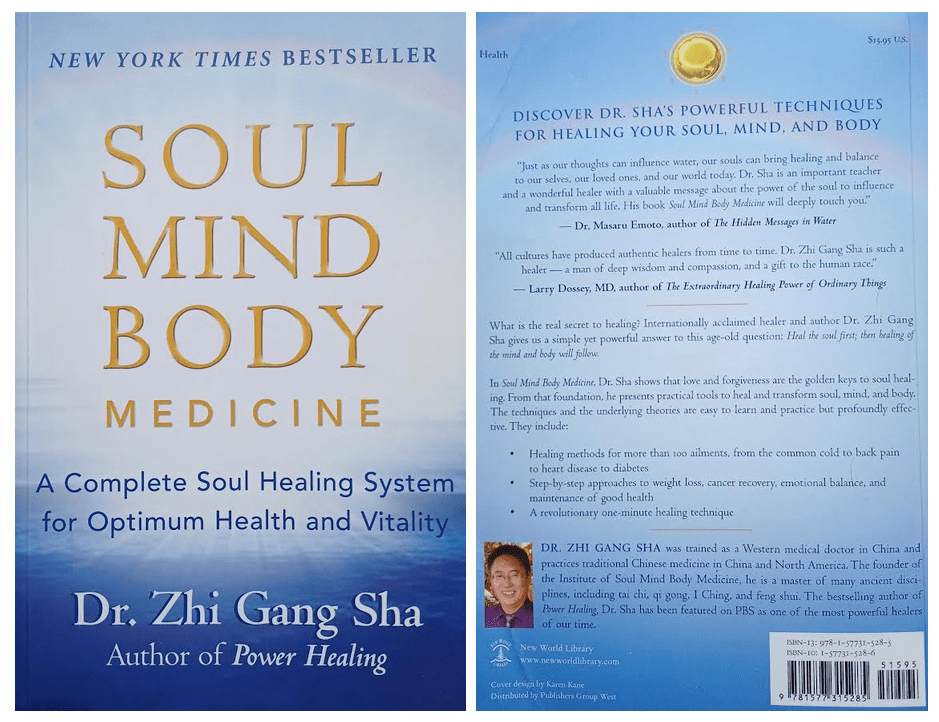
The meanings of all twelve mantras are briefly discussed in Dr. Zhi Gang Sha’s book Soul, Mind, Body Medicine: A Complete Soul Healing System for Optimum Health and Vitality. In the 2006 edition, the meanings of these mantras are explained on pages 125 and 179. Some slightly different or expanded meanings of the Yiand Shimantras can be found on my blog.
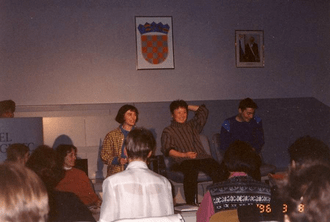
Aiping Wang (in the middle) and Lea ZgonikCestnik (left) in Croatia, 1996. Source: Wikimedia Commons, File:Aiping stubiske 1996.PNG
The number mantras can be compared with the so called Five Healing Sounds. There are at least two different correspondences between the Five Healing Sounds and the Five Elements. I use the following system, which I learned in 2004 from my former teacher, Lea Zgonik Cestnik, who in turn learned it from her teacher, Aiping Wang. Aiping Wang initially taught Healing Qigong, but later developed a different form of spiritual technology in Zagreb and New Zealand. The sequence of sounds and elements in this lineage is KONG, SHANG, JIAO/CIAO, ZHENG and YU:
Gōng (宫), pronounced “GOON(G).” The final NG has no audible G. This type of NG is sometimes written as Ŋ. The GONG mantra represents the Earth element, the spleen, pancreas, and stomach. In Qigong, the alternative and less suitable sound KONG is sometimes used; it is pronounced approximately “KON(G).”
Shāng (商), pronounced “SHAHN(G).” It represents the Metal element, the lungs, and the large intestine.
Jué (角), pronounced “JOO-WEH.” In Qigong, JIAO is sometimes used as an alternative, pronounced approximately “JYOW / JEE-AH-OH,” as is CIAO, pronounced “TSYOW / TSEE-AH-OH.” It represents the Water element, the kidneys, and the bladder.
Zhǐ (徵), pronounced “JIR” or “JƏR.” In Qigong, the sound ZHENG is sometimes used, pronounced approximately “JHNG” or “JƏNG.” It represents the Wood element, the liver, and the gallbladder.
Yǔ (羽), pronounced “Ü” or “YEE-OO.” The sound Ü, sometimes approximated as “UEE,” is pronounced somewhat like “OO,” but with the lips rounded, as in German. It represents the Fire element, the heart, small intestine, and brain. It concentrates energy and often directs it upward.
We can see that four of the Five Healing Sounds have counterparts among the number mantras:
Shāng (商) and Sān (三) both govern the lungs.
Jué (角) and Jiǔ (九) both govern the kidneys and bladder.
Zhǐ (徵) and Qī (七) both govern the liver and gallbladder.
Yǔ (羽) and Yī (一) both govern the heart and brain.
This means that, in certain protocols, the number mantras Yī (一), Sān (三), Jiǔ (九), and Qī (七) can potentially be replaced with the Healing Sounds Yǔ (羽), Shāng (商), Jué (角), and Zhǐ (徵), respectively.
In Dr. Zhi Gang Sha’s book, part of the alleged healing number code promoted by Dr. Zhi Chen Guo could likewise be replaced with the pronunciation of the Five Healing Sounds. This number code is described on pages 56–57 of the 2006 edition.
Likewise, when studying the healing protocols based on the “One Hand Near, One Hand Far” healing technique, you can explore the alternative sounds Yǔ (羽), Shāng (商), Jué (角), and Zhǐ (徵) in all protocols that involve chanting the sounds Yī (一), Sān (三), Jiǔ (九), and Qī (七). In the 2006 edition of his book, Dr. Zhi Gang Sha describes the One Hand Near, One Hand Far protocols for various illnesses and bodily dysfunctions on pages 182–300.
In Chaldean numerology, the number 71 is considered unfortunate. In the Chaldean Tarot, the Three of Pentacles, which represents this number, is called the “Reaper.”
In the divinatory Tarot, as it developed from the time of Etteilla onward, 71, or the Three of Pentacles, represents a favorable card. It brings advancement, position, and honors, or it may symbolize children. We must bear in mind, however, that the divinatory Tarot does not follow the Chaldean tradition in its treatment of the Minor Arcana.
The interpretation within Kabbalistic astrology, which represented an unusual phase in the development of Chaldean numerology, is different. It incorporates the nature of Arcanum XIII. Pentacles represent money, investments, and potentially business. Because Pentacles are the final suit in the Tarot, they may also represent health problems. When the suit of Pentacles is combined with the concept of Arcanum XIII, this indicates difficulties involving money, investments, business and health, despite possible initial success. Sepharial also added executive powers to these meanings.
Since XIII can sometimes represent transformation and progress rather than death, we cannot know in which direction the path of destiny will take a person. The path is not necessarily always so difficult. It may represent money invested wisely or money spent beneficially, as well as an opportunity for recovery and regeneration. At least, this is what can be inferred from the Chaldean Tarot, although the traditional interpretation unfortunately does not support such a reading. In principle, for a 71 person to achieve wise and effective management of money, a great deal of effort is required.
In any case, it is important to point out that 71 is NOT the same as 17. Among modern Chaldean numerologists, a rather strange habit has become widespread: when dealing with numbers above 52, they simply reverse the digits. Yet these learned masters should then explain why, for example, 21 does not have the same meaning as 12, why 31 does not have the same meaning as 13, why 32 does not have the same meaning as 23, why 52 does not have the same meaning as 25, and so on.
Therefore, 71 is generally not a number associated with public recognition or even fame. If a person with 71 puts a great deal of effort into a public career or public appearances, this can sometimes be achieved. However, 71 has to invest considerably more effort and time than 17 in order to achieve it.
The number 71 is quite high. As a rule, it does not occur in a personal name or surname. Nor do the totals of first names and surnames frequently produce such a high number. However, Bridge Numbers can create this number quite easily, which is why it is useful to understand its meaning.
The word Yi (一, pinyin yī, pronounced like “EE”) means the number “one” in Chinese. As a mantra, however, it represents the sound of our inner self. It can be used to seek a general balance within our energy system. The sound has a gentle (not very strong) effect.
The mantra is also related to the sound Yu (pronounced like “Ü” or “UEE”—similar to “OO,” but with rounded lips. A comparable sound is familiar from the German language). For this reason, some practitioners use the Yi sound as a substitute for Yu, in an attempt to create balance in the small intestine, heart, brain, eyes, tongue, circulatory system, and so on. In this case, however, I recommend using the Yu sound rather than Yi, because Yu has a considerably stronger effect on these areas.
2. PRACTICE
The sound can be practiced together with the mantras SHAO and T’AI. In this case, pronounce T’AI YI (汰一) at least six times, and then pronounce SHAO YI (捎一) at least six times. As a general rule, perform the SHAO YI repetitions the same number of times as the number of T’AI YI repetitions.
Unlike the Five Healing Sounds, this exercise does not have a specific area of action. Therefore, perform a maximum of 20 repetitions (two-thirds of the maximum number of repetitions recommended for the Five Healing Sounds).
Special warning: If you practice the Five Healing Sounds using the additional mantras SHAO and T’AI, always perform the exercise with the T’AI mantra first and only then practice the SHAO sound. The T’AI sound cleanses old subtle energy, or old Qi, while the SHAO sound supplies refreshed Qi. Introducing fresh energy without first clearing stagnant energy may produce undesirable physical reactions.
The exercise can also be practiced mentally. In this case, you can place the tongue against the roof of the mouth to strengthen the circulation of Qi. At the same time, you can assume the general hand position used for cleansing or energizing.
3. HAND POSITIONS FOR THE T’AI YI EXERCISE
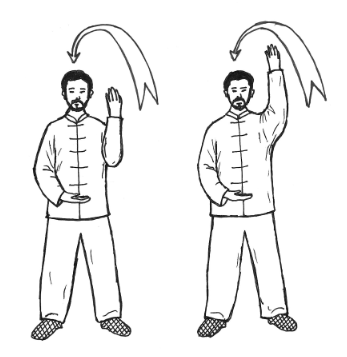
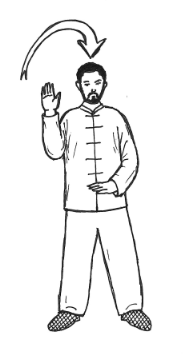
The T’AI YI exercise is intended to cleanse our energetic interior. Depending on gender, we use our prenatal hand. The back of the hand faces forward. This encourages the circulation of energy upward along the front of the body and downward along the back.
If we also practice hand positions during the exercise, we should be aware that men and women practice the T’AI YI sound differently.
A man stands with his feet approximately shoulder-width apart. His left arm is bent at the elbow so that the palm, slightly curved and relaxed, faces backward over his left shoulder, with the back of the hand visible from the front. The hand is not bent at the wrist. The fingers may be slightly separated. The palm of the right hand is positioned in front of the Lower Dan Tian, with the palm facing toward the ground. The palm and fingers of the right hand are straight and parallel to the ground.
A woman performs the same exercise standing with her feet approximately shoulder-width apart. Her right arm is bent at the elbow so that the palm, slightly curved and relaxed, faces backward over her left shoulder, with the back of the hand visible from the front. The hand is not bent at the wrist. The fingers may be slightly separated. The palm of the left hand is positioned in front of the Lower Dan Tian, with the palm facing toward the ground. The palm and fingers of the left hand are straight and parallel to the ground.
A variation of this exercise is to raise the hand as high as possible.
A man stands with his feet approximately shoulder-width apart. His left arm is slightly bent at the elbow and raised high, slightly toward the center of the torso, so that the palm, slightly curved and relaxed, faces backward, with the back of the hand visible from the front.
A woman stands with her feet approximately shoulder-width apart. Her right arm is slightly bent at the elbow and raised high, slightly toward the center of the torso, so that the palm, slightly curved and relaxed, faces backward, with the back of the hand visible from the front.
4. HAND POSITIONS FOR THE SHAO YI EXERCISE
The SHAO YI exercise is intended to energize our inner self. In this exercise, both men and women may use either hand to raise one arm in front of them, while placing the other hand in front of the Lower Dan Tian. The back of the lifted hand faces backward. This encourages the circulation of energy upward along the back of the body and downward along the front.
In the first variation, a man or woman stands with the feet approximately shoulder-width apart. The right arm is bent at the elbow so that the palm, relatively flat, is positioned just beyond and slightly above the shoulder, facing forward. Thus, the palm does not face forward while also pointing downward or to the side; it simply faces forward. The hand is not bent at the wrist. The back of the hand faces in the opposite direction, toward the back. The fingers may be slightly separated. The palm of the left hand is positioned in front of the Lower Dan Tian, with the palm facing toward the ground. The palm and fingers of the left hand are straight and parallel to the ground.
In the second variation, a man or woman stands with the feet approximately shoulder-width apart. The left arm is bent at the elbow so that the palm, relatively flat, is positioned just beyond and slightly above the shoulder, facing forward. The back of the hand faces in the opposite direction, toward the back. Thus, the palm does not face forward while also pointing downward or to the side; it simply faces forward. The hand is not bent at the wrist. The fingers may be slightly separated. The palm of the right hand is positioned in front of the Lower Dan Tian, with the palm facing toward the ground. The palm and fingers of the right hand are straight and parallel to the ground.
Disclaimer: You assume full responsibility for practicing this purported healing sound. Practicing this healing sound should never be used as a substitute for appropriate professional medical care. If you feel unwell during the practice, discontinue it immediately. Mild reactions during or after the practice are possible and are generally considered normal.
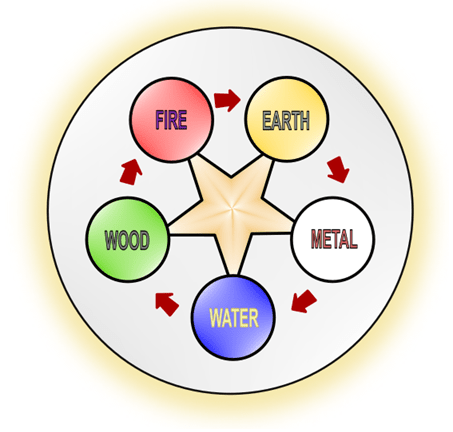
The Five Healing Sounds are based on the names of the five tones of the Chinese musical scale: GONG, SHANG, JUE/JIAO, ZHI/ZHENG, and YU. Each of these sounds is associated with one of the five elements: Wood, Fire, Earth, Metal, and Water.
Wood represents new beginnings and growth; Fire represents culmination and activity. Earth is associated with the search for balance, Metal represents decline and contraction, while Water represents dispersion and stillness. Water nourishes Wood, Wood fuels Fire, Fire produces Ash (Earth), Earth contains Metal ores, and Metal minerals enrich Water. This is the cycle of support. If we move two elements forward in the cycle, however, we obtain forces of pressure, threat, or attack. Water extinguishes Fire, Fire melts Metal, a Metal axe cuts down a tree, plants deplete the Earth, and Earth can contain Water.
The five elements create an inverted pentagram. It is an ancient earth symbol that only acquired an evil reputation in the Middle Ages
The Five Sounds are used to activate the energy of individual organs associated with these elements or to help regulate the emotions associated with them. They may be spoken aloud or repeated mentally. When pronouncing the sounds, we do not use the musical pitch they represent. Instead, we use them as mantras.
Lea ZgonikCestnik (left) and her own teacher Aiping Wang (in the middle) in Croatia, 1996. Source: Wikimedia Commons, File:Aiping stubiske 1996.PNG
In 2004, I was introduced to the Five Healing Sounds by my former teacher, Lea Zgonik Cestnik. We used the sequence KONG, SHANG, CIAO (JIAO), ZHENG, and YU, corresponding to the sequence of the elements Earth, Metal, Water, Wood, and Fire. We combined the mantras with two additional sounds, SHAO and T’AI, to facilitate the circulation of energy and to cleanse the organs, followed by filling them with refreshed subtle energy, or Qi. We always began with the Earth element and ended with the Fire element. The sounds were practiced aloud and drawn out, without distinguishing between tones, while using specific hand positions.
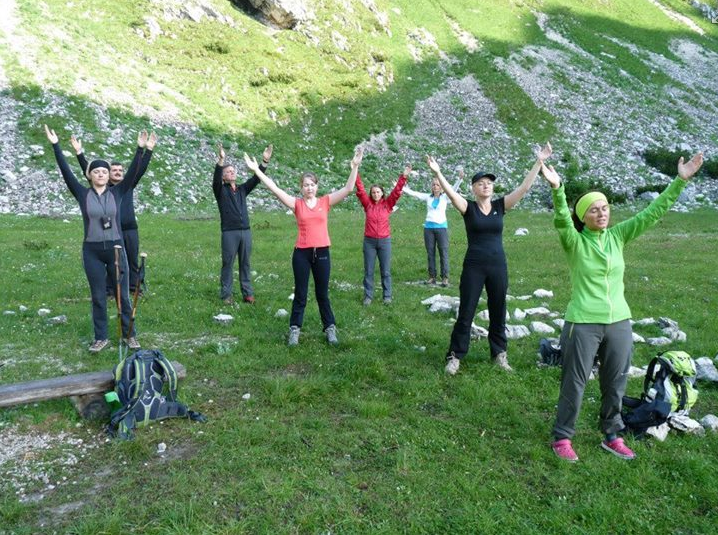
Group Exercise of Healing Sounds. The lady in front is Lea Zgonik Cestnik.JIAO/CIAO exercise. Source: WikimediaCommons, File:Tsiao Sound Exercise.PNG
2. HISTORY OF THE FIVE SOUNDS
The Qigong practice of the Six Healing Sounds is generally well known around the world: Xu for the liver, He for the heart, Hu for the spleen, Si for the lungs, Chui for the kidneys, and Xi for the Triple Burner and Pericardium. Both forms of healing sounds originated in China. The Six Healing Sounds are first mentioned in the fifth or sixth century CE. Less well known to the general public is the practice of the Five Sounds, which at the same time represent the five tones of the traditional Chinese musical scale:
GONG (宫) — the tone Do/C
SHANG (商) — the tone Re/D
JUE (角) — the tone Mi/E
ZHI (徵) — the tone Sol/G
YU (羽) — the tone La/A
According to one story, the Five Healing Sounds came into use long ago, when a Qigong master prescribed them to an emperor who was having difficulty satisfying his large number of wives. Through regular practice, the emperor supposedly strengthened his sexual vitality and thereby prolonged his life. That is simply the story as it has been passed down to the present day. Such stories do not need to be taken literally. In order to reinforce their authority, almost all important systems of Chinese metaphysics trace their origins to some kind of mythological framework. We can therefore regard such accounts as a form of traditional Chinese “storytelling.” If we look at the actual history of these exercises, they developed before the second century BCE, during the earlier period of Chinese history.
All five healing sounds are already mentioned in the Yue Ling, which was written before 240 BCE. The sounds, or musical tones, are presented according to the doctrine of the Five Elements as Jue for Wood, Zhi for Fire, Gong for Earth, Shang for Metal, and Yu for Water. The values appear to have been deliberately mixed up so that the general public would not understand the mantras and their connections with the elements. In reality, the individual words function as mantras that activate specific organs, and it appears that these mantras were subsequently used as the names of the musical tones.
The cycle of the Five Elements follows the sequence Wood–Fire–Earth–Metal–Water in an endless repetition. The Huai Nan Zi, a work from the second century BCE, contains a passage referring to an earlier work from the fourth century BCE and mentions the energetic sounds in the correct sequence:
Earth = GONG, pronounced “GOONG,” and the tone “C”
Metal = SHANG, pronounced “SHAHNG,” and the tone “D”
Water = JUE, pronounced “JOO-WEH,” and the tone “E”
(no element = the tone “F”)
Wood = ZHI, pronounced “JIR,” and the tone “G”
Fire = YU, pronounced “YÜ” or “Ü”, “UEE”; the sound Ü/“UEE” is pronounced like “OO,” but with the lips rounded, as in German. The tone is “A.”
(no element = the tone “B”)
The secret use of precisely this sequence and its connections with the elements was later concealed in mantras that appear in the form of Chinese numbers. From the system of numerical mantras taught by Dr. Zhi Chen Guo (1943–2011) and revealed to an English-speaking audience by his student Dr. Zhi Gang Sha, it is evident that the number yī (1) corresponds to the sound Yu, sān (3) corresponds to Shang, qī (7) corresponds to Zhi, and jiǔ (9) corresponds to Jue/Jiao.
3.WHAT IS THE SUPPOSED PURPOSE OF CHANTING THESE SOUNDS?
These vocal exercises belong to Healing Qigong. Healing Qigong is a metaphysical approach to the body and human energy that deals with the supposed balancing of subtle Qi energy and, through this, the supposed healing of the body. According to the doctrine of Healing Qigong, there are specific sounds that resonate with particular organs, thereby supposedly producing a kind of internal balancing of them. The practice is not limited to physical exercise—the meridians and the energy flowing through the stimulated meridians are also supposedly activated.
The purpose of the practice is to tonify the energetic state of the organs and their meridians and to detoxify the organs. For this reason, certain ordinary reactions may sometimes occur during practice, such as belching, tearing, changes in heart rate, gas, sudden diarrhea, and similar reactions. The practice is supposed to strengthen and balance the meridians and organs, at least to some degree. Where energy is deficient in the meridians and organs, its presence is increased. Where energy has become stagnant, the exercises attempt to remove it or set it in motion so that it can subsequently become available to other organs. The intended result is greater energetic harmony, which is in turn supposed to promote greater physical health as well as greater emotional balance.
4. SILENT OR AUDIBLE SOUNDS?
Unlike the Six Healing Sounds, the Five Healing Sounds may be practiced quite aloud. If desired, they may also be practiced silently, mentally. The sound can simply be pronounced normally, but if we want to prolong its effect, we often draw it out, for example: GOOOOOONG, SHAAAAAAHNG…
If the sound is repeated only mentally, we generally practice it while exhaling. The mouth can be slightly open in a gentle smile, with the back of the tongue pressed downward and the front of the tongue slightly drawn backward and raised. Alternatively, you can simply rest the tongue against the roof of the mouth.
5. ASSISTANCE WITH THE SOUND EXERCISES: STATIC HAND POSITIONS
The static hand positions used in the practice of the Five Sounds may originate from an ancient form of stretching Qigong. However, the static hand positions also produce some of the milder effects associated with Zhan Zhuang Qigong. Zhan Zhuang refers to stationary standing energy exercises in which one maintains a still standing position. A variation of this is stationary seated Qigong.
Because the static hand positions used with the mantras are more likely to originate from stretching exercises and are not classical stationary Qigong exercises, they do not carry the same risks as certain advanced stationary Qigong practices. They can therefore also be performed while sitting in a chair.
Nevertheless, I do not recommend assuming bodily positions around or above the head without simultaneously practicing the mantras. In other words, the vocal exercises can be performed without the hand positions — for example, while driving — but the hand positions should by no means be practiced without simultaneously practicing the Healing Sounds.
6. WHAT VARIATIONS OF THE MANTRAS ARE AVAILABLE FOR EACH ELEMENT?
Some of the mantras have additional variations, while others do not. Below is an overview of the sounds associated with the Five Elements.
Earth and GONG (宫), pronounced “GOON(G).” The final NG has no audible G. Such an NG is sometimes written as Ŋ. The GONG mantra represents the Earth element, the spleen, pancreas, and stomach. In Qigong, the alternative and less suitable sound KONG is sometimes used; it is pronounced “KON(G).” Both sounds have a slight downward-moving effect on energy.
Metal and SHANG (商), pronounced “SHAHN(G).” It represents the Metal element, the lungs, and the large intestine. The energy of this sound tends to move upward.
Water and JUE (角), pronounced “JOO-WEH.” In Qigong, JIAO is sometimes used as an alternative, pronounced “JYOW/JEE-AH-OH,” as is CIAO, pronounced “TSYOW/TSEE-AH-OH.” It represents the Water element, the kidneys, and the bladder. These sounds direct energy upward.
Wood and ZHI (徵), pronounced “JIR” or “JƏR.” In Qigong, the sound ZHENG is sometimes used, pronounced “JHNG” or “JƏNG.” It represents the Wood element, the liver, and the gallbladder. All variations of the sound initiate an upward movement of energy.
Fire and YU (羽), pronounced “Ü” or “YEE-OO;” the sound Ü/“UEE” is pronounced like “OO,” but with the lips rounded, as in German. It represents the Fire element, the heart, small intestine, and brain. It concentrates energy and often directs it upward. Alternatively, the sound HU (“HOO”) may be used. It also activates the heart but allows energy to move downward. Unfortunately, this sound is not as suitable for the brain and small intestine as YU is.
7. COMBINING THE FIVE SOUNDS WITH THE SHAO AND T’AI MANTRAS
The practice of the Five Sounds can be combined with the mantras SHAO (捎) and T’AI (汰), which move part of the Qi energy through the Small Heavenly Circuit (Xiao Zhoutian). With each sound, we first cleanse the energy using the T’AI mantra and then strengthen the fresh energy using the SHANG mantra:
T’AI GONG (汰宫) 6 times (maximum 30 times) + SHAO GONG (捎宫) 6 times (maximum 30 times)
T’AI SHANG (汰商) 6 times (maximum 30 times), SHAO SHANG (捎商) 6 times (maximum 30 times)
T’AI JUE (汰角) 6 times (maximum 30 times), SHAO JUE (捎角) 6 times (maximum 30 times)
T’AI ZHI (汰徵) 6 times (maximum 30 times), SHAO ZHI (捎徵) 6 times (maximum 30 times)
T’AI YU (汰羽) 6 times (maximum 30 times), SHAO YU (捎羽) 6 times (maximum 30 times)
Special warning: If you practice the Five Healing Sounds using the additional mantras SHAO and T’AI, always perform the exercise with the T’AI mantra first and only then practice the SHAO sound. The T’AI sound cleanses old subtle energy, or old Qi, while the SHANG sound supplies refreshed Qi. If the order were reversed, the organs associated with a particular element would first be filled with fresh Qi, after which both the fresh and old Qi would be removed. Such a practice cannot strengthen your organs. In the worst case, it could lead to unnecessary reactions and even weaken the body. Introducing fresh energy without first clearing stagnant energy may also produce undesirable physical reactions.
8. CHOOSING THE DURATION OF PRACTICE FOR EACH SOUND
If you have certain physical conditions, you may practice a particular sound more times for certain problems, but no more than 30 times. Each sound should be repeated at least 6 times. When should individual sounds be practiced more frequently? Below are some conditions for which a particular sound is recommended to be practiced for a longer period:
GONG (宫): digestion, spleen, pancreas, stomach, mouth, saliva, possibly the skin and muscles, restlessness, worry
SHANG (商): lungs and large intestine, anus, respiratory system, nose, colds, teeth, possibly the uterus, according to some traditions the hair, also the chest in general, depression, sadness, criticism
JUE (角): kidneys, adrenal glands, and bladder, hearing, teeth, bones, reproductive organs in general and ureters, the abdominal area in general, confusion, deep fears
ZHI (徵): liver, gallbladder, hands, legs, fingers, hair, eyes, possibly the skin, tendons, possibly the neck and head, possibly the penis, circulation in the reproductive organs, menstrual problems, anger, hatred, frustration, criticism
9. DESCRIPTIONS OF THE FIVE HEALING SOUNDS EXERCISES
Both the Six Healing Sounds and the Five Healing Sounds can be combined with specific body postures. Below, I present the hand and body positions as they were shown to me by my teacher, Lea, along with several variations I have encountered over the years. I personally do not practice Qigong except for some medical Qigong exercises from time to time, so please bear with me if I am unable to explain certain aspects here in complete detail. The fact is that the Five Healing Sounds exercises are much less familiar, at least to an English-speaking audience, than the Six Healing Sounds. For this reason, I nevertheless believe that it is worthwhile writing about them.
I would like to emphasize that our bodies are different, and many people do not tolerate holding hands upward very well, because Qi may begin to accumulate in the upper part of the body. You may try the practice at your own risk. Practice does not necessarily produce the desired results and therefore is not a substitute for conventional or alternative medical treatment. If the hand positions make you feel unwell, you can also try practicing without them, or you can try different hand positions if you know a teacher who teaches alternative positions. Above all, listen to your body. You may also find it useful to use some of the different hand positions recommended by certain teachers, such as Mantak Chia, for practicing the six healing sonds sounds silently.
You can also try practicing the sounds in the following sequence: first ZHI, then YU, followed by GONG, SHANG, and JUE. In this case, you can finish the practice with the sound HǍO (好), which is used to distribute energy throughout the body. When practicing T’AI/SHAO, raise your relaxed arms in front of you, with the wrists and elbows slightly bent, until they reach shoulder height, keeping the palms facing downward. When practicing HǍO, relax the arms downward as if you were making a gentle waving motion, and then complete the sound exercise with your arms lowered. As you lower your arms, you can also bend your knees slightly while trying to keep your back upright. The sound HǍO means “good” in Chinese.
PREPARATORY EXERCISE
If you practice while seated, keep your back straight. If you practice standing, stand in a relaxed position with your feet approximately shoulder-width apart. Remain as calm and relaxed as possible.
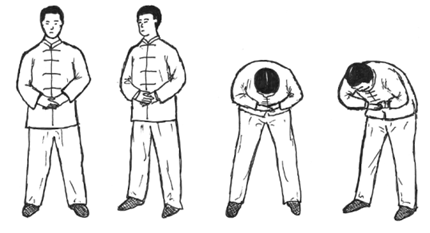
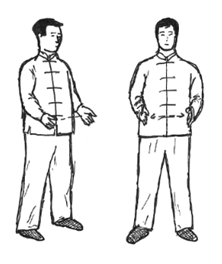
Place your hands over the lower Dan Tian, with the palms resting over the area slightly below the navel.
The Dan Tian is a special energy center traditionally said to be located approximately 2 to 5 centimeters, or 1 to 3 inches, below the navel and about 4 to 6 centimeters deep inside the abdomen. The Lower Dan Tian is traditionally understood as an energetic center in the lower abdomen rather than as a single anatomical point. It is commonly located below the navel, with different traditions placing its center at somewhat different depths and distances from the navel (approximately 2.5–7.5 centimeters (1–3 inches) below the navel).
Men first place the left palm over the Dan Tian and then the right palm over it. Women first place the right hand over the Dan Tian and then the left. The left hand is regarded as the prenatal male hand and is used to emit Qi. The right hand is regarded as the prenatal female hand and is suitable for emitting Qi for females. In men, the right hand is the receiving hand, while in women the receiving hand is the left. These associations represent the prenatal level and are used for energetic work. The postnatal and more physical level uses the opposite arrangement: the entire right side of the body represents the masculine aspect, while the left side represents the feminine aspect.
OPENING AND CLOSING EXERCISE
With the hands in front of you and the palms resting over the abdomen, you can also bow forward. Some Qigong practitioners begin their practice of selected exercises in this way.
Preparatory exercise can also be useful if you experience tension in your lower back after standing in upright positions for an extended period. In that case, you can perform it between two sets — for example, between the JUE and ZHI sound exercises.
GONG SOUND EXERCISE
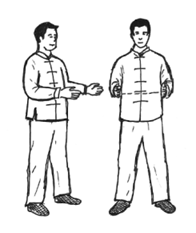
Stand in a relaxed position with your feet shoulder-width apart. Bend your elbows to approximately 90 degrees so that your forearms are at the same height as your stomach, pointing forward and parallel to each other. Keep your palms open, with the fingers together and the palms facing each other.
Now pronounce T’AI GONG six times (or more), followed by SHAO GONG six times (or more). The SHAO GONG sound must be repeated the same number of times as the T’AI GONG sound.
SHANG SOUND EXERCISE
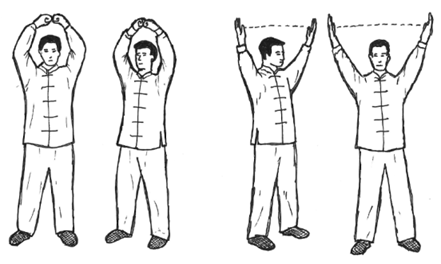
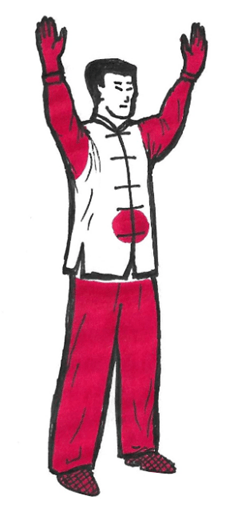
Stand in a relaxed position with your feet shoulder-width apart. Raise your arms upward into a V shape so that the distance between your palms is slightly greater than the width of your shoulders. Keep the hands positioned so that the palms are not tilted either forward or backward and keep fingers together; they maintain the same angle relative to the torso as the arms themselves. Despite raising the arms, keep the shoulders as relaxed and low as possible.
Now pronounce T’AI SHANG six times (or more), followed by SHAO SHANG six times (or more). The SHAO SHANG sound must be repeated the same number of times as the T’AI SHANG sound.
Variation of the hand position: Stand in a relaxed position with your feet shoulder-width apart. Raise your arms upward and then bring them toward each other. Make fists with your hands so that the second knuckles of the fingers of one hand touch the corresponding knuckles of the other hand. Despite raising the arms, keep the shoulders as relaxed and low as possible.
Now pronounce T’AI SHANG six times (or more), followed by SHAO SHANG six times (or more). The SHAO SHANG sound must be repeated the same number of times as the T’AI SHANG sound.
JUE SOUND EXERCISE
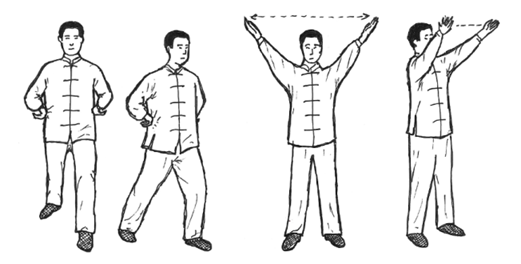
Stand in a relaxed position with your feet shoulder-width apart. Raise your arms upward and forward into a V shape so that the distance between your palms is approximately twice the width of your shoulders. Position your hands so that the palms, like the arms themselves, are tilted slightly forward. Keep fingers together. The palms should maintain the same angle relative to the torso as the arms themselves. Despite raising the arms, keep the shoulders as relaxed and low as possible.
Now pronounce T’AI JUE six times (or more), followed by SHAO JUE six times (or more). The SHAO JUE sound must be repeated the same number of times as the T’AI JUE sound.
Variation of the body position: Step slightly forward with one foot. Arch your back slightly so that it places pressure on the kidneys. Rest your palms against your sides so that the palms and fingers curve slightly upward.
Now pronounce T’AI JUE three times (or more), switch the position of your feet, and pronounce T’AI JUE another three times (or more). Then switch the position of your feet again and pronounce SHAO JUE three times (or more). Switch the position of your feet once more and pronounce SHAO JUE three times (or more).
The SHAO JUE sound must be repeated the same number of times as the T’AI JUE sound. This type of exercise may be practiced by people who experience blockages in the head or excessively concentrated Qi.
ZHI SOUND EXERCISE
Stand in a relaxed position with your feet shoulder-width apart.
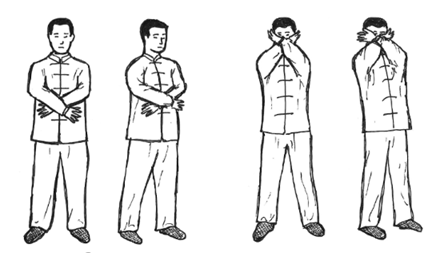
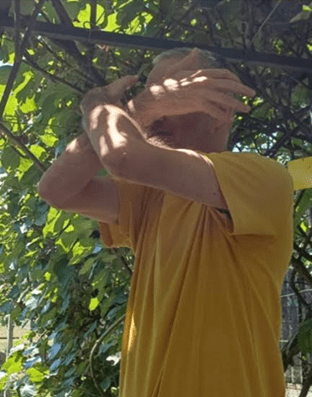
Raise your arms as follows: men first place the right hand across the face without touching it, with the right palm facing toward and parallel to the left temple. The palm is therefore slightly bent toward the head in relation to the forearm. Keep the fingers spread apart. The man then crosses his left arm over the right, so that the two arms cross and touch slightly below the elbows. The left palm is facing toward and parallel to the right temple. The left palm is therefore also slightly bent toward the head in relation to the forearm. Keep the fingers spread apart.
Now pronounce T’AI ZHI six times (or more), followed by SHAO ZHI six times (or more). The SHAO ZHI sound must be repeated the same number of times as the T’AI ZHI sound.
Warning! If a man places his left hand across his face first and then crosses his right arm over it, excessive amounts of subtle energy or Qi may accumulate in the head. The same may happen to a woman if she places her right hand across her face first and then crosses her left arm over it.
This may be dangerous for people with disorders of the head or heart, high blood pressure, or mental health problems. People in these categories should also determine whether the correctly performed ZHI sound exercise causes them to become unbalanced. Another reason for caution is that this is already the third stationary exercise involving raised arms, which directs at least some of the Qi toward the head.
A safer version of this exercise is to perform it in front of the solar plexus. You can begin by placing the palms over the lower Dan Tian. For men, the left palm is placed on the inside and for women the right palm. Then extend the hands upward so that the arms cross above the wrists in front of the solar plexus. Keep the fingers spread apart.
Now pronounce T’AI ZHI six times (or more), followed by SHAO ZHI six times (or more). The SHAO ZHI sound must be repeated the same number of times as the T’AI ZHI sound.
This hand position is a safer variation and helps the Qi begin to settle and move downward before the final exercise is performed.
You will notice that men first place the left hand in front of the solar plexus and then the right hand over it, whereas when performing the position at head level, they first place the right hand in front of the face and then cross the left hand over it. Women first place the right hand in front of the solar plexus and then the left hand over it, whereas when performing the position at head level, they first place the left hand in front of the face and then cross the right hand over it.
This is not an error but reflects different energetic effects at the level of the solar plexus and lower Dan Tian on the one hand, and at the level of the head on the other.
YU SOUND EXERCISE
Stand in a relaxed position with your feet shoulder-width apart. Bend your arms upward at the elbows and bring them forward at approximately a 72-degree angle, so that your forearms are at approximately the same height as the small intestine, pointing forward and parallel to each other. Keep the palms open, with the fingers together and the palms facing each other.
Now pronounce T’AI YU six times (or more), followed by SHAO YU six times (or more). The SHAO YU sound must be repeated the same number of times as the T’AI YU sound.
A safer variation of this exercise is to use the HU sound instead of YU. The HU sound directs Qi downward more strongly.
DISCLAIMER: You assume full responsibility for practicing this purported healing sounds. Practicing this healing sounds should never be used as a substitute for appropriate professional medical care. If you feel unwell during the practice, discontinue it immediately. Mild reactions during or after the practice are possible and are generally considered normal.
The SHÍ mantra (十), also pronounced “SHER” or “SHƏ,” literally means the number ten in Chinese. This mantra may be used to activate energy in the following areas:
any part of the legs
any part of the arms
the genitals
the perineum
the anus
the navel
The mantrais practiced in combination with the SHAO and T’AI mantras. First, choose one of the body areas listed above on which you wish to focus. Direct your attention and loving intention toward that area.
Mentally or aloud, repeat T’AI SHÍ (汰十) at least six times to activate the cleansing of Qi (prana) from the selected area. If the condition is more serious, the mantra may be repeated additional times. However, stop the practice when you feel that it is sufficient or after reaching 30 repetitions, whichever comes first.
Next, energize the same body area by repeating SHAO SHÍ (捎十) the same number of times. The combination of the sounds SHAO and SHÍ signifies bringing fresh Qi, or prana, into the body part that is the focus of your attention.
Important! Before using SHAO SHÍ to bring fresh energy into the body, you must first remove the old energy with T’AI SHÍ. Introducing fresh energy without first clearing stagnant energy may produce undesirable physical reactions.
When practicing mentally, SHAO SHÍ may, if desired, be repeated during inhalation. When spoken aloud, however, it is always pronounced during exhalation of course. T’AI SHÍ, whether practiced mentally or aloud, should always be repeated only during exhalation.
The effects of the practice may be enhanced by briefly holding the breath after inhalation and again after exhalation. The practice may also be strengthened by using hand movements to remove or direct energy. There are several methods for doing this. One of the best-known approaches comes from Pranic Healing, in which circular movements of the hands are used to draw stagnant energy outward and then direct fresh energy inward. The complete procedure is described in the basic Pranic Healing manual.
Disclaimer: You assume full responsibility for practicing this purported healing sound. Practicing this healing sound should never be used as a substitute for appropriate professional medical care. If you feel unwell during the practice, discontinue it immediately. Mild reactions during or after the practice are possible and are generally considered normal.
The Chinese mantra SHAO T’AI (汰捎) consists of the words SHAO (捎; pronounced shāo), which in Qigong means “to bring” or “to lead” something (the word literally means !to take along something for someone else, to bring, or to deliver on the side«), and T’AI (汰; pronounced tài), which in Qigong means “to get rid of” or “to eliminate” something (the word literally means »to discard, eliminate, wash out, or weed out«).
In Qigong, the mantra SHAO T’AI, or the individual words SHAO and T’AI, can be used to regulate the so-called Microcosmic Orbit (Xiao Zhou Tian). The sound SHAO directs the movement of qi, or vital energy, down the front midline of the body and up the back midline. This circulation strengthens the body’s energy, its jing essence, and the subtle energy or qi. Excessive practice of this circulation, however, may lead to spiritual stagnation. The sound T’AI directs qi upward along the front midline and downward along the back midline, thereby reversing the direction of the energy circuit. This reversed circulation strengthens the spiritual energy or shen/ shen qi but tends to weaken ordinary qi, the jing essence, and the physical body. When SHAO and T’AI are practiced separately, the ratio of practice should be at least 2:1, favoring the bodily circulation over the spiritual one.
The sounds T’AI and SHAO represent a more radical approach to breath regulation. A more commonly used breathing mantra is the Indian mantra SO HAM, which is an example of onomatopoeia—a word or expression that imitates the natural sound it describes. In this case, it imitates the sound of breathing. SO (Soh) imitates the barely perceptible sound of inhalation, while HAM imitates the barely perceptible sound of exhalation. The Chinese equivalent of this mantra is HONG SAU (Chinese: 洪蘇), where HONG most likely derives from the Indian AHAM, and SAU from the Indian SO in SO HAM.
The Chinese also developed a similar form of onomatopoeia by imitating the sounds produced when breathing through a partially obstructed airway. In this case, SHAO imitates the sound of inhaling through a congested nose, while T’AI imitates the sound of exhaling through the mouth, with the force of the exhalation causing the mouth to open. In this way, SHAO and T’AI function as breathing mantras that are coarser but energetically more powerful than SO and HAM. SO HAM (or SO HENG) is particularly suitable for silent practice, whereas SHAO T’AI may be used in either vocal or silent practice. During vocal practice, the sound SHAO is also pronounced during exhalation. During silent practice, however, SHAO is used during inhalation.
Some practitioners also combine the sounds SHAO and T’AI with the specific tones/sounds associated with the five principal organs and, correspondingly, the Five Elements: GONG and the spleen, SHANG and the lungs, JUE and the kidneys, ZHI and the liver, and YU and the heart. For example: we can use mantra T’AI SHANG and then SHAO SHANG. This is one method used in healing Qigong. In another system, different organ correspondences are assigned to some of these sounds: JUE corresponds to the liver, ZHI to the heart, and YU to the kidneys.
In Chaldean numerology, certain numbers are traditionally classified as masculine or feminine. However, this distinction should not be understood too rigidly. Like all archetypal symbols, numbers rarely express a single quality in a pure and isolated form.
The numbers 1, 3, and 9 are generally considered masculine. Yet both 1 and 9 also symbolize wholeness and completion, qualities that encompass both masculine and feminine principles. For this reason, neither number can be regarded as exclusively masculine.
At first glance, this appears to leave 3 as the only truly masculine number. Even here, however, the symbolism is more nuanced. While 3 typically expresses itself through active, outward-moving, and traditionally masculine qualities, its deeper or formative nature may also contain a receptive, feminine dimension. Interestingly, in the Tarot the number 3 is represented by The Empress, one of the most prominent feminine archetypes.
A similar complexity can be found among the feminine numbers. Although 2 and 6 are generally associated with feminine energy, the number 2 is not entirely feminine in character. It also carries a subtle masculine component, a fact that becomes clearer when we examine the symbolic relationship between the Sun and the Moon.
In the ancient cultures of the Mediterranean and Mesopotamia, agricultural rhythms were influenced as much by the lunar cycle as by the changing seasons. Because growth, fertility, and cyclical renewal were linked to the Moon, these cultures often associated the Moon with the feminine principle. The Sun, in turn, was frequently viewed as the masculine counterpart or companion of the lunar goddess. This symbolic relationship became deeply embedded in later astrological and numerological traditions.
In the more northern regions of Europe and Asia, however, seasonal changes played a much greater role in agricultural life. Here, the Sun was seen as the primary source of fertility and renewal. As a result, some cultures revered the Sun as a feminine deity, while the Moon assumed a masculine role. Traces of this symbolism can still be found in Slavic traditions, where the Moon is linguistically masculine and the Sun occupies a different grammatical category.
These differing traditions remind us that the Sun and the Moon are not strictly masculine or feminine symbols. Rather, each contains aspects of both principles and derives meaning through its relationship with the other. The same pattern appears in numerology. The solar number 1 contains traces of feminine energy, while the lunar number 2 contains traces of masculine energy.
Numbers 4 and 7 represent an even more blended expression of these forces. Since 4 follows the solar number 1, it reflects a softened form of masculine energy. Likewise, 7 follows the lunar number 2 and therefore expresses a more moderated form of feminine energy. In this sense, both numbers occupy a middle ground, combining and balancing qualities traditionally associated with both polarities.
Chaldean numerology does not recognize the master numbers 11 and 22. Although certain older European numerological writings hinted at the special nature of these numbers, even Pythagorean numerologists did not use them until relatively recently — at least not before the notorious and controversial numerologist Aso-Neith Cochran (Asenath Williams Woodcock Cochran) in the early 20th century.
After Cochran elevated the numbers 11 and 22 to a special status, her ideas were adopted by the even more famous Pythagorean numerologist L. Dow Balliett (actually Sarah Joanna Dennis Balliett). Around Balliett gathered a strong circle of neo-Pythagorean numerologists who significantly reshaped the Pythagorean numerological tradition. Soon afterward, Julia Seton, one of the aforementioned Pythagorean number enthusiasts, also classified 33, 44, 55, 66, and so on as master numbers.
It is possible that the Pythagoreans were also influenced by the Tarot cards XI (“Strength”) and 0 or XXII (“The Fool”). Card XI depicts a woman calmly standing beside a lion, closing its jaws with her bare hands. For this reason, the card is sometimes referred to as “ a Lion Muzzled.” Card 0 or XXII shows a man casually walking along his path while a dog — or some beast — bites at his leg. Perhaps this inspired Aso-Neith Cochran to attribute special power to these cards and numbers.
The number 22 is double 11, and in addition, the English word MASTER adds up to 22 according to the reduced numerical values of letters in the English alphabet:
M + A + S + T + E + R = 4 + 1 + 1 + 2 + 5 + 9 = 22.
All subsequent “master numbers” are multiples of 11.
Whatever the logic behind these Pythagorean ideas may have been, they eventually found their way into Chaldean numerology as well. Some Chaldean numerologists abandoned the older Chaldean tradition precisely because of this and adopted the Pythagorean interpretations of the numbers 11 and 22. They did not even exercise enough critical thinking to calculate the Chaldean value of the English word MASTER, which is actually 19, not 22:
M + A + S + T + E + R = 4 + 1 + 3 + 4 + 5 + 2 = 19.
And in other languages, the translation of the word “master” yields entirely different values.
In the Chaldean tradition, the numbers 11 and 22 are considered challenging numbers. In particular, the meaning of 11 here differs somewhat even from the Italian Tarot tradition.
Personally, when it comes to the numbers 11, 22, 33, and so on, I follow the older interpretations. There are not many situations in which 11 functions as a strong and stable number. It seems that this so-called “master level” is more the exception than the rule in the case of this number.
Let me ask you this: How many women would dare approach an untamed lion and close its jaws with their bare hands? And if the Tarot lion is already domesticated, then we cannot really speak of mastery at all…