1. BASICS
The word Yi (一, pinyin yī, pronounced like “EE”) means the number “one” in Chinese. As a mantra, however, it represents the sound of our inner self. It can be used to seek a general balance within our energy system. The sound has a gentle (not very strong) effect.
The mantra is also related to the sound Yu (pronounced like “Ü” or “UEE”—similar to “OO,” but with rounded lips. A comparable sound is familiar from the German language). For this reason, some practitioners use the Yi sound as a substitute for Yu, in an attempt to create balance in the small intestine, heart, brain, eyes, tongue, circulatory system, and so on. In this case, however, I recommend using the Yu sound rather than Yi, because Yu has a considerably stronger effect on these areas.
2. PRACTICE
The sound can be practiced together with the mantras SHAO and T’AI. In this case, pronounce T’AI YI (汰一) at least six times, and then pronounce SHAO YI (捎一) at least six times. As a general rule, perform the SHAO YI repetitions the same number of times as the number of T’AI YI repetitions.
Unlike the Five Healing Sounds, this exercise does not have a specific area of action. Therefore, perform a maximum of 20 repetitions (two-thirds of the maximum number of repetitions recommended for the Five Healing Sounds).
Special warning: If you practice the Five Healing Sounds using the additional mantras SHAO and T’AI, always perform the exercise with the T’AI mantra first and only then practice the SHAO sound. The T’AI sound cleanses old subtle energy, or old Qi, while the SHAO sound supplies refreshed Qi. Introducing fresh energy without first clearing stagnant energy may produce undesirable physical reactions.
The exercise can also be practiced mentally. In this case, you can place the tongue against the roof of the mouth to strengthen the circulation of Qi. At the same time, you can assume the general hand position used for cleansing or energizing.
3. HAND POSITIONS FOR THE T’AI YI EXERCISE
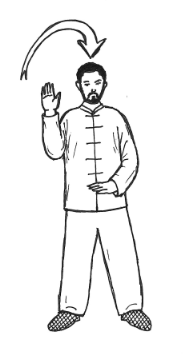
The T’AI YI exercise is intended to cleanse our energetic interior. Depending on gender, we use our prenatal hand. The back of the hand faces forward. This encourages the circulation of energy upward along the front of the body and downward along the back.
If we also practice hand positions during the exercise, we should be aware that men and women practice the T’AI YI sound differently.
A man stands with his feet approximately shoulder-width apart. His left arm is bent at the elbow so that the palm, slightly curved and relaxed, faces backward over his left shoulder, with the back of the hand visible from the front. The hand is not bent at the wrist. The fingers may be slightly separated. The palm of the right hand is positioned in front of the Lower Dan Tian, with the palm facing toward the ground. The palm and fingers of the right hand are straight and parallel to the ground.
A woman performs the same exercise standing with her feet approximately shoulder-width apart. Her right arm is bent at the elbow so that the palm, slightly curved and relaxed, faces backward over her left shoulder, with the back of the hand visible from the front. The hand is not bent at the wrist. The fingers may be slightly separated. The palm of the left hand is positioned in front of the Lower Dan Tian, with the palm facing toward the ground. The palm and fingers of the left hand are straight and parallel to the ground.
A variation of this exercise is to raise the hand as high as possible.
A man stands with his feet approximately shoulder-width apart. His left arm is slightly bent at the elbow and raised high, slightly toward the center of the torso, so that the palm, slightly curved and relaxed, faces backward, with the back of the hand visible from the front.
A woman stands with her feet approximately shoulder-width apart. Her right arm is slightly bent at the elbow and raised high, slightly toward the center of the torso, so that the palm, slightly curved and relaxed, faces backward, with the back of the hand visible from the front.
4. HAND POSITIONS FOR THE SHAO YI EXERCISE
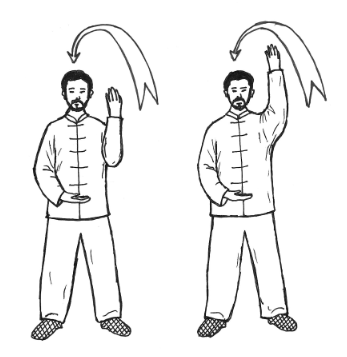
The SHAO YI exercise is intended to energize our inner self. In this exercise, both men and women may use either hand to raise one arm in front of them, while placing the other hand in front of the Lower Dan Tian. The back of the lifted hand faces backward. This encourages the circulation of energy upward along the back of the body and downward along the front.
In the first variation, a man or woman stands with the feet approximately shoulder-width apart. The right arm is bent at the elbow so that the palm, relatively flat, is positioned just beyond and slightly above the shoulder, facing forward. Thus, the palm does not face forward while also pointing downward or to the side; it simply faces forward. The hand is not bent at the wrist. The back of the hand faces in the opposite direction, toward the back. The fingers may be slightly separated. The palm of the left hand is positioned in front of the Lower Dan Tian, with the palm facing toward the ground. The palm and fingers of the left hand are straight and parallel to the ground.
In the second variation, a man or woman stands with the feet approximately shoulder-width apart. The left arm is bent at the elbow so that the palm, relatively flat, is positioned just beyond and slightly above the shoulder, facing forward. The back of the hand faces in the opposite direction, toward the back. Thus, the palm does not face forward while also pointing downward or to the side; it simply faces forward. The hand is not bent at the wrist. The fingers may be slightly separated. The palm of the right hand is positioned in front of the Lower Dan Tian, with the palm facing toward the ground. The palm and fingers of the right hand are straight and parallel to the ground.
Disclaimer: You assume full responsibility for practicing this purported healing sound. Practicing this healing sound should never be used as a substitute for appropriate professional medical care. If you feel unwell during the practice, discontinue it immediately. Mild reactions during or after the practice are possible and are generally considered normal.


