Shortly after the creation of the Italian tarot cards, numerous versions with incorrect numerological sequences emerged. The numerologically correct system is the Marseille tarot, as it maintains the appropriate links between the meanings of tarot cards and the ancient descriptions of numbers. Recently, inaccurate information has surfaced regarding how individual tarot cards are connected to the numbers as known in Chaldean numerology.
Without delving into the numerological philosophy of tarot, it can be stated that in the late 19th and early 20th centuries, Chaldean numerologists used connections between numbers and tarot cards, as illustrated below.
In some cases, the numerological names differ from the most established names. For example, the number 11 is called Lion Muzzled. The card The World is referred to as the Crown of the Magi. The Three of Cups and Three of Coins are called Reaper, as these cards share meanings with the card Reaper XIII. Many terms originate from French occultists of the 19th century, who sought the origins of tarot in ancient Egypt and named individual cards or numbers with pagan names.
The cards of the Major Arcana in Chaldean numerology are typically named as follows:
- 1 – I. The Magician, the Juggler
- 2 – II. The Door of Hidden Sanctuary, the High Priestess
- 3 – III. The Empress, Isis-Urania
- 4 – IV. The Stone Cube, the Emperor
- 5 – V. The Master of the Arcana
- 6 – VI. The Two Ways, the Lovers
- 7 – VII. The Chariot of Osiris
- 8 – VIII. The Justice, The Balance and Sword, Themis
- 9 – IX. The Veiled Lamp, the Hermit
- 10 – X. The Wheel of Fortune, the Wheel, Sphinx
- 11 – XI. The Clenched Hand, the Lion Muzzled, the Force
- 12 – XII. The Sacrifice, the Hangman, the Victim
- 13 – XIII. The Reaper, the Death, the Scythe, the Reaping Skeleton
- 14 – XIV. Temperance, the Two Urns, Solar Spirit
- 15 – XV. Typhon or Devil (especially when associated with 4 or 8)
- 16 – XVI. The Blasted Tower, the Ruined Tower, the Shattered Citadel
- 17 – XVII. The Star of the Magi
- 18 – XVIII. The Twilight, the Blood-stained Path
- 19 – XIX. The Prince of Heaven, the Blazing Light
- 20 – XX. The Awakening of the Dead, the Judgment
- 21 – XXI. The Crown of the Magi, the Universe
- 22 – XXII. Full, the Blind Fool, the Crocodile
Following are the Minor Arcana, which appears in four suits. The names of the four suits in tarot are usually wands, cups, swords, and coins/pentacles. In Chaldean numerology, we generally use the term scepters for wands, and coins for pentacles.
Unlike the Major Arcana, the meanings of the Minor Arcana cards, particularly the pip cards, unfortunately lack connection to their ancient numerological meanings. The number 43 or Three of Cups in Chaldean numerology is, for example, considered unlucky, whereas in the general modern interpretation of tarot, it has a favorable meaning. The interpretations of numbers also differ in content.
Therefore, I strongly advise against interpreting numbers in Chaldean numerology using modern French descriptions of the Minor Arcana and other descriptions of this arcana that stem from French interpretations.
Tarot is also a tool of a divination matrix – once we determine the meanings of a chosen card, that card will “bear” or “communicate” the meanings we have attributed to it. In interpreting numbers in Chaldean numerology, however, such an approach cannot be applied; instead, the meanings must be connected to the actual nature of the numbers. Therefore, we must take into account the exact sequence in the naming.
Minor Arcana:
- 23- The Royal Star of Lion, King of Scepters
- 24- The Queen of Scepters
- 25 – The Knight of Scepters
- 26 – The Page of Scepters
- 27 – The Scepter, Ace of Scepters
- 28 – Two of Scepters
- 29 – Three of Scepters
- 30 – Four of Scepters
- 31 – Five of Scepters
- 32 – Six of Scepters
- 33 – Seven of Scepters
- 34 – Eight of Scepters
- 35 – Nine of Scepters
- 36 – Ten of Scepters
- 37 – The Royal Star of Bull, King of Cups
- 38 – The Queen of Cups
- 39 – The Knight of Cups
- 40 – The Page of Cups
- 41 – The Cup, Ace of Cups
- 42 – Two of Cups
- 43 – The Ripper, the Point of the Reaper, the Death Point, Three of Cups
- 44 – Four of Cups
- 45 – Five of Cups
- 46 – Six of Cups
- 47 – Seven of Cups
- 48 – Eight of Cups
- 49 – Nine of Cups
- 50 – Ten of Cups
- 51 – The Royal Star of Aquarius, the Royal Star of the Waterman, the King of Swords
- 52 – The Queen of Swords
- 53 – The Knight of Swords
- 54 – The Page of Swords
- 55 – The Sword, Ace od Swords
- 56 – Two of Swords
- 57- Three of Swords
- 58- Four of Swords
- 59 – Five of Swords
- 60 – Six of Swords
- 61 – Seven of Swords
- 62 – Eight of Swords
- 63 – Nine of Swords
- 64 – Ten of Swords
- 65 – The Royal Star of Scorpio, King of Coins
- 66 – The Queen of Coins
- 67 – The Knight of Coins
- 68 – The Page of Coins
- 69- The Mars Crowned, The Crown of Mars, the Coin, Ace of Coins
- 70 – Two of Coins
- 71 – The Ripper, Three of Coins
- 72 – Four of Coins
- 73 – Five of Coins
- 74 – Six of Coins
- 75 – Seven of Coins
- 76 – Eight of Coins
- 77 – Nine of Coins
- 78 – Ten of Coins

 The Mystery of Numbers, Luck, Worlds and Planets
Congratulations for your blog, as it’s one of the most well-documented on the subject. I discovered it pretty recently, as I was looking mostly for Vedic/Hindu approaches on numerology.
As you’re saying that the current, French-inspired or post-Marseille Arcana interpretations don’t really fit these correspondences, are the traditional or suitable interpretations of the 78 Arcanas to be found anywhere? Or is it the other way around, with just the compound number meanings to be found, such that the Tarot cards should follow those? The first case would be a great advantage for someone familiar with the card meanings, as he could immediately use it in a numerological analysis.
LikeLiked by 1 person
Congratulations for the blog, as it’s one of the most well-documented on the topic!
Is there any traditional interpretation of the Arcanas, suitable for these correspondencies, to be found? Or is it the numerological meaning of the compound numbers to be taken first? In the second case, as you pointed out, we don’t have a complete, already made, reference for all 78 numbers. But in the first case, the 78 Arcanas could provide that foundation for someone already familiar with the Tarot…
LikeLiked by 1 person
Hello, Vlad,
Chaldean numerology — and numerology as a study of destiny in general — was, in contrast to Pythagorean arithmology, present throughout the centuries rather quietly and in secrecy. Sources about it are scattered across many texts, and at times, the information was conveyed only through metaphors. From certain sources, it is possible to reconstruct the meanings of consecutive traditional numbers — and not only up to 78, but well beyond 100.
Even in Tarot, the Minor Arcana were very likely at first interpreted through the Chaldean system. This can be seen, for instance, in the descriptions of ordinary English playing cards, which have only 13 cards per suit. Those descriptions, however, originate from a model with 14 cards per suit, where the meanings of the Knight and the Page were somewhat merged. Some blending of meanings also occurred among the suits themselves. The most likely source of such English interpretations is undoubtedly the Tarot.
Since Tarot can also be viewed as a closed system, it can be interpreted differently from the basic number meanings found in Chaldean numerology. Thus, we can interpret it, for example, through elements connected to Chaldean numerological methods of number compatibilities, in order to obtain secondary meanings. These “Chaldean Tarot” interpretations, however, become less consistent with ancient tradition shortly after the number 52. This may be one of the reasons why Cheiro published descriptions only up to 52. The divergence between the “Chaldean Tarot” and the ancient meanings actually appears even earlier — with the numbers 39 and 48. According to Cheiro’s “Chaldean Tarot meanings,” these numbers act similarly to 30, whereas in the classical interpretation they correspond more closely to 12 — and I personally agree with the latter view.
The prevailing method of Tarot divination today originates from the foundations proposed by certain French writers on Tarot in the late 18th century. These authors developed their card interpretation on entirely different principles than those of Chaldean numerology. I see nothing problematic about that. Tarot, as a tool for divination and understanding destiny, has a different nature from Chaldean numerology. In Tarot, a given Arcana can be interpreted in various ways — the system will still work, provided the practitioner centers themselves and connects energetically, since the Arcana are merely instruments through which the invisible world (or even we ourselves, as complete beings) communicate with us.
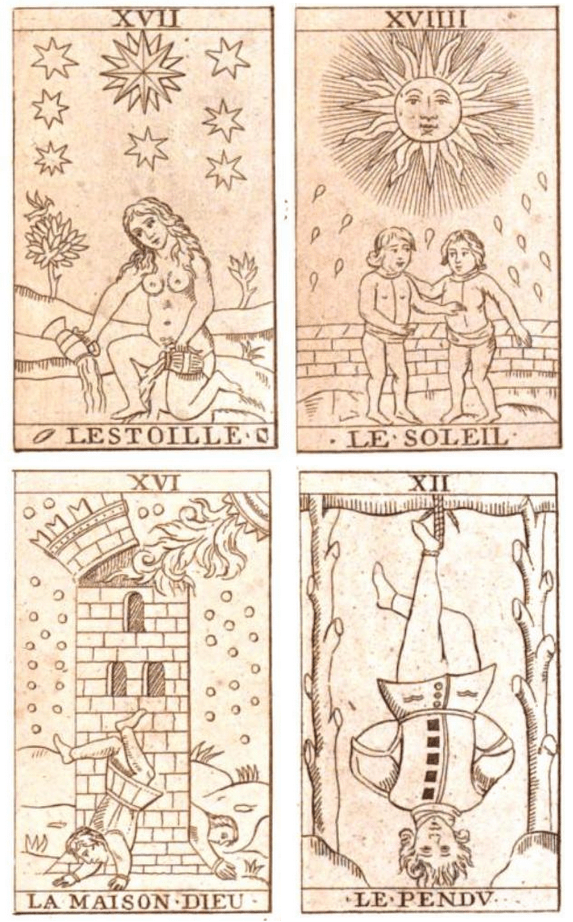
For example, if we assign to card XVI the qualities of positive transformation — without succumbing to the traditional, often troubling, descriptions of that card — then the invisible world will communicate with us accordingly: whenever that card appears, it will signify an opportunity for favorable transformation. This is merely an example.
In Chaldean numerology, however, the meanings are fixed, and therefore one cannot use the French interpretation of the Minor Arcana to understand the numbers in a numeroscope. For instance, the number 36 has been considered generally fortunate for more than 2,000 years, while in the French interpretation, the Ten of Wands — associated with it — carries quite an unfavorable meaning.
Let me add that I do not personally practice Tarot; I am interested in it only in connection with understanding the historical development of numerology. Nevertheless, it would be interesting if someone were to create a functional Tarot system based on Chaldean number meanings. In the long run, I intend to compile my notes and explain the traditional meanings of all numbers up to 99, but that time has not yet come. For now, you can get a taste of this in my article, where you can see which numbers up to 99 are more or less auspicious:
https://bostjanlovrat.com/2025/09/07/compound-numbers-from-10-to-99/
I hope I have clarified some of the puzzles regarding the connection between Tarot and Chaldean numerology. Because of extended travel in recent weeks, I wasn’t able to reply to you sooner.
Best regards,
Boštjan
LikeLiked by 1 person
Hi Boštjan,
Thank you for your answer. I had rewritten my initial comment as I wasn’t sure if it got submitted.
I agree that number meanings can mostly be recovered or reconstructed, and that they cannot be taken from the French-inspired Tarot (Minor Arcana) descriptions. Sure, in the latter case (of the Tarot), meanings can be assigned relatively to the practitioner.
I guess that a functional Chaldean Tarot system can be put in practice with the classic Marseille deck, where Minor Arcana cards aren’t illustrated. The thing is that, as they’re currently described, they somewhat have a connection to their number within the context of the suite (1-10). Maybe that can be considered in conjunction to the cosmic element of the suite (1 – Fire, 2 – Water, 3 – Air, 4 – Earth – in case this correspondence is also accepted in Chaldean) and still keep the correspondence with the Chaldean number (23-78), but this would require some more research.
But so far, I didn’t find cartomancy descriptions where 3 of Cups and 3 of Coins are negative. It would make sense, though, if we consider 3 conjunct with 2 and 4 respectively. Also, in the Chaldean correspondence, I see that 3 of Wands (29) and 3 of Swords (57) are also negative; the latter is so also in the contemporary description. However, I find it strange that all 3’s, which is Jupiter, are negative. But these are just some spontaneous observations and speculations that I can do right now.
Regarding the number-element correspondences I just mentioned, I’m not sure how they are in Chaldean. In Pythagorean numerology, they seem to make sense; other than that, I’ve only encountered Harish Johari’s correspondences, some of which seem strange to me (4 – Fire, 5 – Earth, 8 – Air), even from an astrological perspective in the case of 4/Rāhu.
Anyway, this is a large topic.
Best regards,
Vlad
LikeLike
Hey, Vlad,
I haven’t had time to follow the blog for the past two months. Yes, I also believe that in tarot, the numbers, by their elemental nature, should be somewhat connected to the colors of the suits. According to my information, this is also the reason for the differences, for example, in the traditional meanings of numbers 39 and 48 as challenging numbers, similar to 12, and in the Chaldean tarot as revealed by the Chaldean numerologist Cheiro, where 39 and 48 are more connected to the number 30 and are not considered unlucky. Cheiro himself, by the way, almost certainly never dealt directly with tarot. If he had, he would have written books about it just as he did about palmistry and numerology. So he must have obtained this Chaldean tarot scheme from elsewhere.
It may therefore not be surprising that at least some of the threes in individual suits are negative, even though Jupiter, which is associated with 3, is considered a benefic. In tarot, there is a macro-arrangement from 1 to 78, where the threes of the suits have different overarching numbers: 29, 43, 57, and 71. Numbering the pips is thus a secondary arrangement within a broader scheme. The basis for dividing into four groups of 14 cards appears to be very old and only later became associated with Italian cards and suit sets, which most likely originate from Arabic or Persian sources.
As mentioned, I don’t personally work with tarot. However, a true Chaldean tarot would likely show numbers instead of court cards: for example, XXIII instead of the King of Wands, XXIV instead of the Queen of Wands, and so on. That a Chaldean tarot existed in the 15th and 16th centuries is evident from the court cards (Kings, Queens, Knights, and Pages), which more or less correspond meaningfully to the numbers 23, 24, 25, 26, 37, 38, 39, 40, 51, 52, 53, 54, 65, 66, 67 (?), and 68 as found in Chaldean numerology.
I also published an article on this: Court Cards in Chaldean Tarot – The Intersection of Tradition and the Renaissance.
LikeLiked by 1 person