In 2010, Slovenian researcher Andrej Kikelj published a revised version of the Chaldean numerology method on his website astronumero.org. Through radiesthesia and study, he modified the encoding of individual letters, establishing new numerical correlations.[1] His interpretative approach incorporates Pythagorean principles, including vowel and consonant numbers,[2] master numbers,[3] personal days, months, years, and “pinnacles.”[4]
Kikelj’s general alpha-numeric table takes into account certain Central European pronunciations. In this Germanic-Slavic linguistic region, the letter “H” corresponds to the sound of the ancient letter ḥet, with a phonetic value of 8. The letter “T” can have phonetic values linked to the letters and sounds tau (4, 22, and 400) or ṭet (9), while the letter “S” is widely pronounced as the sound and letter samek (6, 15, and 60) across all Europe. Through radiesthesia, Kikelj assigned the letter “T” a value of 9 and attributed the number 9 to the letter “E” as well.

In addition to a general table for converting the English alphabet to numbers, he created tailored tables for the Slovenian[5] and Croatian[6] alphabets. For example, he associated the letters “Š” and “Ž” with the traditional Croatian and Slovenian interpretation, linking them to the letter shin with values of 3, 21, and 300, and the letter zayin with values of 7, 16, and 70. He sees a phonetic connection of the letters “Ć” and “Č” with the letter ṣadi, valued at 9. For the values of “DŽ,” “Đ,” “NJ,” and “LJ,” Kikelj couldn’t rely on established tradition and arrived at unusual results through radiesthesia.
Incorporating radiesthesia, aura readings, and similar methods into Chaldean numerology requires careful consideration of what we’re actually measuring. Are these the isolated vibrations of individual letters or the typical vibrations of letters within a word? Are we measuring the letters themselves or the sounds they represent? Without knowing exactly what we’re measuring, there’s a risk of methodological error.
It’s essential to understand that Chaldean numerology (also known as Aramaic or Ancient Hebrew numerology) was originally based on letter values rather than phonetics. In ancient Hebrew script, the final sounds “a,” “e,” and “o” were all recorded as the letter he, with a numerical value of 5.[7] So, the letters create their own alphabetic matrix, and European numerologists realized centuries ago that the letter “C” should have a value of 3, and the letter “H,” despite originating from the letter ḥet, should be valued at 5. They assigned the letter “E” a value of 5 and the letter “O” a value of 7, forming a letter-based matrix used for the Latin alphabet.[8]
I agree that in Central Europe, the letter “H” corresponds phonetically to the sound of the ancient letter ḥet, just as the European sound represented by the letter “S” could relate to the ancient letter samek, valued at 6, 15, and 60. Phonetically, the sound and letter “O” might align with the number 6 and the letter vaw, while the value of “E” could be closer to the letter yod, with values of 1 and 10.
Mixing alphabetic and phonetic matrices creates a variety of possible new matrices, each carrying at least some level of energy potential. However, not all matrices possess the same strength of energy potential. When testing names with Kikelj’s method, the results did not appear to me as consistent as those achieved using the classic Chaldean alphanumeric table, whether according to Cheiro’s guidelines or the older tradition as described by Richard Cavendish. Nonetheless, you can explore Kikelj’s approach and try it yourself using the information he provides on astronumero.org.

While full birth information is not available, Andrej Kikelj identifies as an Aquarius and base number 3 and shared that he became involved in bhakti yoga and meditation in his youth. His interest in spiritual knowledge has persisted throughout his life. He is also a professional translator interested in computers and programming.[9] Let’s examine Andrej Kikelj’s numerology chart, calculated using the classic method of converting letters into numbers:
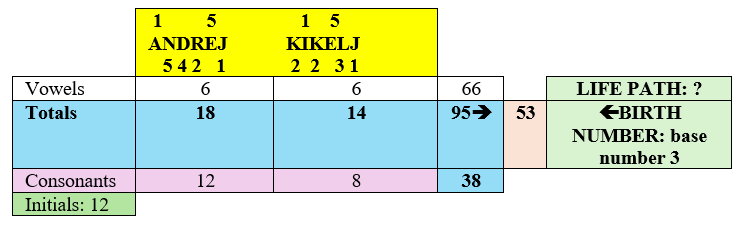
His chart reveals a strong presence of the number chain 3 & 6 & 9, which often signifies an interest in spiritual life (and can also indicate a potential interest in business). Additionally, we see the chain 2 & 3 & 5, which suggests a desire to let go of old behavioral patterns. This could explain his interest in bhakti yoga (Hare Krishna) and meditation. A prominent number 5 is sometimes associated with computers and programming, and it also corresponds to Mercury, communication, and numbers.
The combination of 5 with the chain 3 & 6 & 9 partially accounts for his interest in numerology. Kikelj used to be involved in music as well, which is probably related to the sequence of numbers 3, 6, and 9. Regarding his career in translation, it’s likely connected to the association of the number 5 with 2 and 6. A fuller understanding of his interests and professions would likely require his full birth data and astrological chart.
Added on November 4, 2024: The relationship between the numbers 14 and 95 on one side and the birth base number 3 on the other could potentially lead to traffic accidents or other issues. However, in Kikelj’s numerology chart, these tendencies are balanced by the potential for spiritual growth and the release of old patterns. If he embraces these potentials, it can help to calm the energies reflected in his chart.
Some sources:
[1] Kikelj, Andrej: https://www.astronumero.org/numerology-charts/#chaldean-table-improved
[2] Kikelj, Andrej: https://www.astronumero.org/numerology-guide/name-numbers/
[3] Kikelj, Andrej: https://www.astronumero.org/what-are-the-master-numbers/
[4] Kikelj, Andrej: https://www.astronumero.org/numerology-guide/forecast-numbers/
[5] Kikelj, Andrej: https://www.astronumero.org/numerologija-tabela/
[6] Kikelj, Andrej: https://www.astronumero.org/numeroloska-tablica/
[7] Schmidt Brian B. (2015): Memorializing Conflict: Toward an Iron Age “Shadow” History of Israel’s Earliest Literature, page 87. From: Schmidt Brian B., editor (2015): Contextualizing Israel’s Sacred Writings: Ancient Literacy, Orality, and Literary production.SBL Press, USA.
[8] Lovrat, Boštjan: https://bostjanlovrat.com/2024/09/11/the-use-of-the-latin-alphabet-in-chaldean-numerology/
[9] Kikelj, Andrej: https://www.astronumero.org/about-us/

 The Mystery of Numbers, Luck, Worlds and Planets