Mundane Chaldean Numerology

Mundane Chaldean numerology is a branch of Chaldean numerology that appears to have begun developing more seriously only within the past decade. The word mundane comes from the Latin mundus, meaning “world,” and refers to global affairs.

Just as mundane astrology studies political processes, economic trends, pandemics, wars, and natural disasters based on planetary positions and astrological configurations, mundane numerology attempts to address similar topics—but through the lens of numbers.

Arithmetic Divination

Unlike astrology, numerologists—not only Chaldean ones—have historically focused primarily on how numbers influence individual lives, rather than their impact on entire nations or populations.

In the 19th century, a system known as “arithmetic divination” developed in France. Later, within Martinist numerology, attention turned to the cycles of certain numbers. The Martinist thinker Gérard Encausse Papus also worked with this arithmetic divination and also adopted ideas from the Belgian thinker Robert Bruck, who attempted to construct a numerological system based on weekly, monthly, four-year, sixteen-year, and even five-hundred-year cycles in order to explain the rise and fall of civilizations.

Although Martinism itself and Bruck’s ideas did not significantly influence the development of Chaldean numerology, the approach of arithmetic divination had a strong impact on it. This method is based on adding together the digits of a given year and then adding that result to the original year. In this way, a new year is obtained, supposedly reflecting an important turning point.

For example:

1789 (the French Revolution)

+ 25 (namely: 1+7+8+9)

= 1814 (Napoleon exiled to Elba, marking the end of French imperial power; the connection: a shift in political regimes in France)

1774 (Louis XVI becomes king)

+ 19 (namely: 1+7+7+4)

= 1793 (his death; the connection: the life of a king who shaped French history)

1914 (outbreak of World War I)

+ 15 (namely: 1+9+1+4)

= 1929 (the Great Depression; the connection: social upheaval in the early 20th century)

2010 (the Arab Spring)

+ 3

= 2013 (rise of the Islamic State; the connection: regime changes in the Arab world)

2013 (rise of ISIS)

+ 6

= 2019 (its collapse; the connection: the lifespan of ISIS)

The problem with this approach is that these chains of events can break, and not every important year produces a meaningful arithmetic progression. Arithmetic divination was introduced into Chaldean numerology by the English numerologist Walter Gorn Old- Sepharial and the Australian-Jewish numerologist Isidore Kozminsky (aka Francis Coton). Its use was later firmly established by the Anglo-American numerologist William John Warner- Cheiro.

In my opinion, arithmetic divination is an overrated system.

Early Attempts at Election Numerology

Before World War I, some Chaldean numerologists explored what is known as election numerology. The system they used was based on an older type of alphanumeric coding, and it also assigned values to planets that are not recognized in standard Chaldean numerology.

This approach proved unreliable and appears to have lacked a clear theoretical foundation. After unsuccessful attempt to reform it, Chaldean numerologists eventually abandoned it.

Birthdates of political leaders and Gerune Moore

After World War II, Chaldean numerology went into decline. In 1973, the American numerologist Gerune Moore proposed that the birthdates of political leaders could play an important role in global politics.

He observed that during World War II, two distinct groups of leaders could be identified. One group consisted of leaders born on dates with a “3 essence,” including Franklin D. Roosevelt, the British leader Winston Churchill, and the Soviet leader Joseph Stalin. The other group included leaders born on dates with a “2 essence,” such as the German leader Adolf Hitler, the Italian leader Benito Mussolini, and the Japanese emperor Hirohito.

Moore also made several predictions based on Chaldean numerology and Western astrology that never came true. For example, he claimed that rock & roll would collapse in 1973 and that church services would cease to exist by 1985.

All of this serves as a reminder that mundane Chaldean numerology is still developing, and that predictions should be approached with caution.

Other Failed Predictions by Chaldean Numerologists

In 2008, Chaldean numerologist Tania Gabrielle incorrectly predicted that John McCain would defeat Barack Obama in the presidential election.

A few years later, the Danish numerological school—loosely considered part of Chaldean numerology—gained significant traction. This school uses what is known as the augmentation approach to calculate the numerical value of personal names and surnames. While this approach has existed at least since the time of Cheiro, it is applied differently within the Danish school.

Within this framework, a form of mundane numerology also developed, using so-called “yearly ranks” to analyze the fate of countries or even stocks. One well-known representative of this school predicted in 2020 that Donald Trump would defeat his opponent, Joe Biden. When this did not happen, he claimed—much like Trump himself—that the election had been stolen and that Trump had actually won. However, Chaldean numerology primarily deals with cycles. The one with more favorable conditions prevails—whether fairly or unfairly. Simply put, the prediction made by this numerologist was wrong.

All of this highlights the fact that mundane numerology within Chaldean numerology remains very underdeveloped. When I study it, I often cross-check my findings with astrological forecasts, since combining both approaches can provide a clearer picture.

For example, in the most recent presidential election (2024), I cautiously suggested that Donald Trump might win, while also acknowledging that some astrological predictions pointed in the opposite direction. In other words, I allowed for the possibility that the outcome could go either way.

In the case of COVID, however, numerological and astrological analyses pointed in the same direction, making it possible to predict the end of the pandemic with greater confidence.

How to Analyze Universal Years on Multiple Levels and Why the Bridge Number Is So Important in Chaldean Numerology

I’ve noticed that analyses of the so-called universal year are very popular among numerologists. For example, the year 2026 reduces to 10, with an essence of 1, making it a number of the Sun. However, this number alone is not particularly strong, since a year is influenced by multiple numbers.

That’s why annual influences can also be studied on other levels. Some numerologists, for instance, analyze each individual digit within a given year. In 2026, the digits correspond to the Moon (2), Pluto (0), and Venus (6).

The year 2026 can also be divided into two parts, and the essences of those parts can be combined. This yields the essences 2 (from 20) and 8 (from 26), forming the Bridge Number 28, which contains the digits of the Moon (2) and Saturn (8).

Bridge Numbers are a category of numbers in which adjacent digits (or even groups of digits) are combined into a new number while preserving their original structure. This is an important ancient Chaldean technique that was also revealed in 1926 by the numerologist Cheiro.

The number 28 is generally considered a challenging number. While it is associated with some millionaires, most people do not experience it as fortunate. Rather, it is a number that calls for caution and careful planning; otherwise, it may lead to the collapse of projects. One could also say that Saturn (8) and Pluto (9) point to the risk of wars and economic upheavals.

When analyzing years, we can also use Secondary Bridge Numbers formed from neighboring digit pairs. Stronger Secondary Bridge Numbers can also arise from interaction between digits in odd and even positions, or from the first and last digits of the year. This means we can also consider Secondary Bridge Numbers such as 20, 2, and 26, 22, 6…

The year 1939, which reduces to 22, can be interpreted as the interaction of the digits 1 (Sun), 3 (Jupiter), and 9 (Mars). These include classic “war numbers,” especially those with essences 3 and 9. Following this logic, the year could be described as one of strong leaders and militarism (a combination of 1, 3, and 9). The number 22 is often considered unlucky, associated with naivety and victim mentality. If we divide the year into two parts, we get the essences 1 (from 19) and 3 (from 39), producing a Bridge Number of 13—the number of “Death”. Secondary Bridge Numbers include 19, 93, and 39, and additional 13 and 99 (type of military 18). The numbers 39 and 93 are highly militant and belong to the 12-series, which is often associated with sacrifice and victims. Thus, 1939 can be interpreted as a year of soldiers and death.

Similarly, the year 1914, which reduces to 6, can be divided into the essences 1 (from 19) and 5 (from 14), producing a Bridge Number of 15. A strongly emphasized 15 in global politics often represents the “Devil,” or situations involving manipulation and negative energy. The digits include the Sun (1 & 4), Mars (9), Mercury (5), and Venus (6). The combination of 1 and 9 can bring conflict, while 4 and 9 can indicate explosions and violent upheavals. This was the year World War I began. Secondary Bridge Numbers also include 11 (odd positions of cyphers) and 94 (even positions). The number 94 is a variation of 13 (“Death”) and does not correspond to the number 15.

The year 1917 reduces to 18. Its Bridge Number is also 18, with an essence of 9. In addition to Mars (9), the Sun (1), and Saturn (8), we also find the number 7, which can represent socialism or ideological illusions. That year reflects a convergence of Saturn and Neptune—symbolizing the working class and socialist ideas. The number 18 and Mars’s 9 point to wartime conditions. That year, Russia experienced the Russian Revolution and the fall of the tsarist capitalist regime. Among the secondary Bridge Numbers, we also find 17, suggesting that news of such revolutions can spread worldwide.

The year 2008 reduces to 10 and has a solar essence of 1. Its digits correspond to the Moon (2), Pluto (0), and Saturn (8). The Bridge Number formed from its two parts is 28, further emphasizing the Moon and Saturn. Numerologically, 2008 was therefore somewhat similar to 2026. It is remembered not for a major war, but for the outbreak of the American financial crisis, which soon turned into a global economic crisis.

In 2019, COVID first emerged in China. The year reduces to 21, which is generally considered a successful number. Its Bridge Number is also 21, making it especially prominent. This may have activated the less favorable aspects of Jupiter—expansion of something no one wants. The digits correspond to the Moon (2), Pluto (0), the Sun (1), and Mars (9). The number 1 represents concentration, which could also refer to small particles, while 2 can represent what is hidden. This may help explain the outbreak of the pandemic.

The following year, conditions worsened. The year 2020 reduces to 4, with a Bridge Number of 22. Its numbers are associated with the Moon (2), Pluto (0), and Uranus (4), and may point to aggression or karma (4 and 0), as well as isolation (22 and 4). A strengthened Pluto (0) can be linked to disease, while 2 can represent small or hidden particles. Notably, the number 20 appears three times within 2020 (as Bridge Numbers in the first half, the second half, and between the first and last digits). The number 20 is associated with “Judgment,” as well as hospitals and attempts at recovery. At the time, astrological planetary alignments also pointed to an increased likelihood of a pandemic.

In 1945, the first—and so far, fortunately the only—nuclear war began, involving Japan and the United States. During it, the U.S. dropped two atomic bombs on Japan. The year reduces to 19, and 19 also appears in the first part of the year. The Bridge Number is likewise 19, representing an extreme concentration of fire. The digits include the Sun (1, 4), Uranus (4), Mars (9), and Mercury (5). Within Mercury’s 5, we again find 1 and 4—a strong solar combination. This can therefore be seen as a year of extreme fiery explosions (1 with 9, and 4 with 9), associated with radioactivity (4). Secondary Bridge Numbers include 19, 94, and 45. The number 94 represents victims and death, while 45 represents soldiers. At the same time, Mars operates within 19 and is partially subdued by it. For this reason, the year was also, in some ways, favorable for the world—it marked the end of World War II, precisely because it escalated into nuclear warfare.

In 2025, the year reduces to 9, and the Bridge Number between its first and last parts is 27. The planets involved are the Moon (2), Pluto (0), Mercury (5), and Neptune (7). Bridge Numbers such as 20, 2, and a strong 25, along with 5 and 7, may point to maritime trade flows and speculation. Number 5 represents the movement of goods in general, as well as money; 2 can indicate conflict; and Pluto’s 0 suggests deep transformations or purging. Do these numbers point to an increased risk of trade wars?

In 1883, the Krakatoa eruption occurred, triggering a massive volcanic explosion and a tsunami. The year reduces to 20, with an essence of 2. The primary Bridge Number is 92, another form of 2 and a variation of 11 (division and conflict). Secondary Bridge Numbers include 18 (which may be linked to earthquakes and fire), 88 (a form of 16, associated with collapse), 83 (which, together with 2 and 20, points to water), and 13 (death). The planetary influences include the Sun (1), Moon (2), Saturn (8), Neptune (7), and Jupiter (3). We can see a strong combination of water (2 and 7), with 7 itself composed of two 8s—earth numbers grinding against each other. Meanwhile, 18 and 13 together represent a fiery explosion. Astrologers have long observed that planetary positions can influence earthquakes and volcanoes. Chaldean numerology suggests that even the calendar system—the matrix created by humans—may have an impact on nature.

The Importance of Combining Different Techniques

We can see, then, that numerology can indeed point to certain global social, political, and economic trends. In some years, this holds more strongly, in others, less so. The real “million-dollar question” is where in the world these numerical influences will actually manifest.

General influences can also be compared with the “birth dates” of countries and companies, as well as with the birth numbers of key leaders. It appears that only by combining numerology with astrology can we arrive at more reliable predictions—and sometimes even identify the regions where particular events are more likely to occur.

Basic Meanings of Numbers in Mundane Chaldean Numerology

What are the general meanings of numbers in mundane numerology? Let’s take a look at some of them:

1 (Sun): prominence of leaders, unity, sometimes viruses. Numbers in the 10-series (10, 19, 28, etc.) can indicate major turning points, either upward or downward.

2 (Moon): emotions of the masses, the dairy industry, sometimes viruses, fears, mass psychology, populism, conflicts, and divisions.

3 (Jupiter): expansion (either positive or negative), risk of excess, but also prosperity, money, and business. In a negative sense, it can represent nationalism and imperialism. It is also important whether the number belongs to the 12-series (12, 39, 48, etc.), which is generally considered unfavorable. It can also relate to navigation, the military, the navy, the police, and long-distance trade.

4 (Sun, Uranus): the karma of nations, nuclear weapons, nuclear energy, telecommunications, aircraft, machinery, and strong individualism.

5 (Mercury): short-term deals, speculations, money and commerce, movement, books.

6 (Venus): the beauty industry, the importance of health; in a negative sense, selfish and materialistic tendencies of politicians and nations. Numbers in the 15-series (15, 69, 78, etc.) suggest risks of selfishness, materialism, manipulation, and negative energy, which can sometimes lead to conflict.

7 (Moon, Neptune): national strategy, but also collective illusions, dangerous speculation, conspiracies, and covert activities. It can sometimes represent nationalism or fascism, as well as mass psychology and populism. It is also associated with the sea and oil.

8 (Saturn): industry, large-scale business, major administrative structures, and money. It can represent conservatism, but also servitude, slavery, and the proletariat. It is also linked to oil, mineral resources (including iron), and earthquakes.

9 (Mars): soldiers, weapons, aggression, territorial disputes, as well as iron and surgery.

0 (Pluto and other trans-Neptunian dwarf planets): the release of deep-seated trauma, purification, disease, earthquakes, extremism, transformation, and confrontation with the darker side of nations and political leaders.

Number Combinations

Number combinations are also important. As we have seen, 1 and 2 together can, in certain situations, represent viruses, even though the two numbers are generally compatible.

By contrast, 4 and 9 are usually not compatible and can indicate explosions, firearms, nuclear weapons, or air strikes—though in a positive sense, they may also represent mechanical technology.

The combination of 7 and 8 can point to socialist uprisings, and sometimes to oil.

The numbers 1, 3, and 9 are considered masculine numbers and together they can represent the military.

Compound Numbers

We can also analyze compound numbers. Although numbers like 13 and 15 can be favorable under certain conditions on an individual level, they are generally treated with caution in mundane numerology.

Which numbers indicate the possibility of war? Among core essences, 3 and 9 are especially prominent, as is the militant triad of 1, 3, and 9. Among compound numbers, 11 (conflict) and especially 65—often referred to as a “royal number”—can be associated with war. Numbers in the 12-series can also be dangerous, except for 66; the number 12 itself points to the possibility of victims.

Similarly, numbers in the 13-series are often associated with misfortune or even death. Among the 6-series, the number 15 stands out, as well as 51 (another “royal number”), which is linked to warriors.

Sevens tend to represent strategists and conspirators, and war-related associations are particularly found in numbers such as 16, 43, 52, 70, 79, 97, and possibly 61. Among the 8-series, the number 53 is considered especially concerning.

All 9-series numbers are associated with Mars and are therefore generally linked to war.

The Need for Further Verification in Mundane Chaldean Numerology

I wrote this article because Chaldean numerology in the 21st century clearly needs to be examined more rigorously—especially in the field of mundane numerology.

If you are not a professional numerologist, you have likely found in this text a rich resource on Chaldean mundane numerology. At the same time, even experienced Chaldean numerologists may have encountered new insights here.

If this article has strengthened your belief in the power of Chaldean numerology, then its purpose has been fulfilled.

On the Letters of the Latin and Croatian Alphabets and Changing a Name Using Chaldean Numerology

In Chaldean numerology, there are several systems for assigning numerical values to the letters of the Latin alphabet. However, only two or three of these have significant practical value. The most widely accepted model is the one advocated by the numerologist Cheiro.

Because the Latin alphabet includes letters for sounds that were not represented in ancient Semitic scripts—and because some ancient letters are difficult to match precisely with their modern counterparts—not all Latin letters carry a “pure” vibrational frequency.

When considering a name change, I recommend avoiding the letters C, H, and X. These generally correspond to the values C=3, H=5, and X=5, but in certain contexts, they may also be interpreted as C=2, H=8, and X=6.

The letters T and S are somewhat less problematic, but still not considered vibrationally pure. The same goes for O and E. That said, T, S, O, and E are generally acceptable for use in names.

Caution is also advised when dealing with certain characters from localized alphabets. Let’s take the Croatian letter Đ (IPA: [dʑ]) as an example. There are several different interpretations of this letter’s numerical value:

  • Đ = 1 (based on the sum of Hebrew Dalet [4] + Samekh [6] = 10, reduced to 1)
  • Đ = 2 (Hebrew Dalet [4] + Zayin [7] = 11, reduced to 2)
  • Đ = 3 (by analogy with the Arabic letter Jim – ج – which has the value 3)
  • Đ = 4 (derived from the conceptual design of the letter D; this interpretation is supported by leading Croatian Chaldean numerologist Virna Heles)
  • Đ = 5 (Hebrew Dalet [4] + Yod [10] = 14, reduced to 5)
  • Đ = 9 (allegedly connected to the letter/sound Tsade)

What about other special letters in the Croatian alphabet? The letters Č, Š, and Ž originate from Czech orthography and are not exclusive to the Croatian Gaj’s Latin alphabet—they are also used in Czech, Slovak, and Slovenian alphabets (the Slovenian alphabet, in fact, is a simplified version of Gaj’s system).

  • Č stems from C and retains the value 3.
  • Š derives from S, giving it a value of 3.
  • Ž comes from Z, so its value is 7.

The digraphs LJ and , which are treated as separate letters in the Croatian system, are numerologically interpreted as the sum of their parts: L + J and D + Ž, respectively. Ć, like Č, is based on the letter C, and also holds the value 3.

Given all of this, it’s generally not advisable to use names containing the letter Đ when changing your name in Croatia. Other special letters from localized European alphabets may also pose similar challenges. To be on the safe side, it’s best to use letters whose numerical values are defined in Cheiro’s Chaldean system—excluding C, H, and X.

Andrej Kikelj: “Radiesthesia School” of Chaldean Numerology and Exploring New-Old Meanings of Individual Letters

In 2010, Slovenian researcher Andrej Kikelj published a revised version of the Chaldean numerology method on his website astronumero.org. Through radiesthesia and study, he modified the encoding of individual letters, establishing new numerical correlations.[1] His interpretative approach incorporates Pythagorean principles, including vowel and consonant numbers,[2] master numbers,[3] personal days, months, years, and “pinnacles.”[4]

Kikelj’s general alpha-numeric table takes into account certain Central European pronunciations. In this Germanic-Slavic linguistic region, the letter “H” corresponds to the sound of the ancient letter ḥet, with a phonetic value of 8. The letter “T” can have phonetic values linked to the letters and sounds tau (4, 22, and 400) or ṭet (9), while the letter “S” is widely pronounced as the sound and letter samek (6, 15, and 60) across all Europe. Through radiesthesia, Kikelj assigned the letter “T” a value of 9 and attributed the number 9 to the letter “E” as well.

Chaldean Alphanumeric Encoding According to Andrej Kikelj

In addition to a general table for converting the English alphabet to numbers, he created tailored tables for the Slovenian[5] and Croatian[6] alphabets. For example, he associated the letters “Š” and “Ž” with the traditional Croatian and Slovenian interpretation, linking them to the letter shin with values of 3, 21, and 300, and the letter zayin with values of 7, 16, and 70. He sees a phonetic connection of the letters “Ć” and “Č” with the letter ṣadi, valued at 9. For the values of “,” “Đ,” “NJ,” and “LJ,” Kikelj couldn’t rely on established tradition and arrived at unusual results through radiesthesia.

Incorporating radiesthesia, aura readings, and similar methods into Chaldean numerology requires careful consideration of what we’re actually measuring. Are these the isolated vibrations of individual letters or the typical vibrations of letters within a word? Are we measuring the letters themselves or the sounds they represent? Without knowing exactly what we’re measuring, there’s a risk of methodological error.

It’s essential to understand that Chaldean numerology (also known as Aramaic or Ancient Hebrew numerology) was originally based on letter values rather than phonetics. In ancient Hebrew script, the final sounds “a,” “e,” and “o” were all recorded as the letter he, with a numerical value of 5.[7] So, the letters create their own alphabetic matrix, and European numerologists realized centuries ago that the letter “C” should have a value of 3, and the letter “H,” despite originating from the letter ḥet, should be valued at 5. They assigned the letter “E” a value of 5 and the letter “O” a value of 7, forming a letter-based matrix used for the Latin alphabet.[8]

I agree that in Central Europe, the letter “H” corresponds phonetically to the sound of the ancient letter ḥet, just as the European sound represented by the letter “S” could relate to the ancient letter samek, valued at 6, 15, and 60. Phonetically, the sound and letter “O” might align with the number 6 and the letter vaw, while the value of “E” could be closer to the letter yod, with values of 1 and 10.

Mixing alphabetic and phonetic matrices creates a variety of possible new matrices, each carrying at least some level of energy potential. However, not all matrices possess the same strength of energy potential. When testing names with Kikelj’s method, the results did not appear to me as consistent as those achieved using the classic Chaldean alphanumeric table, whether according to Cheiro’s guidelines or the older tradition as described by Richard Cavendish. Nonetheless, you can explore Kikelj’s approach and try it yourself using the information he provides on astronumero.org.

Classic Chaldean Alphanumeric Encoding

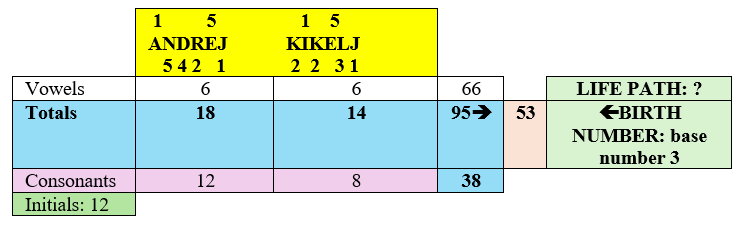
While full birth information is not available, Andrej Kikelj identifies as an Aquarius and base number 3 and shared that he became involved in bhakti yoga and meditation in his youth. His interest in spiritual knowledge has persisted throughout his life. He is also a professional translator interested in computers and programming.[9] Let’s examine Andrej Kikelj’s numerology chart, calculated using the classic method of converting letters into numbers:

His chart reveals a strong presence of the number chain 3 & 6 & 9, which often signifies an interest in spiritual life (and can also indicate a potential interest in business). Additionally, we see the chain 2 & 3 & 5, which suggests a desire to let go of old behavioral patterns. This could explain his interest in bhakti yoga (Hare Krishna) and meditation. A prominent number 5 is sometimes associated with computers and programming, and it also corresponds to Mercury, communication, and numbers.

The combination of 5 with the chain 3 & 6 & 9 partially accounts for his interest in numerology. Kikelj used to be involved in music as well, which is probably related to the sequence of numbers 3, 6, and 9. Regarding his career in translation, it’s likely connected to the association of the number 5 with 2 and 6. A fuller understanding of his interests and professions would likely require his full birth data and astrological chart.

Added on November 4, 2024: The relationship between the numbers 14 and 95 on one side and the birth base number 3 on the other could potentially lead to traffic accidents or other issues. However, in Kikelj’s numerology chart, these tendencies are balanced by the potential for spiritual growth and the release of old patterns. If he embraces these potentials, it can help to calm the energies reflected in his chart.


Some sources:

[1] Kikelj, Andrej: https://www.astronumero.org/numerology-charts/#chaldean-table-improved

[2] Kikelj, Andrej: https://www.astronumero.org/numerology-guide/name-numbers/

[3] Kikelj, Andrej: https://www.astronumero.org/what-are-the-master-numbers/

[4] Kikelj, Andrej: https://www.astronumero.org/numerology-guide/forecast-numbers/

[5] Kikelj, Andrej: https://www.astronumero.org/numerologija-tabela/

[6] Kikelj, Andrej: https://www.astronumero.org/numeroloska-tablica/

[7] Schmidt Brian B. (2015): Memorializing Conflict: Toward an Iron Age “Shadow” History of Israel’s Earliest Literature, page 87. From: Schmidt Brian B., editor (2015): Contextualizing Israel’s Sacred Writings: Ancient Literacy, Orality, and Literary production.SBL Press, USA.

[8] Lovrat, Boštjan: https://bostjanlovrat.com/2024/09/11/the-use-of-the-latin-alphabet-in-chaldean-numerology/

[9] Kikelj, Andrej: https://www.astronumero.org/about-us/

Chaldean Numerologist: Pandit Sethuraman

Pandit Sethuraman (1925-1997) was an Indian numerologist, astrologer, palmist, and occultist who adopted Cheiro’s alpha-numeric coding of the Latin alphabet and enhanced his system with his own approach. In his youth, he entered military service, during which he began to intensely explore the workings of Chaldean numerology. He claimed that the English alphabet was the correct system for addressing Indian names in modern times. This could be true at least until recently, as post-colonial India was still significantly influenced by the English script. Throughout his life, Pandit Sethuraman also studied astrology, palmistry, yoga, mesmerism, and the energetic system of humans.

He was born on the 31st of the month, and his Life Path number is 26. The base numbers of these two figures are 4 (3+1=4) and 8 (2+6=8), which are considered karmic numbers. They often bring complications and blows of fate. However, Sethuraman has a strong name numbers 5, particularly in his Total Name Numerology (TNN), which totals 59 (5+9=14; 1+4=5). This active five calms both the 4 and 8 from his birth date numbers and offers some form of escape from karmic limitations.

The main feature of this numerology chart is the relationship between the numbers 5 and 9, or the relationship between Mercury and Mars, which provides good intellect and a certain sense of military. Despite this, Pandit Sethuraman’s numerology chart contains many numbers that are softer or more feminine in nature. Therefore, he was not a typical soldier; he embodied both the energies of clear goals and a sense of softness. Pandit Sethuraman also had “money numbers,” notably involving connections between the numbers 3, 5, and 8. In addition, he had some other indicators pointing in this direction.

The number 9 in his chart was positioned in such a way that it played a very important role in his business and spiritual development. It was associated with 3 and 6, and also with 5. In Sethuraman’s chart it brings an interest in bio-energy, astrology, yoga, and mesmerism. With such numbers, Pandit Sethuraman could have also engaged with Feng Shui or Vastu Shastra. The relationship between the numbers 5 and 9 in this configuration particularly highlights numerology and palmistry as vocational options.

In 1954, he wrote a book titled “Science of Fortune,” in which he revealed some of his insights about numerology. While he adopted Cheiro’s numerological model, he also incorporated Indian traditions, his insights, and messages that he claimed to have received from the Hindu goddess Gayatri.

It can be noted that Pandit Sethuraman rejected the complex rules that Cheiro employed to determine the key compound number in someone’s numerology chart. Instead, Pandit Sethuraman simply added the unreduced numbers of the first and last names. When considering the relationships between numbers, a significant influence of the theory of interchangeable numbers is evident. Personally, I use slightly different principles for matching numbers. I can agree with him that, in analyzing partnerships, certain deviations from the general rules of number matching are necessary, although I differ with him on some specific solutions.

His book also contains interesting warnings regarding the use of gemstones to balance someone’s fate and regarding how changing the names and surnames of others can attract unresolved karma from that people. Additionally, Pandit Sethuraman developed his own method for checking the compatibility of a new name and surname with a client’s life energy when intending to change their name.

Using numerology, Pandit Sethuraman predicted the outcomes of military conflicts and the likelihood of someone’s death. He also used numerology for a time when betting on horse races and for financial investments. All of this could quickly lead someone to the edge of ethics, which Pandit Sethuraman was fortunately aware of.

Interestingly, he did not differentiate between strong and weak 8s or between strong and weak 4s; he believed that these two numbers always had the same favorable or unfavorable numbers available. Some rules regarding matching and mismatching between numbers are surprising— for example, he defined the relationship between the numbers 3 and 6 as generally unfavorable.

He listed the meanings of the numbers from 1 to 108, claiming that this was the first book on Chaldean numerology that described numbers beyond 52. However, this is not true. Classical Chaldean/Hebrew numerology has even defined some numbers above 108, and in modern numerology, well before Pandit Sethuraman, accepted descriptions of the numbers 55, 65, 69, and 71 can be found. During World War II, one of the Chaldean numerologists adopted the interpretations of numbers presented by the Pythagorean numerologist Mary Adams. Her definitions cover numbers up to and including 65, in addition to the numbers 69, 71, and 73.

Some of Sethuraman’s descriptions of numbers are also questionable— for instance, he defined the number 12 as lucky. Conversely, he classified the numbers 39 and 48 as unlucky forms of the number 12, where he diverged from Cheiro’s descriptions, too. Furthermore, the classical meaning of the number 77 is generally unfavorable, while Pandit Sethuraman defined it as a favorable number.

Regardless, his book offers a wealth of interesting information and provides a researcher of Chaldean numerology with the opportunity for comparative analysis, thus allowing for the search for refined knowledge and new insights.

Chaldean Numerologist: Cheiro

William John Warner, better known as Cheiro (November 1, 1866 – October 8, 1936), was also referred to by nicknames such as Count Louis Hamon and others. However, he is primarily remembered as Cheiro. He was a British astrologer, numerologist, and palm reader.

His birth name contains numbers—13 and 15 (the sum of 96; 9+6=15). The base numbers 4 and 6 govern his numerological chart. This chart reveals a strong desire for recognition and performance (particularly highlighted by 96, with 24 in Life Path and 15 as the base number in his surname), along with a drive for success in business. Cheiro’s official name also reflected a robust longing for friendship and love, from which he drew significant spiritual strength. Additionally, he enjoyed fairly favorable influences of numbers on the chakras, which may have contributed to his reputation as a successful medium for a time.

The combination of numbers 13 and 15 sparked his interest in the occult (both 13 and 15), reforms, pioneering approaches (13), and even magic (15, 41). The number 41, in particular, fosters a fascination with numerology, which is further emphasized by his nickname “Cheiro” (Mercury and 23). Due to the numbers 13 and 15, an individuals may either become a victim of manipulation and circumstances or turn into a manipulator themselves… The overall numerological chart is complex and can bring strokes of fate that often arrive unexpectedly.

Cheiro was convicted and imprisoned in Paris around 1910 for business fraud, and it is said that this scandal closed doors among the English elite, prompting his move to the morally less stringent United States. An analysis of his works reveals a tendency for manipulation and misinformation—claiming, for instance, that he had been offering numerological guidance based on his system since the late 19th century, or that number 9 was so sacred it couldn’t correspond to any letter. Moreover, he downplayed the contributions of his European sources, like Isidore Kozminsky and Sepharial, while asserting he learned Chaldean numerology from an Indian brahmin.

Cheiro. Source: Wikimedia Commons, File:Cheiroy.jpg .

It’s essential to recognize that relationships between 15 and 4, or between 15 and 8, should not be judged too harshly. Not everyone with such combinations inherently becomes a manipulator, criminal, or prisoner. An individual’s morals and self-awareness dictate whether they use their strengths for good or ill, and when, if ever, they will yield to temptation. Furthermore, numerological charts can point to which areas of life help to balance the individual. For Cheiro, these areas primarily involved seeking courage, forming a connection with God, and nurturing love and kindness.

Even in his nicknames—like “Count Louis Hamon” and “Count Leigh de Hamong“—the theme of number 13 is prominently featured. It seems Cheiro intentionally emphasized this number, perhaps because it brings uniqueness and combines with the interchangeable number 1 to form a whole.

His nickname “Cheiro” underscores intellectual depth, as it contains the numbers for Mercury and the Sun. The number 23 derived from the nickname is considered auspicious.

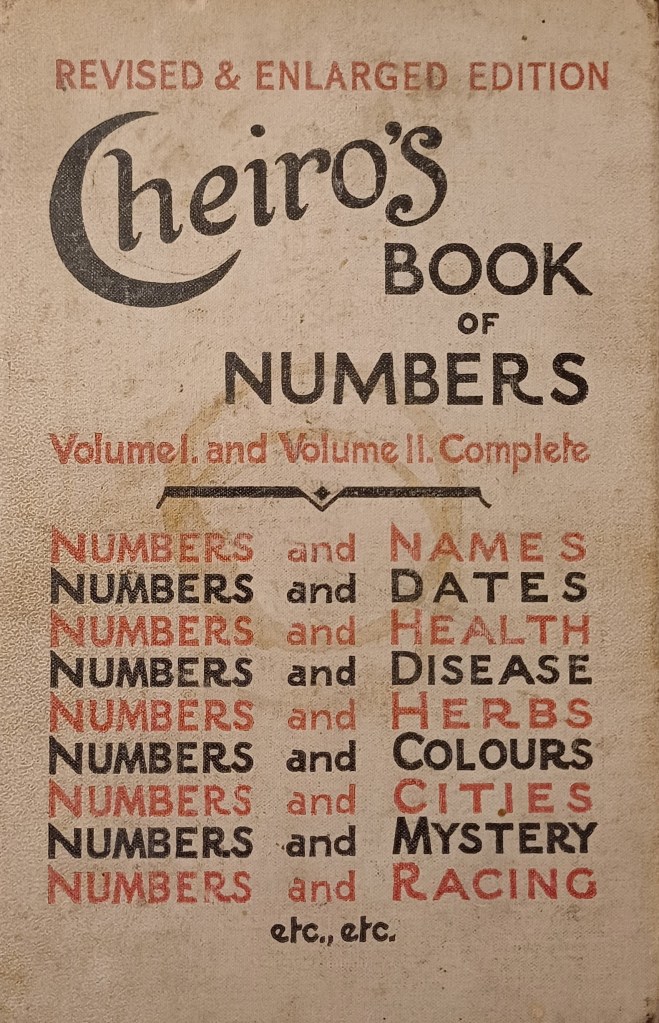
In 1926, Cheiro published a book titled Cheiro’s Book of Numbers. In it, he defined the meanings of numbers in Chaldean tarot from 1 to 52, based on older sources. He also defined the rules of matching and mismatching between numbers. For each of the numbers 4 and 8, he differentiated between karmically strong and weak numbers, determining various numbers that align with them. He described favorable and less favorable months, recommended specific herbs and foods, indicated favorable colors and gemstones, and identified ailments commonly associated with particular numbers.

It’s very likely that Cheiro drew the foundational idea of alpha-numeric coding from Isidore Kozminsky, who assigned the letter H a value of either 5 or 8, and the letter X a value of 5. Based on his research, Cheiro developed an alpha-numeric coding scheme in which letters H and X always hold a value of 5. He also altered the value of the letter C, assigning it a value of 3 instead of 2.

For Cheiro, the key to analysis lies in the birth date, or Birth Number. He believed that the Total Name Number (TNN) should align with the Birth Number; otherwise, an individual might encounter challenges throughout life. He further explored the numerological influences of each day of the year based on the specific day of the month. Around 1936, he published another book titled You and Your Star, in which he detailed favorable numbers for every day.

Cheiro’s ideas of such favorable numbers influenced numerologists like Gerun Moore and Lloyd Strayhorn, who developed their own systems based on these concepts.

In Cheiro’s Book of Numbers, he established special guidelines to identify the most important two-digit number in a numerological chart. This number frequently corresponds to TNN, but sometimes the most significant number is derived from adding the birth date and TNN together (Birth Number + TNN). Cheiro did not assign a name to this number, but I personally refer to it as the Goal Number (which differs from Goal Numbers in Pythagorean numerology). Anmarie Uber called it the “Hidden Number,” while some perceive it as an indicator of career success.

Cheiro’s book, Cheiro’s Book of Numbers, does not provide reliable techniques for predicting the future. It also contains inaccuracies, such as the assertion that the Chaldeans were unaware of letters with a value of 9. Nonetheless, despite not being a comprehensive manual, this work played a pivotal role in the evolution of numerology. In many ways, Cheiro is considered the father of modern Chaldean numerology.

Chaldean Numerology: Richard Cavendish

Richard Cavendish (August 12, 1930 – October 21, 2016) was a British historian who studied mythology, religion, witchcraft, and the occult. He did not consider himself an occultist but primarily explored these fields. However, at least in the case of numerology, one might question whether he truly did not practice it himself. Cavendish didn’t just describe Chaldean or Hebrew numerology but developed his own alphanumeric coding of Latin Alphabet based on the Greek and Hebrew alphabets.

A centuries-old method of alphanumeric coding, which Richard Cavendish also arrived at in his own way. This system differs from Cheiro’s model only in the numeration of the letter X.

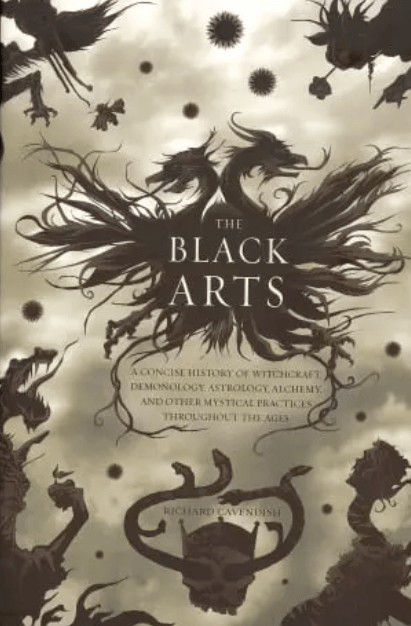
This kind of coding had been used centuries before, but it’s clear that despite his historical knowledge, Cavendish did not have access to all historically relevant information. Therefore, he was unaware of the existence of such alphanumeric coding. His numerology is thus a blend of tarot card descriptions, the mentioned alphanumeric coding, and the Pythagorean approach to vowels and consonants. He published his knowledge of numerology in 1967 in the book The Black Arts: A Concise History of Witchcraft, Demonology, Astrology, and Other Mystical Practices Throughout the Ages.

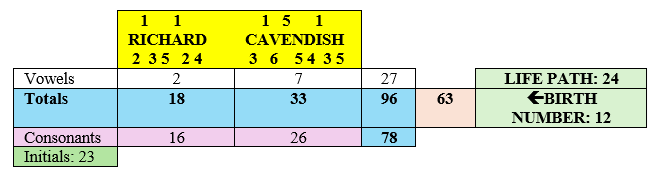
In his numerological chart, we find his birthdate on the 12th, whose base number is 3. The number 3 represents the significance of tradition, values, law, and history. The number 6 (33, 96, 78, 24) is strongly expressed, representing home, while the number 18 in his name and the number 63 as the Goal number sociologically point to the concept of war. With all these numbers, it’s no wonder he became a historian. All of this is further strengthened by the connection between the numbers 3, 6, and 9.

His Total Name Number (TNN) is 96, and his consonant total is 78. These two numbers add up to 15. The number 96 is aligned and can bring good fortune in performances or lectures. The number 78 is connected with the number 8 (26; 2+6=8). When the number 15 meets the number 8, there’s a likelihood of manipulation (such a person can either be a victim of manipulation or manipulate others), and often such a person has a peculiar relationship with the occult. As we can see, the number 15 is only partially exposed to this—the problematic part is the placement of the number 78. In all cases, 15 can represent magic, and in combination with the number 8, it can even signify witchcraft or black magic. It was precisely the number 15 that led Cavendish to his desire to research mythology, magic, and the occult in general.

Chaldean Numerologist: Sepharial

Walter Gorn Old, also known as Sepharial (born March 20, 1864, died December 23, 1929), was an occultist, astrologer, numerologist, and theosophist who also studied medicine, psychology, and oriental languages. He was a friend of Helena Blavatsky and one of the founding members of the Theosophical Society. Around 1894, he parted ways with Blavatsky.

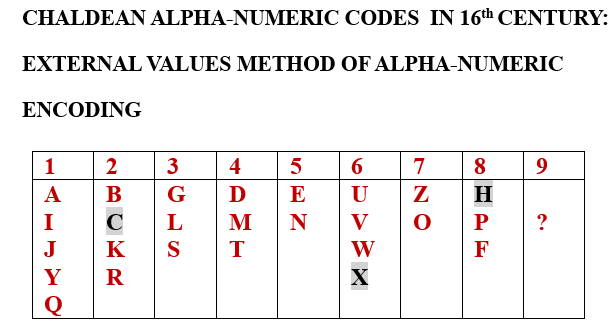
He was born Walter Richard Old on March 20 and later changed his name to Walter Gorn Old (also Gornold or Gorn-Old). This change is believed to have occurred in 1895, the same year he published Kabalistic Astrology, or Your Fortune in Your Name, a book on Kabbalistic astrology (type of Chaldean numerology). Initially, he worked as a Kabbalistic astrologer, utilizing the “external values method of alpha-numeric coding.”

In this form of astrology—though it is more accurately described as a peculiar type of astro-numerology—numbers are closely connected with the tarot. The numbers from I to XXII (the Major Arcana) hold special power. In addition, there are the so-called Royal Stars, which represent the four kings of the suits of wands, cups, swords, and pentacles: the Royal Star of Leo (XXIII), the Royal Star of Taurus (XXXVII), the Royal Star of Aquarius (LI), and the Royal Star of Scorpio (LXV). Likewise, the ace of wands (also known as the ace of sceptres; XXVII), ace of swords (LV), and ace of pentacles (LXIX), along with numbers XLIII and VXXI, are said to hold special potency. Sepharial added meanings for numbers XXIV, XXV, XXVI, and XXVIII to these already established values, greatly influencing Kozminsky and Cheiro. This leads us to the interpretations of numbers in Sepharial’s numerological tarot.

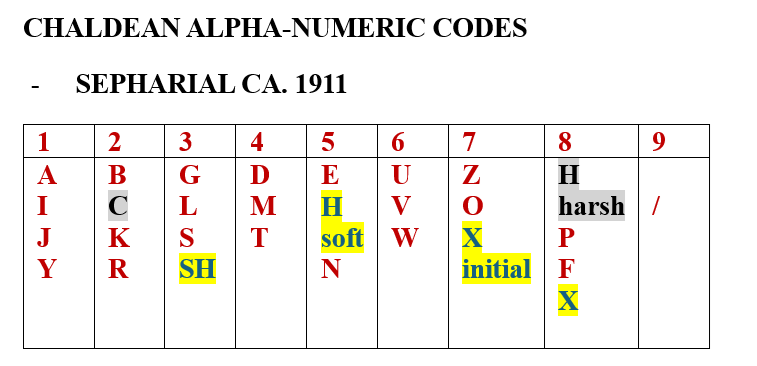
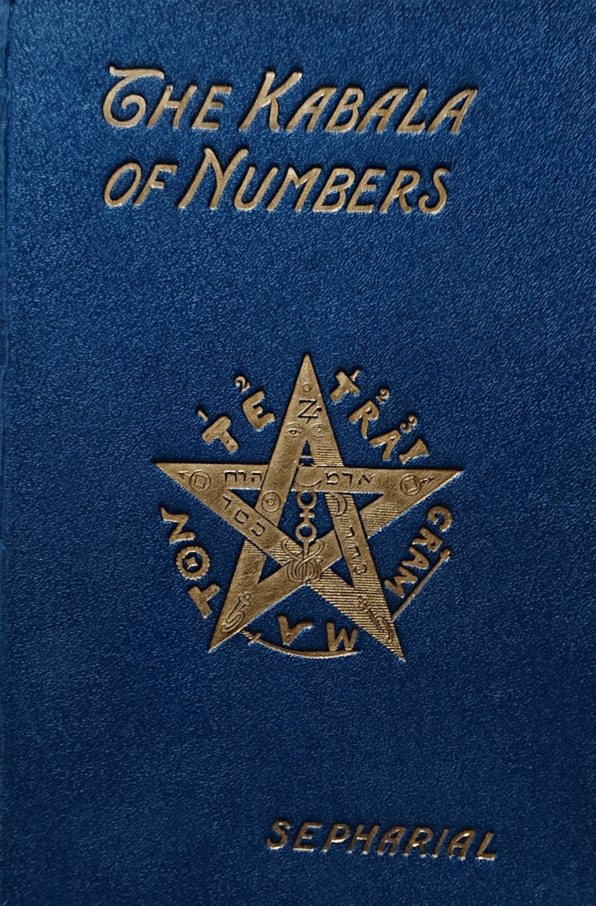
Around 1911, influenced by Isidore Kozminsky and Habeeb Ahmad, Sepharial developed his own alpha-numeric coding system in Chaldean numerology. He also explored phonetic numerology. His most well-known work on numerology is The Kabala of Numbers from 1911.

His original name, Walter Richard Old, results in a Total Name Number (TNN) of 35 and 17, with a base number of 8. This is the number of Saturn and does not align with his birth date of the 20th, which has a base number of 2. For a person with this combination of numbers like Sepharial, there is a possibility that the relationship between the numbers 8 and 2 can be somewhat alleviated, redirecting the energies into creative communication or even manifestation. The challenge with this card lies in the presence of too many unfavorable numbers, which diminish the quality of life and thus limit the possibility of fully resolving the relationship between 2 and 8.

The key number in Walter Richard Old’s numerology chart is the base number 2. The number 2 represents psychology and can also indicate an interest in the occult sciences. Additionally, the number 2 is often associated with nurses and hospitals, and Sepharial did study medicine. His talent for languages is suggested by his inclination toward creative communication, especially in the numbers 2 and 4. This potential is partially reinforced by the numbers 1 and 7.

His new name, Walter Gorn Old, has a TNN of 16 or 34 with base number 7. The dominant influence of these TNNs, along with his interest in psychology and the occult, brings certain complications and blows of fate. At the same time, the connection between the birth date of the 20th and the TNN creates a link between the numbers 2 and 7. These are interchangeable numbers, strengthening each other and giving the person a unique power. Numbers with base numbers 7 and 5 are arranged in a special intellectual structure, which indicates a gift for intellectual work and research. Children are represented by the numbers 23 and 24 in the date numbers, and generally by base numbers 5, 6, and 8. Sepharial had many of these numbers and also had many children. However, it is not guaranteed that someone with child-related numbers in their chart will actually have children. If they do, such numbers help explain family relationships.

With his new name, Sepharial retained some potential for manifestation, but his numerology chart carried predominantly negative energies. Throughout his life, Sepharial faced occasional financial difficulties, often having to move with his family and take on additional jobs beyond astrological counseling.

His pen name was Sepharial. This name carries the primary vibration of the number 29. In older European Kabbalistic traditions, this number reduces to 11, which represents the Arcana XI, or “Force.” It is considered an ambivalent number of fighters. However, in very old traditions and by most modern Chaldean numerologists, this number is regarded as unlucky, as it brings conflicts and emotional suffering.

Sepharial’s life challenges, the change of his name, and the use of an unfortunate pen name can serve as an example of what can happen when a name change is not suitable. Changing a name should enhance one’s quality of life, but this was not the case for Sepharial.


Some sources:

  • Sepharial (1895): Kabalistic Astrology, or Your Fortune in Your Name
  • Sepharial (1911): Kabala of Numbers
  • Sepharial (1911): Silver Key
  • Theosophy Wiki: Walter Gornold

Chaldean Numerologists: On Modern Classics

Every student of Chaldean numerology should be familiar with key modern Chaldean numerologists such as Sepharial, Isidore Kozminsky, Cheiro, Pandit Sethuraman, Richard Cavendish, Gerun Moore, Lloyd Strayhorn, and Linda Goodman. All of these numerologists were also astrologers.

Sepharial (Walter Gorn Old) played a crucial role in transitioning from the older Chaldean school of “Kabbalistic astrologers” to modern numerology. He also introduced classical descriptions of numbers from Kabbalistic astrology, where the highest number described in this approach is 71. He later wrote a very popular book, “Kabala of Numbers” (1911).

In his development, he initially used an external method of alphanumeric coding of the Latin alphabet (C = 2, H = 8, X = 6). Later, he tested several different alphanumeric approaches but ultimately decided on phonetic numerology.

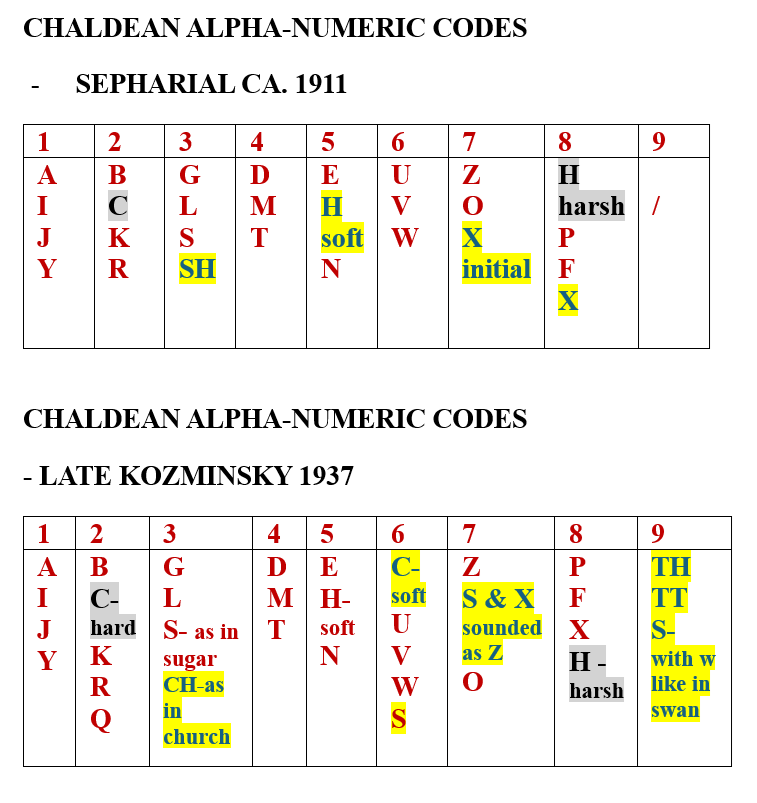
Isidore Kozminsky, like Sepharial, experimented with various methods of alphanumeric coding. At the latest, in an updated edition of “Numbers: Their Meaning and Magic” in 1911, he was the first modern numerologist to predict that we should, in some cases, treat the letter H as 5.  He also assigned the number 5 to the letter X. Like Sepharial, he described all the numbers he believed to have a “distinct potency of its own.” All other numbers he reduced to a number with such potency. His approach of dealing with name numbers is now considered outdated.

Cheiro (William John Warner) is regarded as the father of modern Chaldean numerology. He wrote several books covering numerology, with the most famous being “Cheiro’s Book of Numbers” (1926), where he advocated for the value of 3 for the letter C, 5 for the letter H, and 5 for the letter X.

Cheiro. Source: Wikimedia Commons, File:Cheiroy.jpg .

He emphasized the importance of the Birth number (the day of the month one is born) and its connection to the Name number (that is, Total Name Number, aka TNN). He was one of the first to focus on the compatibility of numbers. He adopted Sepharial’s number descriptions, sometimes expanding them, so they corresponded to some very old descriptions. However, he described numbers only up to 52. He also wrote a book called “You and Your Star”, where he described the most suitable numbers for each day of the year based on astrological techniques.

Pandit Sethuraman, in his book “Science of Fortune” (1954), adopted Cheiro’s alphanumeric coding but summed the unreduced numbers of the first and last names. He also deviated from Cheiro’s views on number compatibility. Sethuraman expanded Cheiro’s descriptions based on his own insights and described numbers up to 108. Unlike Cheiro, he considered numbers 39 and 48 to be unfavorable.

Richard Cavendish, in his 1967 book “The Black Arts” (which has quite an inappropriate book title, especially in connection to astrology and numerology), introduced the classical internal method of alphanumeric coding (with C = 3, H = 8, X = 6), although he seems to have arrived at this through his own research. He emphasizes the importance of considering the numbers of vowels and consonants, a concept long neglected in Chaldean numerology.

Gerun Moore wrote a book in 1973 titled “Number Will Tell”. He adopted Cheiro’s alphanumeric coding system but made several changes and additions to the descriptions of numbers and the rules of compatibility. Notably, he described numbers 39 and 48 as the unlucky number 12.

He also rejected Cheiro’s model of favorable numbers for each day of the year. Instead, he created his own system, where each day of the year is generally assigned two suitable numbers (though in some cases, only one number is given). He labeled these numbers as “keys.” According to him, name numbers matching a person’s key numbers bring luck and harmony.

Lloyd Strayhorn wrote his book “Numbers and You: A Numerology Guide for Everyday Living” no later than 1980. He adopted Cheiro’s alphanumeric coding system. Although he prefers Chaldean numerology, he also considers Pythagorean numerology. Based on his research, Strayhorn introduced his own system of number compatibility, which differs somewhat from Cheiro’s model.

He also rejected Cheiro’s model of favorable numbers for each day of the year, offering instead his own astrological model with lucky numbers. He later published “Lloyd’s Numbers and You Relationship Guide: A Cosmic Blueprint to Happiness & Joy”, in which he distances himself significantly from older Chaldean approaches.

Linda Goodman published a book “Linda Goodman’s Star Signs” in 1987, which also introduces Chaldean numerology. She adopted Cheiro’s alphanumeric coding system and significantly enhanced the descriptions of numbers. However, her method of determining the TNN deviates from those of her predecessors.

Linda Goodman concludes the list of modern classics in Chaldean numerology. I believe that this list provides an appropriate foundation for studying contemporary Chaldean numerology.

There are also a few Chaldean numerologists who have uncritically incorporated Pythagorean methods of interpreting numbers and relationships. While some ideas from the Pythagorean system can be adopted, not all Pythagorean techniques are suitable for Chaldean numerology.

The use of the Latin alphabet in Chaldean numerology

In contrast to Pythagorean numerology, the first examples of the use of the Latin alphabet in Chaldean numerology are only found in the modern era. Initially, two methods of alpha-numeric encoding were used, which are shown below with values by greater cannon (units, tens and hundreds) and lesser cannon (ordinal values) and with reduced values from 1 to 9. I call the first of these methods the internal values method of alpha-numeric encoding and the second the external values method of alpha-numeric encoding.

There are differences between the two methods for two letters. The letter “C” has a value of 3 in the internal method and 2 in the external method, while the letter “H” has a value of 5 in the internal method and 8 in the external method. The internal values approach was a closely guarded secret, so most numerologists only knew the values C = 2, H = 8. In modern Chaldean numerology we also see a reformation of the internal method as early as the 19th century, in which the letter “X” is assigned a value of 5 instead of 6.

The classical internal method with C = 3, H = 5 and X = 6 was introduced to the modern world in 1967 by Richard Cavendish in his book “The Black Arts“, but he seems to have been unaware of the somewhat older Chaldean alphabetic tradition. He seems to have discovered the value of the inner method based on his own findings.  

Both approaches assign vowels similarly to those in the Greek alphabet (which was influenced by Semitic alphabets and Semitic numerologies). The letter “A” is associated with the letter alpha and with a value of 1, the letter “E” is associated with the first letter of the “E”-voice, i.e. with the letter eta and with a value of 5. The letter “I” is associated with the letter iota and with the values 10 and 1, respectively. The letter “O” is associated with the first letter for the voice “O”, namely omicron with the values 70, 16 and 7. The letter “U” has a deviation and is associated with the Semitic letter waw with the value 6, and indirectly with the Greek letter digamma.

Aramaic/Semitic Original

Additionally, under the influence of the Jewish Kabbalah, some people have started to assign different values to the vowels “E” and “O” and to the corresponding letters (10 and 1 for “E” and 6 for “O”). This approach is popular among some Freemasons.

The use of phonetic numerology is also widespread among Freemasons and in certain other circles, with various approaches known. Among these, the school of Habeeb Ahmad stands out. Habeeb Ahmad published a book on the subject in 1903 entitled “The Mysteries of Sound and Number“. Phonetic numerology ignores the fact that the Hebrew alphabet was no longer entirely phonetic. They also ignore the findings of European magic that written words, and thereby letters, have the power of manifestation.

Without knowledge of the existence of the internal method, Isidore Kozminsky began to reform the outer method at the beginning of the 20th century, assigning the value 5 to the letter “X” and to the letter “H” sometimes a value of 5 and sometimes a value of 8.. These reforms are included, at the latest, in the updated edition of the book “Numbers: Their Meaning and Magic” from 1911. Kozminsky later developed his own alphanumeric Chaldean coding specifically for analyzing people’s names and surnames. Sepharial has also been exploring his own coding method.

Kozminsky’s early reforms seem to have been taken up by Cheiro, who then assigned the letter “C” a value of 3 and the letters “H” and “X” a value of 5 in his version of alpha-numeric coding. Thus, Cheiro’s approach arrived at a reformed internal method by another route. The approach was published in 1926 in the book “Cheiro’s Book of Numbers” and soon became a leading method in the field. After the Second World War it was supported and used by many numerologists such as Pandit Sethuraman, Gerun Moore, Linda Goodman, Anmarie Uber and August Darius Danielssonn. This is also the coding I use.

Few Chaldean numerologists still follow the external method. For example, Walter B. Gibson, but in more recent times this method has been supported, for example, by the Indian numerologist Harish Johari.

The Letters U, W, J, and Y and Chaldean Numerology

The ancient Latin alphabet did not include the letters U, W, and J and question could be raised of how to associate these letters with Chaldean numerology. It is clear that the letter U developed from the letter V, which in turn originated from the Semitic letter waw, which has the value of 6. It is also evident that U is always used as a vowel.

The letter W also evolved from the letter V. Its original notation was V V, or UU, with a numerical value of 6+6=12. Over time, a new representation of this consonant (W) became established, which, due to its connection with the letter waw and the sound “w,” has the value of 6.

The letter J developed from the consonant yod. Although this letter is pronounced differently by different peoples, it therefore carries the vibration 10, or the reduced value of 1.

The letter Y, which also originates from the Semitic letter yod with values of 10 and 1, was present in the original Latin alphabet, unlike the letters mentioned above. The question arises as to when it should be considered a vowel and when a consonant.

Some Chaldean numerologists are now convinced that the letter Y should always be considered as a vowel. In the name “New York,” for example, Y would be considered when calculating vowels, even though it represents a consonant in this case.

Since the letter Y originates from the letter Yod, its original vibration is actually that of a consonant. While Y can be used to represent both a vowel and a consonant, its fundamental nature, due to the original vibration of the letter, remains primarily that of a consonant.

The distribution of these effects is not entirely clear, but the concrete results suggest that Y should fundamentally always be analyzed as a consonant, even when Y is associated with the vowel sound “ee.” In the case of Mike Lynch, for example, analyzing the letter Y as a vowel would lead to the loss of all indicators pointing to work with software, resulting in an incorrect analysis.