
Richard Cavendish (August 12, 1930 – October 21, 2016) was a British historian who studied mythology, religion, witchcraft, and the occult. He did not consider himself an occultist but primarily explored these fields. However, at least in the case of numerology, one might question whether he truly did not practice it himself. Cavendish didn’t just describe Chaldean or Hebrew numerology but developed his own alphanumeric coding of Latin Alphabet based on the Greek and Hebrew alphabets.

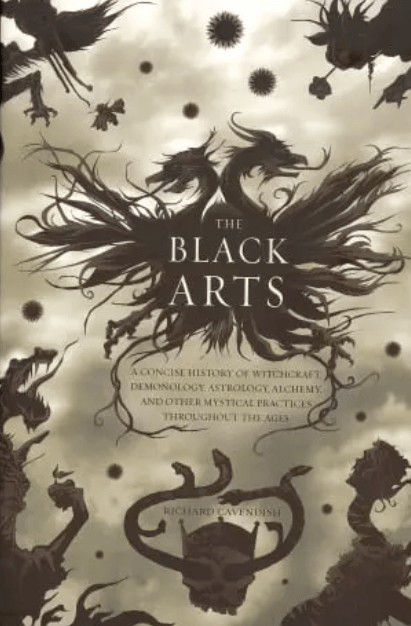
This kind of coding had been used centuries before, but it’s clear that despite his historical knowledge, Cavendish did not have access to all historically relevant information. Therefore, he was unaware of the existence of such alphanumeric coding. His numerology is thus a blend of tarot card descriptions, the mentioned alphanumeric coding, and the Pythagorean approach to vowels and consonants. He published his knowledge of numerology in 1967 in the book The Black Arts: A Concise History of Witchcraft, Demonology, Astrology, and Other Mystical Practices Throughout the Ages.
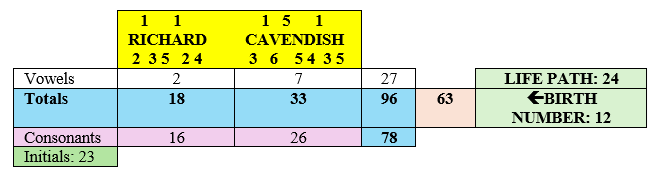
In his numerological chart, we find his birthdate on the 12th, whose base number is 3. The number 3 represents the significance of tradition, values, law, and history. The number 6 (33, 96, 78, 24) is strongly expressed, representing home, while the number 18 in his name and the number 63 as the Goal number sociologically point to the concept of war. With all these numbers, it’s no wonder he became a historian. All of this is further strengthened by the connection between the numbers 3, 6, and 9.
His Total Name Number (TNN) is 96, and his consonant total is 78. These two numbers add up to 15. The number 96 is aligned and can bring good fortune in performances or lectures. The number 78 is connected with the number 8 (26; 2+6=8). When the number 15 meets the number 8, there’s a likelihood of manipulation (such a person can either be a victim of manipulation or manipulate others), and often such a person has a peculiar relationship with the occult. As we can see, the number 15 is only partially exposed to this—the problematic part is the placement of the number 78. In all cases, 15 can represent magic, and in combination with the number 8, it can even signify witchcraft or black magic. It was precisely the number 15 that led Cavendish to his desire to research mythology, magic, and the occult in general.

 The Mystery of Numbers, Luck, Worlds and Planets