In contrast to Pythagorean numerology, the first examples of the use of the Latin alphabet in Chaldean numerology are only found in the modern era. Initially, two methods of alpha-numeric encoding were used, which are shown below with values by greater cannon (units, tens and hundreds) and lesser cannon (ordinal values) and with reduced values from 1 to 9. I call the first of these methods the internal values method of alpha-numeric encoding and the second the external values method of alpha-numeric encoding.


There are differences between the two methods for two letters. The letter “C” has a value of 3 in the internal method and 2 in the external method, while the letter “H” has a value of 5 in the internal method and 8 in the external method. The internal values approach was a closely guarded secret, so most numerologists only knew the values C = 2, H = 8. In modern Chaldean numerology we also see a reformation of the internal method as early as the 19th century, in which the letter “X” is assigned a value of 5 instead of 6.
The classical internal method with C = 3, H = 5 and X = 6 was introduced to the modern world in 1967 by Richard Cavendish in his book “The Black Arts“, but he seems to have been unaware of the somewhat older Chaldean alphabetic tradition. He seems to have discovered the value of the inner method based on his own findings.
Both approaches assign vowels similarly to those in the Greek alphabet (which was influenced by Semitic alphabets and Semitic numerologies). The letter “A” is associated with the letter alpha and with a value of 1, the letter “E” is associated with the first letter of the “E”-voice, i.e. with the letter eta and with a value of 5. The letter “I” is associated with the letter iota and with the values 10 and 1, respectively. The letter “O” is associated with the first letter for the voice “O”, namely omicron with the values 70, 16 and 7. The letter “U” has a deviation and is associated with the Semitic letter waw with the value 6, and indirectly with the Greek letter digamma.

Additionally, under the influence of the Jewish Kabbalah, some people have started to assign different values to the vowels “E” and “O” and to the corresponding letters (10 and 1 for “E” and 6 for “O”). This approach is popular among some Freemasons.
The use of phonetic numerology is also widespread among Freemasons and in certain other circles, with various approaches known. Among these, the school of Habeeb Ahmad stands out. Habeeb Ahmad published a book on the subject in 1903 entitled “The Mysteries of Sound and Number“. Phonetic numerology ignores the fact that the Hebrew alphabet was no longer entirely phonetic. They also ignore the findings of European magic that written words, and thereby letters, have the power of manifestation.
Without knowledge of the existence of the internal method, Isidore Kozminsky began to reform the outer method at the beginning of the 20th century, assigning the value 5 to the letter “X” and to the letter “H” sometimes a value of 5 and sometimes a value of 8.. These reforms are included, at the latest, in the updated edition of the book “Numbers: Their Meaning and Magic” from 1911. Kozminsky later developed his own alphanumeric Chaldean coding specifically for analyzing people’s names and surnames. Sepharial has also been exploring his own coding method.
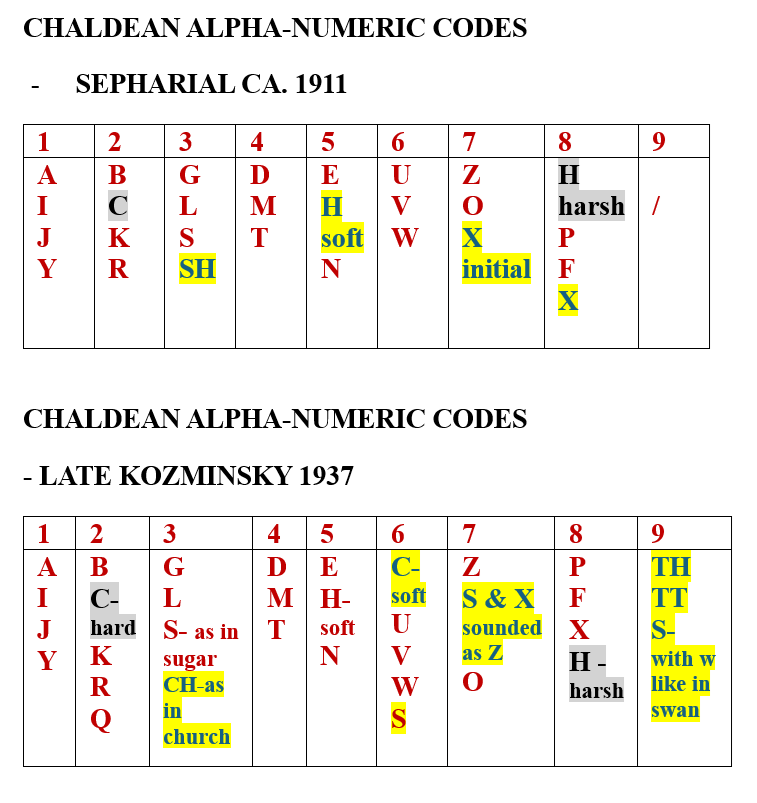
Kozminsky’s early reforms seem to have been taken up by Cheiro, who then assigned the letter “C” a value of 3 and the letters “H” and “X” a value of 5 in his version of alpha-numeric coding. Thus, Cheiro’s approach arrived at a reformed internal method by another route. The approach was published in 1926 in the book “Cheiro’s Book of Numbers” and soon became a leading method in the field. After the Second World War it was supported and used by many numerologists such as Pandit Sethuraman, Gerun Moore, Linda Goodman, Anmarie Uber and August Darius Danielssonn. This is also the coding I use.

Few Chaldean numerologists still follow the external method. For example, Walter B. Gibson, but in more recent times this method has been supported, for example, by the Indian numerologist Harish Johari.

 The Mystery of Numbers, Luck, Worlds and Planets