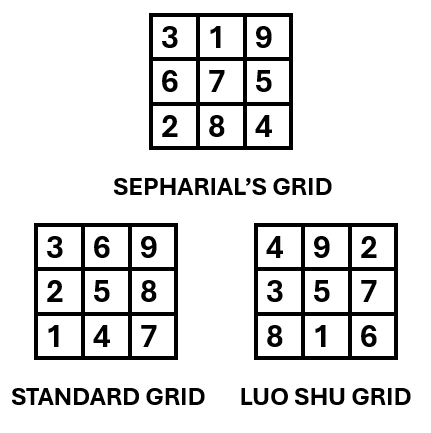
In his book The Kabala of Numbers (1909), Sepharial published a special arrangement of numbers in a 3×3 matrix:
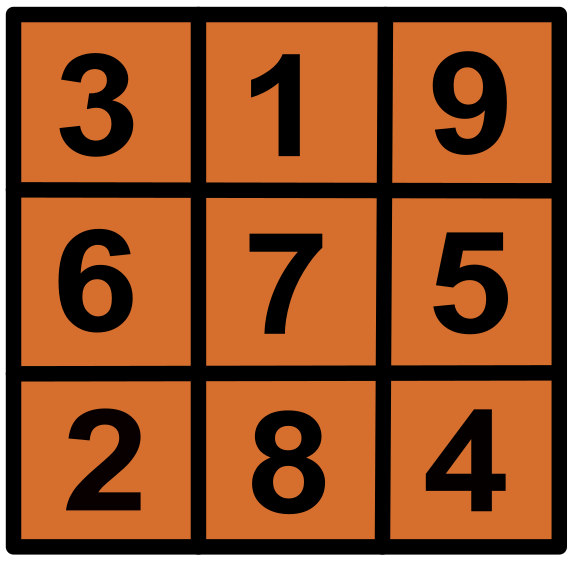
Based on my research, this is not necessarily Sepharial’s own invention, but it clearly belongs to the Chaldean tradition. However, since this grid was first published by Sepharial, I refer to it as “Sepharial’s Grid.”
This grid is derived from the Chaldean triangular groups:
1, 5, 7
3, 6, 9
2, 4, 8
These three groups originate in ancient Chaldean numerology and were published in modern times in 1908 by the Pythagorean numerologist Luo Clement in The Ancient Science of Numbers. It appears that someone may have combined this knowledge with the concept of the most masculine numbers -1 (the Sun), 3 (Jupiter), and 9 (Mars). As a result, the positions within the triangles 3–6–9 and 1–5–7 had to be adjusted, specifically by exchanging the positions of the numbers 1 and 6.
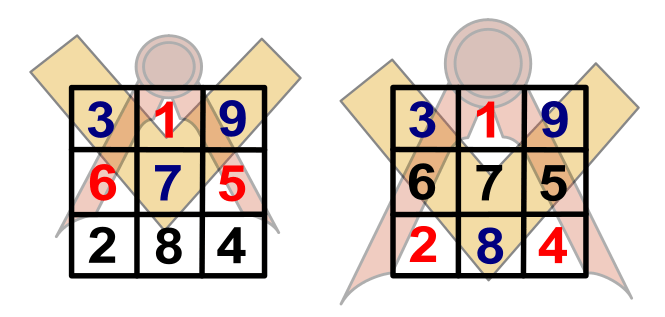
This grid may be of very ancient origin (a possibility I am currently investigating). It is also possible that Sepharial encountered it through Freemasonry, since the numerical arrangement of this grid can be interpreted through the Masonic symbol of the compass and the square. In the top row, the lowest number is placed in the center, with two higher numbers on the sides. In the second and third rows, the relationship is reversed. This produces the following pattern:
HIGHER – LOWEST – HIGHER
LOWER – HIGHEST – LOWER
LOWER – HIGHEST – LOWER
By connecting the first and second rows, we can draw the shapes of the letters V and Λ (Lambda). The letter V is formed by the numbers 3, 7, and 9, while the letter Λ is formed by 6, 1, and 5. Together, these shapes correspond to the Masonic image of the compass and the square. The same can be done with the first and third rows: here, the letter V is formed by the numbers 3, 8, and 9, and Λ by the numbers 2, 1, and 4.
Within this grid, Sepharial analyzed planetary conjunctions. He placed the digits of a person’s birth date (day, month, and the last two digits of the year) into the matrix. If two adjacent cells in the matrix were activated by the digits of the birth date, the relationship was interpreted as a conjunction between two planets. For example, the relationship between 4 and 8 was interpreted as a conjunction between the Sun and Saturn, while the relationship between 1 and 3 was interpreted as a conjunction between the Sun and Jupiter.
By the 21st century at the latest, Sepharial’s “Masonic” grid had become widespread in modern neo-Vedic numerology. Since older Indian sources from the 20th century do not mention this grid, we can conclude that its use in Indian numerology began only relatively recently, under the influence of Sepharial. It appears that Indian practitioners combined Sepharial’s 3×3 matrix with the concept of arrows, introduced into Pythagorean numerology in 1940 by Hettie Templeton. Following the example of Jyotish, the formations of these arrows were called yogas. Over time, some additional configurations were also classified as yogas, even though they do not appear in this matrix as straight arrows.
 The Mystery of Numbers, Luck, Worlds and Planets