Court Cards in Chaldean Tarot – The Intersection of Tradition and the Renaissance

In the previous article, I briefly outlined the connections between tarot cards and numbers. Some connections to Chaldean tradition may seem unusual at first glance, especially among the pips cards, since, for example, all threes of the suits are considered unlucky numbers (29, 43, 57, 71), while the number 3 itself is generally not unlucky. There can be several reasons for this. Among other things, we must consider that these cards are placed within the general numerical sequence from 1 to 78, which corresponds to Chaldean numerology. It should be emphasized that the interpretations of pips revealed by French occultists from the late 18th century differ significantly from the Chaldean tarot. Reconstructing the original tarot, or Chaldean tarot, is therefore a challenge. Regardless of the solutions proposed, it should be noted that in divination, any interpretation works, because the chosen interpretation becomes part of one’s own divinatory matrix. This is a comment from a numerologist who, by the way, does not practice divination 😊.

That Chaldean tarot existed in the 15th and 16th centuries is evident, besides the Major Arcana, primarily from the court cards, which consist of Kings, Queens, Knights, and Pages (23, 24, 25, 26, 37, 38, 39, 40, 51, 52, 53, 54, 65, 66, 67 (?) and 68). Kings 23, 37, 51, and 65 are powerful figures. Wands and Cups represent cycles of growth, while Swords and Coins represent cycles of decline. Wands and Swords are active, Cups and Coins are passive.

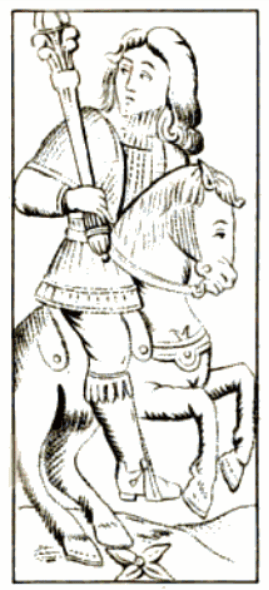
Thus, the Kings of Wands and Cups are favorable, as they govern the cycle of growth and success. The King of Wands aka Royal Star of Leo (23) is favorable for career, business, and assistance from people in authority, and his Queen is also emotional yet still successful (=24). The Knight of Wands (25) is considered a successful career knight/general, representing good analysis and strategy (this is the meaning of 25). The Page represents the lowest court rank and may also signify challenges and difficulties, for example in career or business (26). Similarly, 37 is the King of Cups aka The Royal Star of the Bull, or the King of Emotions, at the peak of his power—the number signifies favorable relationships, partnerships, etc. The Queen of Cups embodies emotions to the square, which probably is no longer a favorable solution (38). The Knight of Cups is impulsive and sometimes dangerous, as he is a successful commander who can occasionally be misled or betrayed by emotions. Thus, the number can signify both success and difficulties, giving it a more neutral meaning (39). The Page of Cups represents the risk of emotional entanglements and emotional exploitation, and from this perspective is not a favorable number (40).

The Kings of Swords aka The Royal Star of the Waterman (51) and Coins (65) are not necessarily lucky, as the numerical cycle turns downward after 51. The King of Swords, therefore, brings both success and danger in conflict (51), while the Queen of Swords adds a touch of emotion and intrigue—sword and emotions and grudges don’t go well together (52). The Knight of Swords is a sword to the square and in a more exposed position than the King (53). The Page of Swords, due to low rank, is like cannon fodder and in an even worse position (54). The King of Coins aka The Royal Star of Scorpio (65) is also a powerful figure like all kings, but he governs the final phase, which is also a phase of stronger disintegration—wealth must be hidden and protected, and wounds are not excluded. The Queen of Coins (66) is more successful at hiding wealth and in diplomacy, and is therefore generally luckier than the King of Coins. 67 is the Knight of Coins—probably represents danger in tarot as well, but this is the card that is most difficult to interpret using court card symbolism (??). The Page of Coins (68) cannot be a lucky number, as it is the lowest court card and is in an even more disintegrative phase.

Number 37 – The Royal Star of the Bull or The Royal star of Taurus

Number 37 is known as the “Royal Star of the Bull,” “Royal star of Taurus” or Aldebaran, also referred to as Facula. The Roman astrologer Ptolemy once wrote, “Of the stars in the head, that one of the Hyades which is bright and ruddy, and called Facula, has the same temperament as Mars.”

Taurus with Aldebaran. Source: Wikimedia Commons. File:Sidney Hall – Urania’s Mirror – Taurus.jpg

Based on this, Aldebaran is often interpreted as a star of honors and successes, but also as a star of disputes and violence. Number 37 is not only a royal star, but it is also associated with the leading luminary that governs this number. Number 37 has a base number of 1, which represents the Sun. Following the standard astrological interpretation, the conjunction of Mars with the Sun leads to the following interpretation: disputes or violence, danger of wounds, and violent deaths. At the same time, it must be considered that Aldebaran, being the “royal star,” also brings honors and success. Given the generally unstable nature of political positions, we may arrive at the idea that with the conjunction of Aldebaran and the Sun, success and fame are often followed by downfall and disgrace.

It’s important to note that due to its status as a highly favorable royal star, Chaldean numerology has regarded Aldebaran for centuries as a more favorable influence of Mars. According to this interpretation, the star brings positive developments, brilliance, and influence. Individuals associated with this star are courageous, unafraid of their adversaries, and usually emerge victorious in battles against them. Their ability to fight for their goals stems from the martial nature of this star. They often act for the greater good, and it is rare for them to suffer wounds from opponents (which contrasts with the general interpretation!).

As a conjunction of the Sun with “positive Mars”/Aldebaran, number 37 can indeed bring some disputes and conflicts, yet individuals with this number typically emerge as winners. This conjunction also brings business triumphs, enabling a person to secure both their prosperity and beneficial partnerships. Due to the intrinsic nature of Aldebaran, it is advisable to avoid connections with aggressive numbers, such as 18. Modern interpretations by Chaldean numerologists in the latter half of the 19th century and the early 20th century follow this “Chaldean” astrological reasoning, largely preserving the traditional meaning of the number.

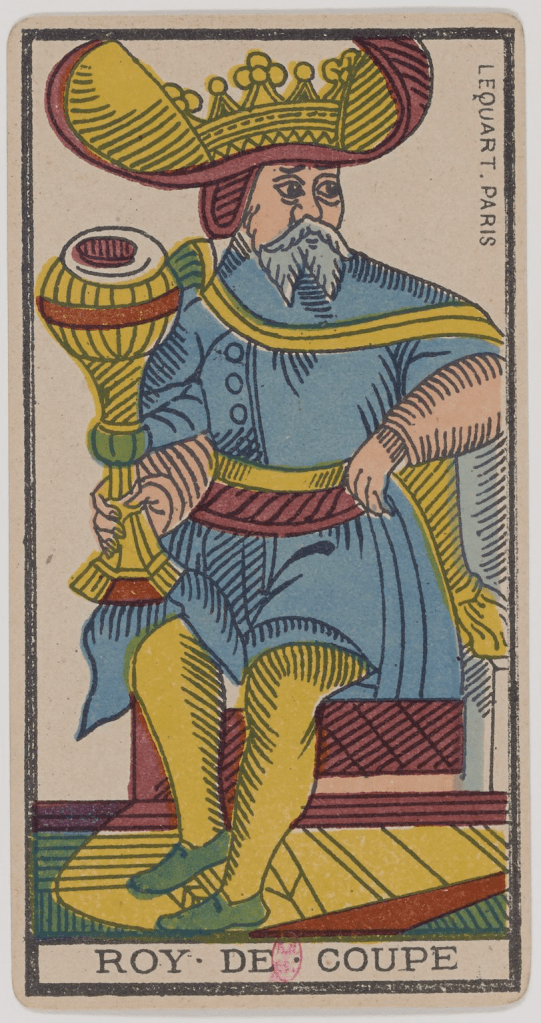
Chaldean numerology and astrology were utilized in the 15th century for the Italian interpretation of tarot cards. Thus, Aldebaran appears as the “King of Cups,” and, in addition to courage and honor, brings pleasant emotions, friendship, and love. This aligns with the traditional nature of number 37.

King of Cups. Source: Wikimedia Commons, File:KC Tarot.png

Sepharial provided the following explanation of the number: “XXXVII (37). Royal star of Taurus. Union; marriage; protection of ladies in position; goodwill; sincere friendship; success through associations with the opposite sex.”

Cheiro described the number as follows: “37. This number has a distinct potency of its own. It is a number of good and fortunate friendships in love, and in combinations connected with the opposite sex. It is also good for partnerships of all kinds. It is a fortunate indication if it appears in connection with future events.”


Sources:

Cheiro (1935). The Cheiro’s Book of Numbers. London, Herbert Jenkins Limited.

Firmici Materni Matheseos: Liber Sextus, II.

Ptolemaios (2nd century AD): Tertrabiblos, chapter IX: The influence of the fixed stars.

Sepharial: Your Fortune in Your Name or Kabalistic Astrology‘ (revised edition from 1909).

Fixed Stars and Constellations in Chaldean Numerology

Although Western astrology is based on the seasons (tropical system), Chaldean numerology also explores connections with fixed stars and constellations. The development of Chaldean numerology was undoubtedly influenced by Egyptian sidereal astronomy (circa 3000 BCE) and later, during the Hellenistic period, by Egyptian sidereal astrology (ancient decans).

There is ongoing debate about whether an ancient Chaldean astrology (around the 5th to 4th century BCE), was based on sidereal or tropical astrology. My personal opinion is that the shared astro-numerological foundation was sidereal, although I won’t delve into proving this here. If true, Chaldean numerology is, in a way, closer to Indian astrology (which is sidereal) than to Western astrology (which is tropical).

The basic fixed stars in Chaldean numerology include the four so-called “royal stars,” associated with the following numbers:
23 – The Royal Star of the Lion, or Regulus
37 – The Royal Star of the Bull, or Aldebaran
51 – The Royal Star of Aquarius, or Markab (contrary to the common notion that Fomalhaut is the royal star in this sign)
65 – The Royal Star of Scorpio, or Antares

These four stars can also be combined with planets represented by specific numbers. For instance, 23 represents Mercury in conjunction with Regulus, 37 represents the Sun in conjunction with Aldebaran, and 51 represents Venus in conjunction with the star Markab. The conjunction between the Moon and Antares symbolizes the number 65.

Chaldean numerology can be used to designate additional stars. Various criteria exist for categorizing stars numerologically, and according to one criterion, the following fixed stars can be defined:
21 – Polaris
82 – Arcturus
91 – Sirius

Some constellations include:
11 – Virgo and Leo
17 – Andromeda
37 and 111– Pleiades
13 and 43 – Draco

Other interpretations are also possible.