Renée Nicole Macklin Good was shot on January 7, 2026, during protests in Minneapolis by United States Immigration and Customs Enforcement (ICE).
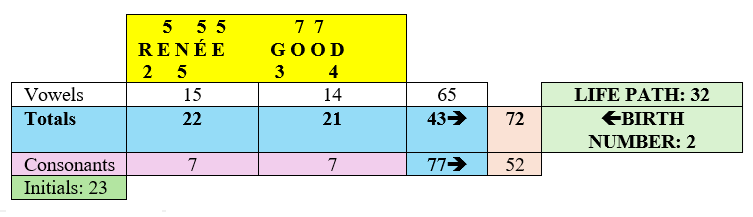
In her chart, there is a very strong combination of the numbers 43 and 52. Chaldean tarot interprets the number 52 as the Queen of Swords and warns of wars and death. Cheiro therefore associated this number with43. The number 43, like the number 13, is called “Death” or “The Reaper” and is traditionally linked with war and upheaval.
Sepharial defines the number XLIII (43) as: “Point of Reaper. Destruction; abortive enterprises; things brought to nothing; annihilation.”Cheiro, however, defines the number 43 as follows: “This is an unfortunate number. It is symbolised by the signs of revolution, upheaval, strife, failure and prevention, and is not a fortunate number, if it comes out in calculations relating to future events.”
Many people have such a number in their numerological charts, yet most are not shot or do not experience an accident. However, a chart dominated by unfavorable numbers increases the likelihood of extreme events. In this particular numerological chart, the favorable numbers are 23 and 24, and probably 72. The number 21, like 2, is more neutral. Everything else is challenging in one way or another.
On January 7, 2026, scattered but negative numbers prevailed in her system. Somewhat more emphasized was the relationship between the number 15 and the unfavorable essence 4. Within this essence we find the number 13, which signifies “Death.” An unfavorably positioned 17 contributed to the spread of unfavorable news—the news of her own death.
As in the case of Alex Pretti, another victim in the ongoing American protests, it must be emphasized that numerology does not predict the future. It affects us to the extent that we remain within the dual matrix, of which the workings of Chaldean numerology are also a part. Renée Good possessed within herself a certain strength for seeking spiritual wholeness and intuition. With some luck, she might perhaps have avoided the fatal scenario.
From: Wikimedia Commons; File:Renee Good DHS agent perspective.jpg
In the previous article, I briefly outlined the connections between tarot cards and numbers. Some connections to Chaldean tradition may seem unusual at first glance, especially among the pips cards, since, for example, all threes of the suits are considered unlucky numbers (29, 43, 57, 71), while the number 3 itself is generally not unlucky. There can be several reasons for this. Among other things, we must consider that these cards are placed within the general numerical sequence from 1 to 78, which corresponds to Chaldean numerology. It should be emphasized that the interpretations of pips revealed by French occultists from the late 18th century differ significantly from the Chaldean tarot. Reconstructing the original tarot, or Chaldean tarot, is therefore a challenge. Regardless of the solutions proposed, it should be noted that in divination, any interpretation works, because the chosen interpretation becomes part of one’s own divinatory matrix. This is a comment from a numerologist who, by the way, does not practice divination 😊.
That Chaldean tarot existed in the 15th and 16th centuries is evident, besides the Major Arcana, primarily from the court cards, which consist of Kings, Queens, Knights, and Pages (23, 24, 25, 26, 37, 38, 39, 40, 51, 52, 53, 54, 65, 66, 67 (?) and 68). Kings 23, 37, 51, and 65 are powerful figures. Wands and Cups represent cycles of growth, while Swords and Coins represent cycles of decline. Wands and Swords are active, Cups and Coins are passive.
Thus, the Kings of Wands and Cups are favorable, as they govern the cycle of growth and success. The King of Wands aka Royal Star of Leo (23) is favorable for career, business, and assistance from people in authority, and his Queen is also emotional yet still successful (=24). The Knight of Wands (25) is considered a successful career knight/general, representing good analysis and strategy (this is the meaning of 25). The Page represents the lowest court rank and may also signify challenges and difficulties, for example in career or business (26). Similarly, 37 is the King of Cups aka The Royal Star of the Bull, or the King of Emotions, at the peak of his power—the number signifies favorable relationships, partnerships, etc. The Queen of Cups embodies emotions to the square, which probably is no longer a favorable solution (38). The Knight of Cups is impulsive and sometimes dangerous, as he is a successful commander who can occasionally be misled or betrayed by emotions. Thus, the number can signify both success and difficulties, giving it a more neutral meaning (39). The Page of Cups represents the risk of emotional entanglements and emotional exploitation, and from this perspective is not a favorable number (40).
The Kings of Swords aka The Royal Star of the Waterman (51) and Coins (65) are not necessarily lucky, as the numerical cycle turns downward after 51. The King of Swords, therefore, brings both success and danger in conflict (51), while the Queen of Swords adds a touch of emotion and intrigue—sword and emotions and grudges don’t go well together (52). The Knight of Swords is a sword to the square and in a more exposed position than the King (53). The Page of Swords, due to low rank, is like cannon fodder and in an even worse position (54). The King of Coins aka The Royal Star of Scorpio (65) is also a powerful figure like all kings, but he governs the final phase, which is also a phase of stronger disintegration—wealth must be hidden and protected, and wounds are not excluded. The Queen of Coins (66) is more successful at hiding wealth and in diplomacy, and is therefore generally luckier than the King of Coins. 67 is the Knight of Coins—probably represents danger in tarot as well, but this is the card that is most difficult to interpret using court card symbolism (??). The Page of Coins (68) cannot be a lucky number, as it is the lowest court card and is in an even more disintegrative phase.
“The Royal Star of Aquarius,” or “The Royal star of the Waterman”, also known as Markab, should more accurately be called the “Royal Star of Pegasus,” as there is no bright star located at 20 degrees of Aquarius. If we travel from 20 degrees of Aquarius on the ecliptic along the celestial meridian, which is perpendicular to the celestial equator, we reach the vicinity of the bright star Markab to the north and the star Fomalhaut to the south, a very luminous star in the constellation Piscis Austrinus (the Southern Fish).
Fomalhaut is traditionally associated with communication and attracting attention. Its nature is gentler, often tied to business affairs, but it can also be connected with a less favorable disposition. However, it is not associated with danger or war, which are traditional themes in Chaldean numerology.
This leaves us with Markab, a bright star located to the north of Aquarius. As a royal star, Markab symbolizes brilliance, honor, and authority, as well as warriors, intelligence, and, unfortunately, war, conflicts, injuries, and danger. Number 51 is not just linked to this royal star but also to the ruling planet associated with the number.
Pegasus and Markab. Source: Wikimedia Commons: File:1776 – John Flamsteed – Pegase, Le Petit Cheval, Le Dauphin (Pegasus, Pisces and Equuleus).jpg
Astrologers who influenced the development of modern Chaldean numerology did not believe in the general interpretation that the conjunction between Markab and Venus would only bring unreliable friends, a negative impact on business, or lead to excessive drinking; rather, they believed that this aspect signifies warriors, fame, honor, and the potential for injuries in battle or during an attack. In Tarot, this royal star is referred to as the King of Swords, which also governs warfare and danger.
Chaldean numerologists of the late 19th and early 20th centuries followed this astrological interpretation through the star Markab, maintaining much of the traditional meaning of the number.
Sepharialprovided the following explanation of the number:
“LI (51). Royal star of Aquarius. Fortuitous elevation; martial tendencies; powerful enemies; troubles through Mars men.“
“51. This number has a very powerful potency of its own. It represents the nature of the warrior; it promises sudden advancement in whatever one undertakes; it is especially favourable for those in military or naval life and for leaders in any cause. At the same time it threatens enemies, danger, and the likelihood of assassination.“
Sources:
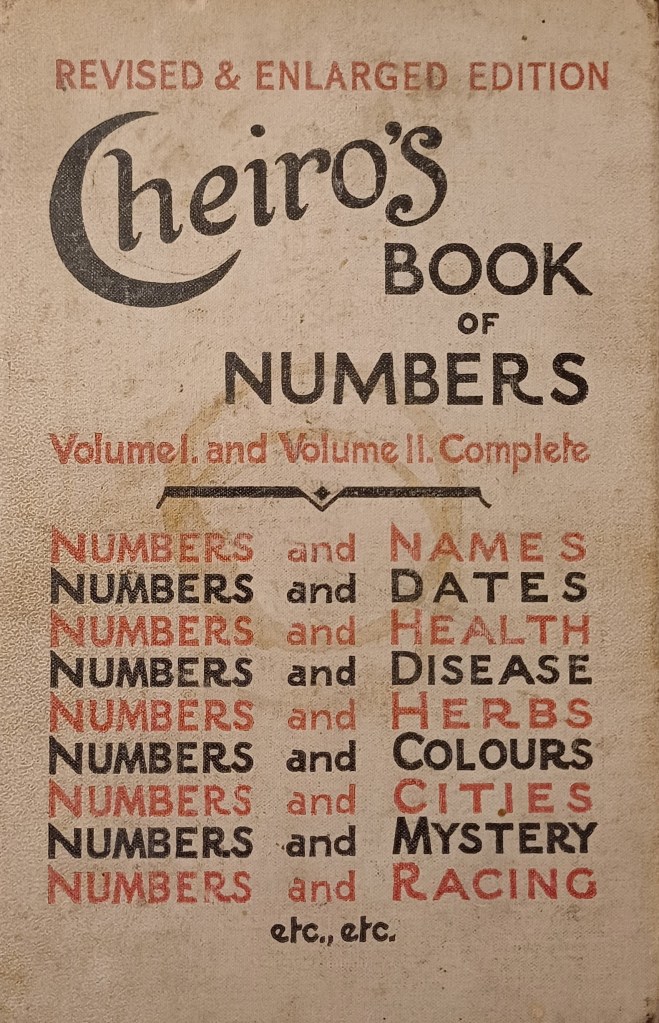
Cheiro (1935). The Cheiro’s Book of Numbers. London, Herbert Jenkins Limited.
Sepharial (revised edition from 1909). Your Fortune in Your Name or Kabalistic Astrology.
Number 37 is known as the “Royal Star of the Bull,” “Royal star of Taurus” or Aldebaran, also referred to as Facula. The Roman astrologer Ptolemy once wrote, “Of the stars in the head, that one of the Hyades which is bright and ruddy, and called Facula, has the same temperament as Mars.”
Taurus with Aldebaran. Source: Wikimedia Commons. File:Sidney Hall – Urania’s Mirror – Taurus.jpg
Based on this, Aldebaran is often interpreted as a star of honors and successes, but also as a star of disputes and violence. Number 37 is not only a royal star, but it is also associated with the leading luminary that governs this number. Number 37 has a base number of 1, which represents the Sun. Following the standard astrological interpretation, the conjunction of Mars with the Sun leads to the following interpretation: disputes or violence, danger of wounds, and violent deaths. At the same time, it must be considered that Aldebaran, being the “royal star,” also brings honors and success. Given the generally unstable nature of political positions, we may arrive at the idea that with the conjunction of Aldebaran and the Sun, success and fame are often followed by downfall and disgrace.
It’s important to note that due to its status as a highly favorable royal star, Chaldean numerology has regarded Aldebaran for centuries as a more favorable influence of Mars. According to this interpretation, the star brings positive developments, brilliance, and influence. Individuals associated with this star are courageous, unafraid of their adversaries, and usually emerge victorious in battles against them. Their ability to fight for their goals stems from the martial nature of this star. They often act for the greater good, and it is rare for them to suffer wounds from opponents (which contrasts with the general interpretation!).
As a conjunction of the Sun with “positive Mars”/Aldebaran, number 37 can indeed bring some disputes and conflicts, yet individuals with this number typically emerge as winners. This conjunction also brings business triumphs, enabling a person to secure both their prosperity and beneficial partnerships. Due to the intrinsic nature of Aldebaran, it is advisable to avoid connections with aggressive numbers, such as 18. Modern interpretations by Chaldean numerologists in the latter half of the 19th century and the early 20th century follow this “Chaldean” astrological reasoning, largely preserving the traditional meaning of the number.
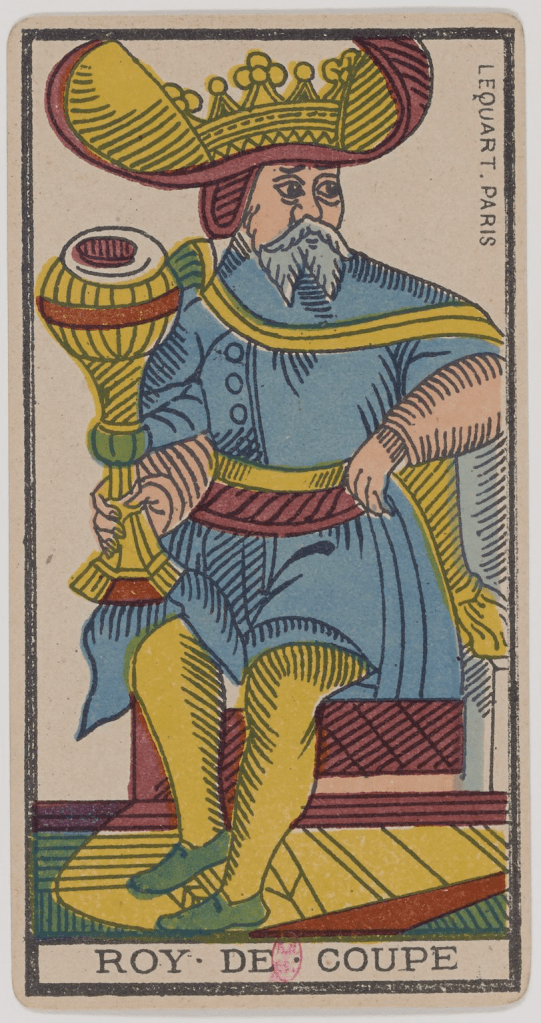
Chaldean numerology and astrology were utilized in the 15th century for the Italian interpretation of tarot cards. Thus, Aldebaran appears as the “King of Cups,” and, in addition to courage and honor, brings pleasant emotions, friendship, and love. This aligns with the traditional nature of number 37.
King of Cups. Source: Wikimedia Commons, File:KC Tarot.png
Sepharial provided the following explanation of the number: “XXXVII (37). Royal star of Taurus. Union; marriage; protection of ladies in position; goodwill; sincere friendship; success through associations with the opposite sex.”
Cheiro described the number as follows: “37. This number has a distinct potency of its own. It is a number of good and fortunate friendships in love, and in combinations connected with the opposite sex. It is also good for partnerships of all kinds. It is a fortunate indication if it appears in connection with future events.”
Sources:
Cheiro (1935). The Cheiro’s Book of Numbers. London, Herbert Jenkins Limited.
Firmici Materni Matheseos: Liber Sextus, II.
Ptolemaios (2nd century AD): Tertrabiblos, chapter IX: The influence of the fixed stars.
Sepharial: Your Fortune in Your Name or Kabalistic Astrology‘ (revised edition from 1909).
Shortly after the creation of the Italian tarot cards, numerous versions with incorrect numerological sequences emerged. The numerologically correct system is the Marseille tarot, as it maintains the appropriate links between the meanings of tarot cards and the ancient descriptions of numbers. Recently, inaccurate information has surfaced regarding how individual tarot cards are connected to the numbers as known in Chaldean numerology.
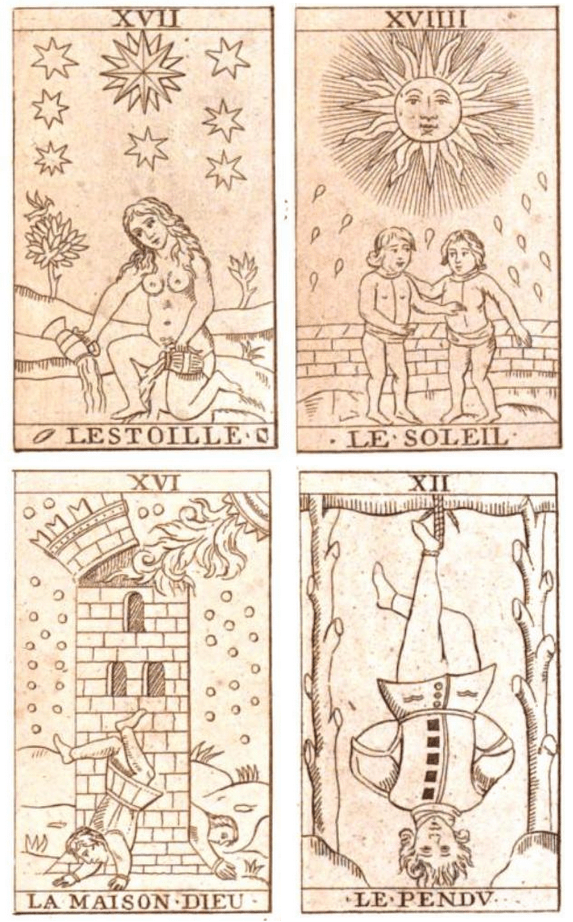
Without delving into the numerological philosophy of tarot, it can be stated that in the late 19th and early 20th centuries, Chaldean numerologists used connections between numbers and tarot cards, as illustrated below.
In some cases, the numerological names differ from the most established names. For example, the number 11 is called Lion Muzzled. The card The World is referred to as the Crown of the Magi. The Three of Cups and Three of Coins are called Reaper, as these cards share meanings with the card Reaper XIII. Many terms originate from French occultists of the 19th century, who sought the origins of tarot in ancient Egypt and named individual cards or numbers with pagan names.
The cards of the Major Arcana in Chaldean numerology are typically named as follows:
1 – I. The Magician, the Juggler
2 – II. The Door of Hidden Sanctuary, the High Priestess
3 – III. The Empress, Isis-Urania
4 – IV. The Stone Cube, the Emperor
5 – V. The Master of the Arcana
6 – VI. The Two Ways, the Lovers
7 – VII. The Chariot of Osiris
8 – VIII. The Justice, The Balance and Sword, Themis
9 – IX. The Veiled Lamp, the Hermit
10 – X. The Wheel of Fortune, the Wheel, Sphinx
11 – XI. The Clenched Hand, the Lion Muzzled, the Force
12 – XII. The Sacrifice, the Hangman, the Victim
13 – XIII. The Reaper, the Death, the Scythe, the Reaping Skeleton
14 – XIV. Temperance, the Two Urns, Solar Spirit
15 – XV. Typhon or Devil (especially when associated with 4 or 8)
16 – XVI. The Blasted Tower, the Ruined Tower, the Shattered Citadel
17 – XVII. The Star of the Magi
18 – XVIII. The Twilight, the Blood-stained Path
19 – XIX. The Prince of Heaven, the Blazing Light
20 – XX. The Awakening of the Dead, the Judgment
21 – XXI. The Crown of the Magi, the Universe
22 – XXII. Full, the Blind Fool, the Crocodile
Following are the Minor Arcana, which appears in four suits. The names of the four suits in tarot are usually wands, cups, swords, and coins/pentacles. In Chaldean numerology, we generally use the term scepters for wands, and coins for pentacles.
Unlike the Major Arcana, the meanings of the Minor Arcana cards, particularly the pip cards, unfortunately lack connection to their ancient numerological meanings. The number 43 or Three of Cups in Chaldean numerology is, for example, considered unlucky, whereas in the general modern interpretation of tarot, it has a favorable meaning. The interpretations of numbers also differ in content.
Therefore, I strongly advise against interpreting numbers in Chaldean numerology using modern French descriptions of the Minor Arcana and other descriptions of this arcana that stem from French interpretations.
Tarot is also a tool of a divination matrix – once we determine the meanings of a chosen card, that card will “bear” or “communicate” the meanings we have attributed to it. In interpreting numbers in Chaldean numerology, however, such an approach cannot be applied; instead, the meanings must be connected to the actual nature of the numbers. Therefore, we must take into account the exact sequence in the naming.
William John Warner, better known as Cheiro (November 1, 1866 – October 8, 1936), was also referred to by nicknames such as Count Louis Hamon and others. However, he is primarily remembered as Cheiro. He was a British astrologer, numerologist, and palm reader.
His birth name contains numbers—13 and 15 (the sum of 96; 9+6=15). The base numbers 4 and 6 govern his numerological chart. This chart reveals a strong desire for recognition and performance (particularly highlighted by 96, with 24 in Life Path and 15 as the base number in his surname), along with a drive for success in business. Cheiro’s official name also reflected a robust longing for friendship and love, from which he drew significant spiritual strength. Additionally, he enjoyed fairly favorable influences of numbers on the chakras, which may have contributed to his reputation as a successful medium for a time.
The combination of numbers 13 and 15 sparked his interest in the occult (both 13 and 15), reforms, pioneering approaches (13), and even magic (15, 41). The number 41, in particular, fosters a fascination with numerology, which is further emphasized by his nickname “Cheiro” (Mercury and 23). Due to the numbers 13 and 15, an individuals may either become a victim of manipulation and circumstances or turn into a manipulator themselves… The overall numerological chart is complex and can bring strokes of fate that often arrive unexpectedly.
Cheiro was convicted and imprisoned in Paris around 1910 for business fraud, and it is said that this scandal closed doors among the English elite, prompting his move to the morally less stringent United States. An analysis of his works reveals a tendency for manipulation and misinformation—claiming, for instance, that he had been offering numerological guidance based on his system since the late 19th century, or that number 9 was so sacred it couldn’t correspond to any letter. Moreover, he downplayed the contributions of his European sources, likeIsidore Kozminsky and Sepharial, while asserting he learned Chaldean numerology from an Indian brahmin.
It’s essential to recognize that relationships between 15 and 4, or between 15 and 8, should not be judged too harshly. Not everyone with such combinations inherently becomes a manipulator, criminal, or prisoner. An individual’s morals and self-awareness dictate whether they use their strengths for good or ill, and when, if ever, they will yield to temptation. Furthermore, numerological charts can point to which areas of life help to balance the individual. For Cheiro, these areas primarily involved seeking courage, forming a connection with God, and nurturing love and kindness.
Even in his nicknames—like “Count Louis Hamon” and “Count Leigh de Hamong“—the theme of number 13 is prominently featured. It seems Cheiro intentionally emphasized this number, perhaps because it brings uniqueness and combines with the interchangeable number 1 to form a whole.
His nickname “Cheiro” underscores intellectual depth, as it contains the numbers for Mercury and the Sun. The number 23 derived from the nickname is considered auspicious.
In 1926, Cheiro published a book titled Cheiro’s Book of Numbers. In it, he defined the meanings of numbers in Chaldean tarot from 1 to 52, based on older sources. He also defined the rules of matching and mismatching between numbers. For each of the numbers 4 and 8, he differentiated between karmically strong and weak numbers, determining various numbers that align with them. He described favorable and less favorable months, recommended specific herbs and foods, indicated favorable colors and gemstones, and identified ailments commonly associated with particular numbers.
It’s very likely that Cheiro drew the foundational idea of alpha-numeric coding from Isidore Kozminsky, who assigned the letter H a value of either 5 or 8, and the letter X a value of 5. Based on his research, Cheiro developed an alpha-numeric coding scheme in which letters H and X always hold a value of 5. He also altered the value of the letter C, assigning it a value of 3 instead of 2.
For Cheiro, the key to analysis lies in the birth date, or Birth Number. He believed that the Total Name Number (TNN) should align with the Birth Number; otherwise, an individual might encounter challenges throughout life. He further explored the numerological influences of each day of the year based on the specific day of the month. Around 1936, he published another book titled You and Your Star, in which he detailed favorable numbers for every day.
Cheiro’s ideas of such favorable numbers influenced numerologists like Gerun Moore and Lloyd Strayhorn, who developed their own systems based on these concepts.
In Cheiro’s Book of Numbers, he established special guidelines to identify the most important two-digit number in a numerological chart. This number frequently corresponds to TNN, but sometimes the most significant number is derived from adding the birth date and TNN together (Birth Number + TNN). Cheiro did not assign a name to this number, but I personally refer to it as the Goal Number (which differs from Goal Numbers in Pythagorean numerology). Anmarie Uber called it the “Hidden Number,” while some perceive it as an indicator of career success.
Cheiro’s book, Cheiro’s Book of Numbers, does not provide reliable techniques for predicting the future. It also contains inaccuracies, such as the assertion that the Chaldeans were unaware of letters with a value of 9. Nonetheless, despite not being a comprehensive manual, this work played a pivotal role in the evolution of numerology. In many ways, Cheiro is considered the father of modern Chaldean numerology.
Richard Cavendish (August 12, 1930 – October 21, 2016) was a British historian who studied mythology, religion, witchcraft, and the occult. He did not consider himself an occultist but primarily explored these fields. However, at least in the case of numerology, one might question whether he truly did not practice it himself. Cavendish didn’t just describe Chaldean or Hebrew numerology but developed his own alphanumeric coding of Latin Alphabet based on the Greek and Hebrew alphabets.
A centuries-old method of alphanumeric coding, which Richard Cavendish also arrived at in his own way. This system differs from Cheiro’s model only in the numeration of the letter X.
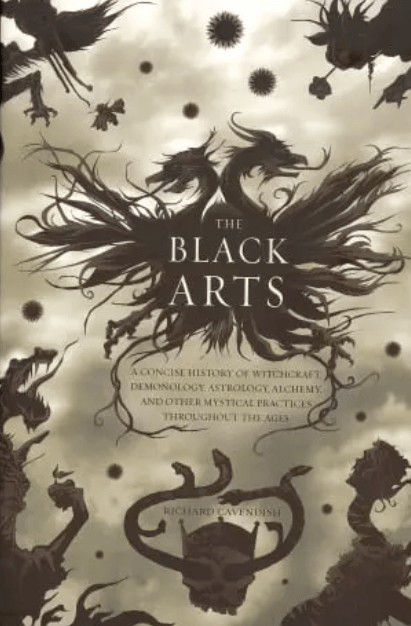
This kind of coding had been used centuries before, but it’s clear that despite his historical knowledge, Cavendish did not have access to all historically relevant information. Therefore, he was unaware of the existence of such alphanumeric coding. His numerology is thus a blend of tarot card descriptions, the mentioned alphanumeric coding, and the Pythagorean approach to vowels and consonants. He published his knowledge of numerology in 1967 in the book The Black Arts: A Concise History of Witchcraft, Demonology, Astrology, and Other Mystical Practices Throughout the Ages.
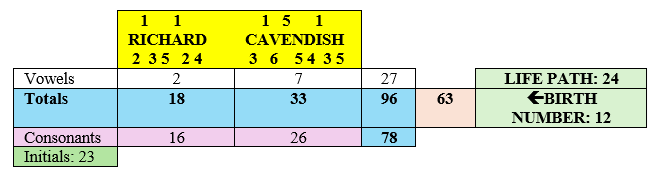
In his numerological chart, we find his birthdateon the 12th, whose base number is 3. The number 3 represents the significance of tradition, values, law, and history. The number 6 (33, 96, 78, 24) is strongly expressed, representing home, while the number 18 in his name and the number 63 as the Goal number sociologically point to the concept of war. With all these numbers, it’s no wonder he became a historian. All of this is further strengthened by the connection between the numbers 3, 6, and 9.
His Total Name Number (TNN) is 96, and his consonant total is 78. These two numbers add up to 15. The number 96 is aligned and can bring good fortune in performances or lectures. The number 78 is connected with the number 8 (26; 2+6=8). When the number 15 meets the number 8, there’s a likelihood of manipulation (such a person can either be a victim of manipulation or manipulate others), and often such a person has a peculiar relationship with the occult. As we can see, the number 15 is only partially exposed to this—the problematic part is the placement of the number 78. In all cases, 15 can represent magic, and in combination with the number 8, it can even signify witchcraft or black magic. It was precisely the number 15 that led Cavendish to his desire to research mythology, magic, and the occult in general.
Walter Gorn Old, also known as Sepharial (born March 20, 1864, died December 23, 1929), was an occultist, astrologer, numerologist, and theosophist who also studied medicine, psychology, and oriental languages. He was a friend of Helena Blavatsky and one of the founding members of the Theosophical Society. Around 1894, he parted ways with Blavatsky.
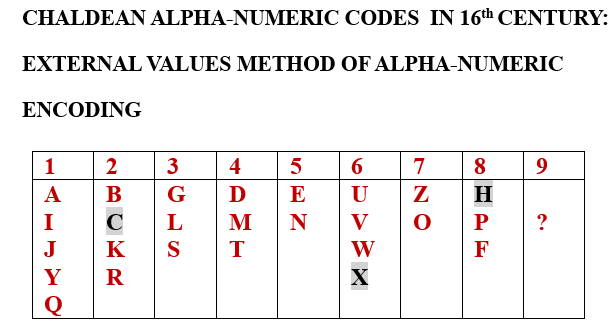
He was born Walter Richard Old on March 20 and later changed his name to Walter Gorn Old (also Gornold or Gorn-Old). This change is believed to have occurred in 1895, the same year he published Kabalistic Astrology, or Your Fortune in Your Name, a book on Kabbalistic astrology (type of Chaldean numerology). Initially, he worked as a Kabbalistic astrologer, utilizing the “external values method of alpha-numeric coding.”
In this form of astrology—though it is more accurately described as a peculiar type of astro-numerology—numbers are closely connected with the tarot. The numbers from I to XXII (the Major Arcana) hold special power. In addition, there are the so-called Royal Stars, which represent the four kings of the suits of wands, cups, swords, and pentacles: the Royal Star of Leo (XXIII), the Royal Star of Taurus (XXXVII), the Royal Star of Aquarius (LI), and the Royal Star of Scorpio (LXV). Likewise, the ace of wands (also known as the ace of sceptres; XXVII), ace of swords (LV), and ace of pentacles (LXIX), along with numbers XLIII and VXXI, are said to hold special potency. Sepharial added meanings for numbers XXIV, XXV, XXVI, and XXVIII to these already established values, greatly influencing Kozminsky and Cheiro. This leads us to the interpretations of numbers in Sepharial’s numerological tarot.
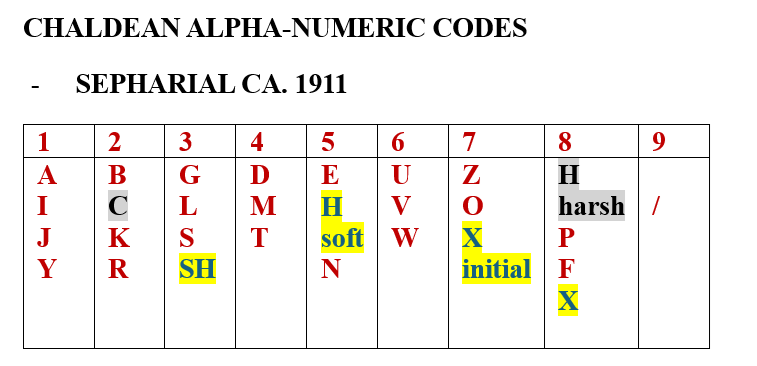
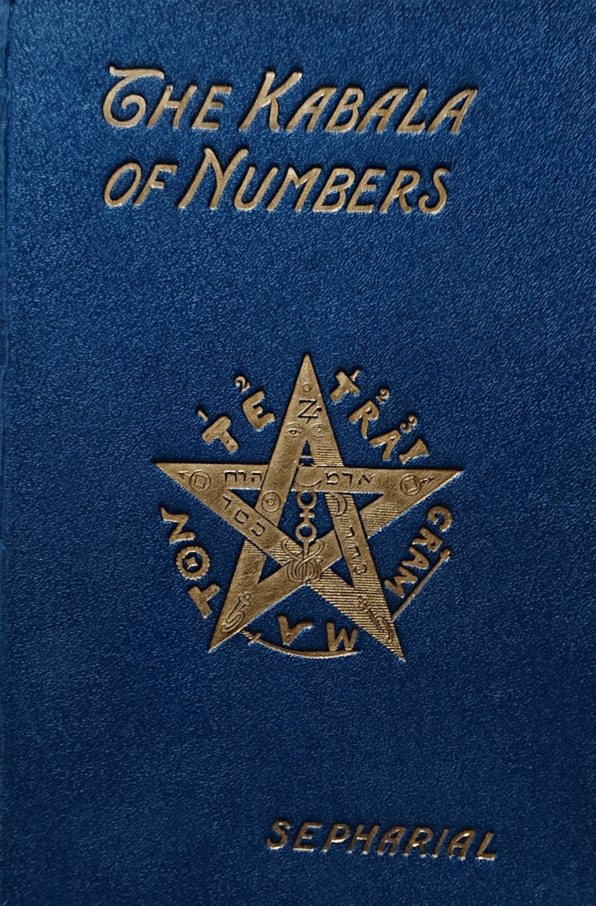
Around 1911, influenced by Isidore Kozminsky and Habeeb Ahmad, Sepharial developed his own alpha-numeric coding system in Chaldean numerology. He also explored phonetic numerology. His most well-known work on numerology is The Kabala of Numbers from 1911.
His original name, Walter Richard Old, results in a Total Name Number (TNN) of 35 and 17, with a base number of 8. This is the number of Saturn and does not align with his birth date of the 20th, which has a base number of 2. For a person with this combination of numbers like Sepharial, there is a possibility that the relationship between the numbers 8 and 2 can be somewhat alleviated, redirecting the energies into creative communication or even manifestation. The challenge with this card lies in the presence of too many unfavorable numbers, which diminish the quality of life and thus limit the possibility of fully resolving the relationship between 2 and 8.
The key number in Walter Richard Old’s numerology chart is the base number 2. The number 2 represents psychology and can also indicate an interest in the occult sciences. Additionally, the number 2 is often associated with nurses and hospitals, and Sepharial did study medicine. His talent for languages is suggested by his inclination toward creative communication, especially in the numbers 2 and 4. This potential is partially reinforced by the numbers 1 and 7.
His new name, Walter Gorn Old, has a TNN of 16 or 34 with base number 7. The dominant influence of these TNNs, along with his interest in psychology and the occult, brings certain complications and blows of fate. At the same time, the connection between the birth date of the 20th and the TNN creates a link between the numbers 2 and 7. These are interchangeable numbers, strengthening each other and giving the person a unique power. Numbers with base numbers 7 and 5 are arranged in a special intellectual structure, which indicates a gift for intellectual work and research. Children are represented by the numbers 23 and 24 in the date numbers, and generally by base numbers 5, 6, and 8. Sepharial had many of these numbers and also had many children. However, it is not guaranteed that someone with child-related numbers in their chart will actually have children. If they do, such numbers help explain family relationships.
With his new name, Sepharial retained some potential for manifestation, but his numerology chart carried predominantly negative energies. Throughout his life, Sepharial faced occasional financial difficulties, often having to move with his family and take on additional jobs beyond astrological counseling.
His pen name was Sepharial. This name carries the primary vibration of the number 29. In older European Kabbalistic traditions, this number reduces to 11, which represents the Arcana XI, or “Force.” It is considered an ambivalent number of fighters. However, in very old traditions and by most modern Chaldean numerologists, this number is regarded as unlucky, as it brings conflicts and emotional suffering.
Sepharial’s life challenges, the change of his name, and the use of an unfortunate pen name can serve as an example of what can happen when a name change is not suitable. Changing a name should enhance one’s quality of life, but this was not the case for Sepharial.
Some sources:
Sepharial (1895): Kabalistic Astrology, or Your Fortune in Your Name
Isidore Kozminsky was reportedly born on October 25, 1870. He grew up in a family of Australian Jews and jewelers. He was known as an astrologer, numerologist, and an expert on gemstones and the Kabbalah. Because he married outside of Jewish circles, he adopted the name Francis Coton and moved with his family from Australia to London in 1935. Isidore Kozminsky remained his pen name. He died during World War II, but the exact time and cause of his death are unclear. One account suggests he died after tripping down an escalator in the London underground, while another claims he succumbed to pneumonia.
Isidore Israel Kozminsky, born on 25th October 1870
His numerological chart for the name Isidore Kozminsky shows a strong and quite favorable alignment of energies. It includes the auspicious numbers 23 and 55, as well as the number 96, which can be unfavorable (depending on how often it encounters the numbers 4 and 8). His chart reveals a strong relationship between 1 and 6, which often suggests a love of luxury and likely influenced his interest in gemstones. Numbers 96 and 24 bring a certain level of material comfort. Numbers 1 and 5 are positioned in a way that enhances the role of intellect, knowledge, and information. Numbers 96, 17 and 25 indicate an interest in the occult, with 96 potentially invoking darker spiritual influences. Therefore, due to the number 96, he needed to be cautious of the darker aspects of spirituality and manipulation. Base number 5 (23, 32) also signifies an interest in numbers, giving him some potential for communication and writing.
The reader can see that I treat the letter Y as a consonant. There is no consensus among numerologists on this, but studying various cases shows that it is more appropriate to treat Y as a consonant.
In 1905, Kozminsky wrote Numbers, Their Magic and Mystery, where he advocated for the Chaldean-Hebrew system with the values C = 2, H = 8, and X = 6 (the external values method of alpha-numeric coding). In 1912, he published Numbers: Their Meaning and Magic. Being an Enlarged and Revised Edition, in which he shifted to a coding system where C = 2, H = 5 or 8, and X = 5. This approach had a significant influence on Cheiro.
The method Kozminsky used for summing numbers in the Total Name Number (TNN) is controversial and outdated. Based on a specific form of Kabbalistic astrology, which Sepharial also endorsed, he identified certain numbers from 1 to 28 as having “potency of their own,” as well as numbers 37, 43, 51, 55, 65, 69, and 71. According to this system, if a name or surname corresponds to a number with its own potency, it is not reduced to a basic value. If it does not have its own potency, the number must be reduced to the first number that does. For example, the name Napoleon Buonaparte (an earlier version of the famous French general’s name) vibrates at 41 & 41. Since 41 does not have its own potency in Sepharial’s system, it must be reduced to 5 (4+1=5).
Vintage Book- image published on WorthPoint
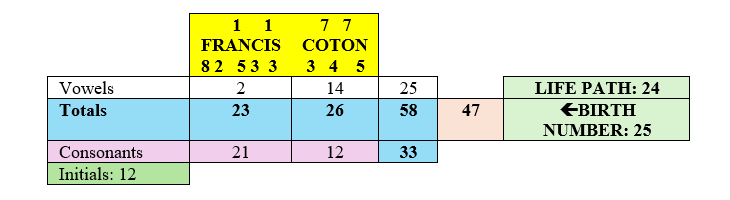
In the case of Isidore Kozminsky, we get the name value 23 and the surname value 5 (from 32, which is reduced as 3+2=5). The sum is 28, which has its own potency and therefore does not get reduced to 10. The number 28 is considered a key number and is regarded as an unfavorable one. For the name Francis (8+2+1+5+2+1+3) Coton (2+7+4+7+5), the name sums to 22 and the surname to 25. 22 is generally unlucky, while 25 was considered fortunate in older traditions. The total is 47, which does not have its own potency and must be reduced to 4+7=11. The TNN value is 11, which Kozminsky treated as neutral. Since he was born under base number 7, we get interchangeable numbers. Kozminsky likely believed that his new name, Francis Coton, would be lucky.
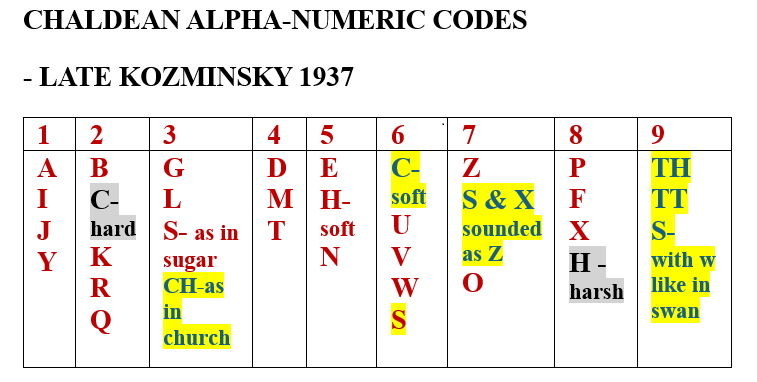
In horse racing, Kozminsky adopted phonetic numerology (books Numbers and Horse Racing, 1928, and My Key Treatise, 1936). He believed that for humans, the written name was influential, while for animals, the spoken name held more power. In 1937, he also published Numbers And Their Practical Application, in which he used a reformed Chaldean coding system for interpreting people’s numerological charts, diverging significantly from Cheiro’s model. He also provided weaker descriptionsof numbers compared to his earlier works.
According to his reformed alpha-numeric coding system, the name Isidore Kozminsky carried the values 26 and 35. In the new book, Kozminsky did not explain how to calculate the TNN. According to his earlier method in Numbers, Their Magic and Mystery, the number 35 is not given its own potency and is reduced to 8. The sum of 26+8=34. However, the name Francis Coton gives the name value 25 and the surname value 25. These combine to 50, which he considered his TNN. Nonetheless, the alpha-numeric coding used by Kozminsky in the final years of his life no longer had much influence.
According to the classic Chaldean alpha-numeric coding model (Cheiro’s approach), the name Francis Coton results in a numerological chart, which contains more unfavorable numbers. The chart is rather weak and shows conflicts between the numbers 23 and 26, 58 and 33, 26 and 58, and 33 and 28. This chart no longer indicates as much interest in gemstones, although some financial potential and interest in communication remain. The strong number 58 indicates a tendency toward eccentricity and reforms, which likely did not go in the right direction. We can see that Kozminsky’s numerological expertise declined in his later years. The information he disseminated lost touch with the Chaldean tradition and reliable interpretation.
Numbers 58 and 71 together emphasize the themes of death and difficulties. The surname Coton carries very unfavorable vibrations of 26 and 12, represented as a pillar. This might have influenced the spread of the story about the escalator accident. The numbers 8 (2+6=8) and 3 (1+2=3) can represent buildings, with 8 also symbolizing railways and underground structures. The number 12 can represent a pillar, which may symbolize ascending or descending via escalators. The conflict between 58 and 33, and between 23 and 26, could be connected to respiratory illnesses. Thus, both stories of his death have roots in his numerological chart. The interaction between number 58 and numbers 26 and 71 represents a conflict between base numbers 4 and 8. This pair often indicates significant difficulties and suffering. 58 is also an unfavorable TNN for period 6 (October, extended influence of Libra).
It becomes clear that in Isidore Kozminsky’s case, the name and surname change brought about unfortunate circumstances. Fortunately, Isidore Kozminsky continued to use his original name in his writing. The number 69 in the name Isidore Kozminsky also interacts with the number 58 in the name Francis Coton, adding to the negative influences. 69 reduces to 15, and 15, in its negative aspect, represents manipulation and even black magic. This might explain why Kozminsky’s books carry an unusual vibration. After reading them, I had to cleanse my aura several times. It would have been much better if Isidore Kozminsky had kept his original name in his everyday life. So, a word of caution: one must be careful when changing names. The goal of a name change should be to increase satisfaction or success in life, not to accumulate problems.
Pavel Durov (Pavel Valeryevich Durov; Russian: Па́вел Вале́рьевич Ду́ров) is a Russian-Ukrainian entrepreneur who founded the social network VKontakte and later created the messaging platform Telegram. He is a strong advocate for internet freedom without government control. Opinions on his work are divided. His social networks have facilitated communication among Russian protesters, connections between Belarusian activists, the organization of the Euro-Maidan protests in Ukraine, and have been used in protests in Iran.
On the other hand, both Ukrainian and Russian authorities, as well as organized crime and pedophile networks, have exploited Telegram for their own purposes. Some view Durov as a victim of Putin’s regime, while others see him as a secret Russian agent. His recent arrest in France has caused a stir in international public opinion.
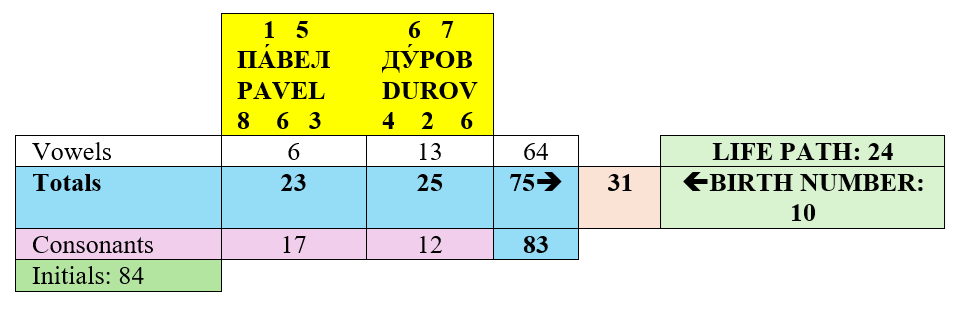
What does numerology say about him? He was born on the 10th of the month (base number 1), and his Total Name Number (TNN) in Chaldean numerology is 75 (base number 3). These are strong, masculine numbers. He also has the numbers 11 and 83 (base number 2), a Life Path Number of 24 (base number 6), and other numbers that bring some softer energies, too.
Like Donald Trump and Mike Lynch, Pavel Durov also has a number chain of 3, 5, and 8, which can represent money (and very rarely financial difficulties). The TNN, Life Path, and birth date represent a combination of powerful numbers 1, 3, and 6, governed by the benefics Sun, Jupiter, and Venus. This suggests a potential for financial stability. However, from a numerological perspective, this alone may not be enough to bring someone immense wealth. We must always remember that alongside numerology, a person’s life is influenced by other aspects of fate and various other factors. Moreover, exceptional achievements are often not traceable in fate analyses; rather, fate analyses reflect character and fundamental interests.
Pavel Durov’s numerological chart is also a karmic one, as it contains the numbers 12 and 75 (whose digits also sum to 12;7+5=12). Sepharialinterpreted the number 12 as: “Reversal of position; culpability; chastisement; loss of honour; danger of violent death; either enforced or voluntary; dangers from women; catastrophe.”
These numbers, 12 and 75, connect with some others in a way that creates very strong spiritual tendencies. It is said that Pavel Durov is a vegetarian (or at least doesn’t consume meat from supermarkets) and lives a relatively ascetic life for a wealthy man. The spiritual power of the number 12 can be channeled into good deeds and seeking good karma, which can enhance the positive aspects of his chart. Thus, the number 12 is not always negative. Of course, Durov must still be careful not to become a victim or to victimize others.
The combination of the numbers 23 and 75 can generate an interest in software and computing. Numbers like 11, 86, and 24 increase interest in social life, as do the number 23 and the number chain with base numbers 1, 5, and 6.
However, the repeated number 12 (75, 84) still indicates that a person can become a victim, especially if he or she also sacrifice others. As mentioned, 12 is a karmic number. The number 11 (83) can represent legal disputes or opponents, too. Cheirodescribed the number 11 as: “It gives warning of hidden dangers, trial, and treachery from others.” The number 10 from his birth date can represent swings of fate, both upward and downward. It is known that Pavel Durov sold his company VKontakte, allegedly under pressure and for a lower price. Soon after, he fled Putin’s regime, relocating to a safer environment and focusing on developing Telegram. But even then, there were difficulties—on August 24, 2024, he was arrested in France for allegedly allowing criminal organizations to connect on Telegram.
Pavel Durov mentioned that he had changed his name in his French passport to Paul du Rove, which is meant to be a humorous translation of his name. However, if this is true, the new name (which he only uses in France) may not have done him much good—TNN is 93, which corresponds to the number 12 (and this 12 is strongly reinforced by other 12s in his numerology chart), while the name itself has the number 18. Together, this could indicate being a victim in legal proceedings. Additionally, the name was not changed according to numerological rules and has retained much of the essence of his widely known name, Pavel Durov.
If we look at the energy trends in Pavel Durov’s life, we can see that in July and August 2024, the energies of the numbers reached an energetic low. The day of August 24, 2024, by the criteria I use, brought unfortunate energies. On that day, Durov was arrested in France. Since the energies in his prognostic chart then improve, it will be interesting to see what happens in the coming months and the next year.
I should point out that classical techniques for personal year, month, and day, which are strongly present especially in Pythagorean numerology, are generally not reliable. On August 24, 2024, Durov’s personal year is 1+0+1+0+2+0+2+4= 10, his personal month is 10+8= 18, and his personal day is 18+2+4=24. The number 18, in contact with the annual number 10, can bring severe legal disputes, but it is somewhat balanced by the number 24, which is one of the luckiest numbers in numerology. Cheiro describes this number as: “Fortunate; it promises the assistance and association of those of rank and position with one’s plans; it also denotes gain through love and the opposite sex; it is a favourable number when it comes out in relation o future events.” However, it is unusual to expect someone to be arrested on a fortunate personal day with number 24 (!).
From a numerological perspective, Durov remains an enigma: Is this man merely a victim, or does he occasionally sacrifice others? What are the actual consequences of a free internet? From 2017 to 2021, Durov was at an energetic peak. The current years bring legal troubles but also analytical abilities. Soon, years marked by the relationship between numbers 9 and 7 (possible intrigue, spies, covert actions, crime) will arrive, likely meaning that the issues currently stirring global public opinion will resurface in a few years.
What can Pavel Durov do to improve his prospects? He must always strive to maintain authority and develop courage. Additionally, he has an increased ability to approach life in a spiritual way and to improve his karma through good deeds. This way, he can reduce the unfavorable influences in his fate and enhance the favorable ones.












 The Mystery of Numbers, Luck, Worlds and Planets