Richard Cavendish (August 12, 1930 – October 21, 2016) was a British historian who studied mythology, religion, witchcraft, and the occult. He did not consider himself an occultist but primarily explored these fields. However, at least in the case of numerology, one might question whether he truly did not practice it himself. Cavendish didn’t just describe Chaldean or Hebrew numerology but developed his own alphanumeric coding of Latin Alphabet based on the Greek and Hebrew alphabets.
A centuries-old method of alphanumeric coding, which Richard Cavendish also arrived at in his own way. This system differs from Cheiro’s model only in the numeration of the letter X.
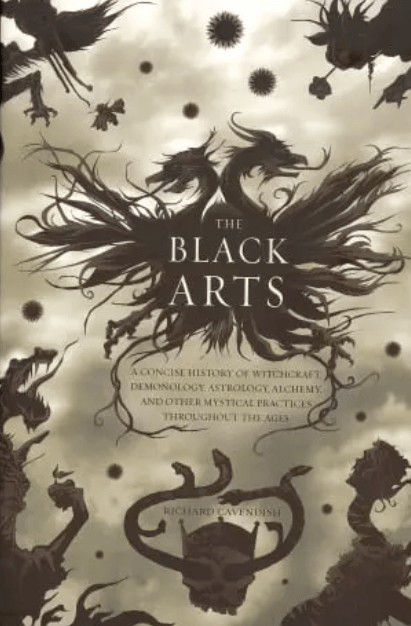
This kind of coding had been used centuries before, but it’s clear that despite his historical knowledge, Cavendish did not have access to all historically relevant information. Therefore, he was unaware of the existence of such alphanumeric coding. His numerology is thus a blend of tarot card descriptions, the mentioned alphanumeric coding, and the Pythagorean approach to vowels and consonants. He published his knowledge of numerology in 1967 in the book The Black Arts: A Concise History of Witchcraft, Demonology, Astrology, and Other Mystical Practices Throughout the Ages.
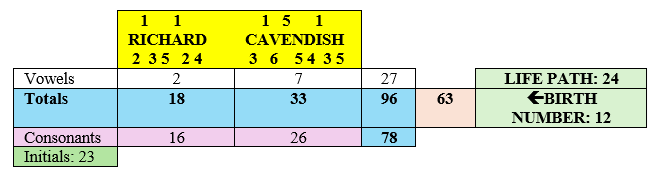
In his numerological chart, we find his birthdateon the 12th, whose base number is 3. The number 3 represents the significance of tradition, values, law, and history. The number 6 (33, 96, 78, 24) is strongly expressed, representing home, while the number 18 in his name and the number 63 as the Goal number sociologically point to the concept of war. With all these numbers, it’s no wonder he became a historian. All of this is further strengthened by the connection between the numbers 3, 6, and 9.
His Total Name Number (TNN) is 96, and his consonant total is 78. These two numbers add up to 15. The number 96 is aligned and can bring good fortune in performances or lectures. The number 78 is connected with the number 8 (26; 2+6=8). When the number 15 meets the number 8, there’s a likelihood of manipulation (such a person can either be a victim of manipulation or manipulate others), and often such a person has a peculiar relationship with the occult. As we can see, the number 15 is only partially exposed to this—the problematic part is the placement of the number 78. In all cases, 15 can represent magic, and in combination with the number 8, it can even signify witchcraft or black magic. It was precisely the number 15 that led Cavendish to his desire to research mythology, magic, and the occult in general.
Every student of Chaldean numerology should be familiar with key modern Chaldean numerologists such as Sepharial, Isidore Kozminsky, Cheiro, Pandit Sethuraman, Richard Cavendish, Gerun Moore, Lloyd Strayhorn, and Linda Goodman. All of these numerologists were also astrologers.
Sepharial(Walter Gorn Old) played a crucial role in transitioning from the older Chaldean school of “Kabbalistic astrologers” to modern numerology. He also introduced classical descriptions of numbers from Kabbalistic astrology, where the highest number described in this approach is 71. He later wrote a very popular book, “Kabala of Numbers” (1911).
In his development, he initially used an external method of alphanumeric coding of the Latin alphabet (C = 2, H = 8, X = 6). Later, he tested several different alphanumeric approaches but ultimately decided on phonetic numerology.
Isidore Kozminsky, like Sepharial, experimented with various methods of alphanumeric coding. At the latest, in an updated edition of “Numbers: Their Meaning and Magic” in 1911, he was the first modern numerologist to predict that we should, in some cases, treat the letter H as 5. He also assigned the number 5 to the letter X. Like Sepharial, he described all the numbers he believed to have a “distinct potency of its own.” All other numbers he reduced to a number with such potency. His approach of dealing with name numbers is now considered outdated.
Cheiro(William John Warner) is regarded as the father of modern Chaldean numerology. He wrote several books covering numerology, with the most famous being “Cheiro’s Book of Numbers” (1926), where he advocated for the value of 3 for the letter C, 5 for the letter H, and 5 for the letter X.
He emphasized the importance of the Birth number (the day of the month one is born) and its connection to the Name number (that is, Total Name Number, aka TNN). He was one of the first to focus on the compatibility of numbers. He adopted Sepharial’s number descriptions, sometimes expanding them, so they corresponded to some very old descriptions. However, he described numbers only up to 52. He also wrote a book called “You and Your Star”, where he described the most suitable numbers for each day of the year based on astrological techniques.
Pandit Sethuraman, in his book “Science of Fortune” (1954), adopted Cheiro’s alphanumeric coding but summed the unreduced numbers of the first and last names. He also deviated from Cheiro’s views on number compatibility. Sethuraman expanded Cheiro’s descriptions based on his own insights and described numbers up to 108. Unlike Cheiro, he considered numbers 39 and 48 to be unfavorable.
Richard Cavendish, in his 1967 book “The Black Arts” (which has quite an inappropriate book title, especially in connection to astrology and numerology), introduced the classical internal method of alphanumeric coding (with C = 3, H = 8, X = 6), although he seems to have arrived at this through his own research. He emphasizes the importance of considering the numbers of vowels and consonants, a concept long neglected in Chaldean numerology.
Gerun Moore wrote a book in 1973 titled “Number Will Tell”. He adopted Cheiro’s alphanumeric coding system but made several changes and additions to the descriptions of numbers and the rules of compatibility. Notably, he described numbers 39 and 48 as the unlucky number 12.
He also rejected Cheiro’s model of favorable numbers for each day of the year. Instead, he created his own system, where each day of the year is generally assigned two suitable numbers (though in some cases, only one number is given). He labeled these numbers as “keys.” According to him, name numbers matching a person’s key numbers bring luck and harmony.
Lloyd Strayhorn wrote his book “Numbers and You: A Numerology Guide for Everyday Living” no later than 1980. He adopted Cheiro’s alphanumeric coding system. Although he prefers Chaldean numerology, he also considers Pythagorean numerology. Based on his research, Strayhorn introduced his own system of number compatibility, which differs somewhat from Cheiro’s model.
He also rejected Cheiro’s model of favorable numbers for each day of the year, offering instead his own astrological model with lucky numbers. He later published “Lloyd’s Numbers and You Relationship Guide: A Cosmic Blueprint to Happiness & Joy”, in which he distances himself significantly from older Chaldean approaches.
Linda Goodman published a book “Linda Goodman’s Star Signs” in 1987, which also introduces Chaldean numerology. She adopted Cheiro’s alphanumeric coding system and significantly enhanced the descriptions of numbers. However, her method of determining the TNN deviates from those of her predecessors.
Linda Goodman concludes the list of modern classics in Chaldean numerology. I believe that this list provides an appropriate foundation for studying contemporary Chaldean numerology.
There are also a few Chaldean numerologists who have uncritically incorporated Pythagorean methodsof interpreting numbers and relationships. While some ideas from the Pythagorean system can be adopted, not all Pythagorean techniques are suitable for Chaldean numerology.
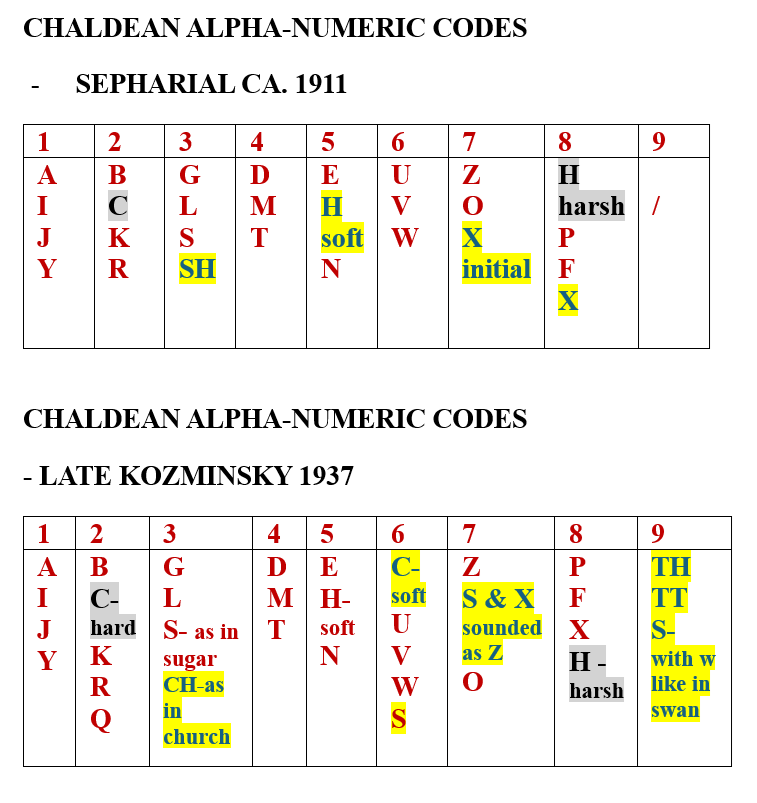
In contrast to Pythagorean numerology, the first examples of the use of the Latin alphabet in Chaldean numerology are only found in the modern era. Initially, two methods of alpha-numeric encoding were used, which are shown below with values by greater cannon (units, tens and hundreds) and lesser cannon (ordinal values) and with reduced values from 1 to 9. I call the first of these methods the internal values method of alpha-numeric encoding and the second the external values method of alpha-numeric encoding.
There are differences between the two methods for two letters. The letter “C” has a value of 3 in the internal method and 2 in the external method, while the letter “H” has a value of 5 in the internal method and 8 in the external method. The internal values approach was a closely guarded secret, so most numerologists only knew the values C = 2, H = 8. In modern Chaldean numerology we also see a reformation of the internal method as early as the 19th century, in which the letter “X” is assigned a value of 5 instead of 6.
The classical internal method with C = 3, H = 5 and X = 6 was introduced to the modern world in 1967 by Richard Cavendish in his book “The Black Arts“, but he seems to have been unaware of the somewhat older Chaldean alphabetic tradition. He seems to have discovered the value of the inner method based on his own findings.
Both approaches assign vowels similarly to those in the Greek alphabet (which was influenced by Semitic alphabets and Semitic numerologies). The letter “A” is associated with the letter alpha and with a value of 1, the letter “E” is associated with the first letter of the “E”-voice, i.e. with the letter eta and with a value of 5. The letter “I” is associated with the letter iota and with the values 10 and 1, respectively. The letter “O” is associated with the first letter for the voice “O”, namely omicron with the values 70, 16 and 7. The letter “U” has a deviation and is associated with the Semitic letter waw with the value 6, and indirectly with the Greek letter digamma.
Aramaic/Semitic Original
Additionally, under the influence of the Jewish Kabbalah, some people have started to assign different values to the vowels “E” and “O” and to the corresponding letters (10 and 1 for “E” and 6 for “O”). This approach is popular among some Freemasons.
The use of phonetic numerology is also widespread among Freemasons and in certain other circles, with various approaches known. Among these, the school of Habeeb Ahmad stands out. Habeeb Ahmad published a book on the subject in 1903 entitled “The Mysteries of Sound and Number“. Phonetic numerology ignores the fact that the Hebrew alphabet was no longer entirely phonetic. They also ignore the findings of European magic that written words, and thereby letters, have the power of manifestation.
Without knowledge of the existence of the internal method, Isidore Kozminsky began to reform the outer method at the beginning of the 20th century, assigning the value 5 to the letter “X” and to the letter “H” sometimes a value of 5 and sometimes a value of 8.. These reforms are included, at the latest, in the updated edition of the book “Numbers: Their Meaning and Magic” from 1911. Kozminsky later developed his own alphanumeric Chaldean coding specifically for analyzing people’s names and surnames. Sepharialhas also been exploring his own coding method.
Kozminsky’s early reforms seem to have been taken up by Cheiro, who then assigned the letter “C” a value of 3 and the letters “H” and “X” a value of 5 in his version of alpha-numeric coding. Thus, Cheiro’s approach arrived at a reformed internal method by another route. The approach was published in 1926 in the book “Cheiro’s Book of Numbers” and soon became a leading method in the field. After the Second World War it was supported and used by many numerologists such as Pandit Sethuraman, Gerun Moore, Linda Goodman, Anmarie Uber and August Darius Danielssonn. This is also the coding I use.
Few Chaldean numerologists still follow the external method. For example, Walter B. Gibson, but in more recent times this method has been supported, for example, by the Indian numerologist Harish Johari.




 The Mystery of Numbers, Luck, Worlds and Planets