Name numerology most likely originates from ancient Egypt. The first known example of its use comes from ancient Assyria. Sargon II, the Assyrian ruler of the 8th century BCE, built a wall in the city of Khorsabad whose total volume corresponded numerically to the value of the king’s own name.
The Greeks called word-based numerology isopsephy. The term derives from the words ἴσοσ (ísos) meaning equal and ψῆφοσ(psêphos) meaning count. Early examples of using the Greek alphabet for analyzing names and phrases date from the 3rd century BCE. Within isopsephy, a distinction between vowels and consonants was already being observed.
Among the Hebrews, name numerology (originally still Chaldean in nature) was known from at least the 1st century CE onward as gematria(גמטריא). The term may have originated from the Greek word for geometry. An early example of Hebrew gematria is the analysis of the name of Emperor Nero, which in Hebrew transcription — NRVN QSR (that is, Neron Caesar) — produces the number 666, the number of the beast and of man. The calculation uses the classical Chaldean “large values” (mispar hechrachi) rather than the later Jewish “great values” system (mispar gadol), which came into use only later, perhaps with the development of classical Jewish Kabbalah.
N (Nun) = נ = 50 R (Resh) = ר = 200 V (Vav) = ו = 6 N (Nun) = נ = 50 Q (Kuf) = ק = 100 S (Samech) = ס = 60 R (Resh) = ר = 200
Total: 50 + 200 + 6 + 50 + 100 + 60 + 200 = 666.
Much later, the word gematria also came to be used for the analysis of Christian names and expressions written in the Greek alphabet — though in reality this represents a Christian adaptation or extension of isopsephy. In late antiquity or the early Middle Ages, India also developed its own systems for encoding names with numbers. The main figure associated with numerology is the Indian scholar Vararuci. The Arabic system analyzed names based on 28 letters and was called ʿilm al-ḥurūf(علم الحروف).
The analysis of names for the purpose of studying human destiny appeared in Europe only around the 16th century. From this period onward, two main schools began to take shape. One is known as the Pythagorean school (which, despite the name, has only limited connection to the original ancient Pythagorean numerology), and the other is the Chaldean school, which is based at least in part on the reconstruction of numerological knowledge once held by the Western Semites.
Both schools went through several stages of development. There are also notable similarities between them, as their traditions influenced each other over time. Name numerology that uses the same type of alphanumeric coding later employed by Cheirofirst appeared shortly before his time. However, Cheiro’s interpretive method itself is much older — it incorporates both Tarot symbolism and ancient tradition.
Modern Pythagorean numbering of the English alphabet emerged slightly earlier than Cheiro’s approach, but the method of interpreting names as we know it today took shape within the Pythagorean school only sometime between 1907 and 1930.
Whether Pythagorean or Chaldean, numerology is not the most straightforward or reliable method for forecasting the future or for studying how favorable or unfavorable numbers operate over time. The range of available techniques is simply too broad, and their effectiveness is often difficult to evaluate.
By contrast, consider how many predictive methods are used in BaZi, or the Four Pillars of Destiny:
Analysis based on the core Four Pillars
Analysis through ten-year and five-year cycles
Annual cycle analysis
Monthly cycle analysis
Daily cycle analysis
Hourly cycle analysis
That’s only six techniques in total!
Western astrologers, likewise, typically rely on six primary predictive methods:
Transits of planets through sensitive areas of the natal chart
Primary directions
Secondary progressions
Symbolic directions
Lunations
Solar returns
Again, just six techniques.
In contrast, I’ve personally encountered a large number of predictive methods within numerology. While some of them are of little real value, many—dozens, in fact—do seem to exert a certain influence. However, applying numerology to the analysis of time cycles is extremely challenging. It’s hard to achieve clarity, and even harder to assess how different numerical influences interact with one another.
Some numerologists try to simplify matters by focusing only on universal and personal days, months, and years. Danish post-Chaldean numerologists, for example, use yearly and daily ranks along with a single technique for analyzing multi-year cycles. Yet all of these approaches are overly reductive, and the results inevitably vary.
Personally, I use and study numerological techniques primarily in ex post analysis—that is, in reviewing past events. On rare occasions, especially in the context of mundane (political) numerology, which I’m still learning, I do look at how fundamental number patterns may evolve in future scenarios.
Many numerologists resolve the issue of prediction by turning to astrological methods, such as planetary astrology or Four Pillars techniques, to forecast future energy flows. In these cases, numerology is mainly used to identify the foundational energetic patterns that aim to influence the individual.
Even when numerology (or astrology—or any system, really) is applied to forecasting, it can never produce 100% accurate results. It’s simply not possible. We must remember: it only seems as though numerology or astrology can truly predict the future. It only seems as though fate can be read from a birth chart or numerological matrix.
States of deep divine attunement, states of profound emptiness, and personal conscious action can all weaken the influence of the numerological (and astrological) matrix. When we act without attachment and with total freshness, we can step beyond these limitations—into realms that transcend all systems.
Karma refers to the principle of cause and effect—the idea that certain causes inevitably lead to certain consequences. Because this connection enables a cause to attract a specific outcome, the law of karma can also be seen as a form of the law of attraction. Agricultural metaphors are often used in relation to karma. One of the most well-known sayings is: “You reap what you sow.” The law of karma is also closely related to the so-called “Golden Rule,” which, in Christian tradition, is expressed as:
“So in everything, do to others what you would have them do to you, for this sums up the Law and the Prophets.” (Matthew 7:12)
Opinions differ on whether the law of karma always applies or whether exceptions exist. There’s also debate about whether karma necessarily requires a reversal of roles over time, which presumes the existence of a reincarnation cycle. Most Christians, however, believe that final karmic justice is not achieved through multiple lifetimes but rather through God’s judgment as a singular event.
Nevertheless, both astrology and numerology must, to some degree, adhere to the principle of karma. Otherwise, we couldn’t claim that specific planetary alignments or numbers lead to specific outcomes. In that sense, all numbers can be considered karmic to some extent.
However, there are narrower interpretations of “karmic numbers.” In Pythagorean numerology, the following are traditionally regarded as karmic:
13 – associated with death and destruction (influenced by the Tarot)
14 – linked to accidents, illness, and loss
16 – connected to downfall or collapse (also reflecting Tarot influence)
19 – represents unresolved past challenges that manifest as difficulties in the present
These numbers are said to bring challenges, but in some cases, they can have positive effects—especially when one chooses a more spiritual path.
In contrast, Chaldean numerology generally regards base numbers 4 and 8 as karmic. These numbers often carry challenges or bring about difficult circumstances. They may also generate ongoing karma. However, individuals operating on a higher spiritual level may experience these numbers as karmic rewards rather than burdens.
Beyond the base numbers, all compound numbers in Chaldean numerology are considered karmic as well. If a compound number is positive (such as 10, 15, 17, 19, 21, 23, 24, 25, 27, and others), it is believed to generate or express favorable karma. If it is negative (like 11, 12, 16, 18, 22, 26, 28, 29, and so on), it is thought to produce or exprtess challenging or negative karma. The philosophy behind these numbers often aligns with that of the Tarot.
Chaldean numerology also attributes aspects of one’s past karma to the birth date, viewing it as a reflection of existing karmic patterns. Meanwhile, name numbers and the Life Path number point more to the direction of personal growth and the creation of new karma.
So how do Chaldean and Pythagorean numerology relate in terms of karmic numbers? Interestingly, both systems associate 14 with accidents and misfortune (traditional Chaldean system!), and both see 16 as a number of collapse or downfall. The number 13 has traditionally been considered unlucky in both systems as well. Descriptions of 13 and 16 in both approaches are heavily influenced by Tarot symbolism.
Despite these similarities, the differences between the two systems are significant. In the Pythagorean tradition, base numbers 4 and 8 are not generally seen as problematic. In contrast, modern Chaldean numerology does not necessarily view 13 as a symbol of death or destruction—it can actually be beneficial in many cases. The number 19 is usually regarded as extremely fortunate, though in very specific number combinations it may act in a way similar to the challenging number 28. Perhaps the most fundamental difference is that Chaldean numerologists interpret all compound numbers through a karmic lens.
There are several types of numerology. Here are some of the most well-known examples:
The so-called Chaldean numerology (sometimes also referred to as Aramaic or ancient Hebrew numerology). In modern times, it has been represented by figures such as Cheiro, Linda Goodman, and Gerun Moore.
Greek name numerology, or isopsephy, which was also adopted by the Pythagoreans.
Pythagorean numerology, which has several subcategories. It was likely initiated by Philolaus, a follower of Pythagoras’ philosophy who lived about a century after him. The dominant branch today was influenced by L. Dow Balliett, with notable figures including Florence Campbell and Juno Jordan.
Hebrew name numerology, or gematria. It was already used by Philo of Alexandria.
Kabbalistic gematria. Its foundations are described in the late antique text Sepher Yetzirah.
Arithmology, the analysis of names of people and concepts found in sacred texts, primarily those of Jewish and Christian Bibles. Key figures include Martianus Capella and Pietro Bongo.
Greek gematria and Latin gematria as parts of arithmology.
Arabic name numerology, or‘ilm al-huruf, which also incorporates Islamic arithmological interpretations. Notable figures include Ibn Arabi, Al-Farabi, and Ahmad al-Buni.
Within ‘ilm al-huruf, some Persian numerologists also contributed or developed their own models.
Vedic numerology, with its most famous numerologist being Vararuci.
Martinist numerology, represented by figures such as Martines de Pasqually, Louis-Claude de Saint-Martin, and Papus.
Bagua, or spatial numerology of the eight directions.
Yi Jing(I Ching) numerology, based on 64 hexagrams.
Astro-numerological calendar-based school of the Nine Star Ki.
Astro-numerological calendar-based school of Sizhu/Bazi (Four Pillars of Destiny). Its classical representative is Xu Ziping, after whom the main branch of this school is named.
Astro-numerological calendar-based school of Zi Wei Dou Shu.
Spatial numerology Fei Xing (Flying Stars), used in Feng Shui.
Spatial numerology San He, a branch of Feng Shui.
Spatial numerology San Yuan, another branch of Feng Shui.
Spatial numerology of the Eight Mansions, or Ba Zhai, which is used in Feng Shui.
All these and other approaches have their own principles, which are sometimes compatible and sometimes not. For example, the Chaldean method shares several similarities with the Pythagorean school but has little to no connection with the Ba Zhai school.
William John Warner, better known as Cheiro (November 1, 1866 – October 8, 1936), was also referred to by nicknames such as Count Louis Hamon and others. However, he is primarily remembered as Cheiro. He was a British astrologer, numerologist, and palm reader.
His birth name contains numbers—13 and 15 (the sum of 96; 9+6=15). The base numbers 4 and 6 govern his numerological chart. This chart reveals a strong desire for recognition and performance (particularly highlighted by 96, with 24 in Life Path and 15 as the base number in his surname), along with a drive for success in business. Cheiro’s official name also reflected a robust longing for friendship and love, from which he drew significant spiritual strength. Additionally, he enjoyed fairly favorable influences of numbers on the chakras, which may have contributed to his reputation as a successful medium for a time.
The combination of numbers 13 and 15 sparked his interest in the occult (both 13 and 15), reforms, pioneering approaches (13), and even magic (15, 41). The number 41, in particular, fosters a fascination with numerology, which is further emphasized by his nickname “Cheiro” (Mercury and 23). Due to the numbers 13 and 15, an individuals may either become a victim of manipulation and circumstances or turn into a manipulator themselves… The overall numerological chart is complex and can bring strokes of fate that often arrive unexpectedly.
Cheiro was convicted and imprisoned in Paris around 1910 for business fraud, and it is said that this scandal closed doors among the English elite, prompting his move to the morally less stringent United States. An analysis of his works reveals a tendency for manipulation and misinformation—claiming, for instance, that he had been offering numerological guidance based on his system since the late 19th century, or that number 9 was so sacred it couldn’t correspond to any letter. Moreover, he downplayed the contributions of his European sources, likeIsidore Kozminsky and Sepharial, while asserting he learned Chaldean numerology from an Indian brahmin.
It’s essential to recognize that relationships between 15 and 4, or between 15 and 8, should not be judged too harshly. Not everyone with such combinations inherently becomes a manipulator, criminal, or prisoner. An individual’s morals and self-awareness dictate whether they use their strengths for good or ill, and when, if ever, they will yield to temptation. Furthermore, numerological charts can point to which areas of life help to balance the individual. For Cheiro, these areas primarily involved seeking courage, forming a connection with God, and nurturing love and kindness.
Even in his nicknames—like “Count Louis Hamon” and “Count Leigh de Hamong“—the theme of number 13 is prominently featured. It seems Cheiro intentionally emphasized this number, perhaps because it brings uniqueness and combines with the interchangeable number 1 to form a whole.
His nickname “Cheiro” underscores intellectual depth, as it contains the numbers for Mercury and the Sun. The number 23 derived from the nickname is considered auspicious.
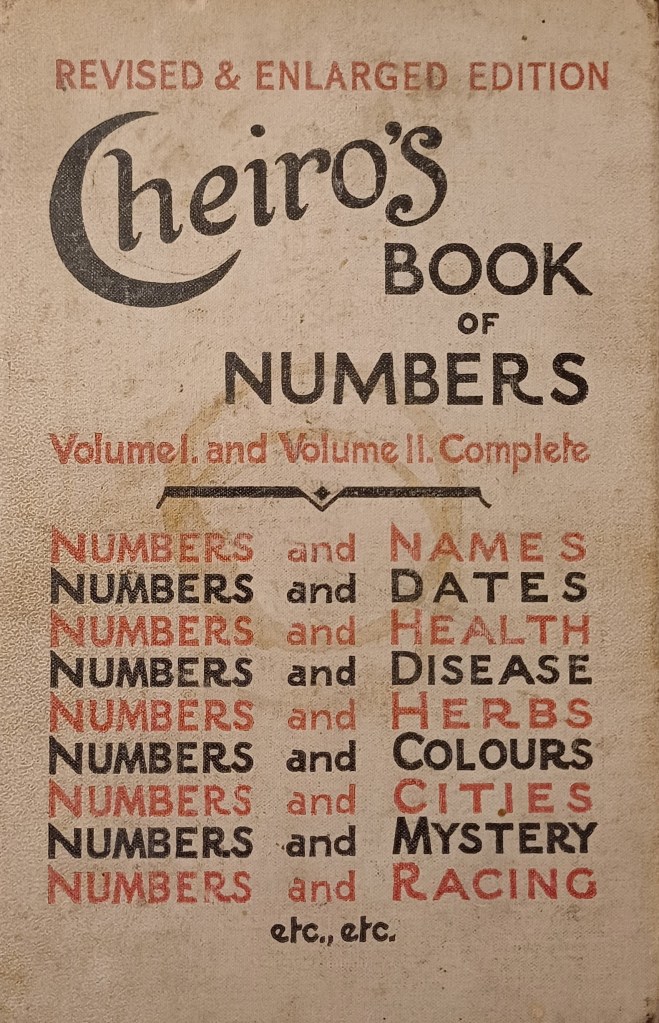
In 1926, Cheiro published a book titled Cheiro’s Book of Numbers. In it, he defined the meanings of numbers in Chaldean tarot from 1 to 52, based on older sources. He also defined the rules of matching and mismatching between numbers. For each of the numbers 4 and 8, he differentiated between karmically strong and weak numbers, determining various numbers that align with them. He described favorable and less favorable months, recommended specific herbs and foods, indicated favorable colors and gemstones, and identified ailments commonly associated with particular numbers.
It’s very likely that Cheiro drew the foundational idea of alpha-numeric coding from Isidore Kozminsky, who assigned the letter H a value of either 5 or 8, and the letter X a value of 5. Based on his research, Cheiro developed an alpha-numeric coding scheme in which letters H and X always hold a value of 5. He also altered the value of the letter C, assigning it a value of 3 instead of 2.
For Cheiro, the key to analysis lies in the birth date, or Birth Number. He believed that the Total Name Number (TNN) should align with the Birth Number; otherwise, an individual might encounter challenges throughout life. He further explored the numerological influences of each day of the year based on the specific day of the month. Around 1936, he published another book titled You and Your Star, in which he detailed favorable numbers for every day.
Cheiro’s ideas of such favorable numbers influenced numerologists like Gerun Moore and Lloyd Strayhorn, who developed their own systems based on these concepts.
In Cheiro’s Book of Numbers, he established special guidelines to identify the most important two-digit number in a numerological chart. This number frequently corresponds to TNN, but sometimes the most significant number is derived from adding the birth date and TNN together (Birth Number + TNN). Cheiro did not assign a name to this number, but I personally refer to it as the Goal Number (which differs from Goal Numbers in Pythagorean numerology). Anmarie Uber called it the “Hidden Number,” while some perceive it as an indicator of career success.
Cheiro’s book, Cheiro’s Book of Numbers, does not provide reliable techniques for predicting the future. It also contains inaccuracies, such as the assertion that the Chaldeans were unaware of letters with a value of 9. Nonetheless, despite not being a comprehensive manual, this work played a pivotal role in the evolution of numerology. In many ways, Cheiro is considered the father of modern Chaldean numerology.
A numerological chart or numeroscope (from Latin numerus = “number” and Greek σκόπος = “observer, watcher”) is a comprehensive display of name and date numbers associated with one’s destiny. There is no unified approach among numerologists regarding what exactly a numeroscope should include or how it should be visually represented. Each numerologist designs the numerological chart in their own way.
In Chaldean numerology, for many practitioners, the numerological chart includes only the name number, surname number, Total Name Number (TNN), and Birth date number. Some add the Life Path number and a special Goal number, which is derived from the Birth date number and the TNN (also referred to as the Career number or Hidden number). Chaldean numerologists rarely consider the number derived from the day and month of birth.
Complex numeroscopes first appeared in modern Pythagorean numerology after World War I. These numeroscopes are also the most standardized. They display name numbers, which are divided into vowel numbers (Soul Urge, Soul or Heart’s Desire), consonant numbers (Personality, Body or Quiescent Self), and whole numbers (Expression, Mind). For date numbers, the Life Path is primarily considered, while predictions use Pinnacles, Challenges, letter transits, and universal and personal years, months, and days. A special Goal number is also used, derived from the TNN and Life Path. In the last 20 years, the interpretation of so-called Arrows has also become widespread.
There are, of course, mutual influences and shared foundations between Chaldean and Pythagorean numerology. The differences between the two schools are not as significant as some claim. Unfortunately, some Chaldean numerologists have gone so far as to uncritically adopt all Pythagorean techniques for designing and interpreting numerological charts. For example, personal years, months, and days have such a minimal effect that their use causes more confusion than clarity.
In Chaldean numerology, vowel and especially consonant numbers are crucial for proper interpretation and, in my opinion, should be included in the numerological chart. In fact, these numbers were already known in 19th-century Chaldean numerology, but this knowledge faded into obscurity. After World War II, Chaldean numerologists began using them again under the influence of the Pythagorean school. The Life Path number should also be considered, even though it does not hold as much significance as the day of the month number.
My style of numerology chart using Nikola Tesla as an example.
Some modern numerologists (both Chaldean and Pythagorean) have gone a step further by introducing various other numbers. In Chaldean numerology, the growth of the Danish numerology school (August Darius Danielsson, Johannes and Estel Ehwass, Novalee Wilder) is especially notable. This school connects name and date numbers in a special way with the Kabbalistic Tree of Life, which is typically represented in the shape of a rhombus.
August Darius Danielsson, apparently the founder of this school, calls the basic numerological Tree of Life (represented as rhombus) “The Human Self,” while the basic date matrix is represented as a triangle, which he calls “The Higher Self.” Date numbers also create a parallel with “The Human Self,” forming an additional Tree of Life. Danielsson refers to this rhombus as “The Highest Self.” Each of these sections contains a multitude of numbers.
The Ehwass duo presents a similar structure for the numerological chart. They call “The Human Self” the “Name Chart,” and “The Highest Self” the “Psychic Chart.” They retain the name “The Higher Self.” For consonant numbers, they design their Tree of Life/rhombus as the “Personality Chart,” and for vowel numbers as the “Vocation Chart.”
The Danish school, therefore, introduced advanced standardized numerological charts. However, it diverges significantly from the traditional understanding of how to calculate name numbers. Practitioners of this school create composite numbers from non-composite name or surname numbers, which then become the actual name or surname numbers. They do something similar with date numbers in “The Highest Self”/”Psychic Chart.” Members of this school also calculate so-called year ranks and day ranks, which they use for prediction. Personally, I do not belong to the Danish school. I have reservations both about their application of the Tree of Life and their method of calculating name numbers.
Some Sources:
Campbell, Florence (reprint from 1992): Your Days Are Numbered. A Manual of Numerology for Everybody. DeVorss & Company, USA.
The traditional method of calculating personal years, months, and days, based on birth data, has been in use for approximately a century. This method involves considering the digits of the day and month, and then adding the digits of the current year to calculate the personal year. Subsequently, the digits of the current month are added to this result to determine the number for the personal month, and finally, by adding the digits of the current day, the personal day is obtained. Unfortunately, the method for determining personal years, months, and days mostly doesn’t provide accurate results.
As an example, let’s consider the day of Pavel Durov’s arrest—August 24, 2024. According to the traditional method, on this date, Durov would have a personal year of 1+0+1+0+2+0+2+4 = 10, a personal month of 10+8 = 18, and a personal day of 18+2+4 = 24. The number 18 can bring legal disputes. On the one hand it is favorably influenced by the number 24, which is otherwise one of the luckiest numbers in numerology. However, it is also influenced by the negative relationship with the annual number 10. Although the period could be said to work, an arrest would be expected on an inauspicious day. Yet 24 is a lucky number. How can someone be arrested on a lucky day?
In contrast, Chaldean numerology provides a precise analysis of compound numbers in the personal year, month, and day. This approach offers a powerful tool for scrutinizing established hypotheses and sheds light on the fact that not all teachings from the traditional method are universally true. It is intriguing to note that despite its strong prevalence and propagation in Pythagorean numerology, many Chaldean numerologists do not adopt this approach of personal years, months, and days.
Exploring different numerological perspectives unveils the rich complexity and potential inconsistencies within this field, prompting further contemplation and critical examination of established methods and beliefs.
In a previous article, we explored the differences between Pythagorean and Chaldean numerology. We examined 14 criteria and found that, in most cases, the differences were largely imaginary.
However, there is at least a 15th criterion. According to this criterion, Chaldean and Pythagorean numerology differ in that Pythagorean numerologists analyze the official name given at birth, while Chaldean numerologists take the established name in use at a certain time.
For example, Desmond Doss had the official name Desmond Thomas Doss, and according to the Pythagorean approach the whole name should be analyzed, including the second personal name Thomas. Under the Chaldean approach, only the established name Desmond Doss would be analyzed. Donald Trump has the official name Donald John Trump, and the Pythagoreans would analyze this whole name. Chaldean numerologists, on the other hand, would analyze primarily the established name Donald Trump.
THE STATEMENT IS CORRECT TO SOME EXTENT. While Pythagoreans generally analyze the birth name, Chaldean numerologists typically analyze the name currently in use. However, even among Pythagorean numerologists, some consider the common or established name. Historically, Chaldean numerology also primarily considered the birth name, arguing that it was connected to the moment of birth and the natal astrological chart. Isidore Kozminskyanalyzed current name, and he was likely the first Chaldean numerologist to advocate for analyzing a name change. Later, Cheiro also analyzed the common or established name.
In my experience, analyzing an established name in Chaldean numerology yields very good results. The birth name also resides in the energy matrix of humanity, so it certainly has some background influence. The same applies to name changes. It is rare for the energies of an old name to leave a person entirely. Often, the vibrations of the old name remain hidden in subconscious patterns locked in the muscles, fasciae, and organs of the body. However, as a rule, the old name loses its real power within a few years at the latest.
Although I have been using and studying Chaldean numerology for many years, I will also write some articles on Pythagorean numerology. Why would someone write anything about a “competing” method of numerology? One reason is that the Pythagorean method is based on the official sequence of the alphabet and is therefore located in the collective matrix. The question is whether the effects of Pythagorean numerology are tangible, or how strongly this pattern works in the matrix.
Based on a multitude of analyses, I am personally convinced by Chaldean numerology. I was disappointed with Pythagorean numerology, especially when studying the influence of the universal and personal years, months and days. However, two or three years ago I also became acquainted with a particular Pythagorean technique which seems to have a predictive validity of about 80% (more analysis would be needed). The Chaldean approach is undoubtedly the leading one when analyzing a personal chart. There are several pitfalls to be considered and known by the numerologist when changing a first or last name. In fact, this is why some Chaldean numerologists use the Pythagorean school as an additional aid in their analysis. This eclectic approach was pioneered by numerologist Lloyd Strayhorn. It is a kind of fine-tuning to get the most out of a change of first or last name.
So, what can we say about Pythagorean numerology? Its originator is said to have been Pythagoras, half mythological being and half philosopher. Some consider it to represent the combined “embodiment” of several philosophers. The most widely accepted interpretation is that he lived in the 6th century BC and that he formed a secret spiritual and philosophical school around 500 BC. There is no historical evidence that Pythagoras also used numerology. The first Pythagorean to use numerology is thought to have been the 5th century BC philosopher Philolaus. Pythagorean numerology had a unique interpretation of numbers in antiquity – the monad (1) was supposed to represent God and unity, the dyad (2) was supposed to represent duality, the tryad (3) represented perfection, and so on. For some, the number 10 represents the tetractys, a special and sacred number.
The original Pythagoreans numbered the Greek alphabet, but later they also began to study the sequence of letters in the Latin alphabet. Sometimes they assigned ones to the first nine letters, tens to the next nine, and hundreds to the rest. At other times, ordinal values were used, where a number in the sequence was assigned to the letter. By the beginning of the 20th century, reduced values from 1 to 9 prevailed. We can see some historical alpha-numeric codes in Pythagorean numerology, shown with reduced values for ease of comparison with modern coding:
Modern Pythagorean numerology as an occult or metaphysical science about the influence of numbers on people’s destiny was developed in the 16th century by Heinrich Cornelius Agrippa. His coding was used by some numerologists until the beginning of the 20th century. Interestingly, between 1870 and 1908, Pythagorean numerologists mainly used the system first traced by Louisa Lawford (1870). Her descriptions of numbers are quite different from the ancient Pythagorean school and are in some places influenced by Chaldean numerology, or at least the numerology of the Tarot. From the total name number (TNN) it was necessary to subtract the highest number described that could be subtracted. Then we use the next highest possible number… The numbers we have used are supposed to have a special meaning. This approach is not very convincing; Sepharial claimed that such list of numbers was an expanded version of another text, and that not all numbers should be considered.
In 1908, Luo Clement and L. Dow Balliett each published a book. Both used modern alphabet numbering and different meanings of numbers than Lawford’s. This gave birth to the modern Pythagorean school. Luo Clement used the system of tryads (1&5&7; 3&6&9; 2&4&8) and the day-of-the-month analysis. L. Dow Balliett, on the other hand, used the Life Path number and attributed to the numbers 9 and 11 meanings like those in the symbolism of the tarot and arcana IX (the Hermit) and 11 (the Force) respectively. The mastery of the lion in the symbolism of arcana 11 represents a force. The English word MASTER has the value 4+1+1+2+5+9= 22. The concept of master numbers 11 and 22 is a complete innovation which has no connection with the older Pythagorean tradition.
The approach of L. Dow Balliett prevailed over all others, as Balliett managed to gather several enthusiastic students (Julia Seton, Roy Page Walton, etc.) around her. In addition to Life Path and vowels, they soon began to analyze consonants, universal and personal years, months and days, and the four pinnacles. They also developed predictive techniques with transits of letters. In this method, the distinctions between odd and even numbers are often of great value. The first manual to present this new numerological trend in a comprehensive way was Florence Campbell‘s Your Days are Numbered (1930). This school of numerology was so successful that it almost completely superseded Chaldean numerology after the Second World War. Until a few years ago, up to 95% (and perhaps even more) of all numerology books belonged to this approach.
It was also the L. Dow Balliett school that some Chaldean numerologists (Strayhorn) began to include in their analyses. Some Chaldean numerologists, however, have stuck to the Chaldean alpha-numeric coding, but then follow the Pythagorean approach when analyzing the results. The first Chaldean numerologist to do this was Montrose, followed by Mykian.
Chaldean numerologyis less well known in the modern world compared to Pythagorean numerology. There are some claims or ideas about what the differences between the two approaches are. Unfortunately, most of these claims are controversial or fake news. Such simplifications put many numerologists in the awkward position of making or repeating nonsensical claims. So, what are the fundamental differences and similarities between these schools? Below, I present some of the established claims about the differences between the two, along with my commentary.
1. In Chaldean numerology, the Latin alphabet is numbered by finding phonetic equivalents in the numerical systems of Western Semitic alphabets. Pythagorean numerology, on the other hand, ignores the phonetic aspects of the individual letters, but numbers the letters of the Latin alphabet in such a way that they correspond to the current order of the letters, either in the English alphabet or in the alphabets of other peoples.
THE STATEMENT IS TRUE. Chaldean numerology does indeed look for the answer in the ancient way of ordering numbers and letters in relation to phonetic values. Today’s Chaldean numerology, however, is no longer completely tied to phonetic values, either in the Latin or in the Hebrew script, but uses general approximations.
2. In Chaldean numerology, the number 9 is never used when numbering the letters of the alphabet because it is considered sacred.
IT IS FAKE NEWS. This claim was made by Cheiro in 1926.[1] Since Cheiro is the most popular Chaldean numerologist, this falsehood has been spread by many other numerologists who have followed Cheiro’s teachings.[2] Cheiro’s claim can be easily debunked by examining the ancient alphabet and its Chaldean numbering. One of these letters is the letter Ṭet (the voice of Ṭ), which has the value 9. Another letter is the letter Ṣade (the voice of Ṣ), which has the values 9, 18 and 90 (depending on the numbering model used; even in the case of 18 and 90, the digits add up to 9). The reason why the Chaldean alpha-numerical code of Latin alphabet does not have the number 9 is simply that in Europe the voices Ṭ and Ṣ do not have universally accepted specific letters. The Czechs, Poles, Croats and Slovenes have a voice called Ts, which is pronounced similarly to Ṣ, but they use the letter C, which has a value of 3, to spell this voice.
Aramaic alphabet with letters for Ṭ and Ṣ sounds.
3. Chaldean numerology is more tradition-based, while Pythagorean numerology is more concerned with finding new ways of interpretation.
THE STATEMENT IS PARTIALLY CORRECT. Especially from the numerologist Cheiro onwards, Chaldean numerology is strongly linked to traditional meanings of numbers and to traditional correspondences between numbers. Modern Pythagorean numerology, on the other hand, breaks more from tradition in its interpretation and seeks modern approaches. There is certainly no black and white picture here. Innovations are found in both approaches, but there are also examples in Pythagorean numerology of a returning to older traditions.
4. Pythagorean numerology was developed by the Greek philosopher Pythagoras, while Chaldean numerology was actually developed in ancient Persia or ancient India.
THE STATEMENT IS INCORRECT. The first examples of the use of Pythagorean numerology are found in the Pythagorean numerologist Philolaus, although we cannot exclude the possibility that the foundations of this numerology were indeed developed by Pythagoras. The earliest examples of the use of numerology are found among the ancient Arameans and Jews. It is almost certain that the Chaldeans also began to use this numerology. However, it is not necessarily true that the Chaldeans were the first to develop this kind of numerology. Pandit Sethuraman claimed decades ago that Chaldean numerology originated in India. He does not offer adequate evidence for this claim. Moreover, by studying the history of ancient peoples, it appears that this numerology was formed among the Western Semites, although it is probably not possible to determine with which of these people it originated. Cheiro describes how he received the knowledge of numerology from Indian Brahmins.[3] By analysing Cheiro’s book on numerology, we come to the specific names of these “Indian Brahmins”: the British numerologist Sepharial aka. Walter Gorn Old, the Australian Jew Isidore Kozminsky, the American numerologist Luo Clement and others. So, although he may have got some of his knowledge from Indians, in general it is a deliberate deception to which almost all present-day Chaldean numerologists have fallen prey.
Danish numerologist Danielsson went a step further, presenting the idea that Chaldean numerology developed in ancient Persia.[4] He did not offer any substantial evidence for this claim. He only offered a nice story about his Iranian teacher who showed him millennia-old tablets which supposedly preserved records of Chaldean numerology. These plates are said to contain the very same descriptions of the numbers 10-32, 37, 43 and 51 as Cheiro describes in his 1926 book.[5] Cheiro’s descriptions of the numbers are derived from even older descriptions of the numbers by 19th and 20th century European numerologists, so this teacher -if he existed- could only have been passing on Cheiro’s descriptions of the numbers.
5. In Pythagorean numerology, numbers are primarily interpreted as odd or even, while in Chaldean numerology, there is a distinction between strong numbers (1, 3, 5, and 6) and other numbers.
THIS CLAIM IS ONLY PARTIALLY TRUE. In Pythagorean numerology, we do indeed often find the numbers separated into odd and even, but representatives of this school sometimes use other ways to explore the nature of the numbers and the correspondences between them.
6. The meanings of the numbers 9, 11, and 22 differ between the two schools.
THIS CLAIM IS NOT ENTIRELY TRUE. Most modern Pythagorean numerologists define these numbers differently from the way Chaldean numerology defines them. In doing so, modern Pythagorean numerologists rely primarily on the traditions of the Tarot without understanding the inner structure of Tarot numerology or the numerology of the Major Arcana. Over a hundred years ago Pythagorean numerologists interpreted the numbers 9, 11 and 22 differently, sometimes even adopting the Chaldean interpretation. On the other hand, some modern Chaldean numerologists have adopted the meanings of the numbers 9, 11 and 22 as they are usually described by Pythagorean numerologists.[6]Linda Goodman considered the numbers 11 and 22 only in the rules for adding the first and last names to the total name numbers.[7]
7. Pythagorean numerologists do not attribute a major role to compound numbers other than 10, 11 and 22, while Chaldean numerologists describe compound numbers up to and including 52.
THE STATEMENT IS FALSE. There are several Pythagorean numerologists who described numbers above 9 (Cochran, Laurie, Adams, etc.). In addition, Chaldean numerologists from the 19th century and the early 20th century were influenced by Tarot theory and described numbers such as 55, 65, 69, and 71. Pandit Sethuraman, however, stopped at the number 108.[8]
8. When analyzing birth data, Pythagorean numerology uses the Life Path number, while Chaldean numerology uses the day of the month.[9]
THIS STATEMENT IS FALSE. Some Pythagorean numerologists as early as the beginning of the 20th century used the number of the birthday of the month. On the other hand, the Chaldean numerologist Walter B. Gibson used the Life Path number when analysing birth data. Many modern Chaldean numerologists use both numbers.
9. In Chaldean numerology, when analyzing birth data, the day of the month, month number, and year number must be interpreted separately.
THIS IS FAKE NEWS. This claim was made by Cheiro in 1926.[10] Since Cheiro is the most popular Chaldean numerologist, this untruth was spread by many other numerologists who followed him. The addition of all three date numbers appeared already in ancient numerology.
10.In Pythagorean numerology, vowel numbers, consonant numbers, and whole numbers are used, while in Chaldean numerology, only whole numbers are used.
THIS IS FAKE NEWS. In Pythagorean numerology, the division into vowel numbers, consonant numbers and whole numbers is found as early as the second century AD. In Chaldean numerology, the first examples of the use of vowel and consonant numbers are found in the 19th century. Influenced by Pythagorean numerology, the use of vowel and consonant numbers is also found in some modern Chaldean numerologists.
11.Pythagorean numerology is more material, while Chaldean numerology is more spiritual. Thus, the former is to be used more in describing character and career, the latter in describing karma or destiny.[11]
THIS CLAIM IS MORE OR LESS UNTRUE. If certain numbers truly chart a life path, then they describe our destiny. If numbers do not describe the course of destiny, such numerology is not valid. On the other hand, in Chaldean numerology, numbers are also used to determine their influence on an individual’s character, career, health, and relationships.
12. In Pythagorean numerology, vowel numbers represent emotions and relationships, whereas in Chaldean numerology, such numbers have a more spiritual aspect.
THIS STATEMENT IS ACCURATE BASED ON MY RESEARCH. This is a case which essentially deviates from the general rule in point 11.
13. Pythagorean numerology is not related to astrology, while Chaldean numerology is.[12]
THIS STATEMENT IS ONLY PARTIALLY TRUE. Pythagorean numerologists generally do not focus on finding connections between numbers and planets. Chaldean numerology, on the other hand, generally links numbers to planets or even to zodiacal signs. However, there are also Pythagorean numerologists who advocate for a connection between numerology and astrology. The father of modern numerology, Heinrich Cornelius Agrippa, was a Pythagorean numerologist who, in the 16th century, adopted the Chaldean model of linking numbers with planets! He was followed a century later by the Pythagorean numerologist John Heydon.
14. Pythagorean numerology has techniques for predicting fate by using numbers for each year, month and day, while Chaldean numerology is largely unconcerned with predicting the future.
THE STATEMENT IS NOT VERY TRUE. Pythagorean numerology has now been using universal and personal days, months and years and the four pinnacles for nearly a century. According to my information, before this, it did not use any specific predictive techniques. Classical Chaldean numerology did have some approaches for studying the future, but Cheiro largely discouraged Chaldean numerologists from this exploration. He placed more emphasis on astrology and palmistry for his predictions. Today, many Chaldean numerologists are adopting Pythagorean predictive techniques. Personally, I am quite critical and reticent about such approaches. I will discuss this further at another time.
[1]Cheiro (1935): Cheiro’s Book Of Numbers. Herbert Jenkins, London. Pg 70-71. Original book is from 1926.
[2] For example, Moore, Gerun; Setley, Ruth Ericsen (1973): Numbers Will Tell. Artur Barker Ltd, Great Britain. Pg. 63-70; Lagan, Heather Alicia (2019): Chaldean Numerology For Beginners. Llewellyn Worldwide Ltd, USA. Pg. 7; Uber, Anmarie (2013): 5 Numbers of Destiny. Change your fate – using the lost art of Ancient Numerology. Tuggle Publishing. Fort Wayne, Indiana. Pg. vi.
[3]Cheiro (1935): Cheiro’s Book Of Numbers. Herbert Jenkins, London. Pg 93. Original book is from 1926.
[9]Uber, Anmarie (2013): 5 Numbers of Destiny. Change your fate – using the lost art of Ancient Numerology. Tuggle Publishing. Fort Wayne, Indiana. Pg. vi.
[10]Cheiro (1935): Cheiro’s Book Of Numbers. Herbert Jenkins, London. Pg 10. Original book is from 1926.
[11] Compare with: Uber, Anmarie (2013): 5 Numbers of Destiny. Change your fate – using the lost art of Ancient Numerology. Tuggle Publishing. Fort Wayne, Indiana. Pg. vi.
[12]Uber, Anmarie (2013): 5 Numbers of Destiny. Change your fate – using the lost art of Ancient Numerology. Tuggle Publishing. Fort Wayne, Indiana. Pg. vi.





 The Mystery of Numbers, Luck, Worlds and Planets