In 1870, Louisa Lawford described a specific system of Pythagorean numerology (Lawford, Louisa (1870): The Dream Book and Fortune -Teller. London, George Routledge and Sons. Pages 103-107). The descriptions of the numbers are quite different from the ancient Pythagorean school and are in some places influenced by Chaldean numerology or at least Tarot numerology. From the total name number (TNN) it was necessary to subtract the highest number described that could be subtracted. Then we use the next highest possible number… The numbers we have used are supposed to have a special meaning. This approach is not very convincing; Sepharial was convinced that her list of numbers was an expanded version of another text, and that not all numbers should be considered.
1. Passion, ambition, design.
2. Destruction, death, catastrophe.
3. Religion, destiny, the soul, charms.
4. Solidity, wisdom, power.
5. The stars, happiness, graces, marriage.
6. Perfection, labour.
7. Course of life, repose, liberty, perfect happiness.
8. Justice, preservation.
9. Imperfection, diminution, grief, pain, expectation.
10. Success, reason, future happiness.
11. Faults, punishment, discord, prevarication.
12. Good omen, a town or city.
13. Impiety.
14. Sacrifice, purification.
15. Piety, self-culture.
16. Love, happiness, voluptuousness.
17. Misfortune, forgetfulness.
18. Hardening of the heart, misfortune.
19. Folly.
20. Austerity, sadness.
21. Mystery, wisdom, the creation.
22. A scourge, the divine vengeance.
23. Ignorance of the doctrines of Christianity.
24. A journey.
25. Intelligence, a birth.
26. Useful works.
27. Firmness, courage.
28. Love tokens.
29. Letters.
30. Fame, a wedding.
31. Love of glory.
32. Marriage.
33. Purity.
34. Suffering trouble of mind.
35. Health, harmony.
36. Genius, vast conception.
37. Domestic virtues, conjugal love.
38. Imperfection, avarice, envy.
39. Praise.
40. Fêtes, wedding.
41. Ignominy.
42. A short and unhappy life, the tomb.
43. Religious ceremonies, a priest.
44. Power, pomp, monarchy.
45. Population.
46. Fertility.
47. Long and happy life.
48. Tribunal, judgment, judge.
49. Love of money.
50. Pardon, liberty.
60. Widowhood.
70. Initiated, science, the graces.
75. The world.
77. Pardon, repentance.
80. A cure.
81. An adept.
90. Blindness, error, affliction.
100. Divine favour.
120: Patriotism, praises.
200. Irresolution.
215. Calamity.
300. Safety, belief, faith, philosophy.
318. Divine messenger.
350. Hope, justice.
360. Home, society.
365. Astronomy.
400. Long and wearisome voyage.
490. Priests, theology.
500. Holiness.
600. Perfection.
666. A malicious person, machinations, plots, enemies.
700. Strength.
800. Empire.
900. War, combats, struggles.
1000. Mercy.
1095. Taciturnity.
1260. Torments.
1390. Persecution.
Lawford still uses the Agrippa’s alpha-numeric coding system:
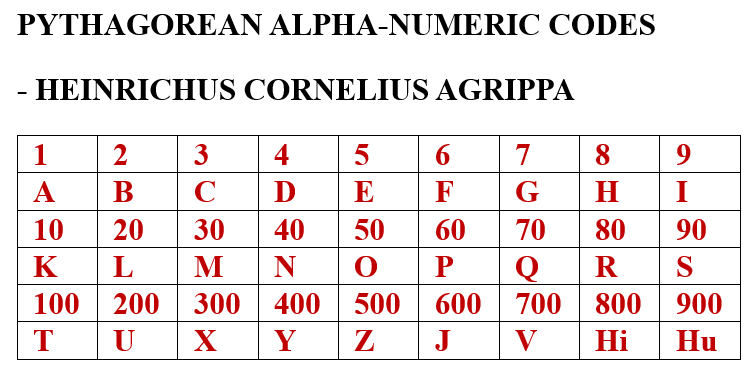
The way we interpret the numbers is to first add all the numbers to TNN, according to the system of Great Values. Jean Jacques Rousseau has 616+ 969+ 716= 2331. From his TNN with value of 2331, we first eliminate the number 2000 (which has no special meaning) and we are left with 331. From this number, we first take away 300, which has the meaning “Safety, belief, faith, philosophy,” and we are left with 31, which has the meaning “Love of glory.”
 The Mystery of Numbers, Luck, Worlds and Planets