In Chaldean numerology, some numerologists attempt to analyze the name “Jesus Christ” using its English form. This approach is both illogical and somewhat laughable, as English did not exist in ancient times—certainly not in regions like ancient Syria, Galilee, Samaria, Judea, or Idumea.
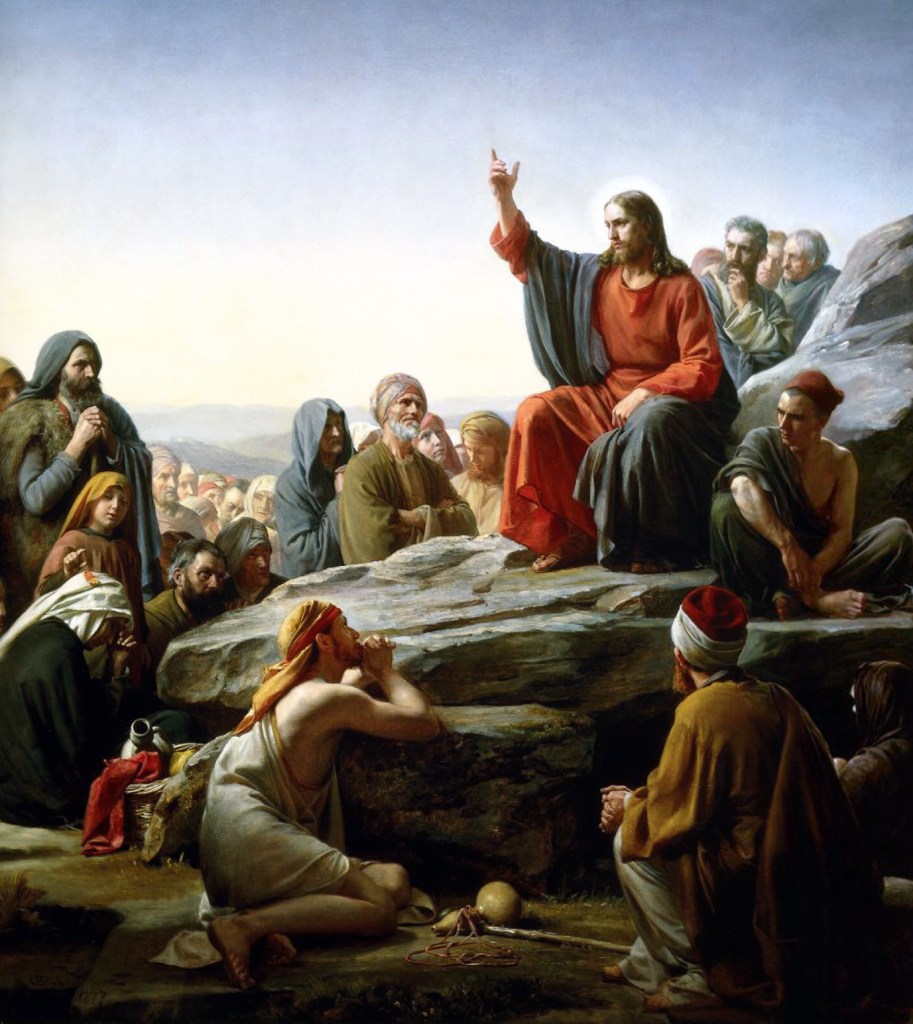
To properly analyze the name, we must use the Hebrew-Aramaic script. At this point, I’m not addressing whether Jesus Christ was a historical figure, a mythological construct, a parody of Roman Flavian Emperors Vespasian or Titus, or a symbolic combination of several Jewish messianic figures. Nor am I discussing his date of birth, which is widely accepted as symbolic and not based on any verified historical source. The Church only selected December 25th in the 4th century, likely because it coincided with the Roman festival of the winter solstice (Sol Invictus). Christmas Day doesn’t typically align with a fixed date on the Jewish calendar, as the Jewish calendar is lunisolar, while the Gregorian calendar (our standard one) is solar. This results in shifting dates between the two each year. The year of his birth is also uncertain.
For this reason, I will focus solely on name-based numerology. The Chaldean analysis will be done using the Mispar Katan technique (מִסְפָּר קָטָן – “small number”), where all standard numerical values of Hebrew letters are reduced to single digits:
Letter Numerical value
א 1
ב 2
ג 3
ד 4
ה 5
ו 6
ז 7
ח 8
ט 9
י 1 (from 10)
כ / ך 2 (from 20)
ל 3 (from 30)
מ / ם 4 (from 40)
נ / ן 5 (from 50)
ס 6 (from 60)
ע 7 (from 70)
פ / ף 8 (from 80)
צ / ץ 9 (from 90)
ק 1 (from 100)
ר 2 (from 200)
ש 3 (from 300)
ת 4 (from 400)
This is arguably the most important technique in Chaldean numerology. Adapted forms of this system have been used for the Latin alphabet by authors like Sepharial, Kozminsky, Hashnu O. Hara, and Cheiro. Note that in this system, we do not use the special final letter values sometimes found in Jewish numerology (used only in the Mispar Gadol – “large number” system):
Letter: Name: Value:
ך kaf 500
ם mem 600
ן nun 700
ף pe 800
ץ tsadi 900
It’s also important to point out that even the name “Jesus Christ” is not reliably known in its original form. The most commonly cited versions in the literature are Yeshua ben Yosef (יֵשׁוּעַ בֶּן יוֹסֵף), Yeshua Ha-Notzri (יֵשׁוּעַ הַנּוֹצְרִי), and Yeshua Ha-Mashiach (יֵשׁוּעַ הַמָּשִׁיחַ). I will therefore focus on these three variations to explore how they numerologically align with the Christian image of the prophet and messiah.
In all cases, the first name is Yeshua (יֵשׁוּעַ), which has a Mispar Katan value of 17—a number inclined toward spirituality and, in some cases, fame that lasts well beyond one’s lifetime. Reduced further, 17 becomes 8, the number associated with Saturn and karmic patterns. The life path of an “8” is often tied to past deeds, whether good or bad.
Yeshua ben Yosef (יֵשׁוּעַ בֶּן יוֹסֵף) contains the values 17 from Yeshua and 21, 7, and 73 from the surname ben Yosef. The surname 21 suggests potential success after hard work, typically post-age 21 or 30. The number 73 relates to leadership and the pursuit of harmony and love. Both numbers (21 and 73) are connected to carpentry. The total value is 81, a Mars number associated with war, misfortune, and aggression. On the positive side, it may indicate business savvy or spiritual transformation. The initials (1 and 2) total 12, which symbolizes sacrifice.
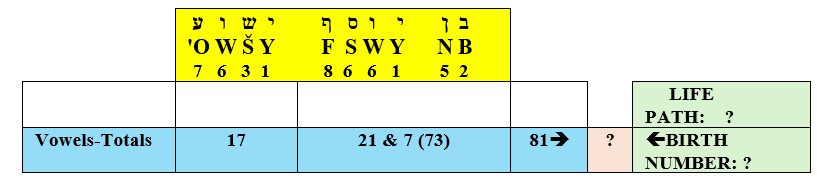
According to the gospel narratives, both Jesus and Joseph were carpenters (21). Jesus gained spiritual fame and remained influential after death (17). Christian teachings describe him as a willing sacrifice (12) for human sins—he died on the cross, which is also an unfavorable aspect of the number 8 within 17. He emphasized the law of love (73). But the Gospels fluctuate between peaceful messages and aggressive, even fearsome tones. References to Peter carrying a weapon, the possible link between “Iscariot” and the Sicarii zealots, and Jesus saying he came to bring fire and the sword, all support the interpretation that the early Christian movement may have had a militant, Zealot foundation. The number 81 aligns with this revolutionary energy.
Yeshua Ha-Notzri (יֵשׁוּעַ הַנּוֹצְרִי), often translated as “Jesus the Nazarene” or “Jesus of Nazareth,” includes the numbers 5, 23, and 55 in the surname. Numbers 5 and 23 denote communication and travel, while 55 symbolizes leadership, judgment, and Jewish law. Again, the total is 81. The initials (1 and 5) total 15, a number tied to magic but also trials and temptation.

Jesus is said to have traveled throughout Galilee, Samaria, and Judea—consistent with the influence of Mercury (numbers 5 and 23). The number 55 relates to Jewish law (like the Ten Commandments—5 on each tablet). 23 is called the Royal Star of Leo. Jesus is sometimes called “the Lion” and the messiah is often seen as a king figure (23, 55). The aggressive Mars number 81 again emerges. The number 15 in this context (15 with 17) suggests spiritual tests—like Satan tempting Jesus in the desert, or accusations that he was possessed or practiced dark magic.
Yeshua Ha-Mashiach (יֵשׁוּעַ הַמָּשִׁיחַ) retains the initials 1 and 5 (totaling 15). The title Ha-Mashiach yields the numbers 5, 16, and 57. The total is 83.
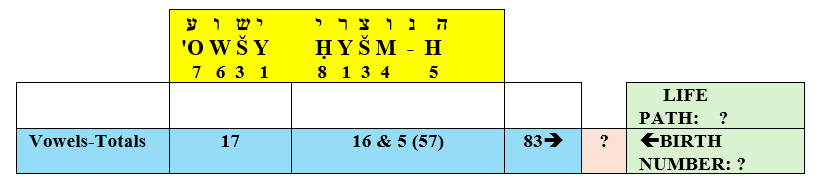
As mentioned, 15—paired with 8 (from 17)—often indicates tests from dark or destructive forces. The number 16 is associated with collapse or ruin, and 57 is a variant of 12, again suggesting sacrifice. This supports the idea of Jesus’ suffering and ultimate sacrifice. The number 83 is commonly emotionally intense—potentially painful—but can also denote the spirit of a fighter and force, once one transcends fear and attachment. Christian theology emphasizes how Jesus transcended attachments to his mother and family- this is aligning with the strength of 83.
While we can’t be certain that these were Jesus’ actual names (alternatives include Yeshu, Yeishu, or Yeshua bar Yosef), the most frequently cited versions align remarkably well with gospel descriptions of his life and mission.
It is also fascinating that the number 3 appears repeatedly in the Gospels and Christian tradition, along with higher multiples like 12 and 30. He was visited by three magi (3), taught in the temple at age 12 (1+2=3), and was searched for over three days (3) by his parents. He had 12 disciples (1+2=3), and one of them betrayed him (12). Jairus’ daughter was 12 years old (3), when Jesus revived her. He predicted his own death and resurrection three times (3), and Peter would deny him three (3) times. Judas betrayed him for 30 pieces of silver (3+0=3). He was crucified at the third hour (3), with two others (3 total), and rose again on the third day (3). Three women (3) discovered the empty tomb (according to Gospel of Mark: Mr 16:1). After his death, the apostles appointed a new “twelfth” disciple (1+2=3).
Despite its spiritual association, these numbers 3 often signal betrayal, sacrifice, denial, and trials. The name value 81 and Yeshua align with 3 and its multiples, but the powerful 83 does not.
There’s also a strong presence of 2, 4, and 6—but not 9.
- 2 is mostly favorable: Jesus and his Father (2), Jesus feeds followers with two fish (2), appears to two disciples (2), and two women (2) discover the empty tomb. Also positive aspect: The Parable of the Servants and the Talents (duplication= x2). But also negative: Jesus and Barabbas (2), Jesus and Satan (2).
- 4 is mixed: four fishermen (4) called as first disciples, 4,000 fed (4+0+0+0=4), and appearances over 40 days (4+0=4). But also: 40 days of temptation, and four woes (4) pronounced.
- 6 is also mixed: conceived six months (6) after John the Baptist, after the crucifixion of Jesus, the sky darkened at the sixth hour (6) on a Friday (day of Venus= 6), and God’s word came in the 15th year (1+5=6) of Emperor Tiberius.
The numbers form a cycle of 2-4-8, with 8 as the core—representing suffering, redemption, and potential success through trial and good deeds. The absence of 9 may be intentional; a strong “8” doesn’t require the finality of 9. Interestingly, 3 and 6 try to complete the influence of 9, but number 8 may disrupt their strength. Ultimately, Jesus’ presence appears as an embodiment of the power of 8, with its themes of karma, endurance, suffering, and eventual spiritual triumph.
 The Mystery of Numbers, Luck, Worlds and Planets