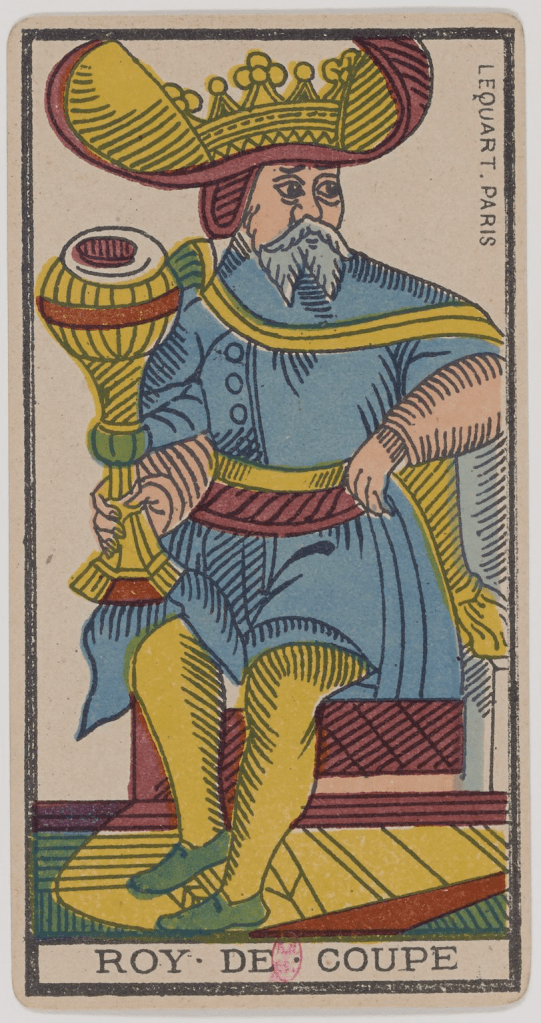
In older traditions, the number 37 was recognized as highly fortunate. In later Chaldean traditions, it became known as the “Royal Star of the Bull” or Aldebaran, as well as the “King of Cups.” Generally, it exerts a positive influence, fostering favorable connections, harmonious partnerships, courage, love, status, and professional success.
When the number 37 is doubled, it yields 74, one of the rare relatively fortunate numbers in the 2 series (7+4=11; 1+1=2). Multiplying 37 by 3 results in 111, which is considered the number of the Pleiades—a predominantly lucky number, similar to 21.
Multiples of 37 also exhibit fascinating numerical properties. When 37 is multiplied by any integer, the result will always numerologically correspond to that multiplier. For example, summing the digits of the multiplier and the result yields the same base number. Consider 37 x 14 = 518: the digits of 14 sum to 1+4=5, and the digits of 518 sum to 5+1+8=14; 1+4=5.
When the digits of the multipliers add up to 3, 6, or 9, the products of numbers from 111 to 999 will always result in a number made up of three identical digits. For example, 37 x 3 = 111, 37 x 6 = 222, 37 x 9 = 333…
The number 333 is widely revered today as a number of manifestation and spiritual reconnection. It represents the first multiplication of 37 (base number 1) by a multiplier with a base number of 9. Numerologically, 1 signifies a beginning, and 9 signifies an end. In the Pythagorean tradition, this relationship symbolizes the Alpha and Omega—a sense of wholeness.
When 37 is multiplied by 18, a number associated with war and materialism, the result is 666. In its negative aspect, 666 symbolizes war, devastation, beasts, and egoism. Numerologically, 37 can signify a military leader, while 18 represents war. In Christian tradition, 666 is the number of man and the beast. According to the Genesis creation narrative, God created man on the sixth day, and 666, being a tripled six, symbolizes humans. Moreover, the digits in 666 sum to 18, the number of war, beasts, and aggression.
When 37 is multiplied by 24, the result is 888. The number 37 represents love and harmonious relationships, while 24 typically brings luck and prosperity. The digits in 888 also sum to 24. In Christian-Pythagorean tradition, influenced by Chaldean numerology, 888 is considered the number of the Redeemer. The Greek name for Jesus, Ιησους (Iesous), carries the numerical values 888. However, in Chaldean numerology, the number 888 can also have a nuanced and challenging meaning related to how the digit 8 operates—a topic for another discussion.

The opening sentence of the Bible, “In the beginning, God created the heavens and the earth” (Bereshit bara Elohim et hashamayim ve’et ha’aretz) has a total numerical value of 2,701 in Hebrew gematria:
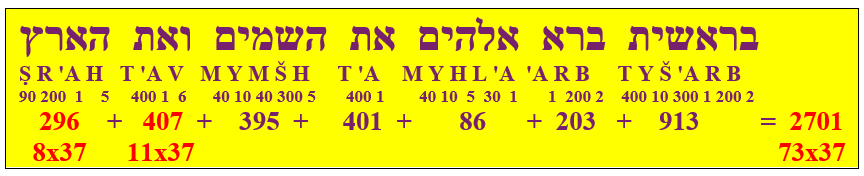
When 37 is multiplied by its mirrored counterpart, 73, the result is also 2,701. Additionally, summing 2,701 with its mirrored counterpart, 1,072, yields 3,773—a number that seems to unify numbers 37 and 73.
The Hebrew word ha’aretz (הארץ), meaning “the earth,” has a numerical value of 295, which is the product of 37 (love and strength) and 8 (Saturn, associated with the element of earth). The word ve’et (ואת), signifying connection (specifically between heaven and earth), has a value of 407. This number is the product of 37 and 11 (base number 2, representing connection or separation). Genesis 1:1 thus establishes the foundation of creation: seven Hebrew words correlate with the seven days of creation, with love (2,701) as the core principle. The created earth (296) exists in a realm of love and is connected to the higher world through love (407). Additional interpretations connect the number 2,701 to Jesus Christ, which can be explored further online.
| NUMBER 37 | MULTIPLIER | RESULT |
| 37 | 1 | 37 |
| 37 | 2 | 74 |
| 37 | 3 | 111 |
| 37 | 4 | 148 |
| 37 | 5 | 185 |
| 37 | 6 | 222 |
| 37 | 7 | 259 |
| 37 | 8 | 296 |
| 37 | 9 | 333 |
| 37 | 10 | 370 |
| 37 | 11 | 407 |
| 37 | 12 | 444 |
| 37 | 13 | 481 |
| 37 | 14 | 518 |
| 37 | 15 | 555 |
| 37 | 16 | 592 |
| 37 | 17 | 629 |
| 37 | 18 | 666 |
| 37 | 19 | 703 |
| 37 | 20 | 740 |
| 37 | 21 | 777 |
| 37 | 22 | 814 |
| 37 | 23 | 851 |
| 37 | 24 | 888 |
| 37 | 25 | 925 |
| 37 | 26 | 962 |
| 37 | 27 | 999 |

 The Mystery of Numbers, Luck, Worlds and Planets