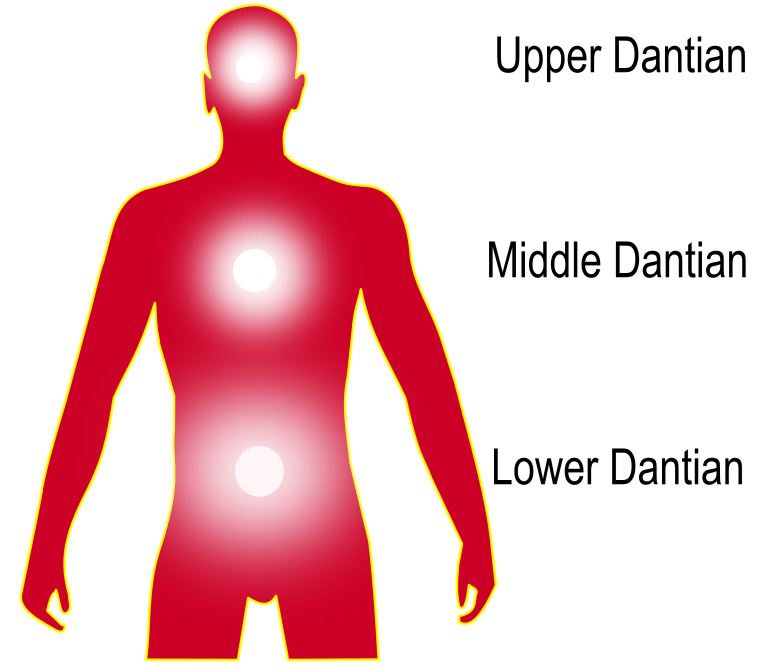
In traditional Chinese spirituality and medicine, the lower dantian is a vital energy reservoir located in the lower abdomen. It is closely associated with several mantras and plays a key role in our connection to life force energy. The lower dantian is linked to the kidneys, to the essence of life known as Jing, and to overall vitality, calmness, and stability. It also serves as an appropriate place to store surplus energy. One can focus attention on the dantian, perform breathing exercises in connection with it, or simply relax and allow the sensation of expansion in that area to unfold. Using mantras is another way to activate it.
In addition to the lower dantian, there are two others: the middle dantian at the level of the chest, and the upper dantian located in the head. However, this piece focuses solely on the lower one.
There are various mantras that can be used with the lower dantian. For example, the Indian mantras VAM (वं) and SITA (सीता) are appropriate, as both are connected to the kidneys, which in turn are associated with the Mingmen and the Dantian. The Buddhist mantra HUM (हूँ)—or in Chinese pronunciation HENG (吽)—is also commonly used in this context. One might also work with the Chinese mantra JUE (劂) or JIAO (pronouncing the letter “J” as a softer version of the English “J”), or a related mantra JIU (九), which literally means the number nine. The mantras TAO and DOU (鬭), which some use in this area, might be variations or distortions of JIAO. Additionally, the mantra SHAO (捎) can be mentally invoked during inhalation.
There are also mantras that guide the flow of energy through a broader area. A good example is the Buddhist OM AH HUM (ॐ आः हूं), which is used to guide energy downward: OM focuses on the head, AH on the heart, and HUM on the abdomen. The Chinese parallel is WENG AR HENG (嗡 啊 吽). Similarly, the Hebrew mantra AMEN (אָמֵן) can be used, where the sound AM corresponds to the head and mirrors OM, while the sound EN can represent the abdomen and the lower dantian.
 The Mystery of Numbers, Luck, Worlds and Planets