Chaldean Numerology and Alcoholism

Alcoholism has been recognized as one of the most common forms of addiction for millennia. It’s no surprise that Chaldean numerologists and Hellenistic astrologers of ancient times (during the Hellenistic period and the Roman Empire) were already studying its connections. Back then, alcoholism was astrologically linked primarily to Mars and, to some extent, Libra. Later, some astrologers also considered the Moon, as it rules over liquids.

Numerologically, excessive drinking was associated with the number 9 (the number of Mars and soldiers). It was also likely linked to Saturn’s number of hardships – 8 – especially when combined with 9 or 15. In addition to these two numbers, almost all other numbers seemed to play a role in some way. For instance, 2 (fluids), 5 (youth), 3 and 4 (excess), and possibly even 1- though these numbers probably had to be in an unfavorable connection with either 8 or 9 to be significant.

In the 19th century, Western astrologers associated wine more with Jupiter, the ruling planet of Sagittarius and Pisces, rather than Mars. Once Neptune’s characteristics were defined, alcohol dependence was often attributed to the influence of both Jupiter and Neptune, which correspond to the numbers 3 and 7.

Chaldean numerologist Cheiro rejected these newer interpretations. To him, alcohol remained connected to Mars and the number 9, and he also suggested that addiction-related issues could appear with the number 4. Meanwhile, Pythagorean numerologist Florence Campbell, a contemporary of Cheiro, identified numbers 5 and 7 as being linked to addiction.

In 1973, Gerun Moore published a book that, under the lens of modern Western astrology, connected alcoholism to numbers 3 and 7, along with the karmic number 8.

My own research suggests that the foundation of alcoholism lies in the negative aspects of numbers 7, 8, and 9. These are followed by numbers 3, 5, and, in some cases, 4—but 4 and 5 only become problematic when they form an unfavorable combination with one of the first three numbers. My formula is as follows:

{ 7, 8, 9 }  >  3  > { 4, 5 }

It’s important to note that not everyone with a strong presence of 7, 8, or 9 (or even 3) in their numerological chart will turn to alcohol as a coping mechanism. Free will always plays a role, and individuals can overcome these tendencies through self-awareness, relaxation techniques, and spiritual growth. The same applies to the interaction of two numbers within relationships.

However, people with the following number combinations may be more prone to alcoholism:

  • 7 and 8: Emotional coldness, a tendency toward depression, and withdrawal from others can lead someone to seek solace in alcohol. Relationships between individuals with these numbers may also struggle with alcohol-related issues.
  • 8 and 9: This combination, whether found in a personal chart or a relationship, can trigger patterns of aggression alternating with apathy. It may also bring feelings of misunderstanding and frustration.
  • 7 and 9: Emotional crises can lead to alcohol dependence.
  • 3 and 7: Emotional drama and relationship turmoil may arise. Alcohol may either be the cause of relationship problems or a consequence of them.
  • 5 and 8, or 2, 5, and 8: Emotionally challenging relationships that cannot be overcome or rationalized may push individuals toward alcohol as a way to cope.
  • 8 and 15: Difficulties in relationships and emotional attachment can drive a person toward excessive drinking.

Chaldean Numerologist: Cheiro

William John Warner, better known as Cheiro (November 1, 1866 – October 8, 1936), was also referred to by nicknames such as Count Louis Hamon and others. However, he is primarily remembered as Cheiro. He was a British astrologer, numerologist, and palm reader.

His birth name contains numbers—13 and 15 (the sum of 96; 9+6=15). The base numbers 4 and 6 govern his numerological chart. This chart reveals a strong desire for recognition and performance (particularly highlighted by 96, with 24 in Life Path and 15 as the base number in his surname), along with a drive for success in business. Cheiro’s official name also reflected a robust longing for friendship and love, from which he drew significant spiritual strength. Additionally, he enjoyed fairly favorable influences of numbers on the chakras, which may have contributed to his reputation as a successful medium for a time.

The combination of numbers 13 and 15 sparked his interest in the occult (both 13 and 15), reforms, pioneering approaches (13), and even magic (15, 41). The number 41, in particular, fosters a fascination with numerology, which is further emphasized by his nickname “Cheiro” (Mercury and 23). Due to the numbers 13 and 15, an individuals may either become a victim of manipulation and circumstances or turn into a manipulator themselves… The overall numerological chart is complex and can bring strokes of fate that often arrive unexpectedly.

Cheiro was convicted and imprisoned in Paris around 1910 for business fraud, and it is said that this scandal closed doors among the English elite, prompting his move to the morally less stringent United States. An analysis of his works reveals a tendency for manipulation and misinformation—claiming, for instance, that he had been offering numerological guidance based on his system since the late 19th century, or that number 9 was so sacred it couldn’t correspond to any letter. Moreover, he downplayed the contributions of his European sources, like Isidore Kozminsky and Sepharial, while asserting he learned Chaldean numerology from an Indian brahmin.

Cheiro. Source: Wikimedia Commons, File:Cheiroy.jpg .

It’s essential to recognize that relationships between 15 and 4, or between 15 and 8, should not be judged too harshly. Not everyone with such combinations inherently becomes a manipulator, criminal, or prisoner. An individual’s morals and self-awareness dictate whether they use their strengths for good or ill, and when, if ever, they will yield to temptation. Furthermore, numerological charts can point to which areas of life help to balance the individual. For Cheiro, these areas primarily involved seeking courage, forming a connection with God, and nurturing love and kindness.

Even in his nicknames—like “Count Louis Hamon” and “Count Leigh de Hamong“—the theme of number 13 is prominently featured. It seems Cheiro intentionally emphasized this number, perhaps because it brings uniqueness and combines with the interchangeable number 1 to form a whole.

His nickname “Cheiro” underscores intellectual depth, as it contains the numbers for Mercury and the Sun. The number 23 derived from the nickname is considered auspicious.

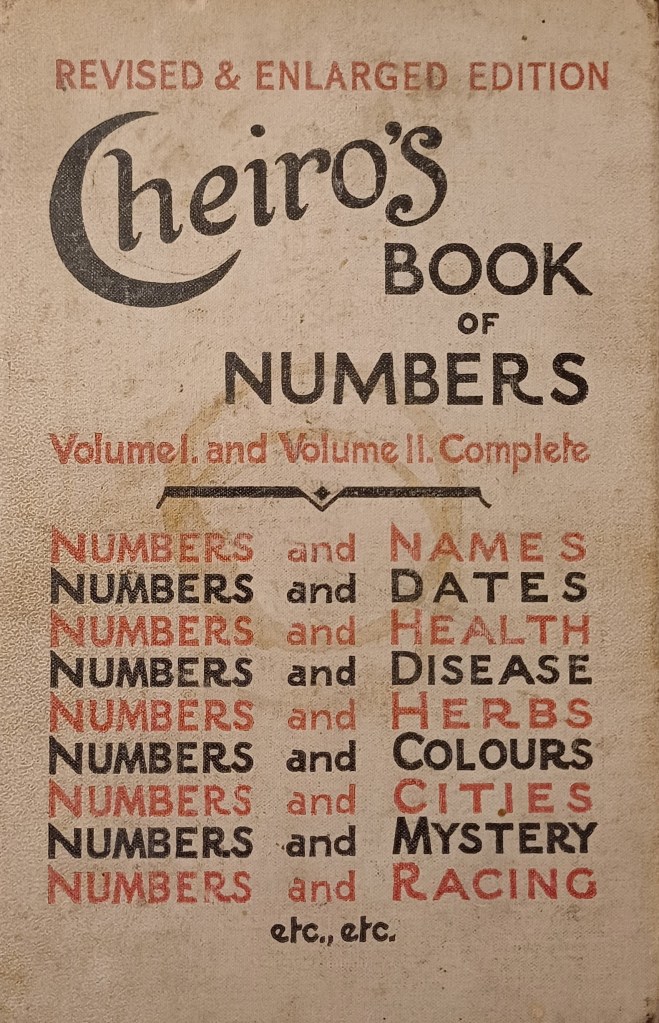
In 1926, Cheiro published a book titled Cheiro’s Book of Numbers. In it, he defined the meanings of numbers in Chaldean tarot from 1 to 52, based on older sources. He also defined the rules of matching and mismatching between numbers. For each of the numbers 4 and 8, he differentiated between karmically strong and weak numbers, determining various numbers that align with them. He described favorable and less favorable months, recommended specific herbs and foods, indicated favorable colors and gemstones, and identified ailments commonly associated with particular numbers.

It’s very likely that Cheiro drew the foundational idea of alpha-numeric coding from Isidore Kozminsky, who assigned the letter H a value of either 5 or 8, and the letter X a value of 5. Based on his research, Cheiro developed an alpha-numeric coding scheme in which letters H and X always hold a value of 5. He also altered the value of the letter C, assigning it a value of 3 instead of 2.

For Cheiro, the key to analysis lies in the birth date, or Birth Number. He believed that the Total Name Number (TNN) should align with the Birth Number; otherwise, an individual might encounter challenges throughout life. He further explored the numerological influences of each day of the year based on the specific day of the month. Around 1936, he published another book titled You and Your Star, in which he detailed favorable numbers for every day.

Cheiro’s ideas of such favorable numbers influenced numerologists like Gerun Moore and Lloyd Strayhorn, who developed their own systems based on these concepts.

In Cheiro’s Book of Numbers, he established special guidelines to identify the most important two-digit number in a numerological chart. This number frequently corresponds to TNN, but sometimes the most significant number is derived from adding the birth date and TNN together (Birth Number + TNN). Cheiro did not assign a name to this number, but I personally refer to it as the Goal Number (which differs from Goal Numbers in Pythagorean numerology). Anmarie Uber called it the “Hidden Number,” while some perceive it as an indicator of career success.

Cheiro’s book, Cheiro’s Book of Numbers, does not provide reliable techniques for predicting the future. It also contains inaccuracies, such as the assertion that the Chaldeans were unaware of letters with a value of 9. Nonetheless, despite not being a comprehensive manual, this work played a pivotal role in the evolution of numerology. In many ways, Cheiro is considered the father of modern Chaldean numerology.

Chaldean Numerologist: Gerun Moore

Gerun Moore (1910–2010) was an American Chaldean numerologist and musician. He was born in March 1910 in New Orleans as Sterling Guerin. According to his own claims, he was born on March 10, but therapist John Ensminger, who visited him in a nursing home, explicitly noted that his last birthday was on Saturday, March 13, 2010. It is very likely that March 10 was simply a “new birthday” for Gerun Moore, as he, being a numerologist, advocated for changing the vibrations of one’s birthdate by celebrating on a favorable day close to the actual birthday. This favorable day would have a base number from the key of the original birthdate. In Moore’s case, the key numbers associated with his birthdate were said to be 1 and 7.

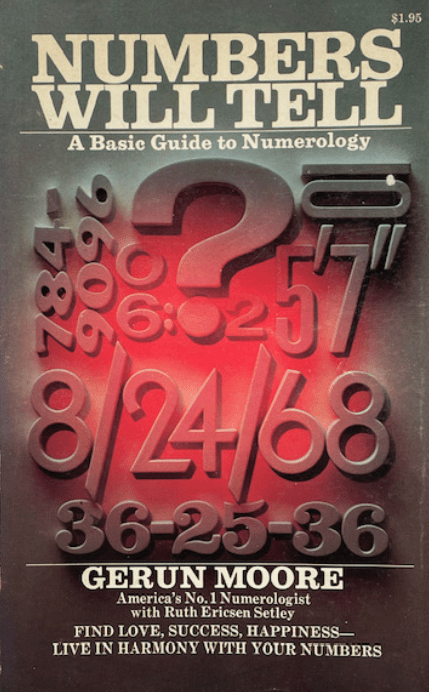
His father was also a musician. Gerun Moore followed in his footsteps and performed in a well-known jazz band Louis Prima Orchestra. Even before World War II, he began delving deeply into numerology. He initially explored Pythagorean numerology, too, but during the war, he became a strong advocate of the Chaldean school. Influenced by Cheiro’s teachings, Moore developed his own approach and changed his name to Gerun Moore. He started celebrating his birthday on March 10. Later, he wrote a book titled Numbers Will Tell. A Basic Guide to Numerology. He was known for his kindness, laughter, and joy.

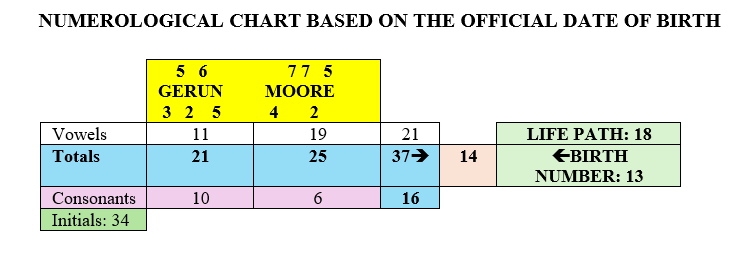
Gerun Moore used alpha-numeric encoding as advocated by Cheiro

His birth numerology chart reveals a lot of negative energy. In his name, surname, and Total Name Number (TNN) as Sterling Guerin, we find difficult numbers: 26, 22, and 84 (or 12; 8+4=12). His Life Path Number was also an unfavorable 18, and in such circumstances, even a birthday on the 13th of the month represents challenges and negative influences. This numerology chart is very demanding, but Sterling Guerin’s consonants at least create somewhat more favorable numbers. However, the number 21, like the TNN 84, is not a number that aligns well with the number 13.

There are many numbers that can be associated with music and art. For example, 15 and 6, which gives stage art, and in the case of Sterling Guerin, 13 (Birth number) may be related. Sometimes the numbers 2 (consonants in personal name) and 7 (goal number) are associated with music. Likewise, the number 3 (TNN 84 and consonant total 21) can bring art, especially when it comes to stage performances. Sterling Guerin’s interest in the occult was probably related to the formation of the numbers 3&6&9, the birthday 13 and the number 7.

Despite the challenging vibrations in Sterling Guerin’s numerology chart, there are several spiritual indicators. If Guerin leaned on the power of faith and spiritual values, he could have greatly alleviated his life. The chart also brings some manifestation abilities and talent for public performances, whether in the media or on stage. Even difficult charts can reveal talents, and Sterling Guerin found his path to the stage.

After changing his name, Gerun Moore retained some indicators for manifestation and spiritual qualities and gained more vibrations of love. His new TNN was 37, which is a highly favorable number. Moore referred to the TNN as the “ruling name number.” Name numbers brought very strong and favorable vibrations, despite the consonant number being 16. When an unfavorable number is surrounded by many positive numbers, its harmful influence is greatly reduced. Whether we consider the 13th or 10th of March as his birthday, the new vibrations are very favorable. Numbers 37 and 13 are also interchangeable, bringing more completeness to life. Additionally, these numbers have an alignment that can bring a youthful spirit.

The new name contains the numbers 11, 25, 21 and 16, which may be associated with music. Also 1 in such a chart can be directed towards artistic talents, especially 37, which is his new TNN. Vibrations that may give an interest in the occult have also been retained (21, 25, 16, 11…).

The numerological change that Gerun Moore made was, therefore, favorable and brought more harmony and satisfaction into his life.

Although he greatly respected Cheiro, as a Chaldean numerologist, Gerun Moore did not believe in the validity of summing unreduced numbers. He rejected Cheiro’s complex method of finding the most powerful active compound number in a numerology chart. Furthermore, he did not trust Cheiro’s model of lucky numbers based on specific days of the year. After three decades of research, Moore developed the so-called “Name Number Chart.” This chart represents a system of “keys,” numbers that bring the most balance to a numerology chart. Almost every date has two such keys, and in three cases, dates have only one key. Moore believed that a name change should always include numbers found in these keys.

Personally, I do not use his keys, as any numerology chart can be studied in different ways. Additionally, there is no consensus among numerologists about which numbers bring the most luck based on specific days of the year. Cheiro presented his model of lucky numbers, and a few years after Gerun Moore, Lloyd Strayhorn, another influential modern Chaldean numerologist, did the same. Neither Cheiro, Linda Goodman, nor Gerun Moore emphasized the Life Path Number, nor the numbers of vowels and consonants. Various analyses show that these numbers should also be considered.

In his book, Gerun Moore also presented his findings on the relationship between numbers and musical instruments. His conclusions are likely quite accurate, as he was a musician who could study the numerology charts of many colleagues. Additionally, he demonstrated connections between numbers and plant species, as well as the relationship between numbers and sexuality.

One of Gerun Moore’s more notable ideas, as mentioned, was his advocacy of the idea that a birthday can be “changed” by celebrating it on a favorable day in the month. In reality, we cannot change our birthdate. What we are actually changing is the vibration. In Slovenia, this approach was adopted by a numerologist (then named Naca Jermanj), who observed in many cases that celebrating a birthday on a favorable day indeed brought good fortune. Certainly, Gerun Moore’s book should have a place in every Chaldean numerologist’s library.


Some sources:

Chaldean Numerologists: On Modern Classics

Every student of Chaldean numerology should be familiar with key modern Chaldean numerologists such as Sepharial, Isidore Kozminsky, Cheiro, Pandit Sethuraman, Richard Cavendish, Gerun Moore, Lloyd Strayhorn, and Linda Goodman. All of these numerologists were also astrologers.

Sepharial (Walter Gorn Old) played a crucial role in transitioning from the older Chaldean school of “Kabbalistic astrologers” to modern numerology. He also introduced classical descriptions of numbers from Kabbalistic astrology, where the highest number described in this approach is 71. He later wrote a very popular book, “Kabala of Numbers” (1911).

In his development, he initially used an external method of alphanumeric coding of the Latin alphabet (C = 2, H = 8, X = 6). Later, he tested several different alphanumeric approaches but ultimately decided on phonetic numerology.

Isidore Kozminsky, like Sepharial, experimented with various methods of alphanumeric coding. At the latest, in an updated edition of “Numbers: Their Meaning and Magic” in 1911, he was the first modern numerologist to predict that we should, in some cases, treat the letter H as 5.  He also assigned the number 5 to the letter X. Like Sepharial, he described all the numbers he believed to have a “distinct potency of its own.” All other numbers he reduced to a number with such potency. His approach of dealing with name numbers is now considered outdated.

Cheiro (William John Warner) is regarded as the father of modern Chaldean numerology. He wrote several books covering numerology, with the most famous being “Cheiro’s Book of Numbers” (1926), where he advocated for the value of 3 for the letter C, 5 for the letter H, and 5 for the letter X.

Cheiro. Source: Wikimedia Commons, File:Cheiroy.jpg .

He emphasized the importance of the Birth number (the day of the month one is born) and its connection to the Name number (that is, Total Name Number, aka TNN). He was one of the first to focus on the compatibility of numbers. He adopted Sepharial’s number descriptions, sometimes expanding them, so they corresponded to some very old descriptions. However, he described numbers only up to 52. He also wrote a book called “You and Your Star”, where he described the most suitable numbers for each day of the year based on astrological techniques.

Pandit Sethuraman, in his book “Science of Fortune” (1954), adopted Cheiro’s alphanumeric coding but summed the unreduced numbers of the first and last names. He also deviated from Cheiro’s views on number compatibility. Sethuraman expanded Cheiro’s descriptions based on his own insights and described numbers up to 108. Unlike Cheiro, he considered numbers 39 and 48 to be unfavorable.

Richard Cavendish, in his 1967 book “The Black Arts” (which has quite an inappropriate book title, especially in connection to astrology and numerology), introduced the classical internal method of alphanumeric coding (with C = 3, H = 8, X = 6), although he seems to have arrived at this through his own research. He emphasizes the importance of considering the numbers of vowels and consonants, a concept long neglected in Chaldean numerology.

Gerun Moore wrote a book in 1973 titled “Number Will Tell”. He adopted Cheiro’s alphanumeric coding system but made several changes and additions to the descriptions of numbers and the rules of compatibility. Notably, he described numbers 39 and 48 as the unlucky number 12.

He also rejected Cheiro’s model of favorable numbers for each day of the year. Instead, he created his own system, where each day of the year is generally assigned two suitable numbers (though in some cases, only one number is given). He labeled these numbers as “keys.” According to him, name numbers matching a person’s key numbers bring luck and harmony.

Lloyd Strayhorn wrote his book “Numbers and You: A Numerology Guide for Everyday Living” no later than 1980. He adopted Cheiro’s alphanumeric coding system. Although he prefers Chaldean numerology, he also considers Pythagorean numerology. Based on his research, Strayhorn introduced his own system of number compatibility, which differs somewhat from Cheiro’s model.

He also rejected Cheiro’s model of favorable numbers for each day of the year, offering instead his own astrological model with lucky numbers. He later published “Lloyd’s Numbers and You Relationship Guide: A Cosmic Blueprint to Happiness & Joy”, in which he distances himself significantly from older Chaldean approaches.

Linda Goodman published a book “Linda Goodman’s Star Signs” in 1987, which also introduces Chaldean numerology. She adopted Cheiro’s alphanumeric coding system and significantly enhanced the descriptions of numbers. However, her method of determining the TNN deviates from those of her predecessors.

Linda Goodman concludes the list of modern classics in Chaldean numerology. I believe that this list provides an appropriate foundation for studying contemporary Chaldean numerology.

There are also a few Chaldean numerologists who have uncritically incorporated Pythagorean methods of interpreting numbers and relationships. While some ideas from the Pythagorean system can be adopted, not all Pythagorean techniques are suitable for Chaldean numerology.