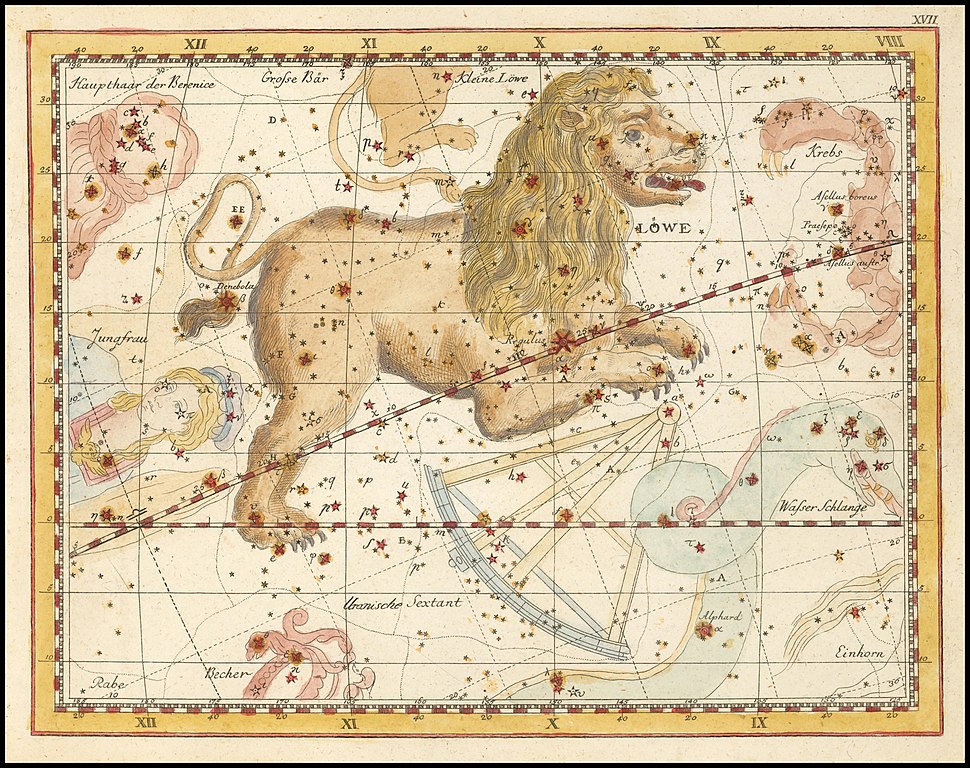
The number 23 is known as the “Royal Star of Leo,” “The Royal Star of the Lion”, or Regulus. Regulus is a powerful and bright star that brings success, courage, and victory, along with intelligence, favorable positions, and positive developments in events. It also offers protection from influential individuals.
The number 23 isn’t just a royal star; it is associated with the ruling planet that governs this number. The conjunction of Mercury and Regulus can lead to great speakers, talented writers, keen intelligence, honorable communication, integrity, and prosperity.
The Constellation of Leo and Regulus (by Johann Elert Bode). Source: Wikimedia Commons. File:Johann Elert Bode – Leo.jpg
The interpretations of Chaldean numerologists from the late 19th and early 20th centuries follow the astrological foundations mentioned above, while largely preserving the traditional meanings of the number.
Sepharial provided the following explanation of the number: “XXIII (23). Royal star of Leo. Protection and favor of persons in authority; celebrity; success.“
Cheirodescribed the number as follows: “23. This number is called “the Royal Star of the Lion.” It is a promise of success, help from superiors and protection from those in high places. In dealing with future events it is a most fortunate number and a promise of success for one’s plans.“
Sources:
Cheiro (1935). The Cheiro’s Book of Numbers. London, Herbert Jenkins Limited.
Sepharial: (revised edition from 1909). Your Fortune in Your Name or Kabalistic Astrology.
The number 65 is classified among the so-called royal stars. These are fourfixed stars located at the four corners of the sky: in Taurus, Leo, Scorpio, and Aquarius.
65 is known as the “Royal Star of Scorpio” or Antares. It brings good fortune but also poses risks from enemies, accidents, and wounds. It can be associated with war. A person with this number may receive protection from influential individuals. Number 65 is not only a royal star but is also connected to the leading luminary that governs this number— the Moon. The conjunction of the Moon with Antares brings intense emotions and danger from plots, conflicts, opponents, and injuries, but it also brings prosperity and potential happiness in love.
The interpretations of Chaldean numerologists in the late 19th and early 20th centuries follow the aforementioned astrological justifications, while largely preserving the traditional meaning of the number.
Scorpio with Antares. File:Johann Elert Bode – Scorpio & Libra.jpg
Sepharialprovided the following explanation of the number: LXV (65). Royal star of Scorpio. Powerful enemies; wounds; dangers; gives also protection of rich persons, and a good marriage.
The interpretations of Chaldean numerologists in the late 19th and early 20th centuries follow the aforementioned astrological justifications, while largely preserving the traditional meaning of the number.
Further reading: Sepharial (revised edition from 1909): Your Fortune in Your Name or Kabalistic Astrology.
Number 37 is known as the “Royal Star of the Bull,” “Royal star of Taurus” or Aldebaran, also referred to as Facula. The Roman astrologer Ptolemy once wrote, “Of the stars in the head, that one of the Hyades which is bright and ruddy, and called Facula, has the same temperament as Mars.”
Taurus with Aldebaran. Source: Wikimedia Commons. File:Sidney Hall – Urania’s Mirror – Taurus.jpg
Based on this, Aldebaran is often interpreted as a star of honors and successes, but also as a star of disputes and violence. Number 37 is not only a royal star, but it is also associated with the leading luminary that governs this number. Number 37 has a base number of 1, which represents the Sun. Following the standard astrological interpretation, the conjunction of Mars with the Sun leads to the following interpretation: disputes or violence, danger of wounds, and violent deaths. At the same time, it must be considered that Aldebaran, being the “royal star,” also brings honors and success. Given the generally unstable nature of political positions, we may arrive at the idea that with the conjunction of Aldebaran and the Sun, success and fame are often followed by downfall and disgrace.
It’s important to note that due to its status as a highly favorable royal star, Chaldean numerology has regarded Aldebaran for centuries as a more favorable influence of Mars. According to this interpretation, the star brings positive developments, brilliance, and influence. Individuals associated with this star are courageous, unafraid of their adversaries, and usually emerge victorious in battles against them. Their ability to fight for their goals stems from the martial nature of this star. They often act for the greater good, and it is rare for them to suffer wounds from opponents (which contrasts with the general interpretation!).
As a conjunction of the Sun with “positive Mars”/Aldebaran, number 37 can indeed bring some disputes and conflicts, yet individuals with this number typically emerge as winners. This conjunction also brings business triumphs, enabling a person to secure both their prosperity and beneficial partnerships. Due to the intrinsic nature of Aldebaran, it is advisable to avoid connections with aggressive numbers, such as 18. Modern interpretations by Chaldean numerologists in the latter half of the 19th century and the early 20th century follow this “Chaldean” astrological reasoning, largely preserving the traditional meaning of the number.
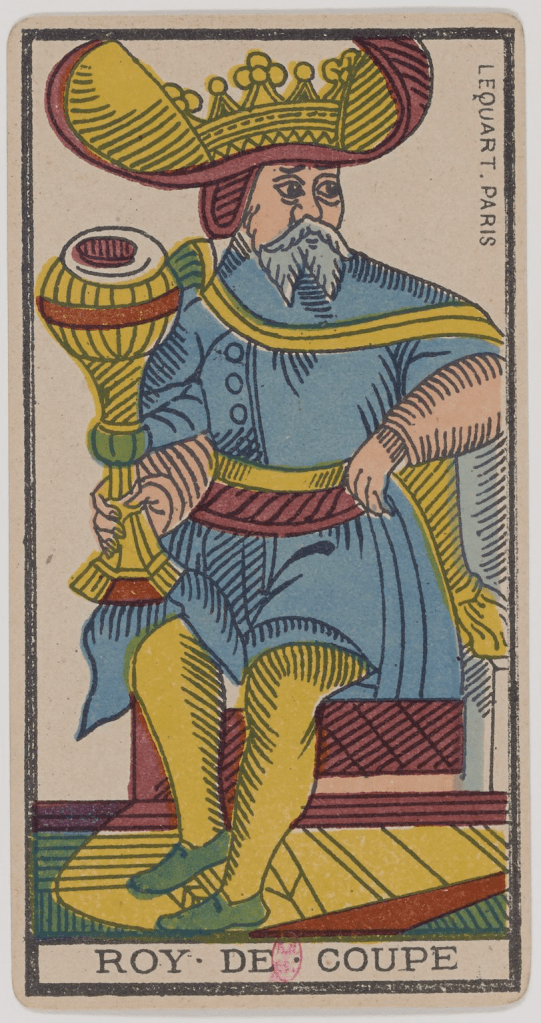
Chaldean numerology and astrology were utilized in the 15th century for the Italian interpretation of tarot cards. Thus, Aldebaran appears as the “King of Cups,” and, in addition to courage and honor, brings pleasant emotions, friendship, and love. This aligns with the traditional nature of number 37.
King of Cups. Source: Wikimedia Commons, File:KC Tarot.png
Sepharial provided the following explanation of the number: “XXXVII (37). Royal star of Taurus. Union; marriage; protection of ladies in position; goodwill; sincere friendship; success through associations with the opposite sex.”
Cheiro described the number as follows: “37. This number has a distinct potency of its own. It is a number of good and fortunate friendships in love, and in combinations connected with the opposite sex. It is also good for partnerships of all kinds. It is a fortunate indication if it appears in connection with future events.”
Sources:
Cheiro (1935). The Cheiro’s Book of Numbers. London, Herbert Jenkins Limited.
Firmici Materni Matheseos: Liber Sextus, II.
Ptolemaios (2nd century AD): Tertrabiblos, chapter IX: The influence of the fixed stars.
Sepharial: Your Fortune in Your Name or Kabalistic Astrology‘ (revised edition from 1909).
Although Western astrology is based on the seasons (tropical system), Chaldean numerology also explores connections with fixed stars and constellations. The development of Chaldean numerology was undoubtedly influenced by Egyptian sidereal astronomy (circa 3000 BCE) and later, during the Hellenistic period, by Egyptian sidereal astrology (ancient decans).
There is ongoing debate about whether an ancient Chaldean astrology (around the 5th to 4th century BCE), was based on sidereal or tropical astrology. My personal opinion is that the shared astro-numerological foundation was sidereal, although I won’t delve into proving this here. If true, Chaldean numerology is, in a way, closer to Indian astrology (which is sidereal) than to Western astrology (which is tropical).
These four stars can also be combined with planets represented by specific numbers. For instance, 23 represents Mercury in conjunction with Regulus, 37 represents the Sun in conjunction with Aldebaran, and 51 represents Venus in conjunction with the star Markab. The conjunction between the Moon and Antares symbolizes the number 65.
Chaldean numerology can be used to designate additional stars. Various criteria exist for categorizing stars numerologically, and according to one criterion, the following fixed stars can be defined: • 21 – Polaris • 82 – Arcturus • 91 – Sirius
Some constellations include: • 11 – Virgo and Leo • 17 – Andromeda • 37 and 111– Pleiades • 13 and 43 – Draco



 The Mystery of Numbers, Luck, Worlds and Planets