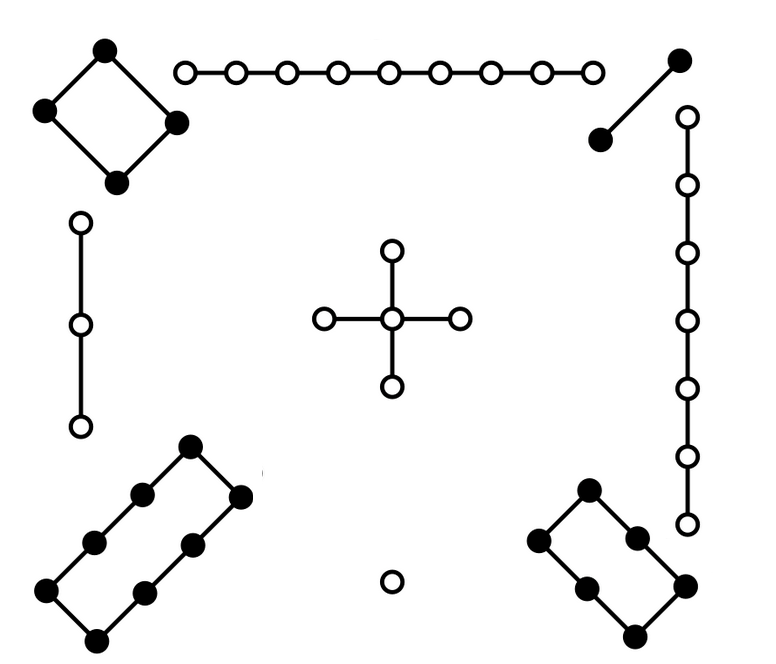
The Luo Shu (洛书; in an older Latinized spelling: Lo Shu) is a 3×3 matrix with a special arrangement of numbers. Only those vertical, horizontal, or diagonal lines that include the central number 5 add up to 15, which represents wholeness. In China, this diagram appears in Feng Shui, where it is used to assign elemental influences to the eight directions and to define specific numerological configurations within the sectors of a structure (Fei Xing).
The idea of connecting the Luo Shu grid with Western numerology is relatively recent. Pythagorean numerologists developed the concept of “arrows” based on the standard matrix of lines (1, 2, 3; 4, 5, 6; 7, 8, 9; 1, 4, 7; 2, 5, 8; 3, 6, 9; 3, 5, 7; and 1, 5, 9). In 1998, Richard Webster interpreted these arrows through the Chinese Luo Shu grid (lines 8, 3, 4; 1, 5, 9; 6, 7, 2; 4, 9, 2; 3, 5, 7; 8, 1, 6; 4, 5, 6; 8, 5, 2).
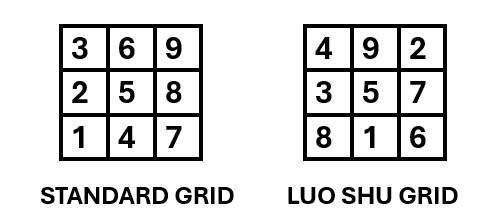
In recent years, Indian numerologists have been promoting the use of the Luo Shu grid within Chaldean numerology. One gets the impression that this represents one of the greatest discoveries of modern numerology. But is that really the case? The lines 1, 5, 9; 3, 5, 7; 4, 5, 6; and 8, 5, 2 are duplicated triplets from the standard matrix. Their interpretation does not depend on the Luo Shu grid as a crucial tool, and in roughly half of the cases, this therefore represents nothing new.
As for the use of the remaining triplets and of Chinese numerology in general within Chaldean and Pythagorean numerology
, we must bear in mind that Chinese numerology developed in a very specific way. For example, nothing suggests that the number 4, as a form of yin wood in the Later Heaven arrangement and yin metal in the Early Heaven arrangement, resembles our conventional Western four; nor that the number 1, as a form of the water element in the Later Heaven arrangement and as a form of earth in the Early Heaven arrangement, resembles our fiery Western one. Furthermore, in China the number 1 is associated with Mercury in the Later Heaven arrangement and with Saturn in the Early Heaven arrangement. In the West, however, both Pythagorean and Chaldean numerology associate the number 1 with the Sun. The number 4 is associated with Jupiter in the Later Heaven arrangement and with Venus in the Early Heaven arrangement. In the West, the same number 4, like the number 1, is associated with the Sun, as well as with Uranus and the North Lunar Node.
I am not claiming that there is no common ground between Chinese and Western interpretations of numbers. Nor am I claiming that the Luo Shu square has no effects in Feng Shui. However, Chaldean and Pythagorean numerologists who apply Chinese techniques in new ways should explain the elemental nature of numbers in the Luo Shu grid and in Western numerology, as well as the relationship between them, and they should also clarify the conceptual differences in how numbers are linked to planets. What purpose does the Luo Shu grid serve in Feng Shui? And what purpose does the Luo Shu grid serve when applied to date-based and name-based numbers?
Personally, I do not use the arrows of the Luo Shu grid. At present, there are no satisfactory theoretical explanations in the public domain that would establish a bridge between East and West. The desire of Indian numerologists to present such a bridge is probably sincere. Unfortunately, that alone is not enough.
 The Mystery of Numbers, Luck, Worlds and Planets