The Day and Month Number can be calculated in several ways. One method is to add together all the digits in the day and the month (for example, for November 13: 1 + 3 + 1 + 1 = 6). Another method is to add the numerical values of the day and the month (for example, 13 + 11 = 24; 2 + 4 = 6). A third method is to derive a “bridge number” from the essence of the day and the month (for example, 1 + 3 = 4 and 1 + 1 = 2, giving a bridge number of 42; 4 + 2 = 6).
Most Chaldean numerologists do not take the Day and Month Number into account in their analysis. However, its significance is emphasized by Chaldean numerologist Heather Alicia Lagan. She refers to this number as the “Life Path”, even though this term is usually used for the number that combines the day, month, and year of birth. Chaldean numerologists of the 20th century didn’t use this number. Instead, Cheiro used his own model of combining the influences of the month and the day by adding the zodiac number to the day number. Based on my findings, this approach is weaker than using the actual digits that make up the day and month.
The Day and Month Number certainly does not carry as much weight as the day of the month or the Life Path number. In short, it represents our relationships and the emotions connected to them, and to some extent, our goals.
In 1926, Chaldean numerologistCheiropublished the idea that in certain cases it is necessary, through a process of combining numbers, to uncover a special active number—a two-digit number with a particular influence. The idea was to reduce the numbers of personal names, surnames, and certain honorific titles to the basic numbers from 1 to 9 and then add them together. If the result is less than 10 and the day of birth is also less than 10, the two are added together in order, if possible, to obtain a compound number. This does not always occur, but when it does, Cheiro proposed that this number be treated as the key number in the analysis of the entire numeroscope.
For example, the name numbers for Anna Kay yield a 3 for the first name (the essence of 12) and a 4 for the surname. Their sum gives a Total Name Number (TNN) of 7, which is a single-digit number. Let us assume that she was born on the 5th of the month. Adding the TNN 7 and the birth day 5 gives 12, which is a compound number. According to Cheiro, this number then becomes the most important number in the chart. Cheiro never named this procedure in his publicly available works.
Some Danish numerologists refer to this process as the “augmentation of numbers,” but they take it one step further than Cheiro. If a personal name or a surname has a value below 10, it must also be augmented using the birth day (reduced to its single-digit essence). Unlike Cheiro, they are not concerned with whether the birth day is a number below 10 or between 10 and 31. In the augmentation process, they always use the vibrational key, or essence, of the birth day. If the result, even after augmentation, is still below 10, they simply add 9 in order to obtain a compound number with the same vibrational key and the next higher value.
In the case of our Anna Kay, this would mean accepting the number 12 for Anna, while the surname Kay, which yields the number 4, would need to be augmented using the birth day 5. This results in 4 + 5 = 9. Since this number is still below 10, we add another 9 and obtain the compound number 18. When we then add the essences of the first name and surname, we again arrive at 12, namely: 3 + 9 = 12. In this case, the result is the same as with Cheiro’s approach—but this is not always so.
If Anna Kay had a daughter named Saly, matters would become more complicated. The name Saly has an essence of 8, and the surname Kay again has an essence of 4. Let us assume she was born on the 17th of the month. Under Cheiro’s approach, the TNN would simply be calculated by adding the essences: 8 + 4 = 12. The key number would therefore be 12. In the Danish approach, however, the name Saly would be augmented with the essence of the birth day, resulting in 8 + 8 = 16. The surname Kay would likewise be augmented to 4 + 8 = 12. The total name number would then be 10, 28, or 73, depending on the technique used. In other words, the TNN would be entirely different from the one Cheiro would have obtained.
Some even claim that the Danish approach is in fact the original form of Chaldean numerology. This, however, is very unlikely. One of the earliest examples of the application of Chaldean numerology to names is the famous riddle of the number of the Beast, which among other things represents the name of Emperor Nero. As NRVN QSR it corresponds to the number 666, and as NRV QSR to the number 616:
N (Nun) = נ = 50 R (Resh) = ר = 200 V (Vav) = ו = 6 N (Nun) = נ = 50
Q (Qof) = ק = 100 S (Samekh) = ס = 60 R (Resh) = ר = 200
Total: 50 + 200 + 6 + 50 + 100 + 60 + 200 = 666.
However, when using reduced values, the name Neron yields the number 18 (NRVN = 18), while the imperial title yields only 9 (QSR = 9). Nero was born on the 15th of the month, with an essence of 6. The imperial title would therefore have to be augmented to 9 + 6 = 15. The emperor’s TNN would then be 15, 24, or 96, depending on the technique used. Yet in antiquity, the name of Emperor Nero was not interpreted in this way, but rather as 18, or—when using standard values—as 666 (where 3 × 6 again equals 18).
When Cheiro analyzes the name of Queen Mary (Mary of Teck), he likewise does not augment the name. QUEEN MARY yields 22 and 8. She was born on the 26th of the month, with an essence of 8. According to the Danish approach, the name Mary would be augmented to 8 + 8 = 16. The final values would then be 22 and 16, which numerologically produce a TNN of 11, 38, or 47, depending on the technique applied. Cheiro, however, defined the TNN in his analysis as the sum of the essences 4 and 8, resulting in 12. Cheiro therefore did not use the augmentation approach employed by the Danish neo-Chaldean school.
August Darius Danielsson, the original author of the Danish neo-Chaldean school, claims that he received knowledge of Chaldean numerology around 2014 from an unnamed Iranian master who showed him ancient Persian cuneiform tablets. These tablets allegedly referred to Chaldean numerology. Yet on Danielsson’s own pages we can also read descriptions of compound numbers up to 52 that are said to appear on these tablets—and these descriptions are identical to Cheiro’s, which themselves were an expansion of Sepharial’s descriptions from 1895. It would therefore appear that someone in the 20th or early 21st century traveled back in time to the Achaemenid era and produced tablets containing 20th-century material—or else someone simply made the whole story up. I am not claiming that this was Danielsson or his alleged teacher. The window for such a fabrication opened as early as 1926 with the publication of Cheiro’s Book of Numbers. If descriptions of compound numbers are falsely presented as Persian tradition, how can we trust the same source when it claims that number augmentation, the structures of the Human Self, Higher Self, and Highest Self, as well as daily and yearly ranks, are authentic traditions of ancient Persia? No known historical source prior to 2014 describes or explains these concepts.
Personally, I do not use the described “Danish-style” augmentation. I also apply Cheiro’s approach only partially. Numbers tell their story even without this added complexity. At times, a somewhat more conservative stance is more appropriate—and less risky.
Sources:
Cheiro: Cheiro’s Book of Numbers (for the analysis of the name Queen Mary)
The Bible (for information on the number of the Beast, 616 or 666; among known proposals, only the name of Emperor Nero fits both)
Numerology Toolbox – Calculator. This calculator allows examples of calculating the Human Self, Higher Self, and Highest Self using the rule of augmentation. You can simulate these examples in the Numerology Toolbox and independently infer the augmentation rule being applied.
Name numerology most likely originates from ancient Egypt. The first known example of its use comes from ancient Assyria. Sargon II, the Assyrian ruler of the 8th century BCE, built a wall in the city of Khorsabad whose total volume corresponded numerically to the value of the king’s own name.
The Greeks called word-based numerology isopsephy. The term derives from the words ἴσοσ (ísos) meaning equal and ψῆφοσ(psêphos) meaning count. Early examples of using the Greek alphabet for analyzing names and phrases date from the 3rd century BCE. Within isopsephy, a distinction between vowels and consonants was already being observed.
Among the Hebrews, name numerology (originally still Chaldean in nature) was known from at least the 1st century CE onward as gematria(גמטריא). The term may have originated from the Greek word for geometry. An early example of Hebrew gematria is the analysis of the name of Emperor Nero, which in Hebrew transcription — NRVN QSR (that is, Neron Caesar) — produces the number 666, the number of the beast and of man. The calculation uses the classical Chaldean “large values” (mispar hechrachi) rather than the later Jewish “great values” system (mispar gadol), which came into use only later, perhaps with the development of classical Jewish Kabbalah.
N (Nun) = נ = 50 R (Resh) = ר = 200 V (Vav) = ו = 6 N (Nun) = נ = 50 Q (Kuf) = ק = 100 S (Samech) = ס = 60 R (Resh) = ר = 200
Total: 50 + 200 + 6 + 50 + 100 + 60 + 200 = 666.
Much later, the word gematria also came to be used for the analysis of Christian names and expressions written in the Greek alphabet — though in reality this represents a Christian adaptation or extension of isopsephy. In late antiquity or the early Middle Ages, India also developed its own systems for encoding names with numbers. The main figure associated with numerology is the Indian scholar Vararuci. The Arabic system analyzed names based on 28 letters and was called ʿilm al-ḥurūf(علم الحروف).
The analysis of names for the purpose of studying human destiny appeared in Europe only around the 16th century. From this period onward, two main schools began to take shape. One is known as the Pythagorean school (which, despite the name, has only limited connection to the original ancient Pythagorean numerology), and the other is the Chaldean school, which is based at least in part on the reconstruction of numerological knowledge once held by the Western Semites.
Both schools went through several stages of development. There are also notable similarities between them, as their traditions influenced each other over time. Name numerology that uses the same type of alphanumeric coding later employed by Cheirofirst appeared shortly before his time. However, Cheiro’s interpretive method itself is much older — it incorporates both Tarot symbolism and ancient tradition.
Modern Pythagorean numbering of the English alphabet emerged slightly earlier than Cheiro’s approach, but the method of interpreting names as we know it today took shape within the Pythagorean school only sometime between 1907 and 1930.
In Chaldean numerology, there are both proponents and opponents of changing one’s name or surname. Advocates of this practice argue that altering one’s name is a legitimate way to introduce more harmonious vibrations into one’s life. One of the first modern Chaldean numerologists to support this idea was Isidore Kozminsky in the early 20th century.[1] In 1926, numerologist Cheiro also advocated for it in his book.[2] Due to Cheiro’s influence, changing one’s name is much more common among Chaldean numerology practitioners than among those who follow modern Pythagorean numerology.
However, there are also opposing views. For example, William Mykian believes that our true name is given at birth and that changing it—even in cases of natural changes, such as marriage—can lead to confusion and difficulties.[3]Bodil Storm argues that name changes should not be made based on numerology because our name and surname carry karmic imprints.[4]
It is important to note that changing a name can indeed present challenges. On one hand, after making a change, there is often an adjustment period as one aligns with the new vibrations. This period can involve intense cleansing and challenges, sometimes lasting several months or even years. On the other hand, Chaldean numerologists often overlook the significance of consonant numbers, which have a substantial impact on the quality of a numerology chart. Ultimately, a name change can result in vibrational shifts that numerologists may not foresee—or may not even be able to predict.
That being said, these concerns should not be taken as arguments against changing one’s name based on Chaldean numerology principles. A birth name is not a fixed, unchangeable element. While we cannot alter the planetary positions in our birth chart, we can change our name or surname. Thus, excessive fatalism in this regard is unnecessary. Many people report positive effects from adopting a new name or surname. The key is to ensure that the new vibrations are truly beneficial, and there are ways to achieve this, at least to some extent.
Regarding the supposed prohibition of numerologically altering one’s name due to karmic imprints, it is crucial to first understand what karma truly is. At its core, karma is the law of cause and effect, but it also operates as a form of the law of attraction. A specific cause draws in a corresponding effect. Karma is not something fixed; rather, it is constantly shaped by our thoughts, emotions, and actions. A common metaphor is that of farming: we reap what we sow.
Consider someone traveling from Madrid to London. If they board a flight to New York instead, they will not arrive in London. Action triggers reaction, and choices lead to consequences. Similarly, one does not typically attend a business meeting in a sweaty, tattered shirt that hasn’t been changed in ten days—otherwise, others may avoid them and not take them seriously. Likewise, if we do not pursue education, we are unlikely to gain deep knowledge in the fields that interest us.
An unfavorable name vibration is like a sweaty shirt—it is advisable to change it before an important business meeting. It is like flying from Madrid to New York while intending to reach London. With enough money, layovers, and delays, one might still eventually reach London, but why not simply take a direct flight from Madrid? The decision to change one’s name or surname is like planting a new seed, which, according to the law of karma, will eventually yield benefits.
There is nothing in this process that contradicts natural laws. In fact, it is a direct application of the law of karma. However, it is important to remember that numerology only influences a part of our destiny. It does not alter planetary karma or the karmic influences of elemental flows in the astrology of Mother Earth (such as the Chinese Four Pillars system, or Bazi). Personal initiative and spiritual connection also create new opportunities—and thus, new karma. Therefore, while the significance of name changes should not be dismissed, it is equally important not to overemphasize their impact.
[1]Kozminsky, Isidore (1912): Numbers. Their Meaning and Magic. Samuel Weiser Inc. Pg. 57.
[2]Cheiro: Cheiro’s Book of numbers. 1935 Edition.
[3]Mykian, William (2011): Numerology Made Easy. Xlibris Corporation, USA. Pg. 142-143.
[4]Storm, Bodyl (2005): Numerology. Pyramideforlaget, Oslo. Amazon Kindle.
Alcoholism has been recognized as one of the most common forms of addiction for millennia. It’s no surprise that Chaldean numerologists and Hellenistic astrologers of ancient times (during the Hellenistic period and the Roman Empire) were already studying its connections. Back then, alcoholism was astrologically linked primarily to Mars and, to some extent, Libra. Later, some astrologers also considered the Moon, as it rules over liquids.
Numerologically, excessive drinking was associated with the number 9 (the number of Mars and soldiers). It was also likely linked to Saturn’s number of hardships – 8 – especially when combined with 9 or 15. In addition to these two numbers, almost all other numbers seemed to play a role in some way. For instance, 2 (fluids), 5 (youth), 3 and 4 (excess), and possibly even 1- though these numbers probably had to be in an unfavorable connection with either 8 or 9 to be significant.
In the 19th century, Western astrologers associated wine more with Jupiter, the ruling planet of Sagittarius and Pisces, rather than Mars. Once Neptune’s characteristics were defined, alcohol dependence was often attributed to the influence of both Jupiter and Neptune, which correspond to the numbers 3 and 7.
Chaldean numerologist Cheiro rejected these newer interpretations. To him, alcohol remained connected to Mars and the number 9, and he also suggested that addiction-related issues could appear with the number 4. Meanwhile, Pythagorean numerologist Florence Campbell, a contemporary of Cheiro, identified numbers 5 and 7 as being linked to addiction.
In 1973, Gerun Moore published a book that, under the lens of modern Western astrology, connected alcoholism to numbers 3 and 7, along with the karmic number 8.
My own research suggests that the foundation of alcoholism lies in the negative aspects of numbers 7, 8, and 9. These are followed by numbers 3, 5, and, in some cases, 4—but 4 and 5 only become problematic when they form an unfavorable combination with one of the first three numbers. My formula is as follows:
{ 7, 8, 9 } > 3 > { 4, 5 }
It’s important to note that not everyone with a strong presence of 7, 8, or 9 (or even 3) in their numerological chart will turn to alcohol as a coping mechanism. Free will always plays a role, and individuals can overcome these tendencies through self-awareness, relaxation techniques, and spiritual growth. The same applies to the interaction of two numbers within relationships.
However, people with the following number combinations may be more prone to alcoholism:
7 and 8: Emotional coldness, a tendency toward depression, and withdrawal from others can lead someone to seek solace in alcohol. Relationships between individuals with these numbers may also struggle with alcohol-related issues.
8 and 9: This combination, whether found in a personal chart or a relationship, can trigger patterns of aggression alternating with apathy. It may also bring feelings of misunderstanding and frustration.
7 and 9: Emotional crises can lead to alcohol dependence.
3 and 7: Emotional drama and relationship turmoil may arise. Alcohol may either be the cause of relationship problems or a consequence of them.
5 and 8, or 2, 5, and 8: Emotionally challenging relationships that cannot be overcome or rationalized may push individuals toward alcohol as a way to cope.
8 and 15: Difficulties in relationships and emotional attachment can drive a person toward excessive drinking.
“The Royal Star of Aquarius,” or “The Royal star of the Waterman”, also known as Markab, should more accurately be called the “Royal Star of Pegasus,” as there is no bright star located at 20 degrees of Aquarius. If we travel from 20 degrees of Aquarius on the ecliptic along the celestial meridian, which is perpendicular to the celestial equator, we reach the vicinity of the bright star Markab to the north and the star Fomalhaut to the south, a very luminous star in the constellation Piscis Austrinus (the Southern Fish).
Fomalhaut is traditionally associated with communication and attracting attention. Its nature is gentler, often tied to business affairs, but it can also be connected with a less favorable disposition. However, it is not associated with danger or war, which are traditional themes in Chaldean numerology.
This leaves us with Markab, a bright star located to the north of Aquarius. As a royal star, Markab symbolizes brilliance, honor, and authority, as well as warriors, intelligence, and, unfortunately, war, conflicts, injuries, and danger. Number 51 is not just linked to this royal star but also to the ruling planet associated with the number.
Pegasus and Markab. Source: Wikimedia Commons: File:1776 – John Flamsteed – Pegase, Le Petit Cheval, Le Dauphin (Pegasus, Pisces and Equuleus).jpg
Astrologers who influenced the development of modern Chaldean numerology did not believe in the general interpretation that the conjunction between Markab and Venus would only bring unreliable friends, a negative impact on business, or lead to excessive drinking; rather, they believed that this aspect signifies warriors, fame, honor, and the potential for injuries in battle or during an attack. In Tarot, this royal star is referred to as the King of Swords, which also governs warfare and danger.
Chaldean numerologists of the late 19th and early 20th centuries followed this astrological interpretation through the star Markab, maintaining much of the traditional meaning of the number.
Sepharialprovided the following explanation of the number:
“LI (51). Royal star of Aquarius. Fortuitous elevation; martial tendencies; powerful enemies; troubles through Mars men.“
“51. This number has a very powerful potency of its own. It represents the nature of the warrior; it promises sudden advancement in whatever one undertakes; it is especially favourable for those in military or naval life and for leaders in any cause. At the same time it threatens enemies, danger, and the likelihood of assassination.“
Sources:
Cheiro (1935). The Cheiro’s Book of Numbers. London, Herbert Jenkins Limited.
Sepharial (revised edition from 1909). Your Fortune in Your Name or Kabalistic Astrology.
Pandit Sethuraman (1925-1997) was an Indian numerologist, astrologer, palmist, and occultist who adopted Cheiro’salpha-numeric codingof the Latin alphabet and enhanced his system with his own approach. In his youth, he entered military service, during which he began to intensely explore the workings of Chaldean numerology. He claimed that the English alphabet was the correct system for addressing Indian names in modern times. This could be true at least until recently, as post-colonial India was still significantly influenced by the English script. Throughout his life, Pandit Sethuraman also studied astrology, palmistry, yoga, mesmerism, and the energetic system of humans.
He was born on the 31st of the month, and his Life Path number is 26. The base numbers of these two figures are 4 (3+1=4) and 8 (2+6=8), which are considered karmic numbers. They often bring complications and blows of fate. However, Sethuraman has a strong name numbers 5, particularly in his Total Name Numerology (TNN), which totals 59 (5+9=14; 1+4=5). This active five calms both the 4 and 8 from his birth date numbers and offers some form of escape from karmic limitations.
The main feature of this numerology chart is the relationship between the numbers 5 and 9, or the relationship between Mercury and Mars, which provides good intellect and a certain sense of military. Despite this, Pandit Sethuraman’s numerology chart contains many numbers that are softer or more feminine in nature. Therefore, he was not a typical soldier; he embodied both the energies of clear goals and a sense of softness. Pandit Sethuraman also had “money numbers,” notably involving connections between the numbers 3, 5, and 8. In addition, he had some other indicators pointing in this direction.
The number 9 in his chart was positioned in such a way that it played a very important role in his business and spiritual development. It was associated with 3 and 6, and also with 5. In Sethuraman’s chart it brings an interest in bio-energy, astrology, yoga, and mesmerism. With such numbers, Pandit Sethuraman could have also engaged with Feng Shui or Vastu Shastra. The relationship between the numbers 5 and 9 in this configuration particularly highlights numerology and palmistry as vocational options.
In 1954, he wrote a book titled “Science of Fortune,” in which he revealed some of his insights about numerology. While he adopted Cheiro’s numerological model, he also incorporated Indian traditions, his insights, and messages that he claimed to have received from the Hindu goddess Gayatri.
It can be noted that Pandit Sethuraman rejected the complex rules that Cheiro employed to determine the key compound number in someone’s numerology chart. Instead, Pandit Sethuraman simply added the unreduced numbers of the first and last names. When considering the relationships between numbers, a significant influence of the theory of interchangeable numbers is evident. Personally, I use slightly different principles for matching numbers. I can agree with him that, in analyzing partnerships, certain deviations from the general rules of number matching are necessary, although I differ with him on some specific solutions.
His book also contains interesting warnings regarding the use of gemstones to balance someone’s fate and regarding how changing the names and surnames of others can attract unresolved karma from that people. Additionally, Pandit Sethuraman developed his own method for checking the compatibility of a new name and surname with a client’s life energy when intending to change their name.
Using numerology, Pandit Sethuraman predicted the outcomes of military conflicts and the likelihood of someone’s death. He also used numerology for a time when betting on horse races and for financial investments. All of this could quickly lead someone to the edge of ethics, which Pandit Sethuraman was fortunately aware of.
Interestingly, he did not differentiate between strong and weak 8s or between strong and weak 4s; he believed that these two numbers always had the same favorable or unfavorable numbers available. Some rules regarding matching and mismatching between numbers are surprising— for example, he defined the relationship between the numbers 3 and 6 as generally unfavorable.
He listed the meanings of the numbers from 1 to 108, claiming that this was the first book on Chaldean numerology that described numbers beyond 52. However, this is not true. Classical Chaldean/Hebrew numerology has even defined some numbers above 108, and in modern numerology, well before Pandit Sethuraman, accepted descriptions of the numbers 55, 65, 69, and 71 can be found. During World War II, one of the Chaldean numerologists adopted the interpretations of numbers presented by the Pythagorean numerologist Mary Adams. Her definitions cover numbers up to and including 65, in addition to the numbers 69, 71, and 73.
Some of Sethuraman’s descriptions of numbers are also questionable— for instance, he defined the number 12 as lucky. Conversely, he classified the numbers 39 and 48 as unlucky forms of the number 12, where he diverged from Cheiro’s descriptions, too. Furthermore, the classical meaning of the number 77 is generally unfavorable, while Pandit Sethuraman defined it as a favorable number.
Regardless, his book offers a wealth of interesting information and provides a researcher of Chaldean numerology with the opportunity for comparative analysis, thus allowing for the search for refined knowledge and new insights.
Every student of Chaldean numerology should be familiar with key modern Chaldean numerologists such as Sepharial, Isidore Kozminsky, Cheiro, Pandit Sethuraman, Richard Cavendish, Gerun Moore, Lloyd Strayhorn, and Linda Goodman. All of these numerologists were also astrologers.
Sepharial(Walter Gorn Old) played a crucial role in transitioning from the older Chaldean school of “Kabbalistic astrologers” to modern numerology. He also introduced classical descriptions of numbers from Kabbalistic astrology, where the highest number described in this approach is 71. He later wrote a very popular book, “Kabala of Numbers” (1911).
In his development, he initially used an external method of alphanumeric coding of the Latin alphabet (C = 2, H = 8, X = 6). Later, he tested several different alphanumeric approaches but ultimately decided on phonetic numerology.
Isidore Kozminsky, like Sepharial, experimented with various methods of alphanumeric coding. At the latest, in an updated edition of “Numbers: Their Meaning and Magic” in 1911, he was the first modern numerologist to predict that we should, in some cases, treat the letter H as 5. He also assigned the number 5 to the letter X. Like Sepharial, he described all the numbers he believed to have a “distinct potency of its own.” All other numbers he reduced to a number with such potency. His approach of dealing with name numbers is now considered outdated.
Cheiro(William John Warner) is regarded as the father of modern Chaldean numerology. He wrote several books covering numerology, with the most famous being “Cheiro’s Book of Numbers” (1926), where he advocated for the value of 3 for the letter C, 5 for the letter H, and 5 for the letter X.
He emphasized the importance of the Birth number (the day of the month one is born) and its connection to the Name number (that is, Total Name Number, aka TNN). He was one of the first to focus on the compatibility of numbers. He adopted Sepharial’s number descriptions, sometimes expanding them, so they corresponded to some very old descriptions. However, he described numbers only up to 52. He also wrote a book called “You and Your Star”, where he described the most suitable numbers for each day of the year based on astrological techniques.
Pandit Sethuraman, in his book “Science of Fortune” (1954), adopted Cheiro’s alphanumeric coding but summed the unreduced numbers of the first and last names. He also deviated from Cheiro’s views on number compatibility. Sethuraman expanded Cheiro’s descriptions based on his own insights and described numbers up to 108. Unlike Cheiro, he considered numbers 39 and 48 to be unfavorable.
Richard Cavendish, in his 1967 book “The Black Arts” (which has quite an inappropriate book title, especially in connection to astrology and numerology), introduced the classical internal method of alphanumeric coding (with C = 3, H = 8, X = 6), although he seems to have arrived at this through his own research. He emphasizes the importance of considering the numbers of vowels and consonants, a concept long neglected in Chaldean numerology.
Gerun Moore wrote a book in 1973 titled “Number Will Tell”. He adopted Cheiro’s alphanumeric coding system but made several changes and additions to the descriptions of numbers and the rules of compatibility. Notably, he described numbers 39 and 48 as the unlucky number 12.
He also rejected Cheiro’s model of favorable numbers for each day of the year. Instead, he created his own system, where each day of the year is generally assigned two suitable numbers (though in some cases, only one number is given). He labeled these numbers as “keys.” According to him, name numbers matching a person’s key numbers bring luck and harmony.
Lloyd Strayhorn wrote his book “Numbers and You: A Numerology Guide for Everyday Living” no later than 1980. He adopted Cheiro’s alphanumeric coding system. Although he prefers Chaldean numerology, he also considers Pythagorean numerology. Based on his research, Strayhorn introduced his own system of number compatibility, which differs somewhat from Cheiro’s model.
He also rejected Cheiro’s model of favorable numbers for each day of the year, offering instead his own astrological model with lucky numbers. He later published “Lloyd’s Numbers and You Relationship Guide: A Cosmic Blueprint to Happiness & Joy”, in which he distances himself significantly from older Chaldean approaches.
Linda Goodman published a book “Linda Goodman’s Star Signs” in 1987, which also introduces Chaldean numerology. She adopted Cheiro’s alphanumeric coding system and significantly enhanced the descriptions of numbers. However, her method of determining the TNN deviates from those of her predecessors.
Linda Goodman concludes the list of modern classics in Chaldean numerology. I believe that this list provides an appropriate foundation for studying contemporary Chaldean numerology.
There are also a few Chaldean numerologists who have uncritically incorporated Pythagorean methodsof interpreting numbers and relationships. While some ideas from the Pythagorean system can be adopted, not all Pythagorean techniques are suitable for Chaldean numerology.
Cheiro described a system of numbers up to 52. For numbers above 52, it’s incorrect to apply the rule of reversed digits (for example, 71, the number “Reaper,” is not the same as 17, the number “Star”), and the rule of adding digits doesn’t always work (65, “Royal Star of the Scorpion,” is not the usual 11, “Force,” but rather a special form of 11).
This raises the question of how Cheiro approached numbers above 52. There are two possibilities. The first is that the Chaldean tarot, which describes the first 78 numbers, does not provide reliable interpretations for numbers beyond 52, so Cheiro may have simply left them out. The second possibility is that numbers above 52. According to the second possibility, numbers above 52 are explained by a series of numbers with the same base number, which follow each individual number with a “distinct potency of its own.” This approach also provides an explanation for numbers from 79 to 99.
Cheiro explained that number “_ has the same meaning as the number _ , which is next to it in its own series of compound numbers.” However, Cheiro extends the influence of numbers with a distinct potency of their own to numbers from 42 onwards. According to Cheiro’s rule of the Chaldean tarot, each number without a “distinct potency of its own” takes on the meaning of the nearest preceding number that has this distinct potency, based on the series of numbers with the same base number. This rule applies up to number 52.
It’s important to note that Cheiro also acknowledged some numbers above 52 that have a “distinct potency of their own.” He used the numbers 55 (“Sword“) and 69 (“The Crown of Mars“), which he took from Kabbalistic astrology. Thus, he was certainly aware of the significance of numbers 65 and 71, too. If we extend Cheiro’s rule about numbers having a nature similar to that of a number with a distinct potency of its own to numbers above 52, we obtain the following pattern:
Base number 1: 28; 37 ≈ 46; 55 ≈ 64 ≈ 73 ≈ 82 ≈ 91;
Base number 2: 29 ≈ 38≈ 47≈ 56; 65 ≈ 74 ≈ 83 ≈ 92;
Base number 3: 30 ≈ 39 ≈ 48 ≈ 57 ≈ 66 ≈ 75 ≈ 84 ≈ 93;
Base number 4: 31 ≈ 40 ≈ 49 ≈ 58 ≈ 67 ≈ 76 ≈ 85 ≈ 94;
Base number 5: 23; 32 ≈ 41 ≈ 50 ≈ 59 ≈ 68 ≈ 77 ≈ 87 ≈ 95;
Base number 6: 24 ≈ 33 ≈ 42; 51 ≈ 60; 69 ≈ 78 ≈ 87 ≈ 96;
Base number 7: 25 ≈ 34; 43 ≈ 52 ≈ 61 ≈ 70 ≈ 79 ≈ 88 ≈ 97;
Base number 8: 26 ≈ 35 ≈ 44 ≈ 53 ≈ 62; 71 ≈ 80 ≈ 89 ≈ 98;
Base number 9: 27 ≈ 36 ≈ 45 ≈ 54 ≈ 63 ≈ 72 ≈ 81 ≈ 90 ≈ 99.
Compared to traditional Chaldean numerology, these values don’t always align. Even within numbers up to 52, there are questionable examples. For instance, the numbers 39 and 48 carry a strong influence from the number 12 and seem more closely related to the characteristics of 12 than to the number 30. Notably, numerologists Pandit Sethuramanand Gerun Moore reverted to the association with the number 12 for these two numbers. I also consider their nature to be that of the number 12. Similar cases can be found among numbers above 52.
Therefore, approach Cheiro’s expanded rule with caution. As mentioned, this is just one of two possible ways Cheiro may have dealt with numbers above 52. Personally, I don’t trust this approach and don’t use it. It is presented here as a third option, alongside the rule of reversed digits and the rule of adding digits.
Pavel Durov (Pavel Valeryevich Durov; Russian: Па́вел Вале́рьевич Ду́ров) is a Russian-Ukrainian entrepreneur who founded the social network VKontakte and later created the messaging platform Telegram. He is a strong advocate for internet freedom without government control. Opinions on his work are divided. His social networks have facilitated communication among Russian protesters, connections between Belarusian activists, the organization of the Euro-Maidan protests in Ukraine, and have been used in protests in Iran.
On the other hand, both Ukrainian and Russian authorities, as well as organized crime and pedophile networks, have exploited Telegram for their own purposes. Some view Durov as a victim of Putin’s regime, while others see him as a secret Russian agent. His recent arrest in France has caused a stir in international public opinion.
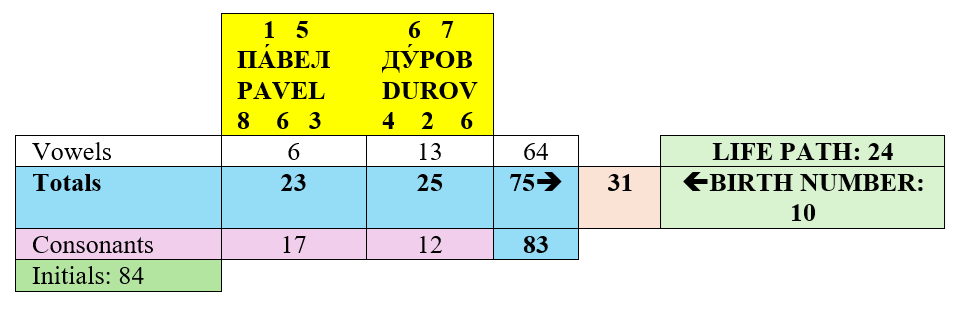
What does numerology say about him? He was born on the 10th of the month (base number 1), and his Total Name Number (TNN) in Chaldean numerology is 75 (base number 3). These are strong, masculine numbers. He also has the numbers 11 and 83 (base number 2), a Life Path Number of 24 (base number 6), and other numbers that bring some softer energies, too.
Like Donald Trump and Mike Lynch, Pavel Durov also has a number chain of 3, 5, and 8, which can represent money (and very rarely financial difficulties). The TNN, Life Path, and birth date represent a combination of powerful numbers 1, 3, and 6, governed by the benefics Sun, Jupiter, and Venus. This suggests a potential for financial stability. However, from a numerological perspective, this alone may not be enough to bring someone immense wealth. We must always remember that alongside numerology, a person’s life is influenced by other aspects of fate and various other factors. Moreover, exceptional achievements are often not traceable in fate analyses; rather, fate analyses reflect character and fundamental interests.
Pavel Durov’s numerological chart is also a karmic one, as it contains the numbers 12 and 75 (whose digits also sum to 12;7+5=12). Sepharialinterpreted the number 12 as: “Reversal of position; culpability; chastisement; loss of honour; danger of violent death; either enforced or voluntary; dangers from women; catastrophe.”
These numbers, 12 and 75, connect with some others in a way that creates very strong spiritual tendencies. It is said that Pavel Durov is a vegetarian (or at least doesn’t consume meat from supermarkets) and lives a relatively ascetic life for a wealthy man. The spiritual power of the number 12 can be channeled into good deeds and seeking good karma, which can enhance the positive aspects of his chart. Thus, the number 12 is not always negative. Of course, Durov must still be careful not to become a victim or to victimize others.
The combination of the numbers 23 and 75 can generate an interest in software and computing. Numbers like 11, 86, and 24 increase interest in social life, as do the number 23 and the number chain with base numbers 1, 5, and 6.
However, the repeated number 12 (75, 84) still indicates that a person can become a victim, especially if he or she also sacrifice others. As mentioned, 12 is a karmic number. The number 11 (83) can represent legal disputes or opponents, too. Cheirodescribed the number 11 as: “It gives warning of hidden dangers, trial, and treachery from others.” The number 10 from his birth date can represent swings of fate, both upward and downward. It is known that Pavel Durov sold his company VKontakte, allegedly under pressure and for a lower price. Soon after, he fled Putin’s regime, relocating to a safer environment and focusing on developing Telegram. But even then, there were difficulties—on August 24, 2024, he was arrested in France for allegedly allowing criminal organizations to connect on Telegram.
Pavel Durov mentioned that he had changed his name in his French passport to Paul du Rove, which is meant to be a humorous translation of his name. However, if this is true, the new name (which he only uses in France) may not have done him much good—TNN is 93, which corresponds to the number 12 (and this 12 is strongly reinforced by other 12s in his numerology chart), while the name itself has the number 18. Together, this could indicate being a victim in legal proceedings. Additionally, the name was not changed according to numerological rules and has retained much of the essence of his widely known name, Pavel Durov.
If we look at the energy trends in Pavel Durov’s life, we can see that in July and August 2024, the energies of the numbers reached an energetic low. The day of August 24, 2024, by the criteria I use, brought unfortunate energies. On that day, Durov was arrested in France. Since the energies in his prognostic chart then improve, it will be interesting to see what happens in the coming months and the next year.
I should point out that classical techniques for personal year, month, and day, which are strongly present especially in Pythagorean numerology, are generally not reliable. On August 24, 2024, Durov’s personal year is 1+0+1+0+2+0+2+4= 10, his personal month is 10+8= 18, and his personal day is 18+2+4=24. The number 18, in contact with the annual number 10, can bring severe legal disputes, but it is somewhat balanced by the number 24, which is one of the luckiest numbers in numerology. Cheiro describes this number as: “Fortunate; it promises the assistance and association of those of rank and position with one’s plans; it also denotes gain through love and the opposite sex; it is a favourable number when it comes out in relation o future events.” However, it is unusual to expect someone to be arrested on a fortunate personal day with number 24 (!).
From a numerological perspective, Durov remains an enigma: Is this man merely a victim, or does he occasionally sacrifice others? What are the actual consequences of a free internet? From 2017 to 2021, Durov was at an energetic peak. The current years bring legal troubles but also analytical abilities. Soon, years marked by the relationship between numbers 9 and 7 (possible intrigue, spies, covert actions, crime) will arrive, likely meaning that the issues currently stirring global public opinion will resurface in a few years.
What can Pavel Durov do to improve his prospects? He must always strive to maintain authority and develop courage. Additionally, he has an increased ability to approach life in a spiritual way and to improve his karma through good deeds. This way, he can reduce the unfavorable influences in his fate and enhance the favorable ones.