When does someone become a good numerologist? What exactly do they need to master? What kind of knowledge is essential? The answer isn’t as simple as it might seem at first glance.
To begin with, a solid understanding of basic numerological theory and practice is a must. But when it comes to working with Chaldean numerology, there’s more to it than just that — it also requires insights that you won’t find in typical numerology books. In other words, you can’t truly learn Chaldean numerology from books alone. You either need to study under an experienced numerologist or discover certain key principles through your own research and exploration.
A numerologist needs to develop a range of additional skills and insights. For example, they need to understand the relationships between numbers, the inner structures of double-digit numbers, what to watch out for when choosing a new name, and so on.
In my own case, I’ve developed an in-depth understanding of general numerological theory and how numbers connect with the chakra system. I also have access to some ancient and medieval formulas used in Chaldean numerology. Through hands-on experience, I’ve come to recognize the significant influence of consonant-based numbers in Chaldean numerology, even though most practitioners don’t really use them. I’ve also discovered meaningful connections between numbers in a numeroscope and the relationships someone has with their family members.
So yes, I would say my knowledge of numerology is quite advanced. And at the same time, I can admit — I don’t know everything. And that’s okay. You don’t need to know everything. For instance, I’ve never really studied the connection between Chaldean numerology and sports betting or the outcomes of sports games. I only started cautiously exploring mundane numerology — which gives insight into world events — a few years ago, and I’m still learning. As for stock market movements, I’ve never looked into that side of things at all. And I’m definitely not the person to ask which flowers are associated with certain numbers.
That said, I have heard of Chaldean numerologists who claim to predict sports outcomes. How successful they are at it, I couldn’t say. I’ve also heard of others who reportedly predict stock market trends with some accuracy. I’m familiar with a few of those techniques, but I’ve never tested them myself.
Overall, my main focus is on creating personal numerology charts. Every numerologist who reaches a certain level of mastery has the potential to branch out into new areas. And that’s how it should be. Some of this knowledge will leave this world with us, some will be passed down to students, and much of it will eventually be shared in affordable books.
It’ll be fascinating to see what Chaldean numerology looks like a few decades from now. . 😊
In Chaldean numerology, some numerologists attempt to analyze the name “Jesus Christ” using its English form. This approach is both illogical and somewhat laughable, as English did not exist in ancient times—certainly not in regions like ancient Syria, Galilee, Samaria, Judea, or Idumea.
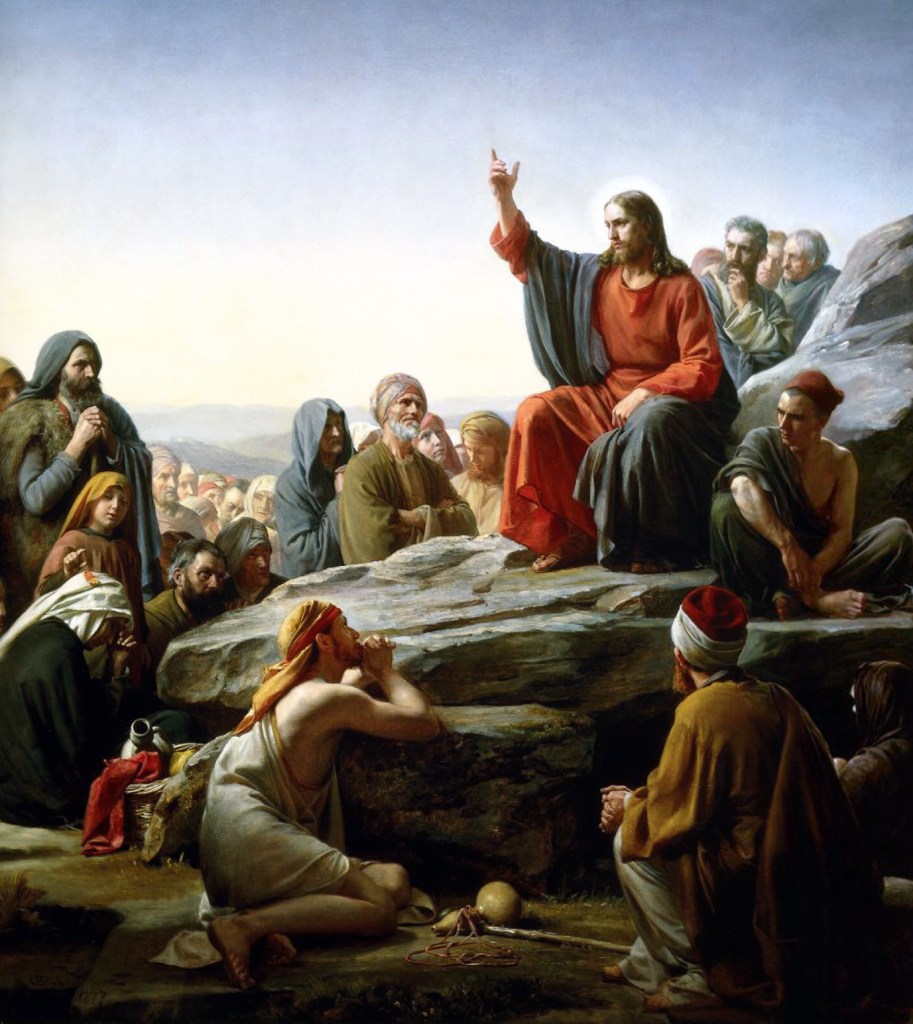
Jesus’ Sermon on the Mount. Bloch, Carl (1877): Sermon on the Mount (1877). From Wikimedia Commons, File:Bloch-SermonOnTheMount.jpg
To properly analyze the name, we must use the Hebrew-Aramaic script. At this point, I’m not addressing whether Jesus Christ was a historical figure, a mythological construct, a parody of Roman Flavian Emperors Vespasian or Titus, or a symbolic combination of several Jewish messianic figures. Nor am I discussing his date of birth, which is widely accepted as symbolic and not based on any verified historical source. The Church only selected December 25th in the 4th century, likely because it coincided with the Roman festival of the winter solstice (Sol Invictus). Christmas Day doesn’t typically align with a fixed date on the Jewish calendar, as the Jewish calendar is lunisolar, while the Gregorian calendar (our standard one) is solar. This results in shifting dates between the two each year. The year of his birth is also uncertain.
For this reason, I will focus solely on name-based numerology. The Chaldean analysis will be done using the Mispar Katan technique (מִסְפָּר קָטָן – “small number”), where all standard numerical values of Hebrew letters are reduced to single digits:
Letter Numerical value
א 1
ב 2
ג 3
ד 4
ה 5
ו 6
ז 7
ח 8
ט 9
י 1 (from 10)
כ / ך 2 (from 20)
ל 3 (from 30)
מ / ם 4 (from 40)
נ / ן 5 (from 50)
ס 6 (from 60)
ע 7 (from 70)
פ / ף 8 (from 80)
צ / ץ 9 (from 90)
ק 1 (from 100)
ר 2 (from 200)
ש 3 (from 300)
ת 4 (from 400)
This is arguably the most important technique in Chaldean numerology. Adapted forms of this system have been used for the Latin alphabet by authors like Sepharial, Kozminsky, Hashnu O. Hara, and Cheiro. Note that in this system, we do not use the special final letter values sometimes found in Jewish numerology (used only in the Mispar Gadol – “large number” system):
Letter: Name: Value:
ך kaf 500
ם mem 600
ן nun 700
ף pe 800
ץ tsadi 900
It’s also important to point out that even the name “Jesus Christ” is not reliably known in its original form. The most commonly cited versions in the literature are Yeshua ben Yosef (יֵשׁוּעַ בֶּן יוֹסֵף), Yeshua Ha-Notzri (יֵשׁוּעַ הַנּוֹצְרִי), and Yeshua Ha-Mashiach (יֵשׁוּעַ הַמָּשִׁיחַ). I will therefore focus on these three variations to explore how they numerologically align with the Christian image of the prophet and messiah.
In all cases, the first name is Yeshua (יֵשׁוּעַ), which has a Mispar Katan value of 17—a number inclined toward spirituality and, in some cases, fame that lasts well beyond one’s lifetime. Reduced further, 17 becomes 8, the number associated with Saturn and karmic patterns. The life path of an “8” is often tied to past deeds, whether good or bad.
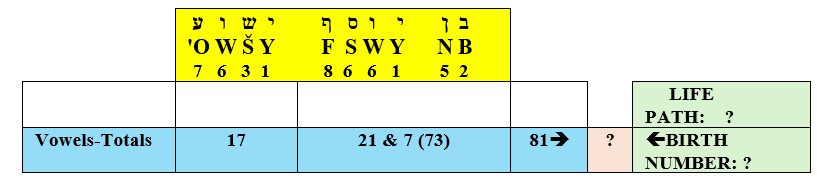
Yeshua ben Yosef (יֵשׁוּעַ בֶּן יוֹסֵף) contains the values 17 from Yeshua and 21, 7, and 73 from the surname ben Yosef. The surname 21 suggests potential success after hard work, typically post-age 21 or 30. The number 73 relates to leadership and the pursuit of harmony and love. Both numbers (21 and 73) are connected to carpentry. The total value is 81, a Mars number associated with war, misfortune, and aggression. On the positive side, it may indicate business savvy or spiritual transformation. The initials (1 and 2) total 12, which symbolizes sacrifice.
According to the gospel narratives, both Jesus and Joseph were carpenters (21). Jesus gained spiritual fame and remained influential after death (17). Christian teachings describe him as a willing sacrifice (12) for human sins—he died on the cross, which is also an unfavorable aspect of the number 8 within 17. He emphasized the law of love (73). But the Gospels fluctuate between peaceful messages and aggressive, even fearsome tones. References to Peter carrying a weapon, the possible link between “Iscariot” and the Sicarii zealots, and Jesus saying he came to bring fire and the sword, all support the interpretation that the early Christian movement may have had a militant, Zealot foundation. The number 81 aligns with this revolutionary energy.
Yeshua Ha-Notzri (יֵשׁוּעַ הַנּוֹצְרִי), often translated as “Jesus the Nazarene” or “Jesus of Nazareth,” includes the numbers 5, 23, and 55 in the surname. Numbers 5 and 23 denote communication and travel, while 55 symbolizes leadership, judgment, and Jewish law. Again, the total is 81. The initials (1 and 5) total 15, a number tied to magic but also trials and temptation.
Jesus is said to have traveled throughout Galilee, Samaria, and Judea—consistent with the influence of Mercury (numbers 5 and 23). The number 55 relates to Jewish law (like the Ten Commandments—5 on each tablet). 23 is called the Royal Star of Leo. Jesus is sometimes called “the Lion” and the messiah is often seen as a king figure (23, 55). The aggressive Mars number 81 again emerges. The number 15 in this context (15 with 17) suggests spiritual tests—like Satan tempting Jesus in the desert, or accusations that he was possessed or practiced dark magic.
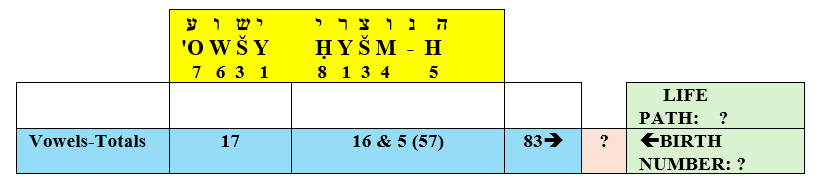
Yeshua Ha-Mashiach (יֵשׁוּעַ הַמָּשִׁיחַ) retains the initials 1 and 5 (totaling 15). The title Ha-Mashiach yields the numbers 5, 16, and 57. The total is 83.
As mentioned, 15—paired with 8 (from 17)—often indicates tests from dark or destructive forces. The number 16 is associated with collapse or ruin, and 57 is a variant of 12, again suggesting sacrifice. This supports the idea of Jesus’ suffering and ultimate sacrifice. The number 83 is commonly emotionally intense—potentially painful—but can also denote the spirit of a fighter and force, once one transcends fear and attachment. Christian theology emphasizes how Jesus transcended attachments to his mother and family- this is aligning with the strength of 83.
While we can’t be certain that these were Jesus’ actual names (alternatives include Yeshu, Yeishu, or Yeshua bar Yosef), the most frequently cited versions align remarkably well with gospel descriptions of his life and mission.
It is also fascinating that the number 3 appears repeatedly in the Gospels and Christian tradition, along with higher multiples like 12 and 30. He was visited by three magi (3), taught in the temple at age 12 (1+2=3), and was searched for over three days (3) by his parents. He had 12 disciples (1+2=3), and one of them betrayed him (12). Jairus’ daughter was 12 years old (3), when Jesus revived her. He predicted his own death and resurrection three times (3), and Peter would deny him three (3) times. Judas betrayed him for 30 pieces of silver (3+0=3). He was crucified at the third hour (3), with two others (3 total), and rose again on the third day (3). Three women (3) discovered the empty tomb (according to Gospel of Mark: Mr 16:1). After his death, the apostles appointed a new “twelfth” disciple (1+2=3).
Despite its spiritual association, these numbers 3 often signal betrayal, sacrifice, denial, and trials. The name value 81 and Yeshua align with 3 and its multiples, but the powerful 83 does not.
There’s also a strong presence of 2, 4, and 6—but not 9.
2 is mostly favorable: Jesus and his Father (2), Jesus feeds followers with two fish (2), appears to two disciples (2), and two women (2) discover the empty tomb. Also positive aspect: The Parable of the Servants and the Talents (duplication= x2). But also negative: Jesus and Barabbas (2), Jesus and Satan (2).
4 is mixed: four fishermen (4) called as first disciples, 4,000 fed (4+0+0+0=4), and appearances over 40 days (4+0=4). But also: 40 days of temptation, and four woes (4) pronounced.
6 is also mixed: conceived six months (6) after John the Baptist, after the crucifixion of Jesus, the sky darkened at the sixth hour (6) on a Friday (day of Venus= 6), and God’s word came in the 15th year (1+5=6) of Emperor Tiberius.
The numbers form a cycle of 2-4-8, with 8 as the core—representing suffering, redemption, and potential success through trial and good deeds. The absence of 9 may be intentional; a strong “8” doesn’t require the finality of 9. Interestingly, 3 and 6 try to complete the influence of 9, but number 8 may disrupt their strength. Ultimately, Jesus’ presence appears as an embodiment of the power of8, with its themes of karma, endurance, suffering, and eventual spiritual triumph.
Karma refers to the principle of cause and effect—the idea that certain causes inevitably lead to certain consequences. Because this connection enables a cause to attract a specific outcome, the law of karma can also be seen as a form of the law of attraction. Agricultural metaphors are often used in relation to karma. One of the most well-known sayings is: “You reap what you sow.” The law of karma is also closely related to the so-called “Golden Rule,” which, in Christian tradition, is expressed as:
“So in everything, do to others what you would have them do to you, for this sums up the Law and the Prophets.” (Matthew 7:12)
Opinions differ on whether the law of karma always applies or whether exceptions exist. There’s also debate about whether karma necessarily requires a reversal of roles over time, which presumes the existence of a reincarnation cycle. Most Christians, however, believe that final karmic justice is not achieved through multiple lifetimes but rather through God’s judgment as a singular event.
Nevertheless, both astrology and numerology must, to some degree, adhere to the principle of karma. Otherwise, we couldn’t claim that specific planetary alignments or numbers lead to specific outcomes. In that sense, all numbers can be considered karmic to some extent.
However, there are narrower interpretations of “karmic numbers.” In Pythagorean numerology, the following are traditionally regarded as karmic:
13 – associated with death and destruction (influenced by the Tarot)
14 – linked to accidents, illness, and loss
16 – connected to downfall or collapse (also reflecting Tarot influence)
19 – represents unresolved past challenges that manifest as difficulties in the present
These numbers are said to bring challenges, but in some cases, they can have positive effects—especially when one chooses a more spiritual path.
In contrast, Chaldean numerology generally regards base numbers 4 and 8 as karmic. These numbers often carry challenges or bring about difficult circumstances. They may also generate ongoing karma. However, individuals operating on a higher spiritual level may experience these numbers as karmic rewards rather than burdens.
Beyond the base numbers, all compound numbers in Chaldean numerology are considered karmic as well. If a compound number is positive (such as 10, 15, 17, 19, 21, 23, 24, 25, 27, and others), it is believed to generate or express favorable karma. If it is negative (like 11, 12, 16, 18, 22, 26, 28, 29, and so on), it is thought to produce or exprtess challenging or negative karma. The philosophy behind these numbers often aligns with that of the Tarot.
Chaldean numerology also attributes aspects of one’s past karma to the birth date, viewing it as a reflection of existing karmic patterns. Meanwhile, name numbers and the Life Path number point more to the direction of personal growth and the creation of new karma.
So how do Chaldean and Pythagorean numerology relate in terms of karmic numbers? Interestingly, both systems associate 14 with accidents and misfortune (traditional Chaldean system!), and both see 16 as a number of collapse or downfall. The number 13 has traditionally been considered unlucky in both systems as well. Descriptions of 13 and 16 in both approaches are heavily influenced by Tarot symbolism.
Despite these similarities, the differences between the two systems are significant. In the Pythagorean tradition, base numbers 4 and 8 are not generally seen as problematic. In contrast, modern Chaldean numerology does not necessarily view 13 as a symbol of death or destruction—it can actually be beneficial in many cases. The number 19 is usually regarded as extremely fortunate, though in very specific number combinations it may act in a way similar to the challenging number 28. Perhaps the most fundamental difference is that Chaldean numerologists interpret all compound numbers through a karmic lens.
There are many ways to interpret fate, including Aztec astrology, palmistry, Zi Wei Dou Shu, Nine Star Ki, Pythagorean numerology, Vedic numerology, and more. Some of these approaches are more suitable than others.
The first challenge in using any given method is to avoid treating it as the only infallible way to interpret fate. No single approach can fully encompass a person’s destiny. The only case in which relying on just one method is reasonable is when one possesses the ability to intuitively or energetically verify the accuracy of the proposed interpretations.
The second challenge is the opposite—avoiding getting lost in too many approaches and blindly trusting each one.
An interesting starting point for studying the influence of fate is to combine two or three approaches. Among the most significant methods of fate interpretation are:
Planetary astrology, though it is riddled with unresolved debates—such as whether to use fixed constellations or the Western zodiac, how to interpret houses, and how to evaluate aspects.
BaZi, or the Four Pillars of Destiny, which offers a simpler yet more robust theoretical foundation compared to methods like Zi Wei Dou Shu.
Chaldean numerology, which in most cases proves to be more powerful than Pythagorean numerology.
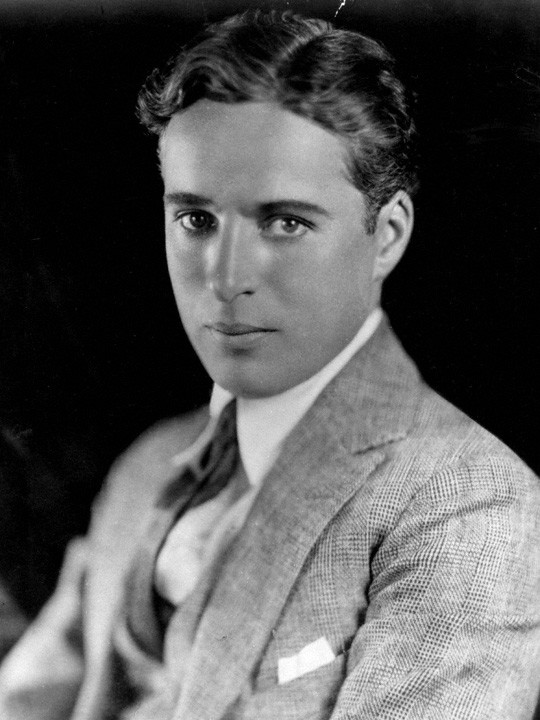
Charlie Chaplin was an English actor, filmmaker, and composer. He achieved great fame with his unique portrayal of the Tramp.
Sir Charles Spencer Chaplin (born: 16 April 1889)
He spent his childhood in poverty, living with his mother, who soon developed mental health issues. In his Chaldean numerologychart, his mother is primarily represented by the number 20. This number is connected to the number 26 in Chaplin’s chart, which can bring emotional struggles and mental pressure. However, in Chaplin’s case, this conflict was somewhat alleviated, so he did not feel it as intensely, as other numbers also influenced him. His mother’s number, though, is more precisely defined and could contribute to such complications. Of course, much depends on her own numerology chart—on one hand, with the right name, she could have had acting talent herself, while on the other, she might have been able to overcome her emotional struggles.
Chaplin’s chart also contains the number 46 (at the consonant level, and additionally, the name numbers 20 and 26 directly sum to 46), while his Life Path number is 37. Although 46 is not a Royal Star on its own, 37 is the Royal Star of the Bull, and in Chaldean numerology, both numbers are interpreted similarly. These are generally favorable numbers that bring good partnerships, friendships, and business success. His Total Name Number is primarily 28 rather than 46, which, combined with his birth date of 16, gave him a strong sense of individualism and an occasional need for solitude. This left him torn between his desire for partnership and difficulties in relationships. However, since his Life Path number was more fortunate than his Birth Number, he ultimately found a more stable relationship in his third marriage. The strong presence of the number 1 and multiple eights undoubtedly contributed to his perfectionism.
Charlie Chaplin in 1921. Source: Wikimedia Commons. File:Charlie Chaplin portrait.jpg.
Chaplin’s roles are both humorous and tinged with melancholy. His birth date of 16 (which suggests withdrawal and melancholy), along with the number 26 from his surname and his goal number 17 (both associated with the melancholic planet Saturn), played a role in this. The number 17, along with 46 and 37, brought him fame. Numbers such as 20, 33, and 24 indicate a talent for public performance. The many eights in his chart suggest that he likely experienced significant hardships in his life.
His first son died shortly after birth, and numbers may have played a role in this as well. The early part of his life was more unfortunate, and Chaplin’s sons were associated with the number 8 (and partially 4), which can be linked to karmic trials. Despite these hardships, Chaplin had many children.
In Chaldean numerology, there are both proponents and opponents of changing one’s name or surname. Advocates of this practice argue that altering one’s name is a legitimate way to introduce more harmonious vibrations into one’s life. One of the first modern Chaldean numerologists to support this idea was Isidore Kozminsky in the early 20th century.[1] In 1926, numerologist Cheiro also advocated for it in his book.[2] Due to Cheiro’s influence, changing one’s name is much more common among Chaldean numerology practitioners than among those who follow modern Pythagorean numerology.
However, there are also opposing views. For example, William Mykian believes that our true name is given at birth and that changing it—even in cases of natural changes, such as marriage—can lead to confusion and difficulties.[3]Bodil Storm argues that name changes should not be made based on numerology because our name and surname carry karmic imprints.[4]
It is important to note that changing a name can indeed present challenges. On one hand, after making a change, there is often an adjustment period as one aligns with the new vibrations. This period can involve intense cleansing and challenges, sometimes lasting several months or even years. On the other hand, Chaldean numerologists often overlook the significance of consonant numbers, which have a substantial impact on the quality of a numerology chart. Ultimately, a name change can result in vibrational shifts that numerologists may not foresee—or may not even be able to predict.
That being said, these concerns should not be taken as arguments against changing one’s name based on Chaldean numerology principles. A birth name is not a fixed, unchangeable element. While we cannot alter the planetary positions in our birth chart, we can change our name or surname. Thus, excessive fatalism in this regard is unnecessary. Many people report positive effects from adopting a new name or surname. The key is to ensure that the new vibrations are truly beneficial, and there are ways to achieve this, at least to some extent.
Regarding the supposed prohibition of numerologically altering one’s name due to karmic imprints, it is crucial to first understand what karma truly is. At its core, karma is the law of cause and effect, but it also operates as a form of the law of attraction. A specific cause draws in a corresponding effect. Karma is not something fixed; rather, it is constantly shaped by our thoughts, emotions, and actions. A common metaphor is that of farming: we reap what we sow.
Consider someone traveling from Madrid to London. If they board a flight to New York instead, they will not arrive in London. Action triggers reaction, and choices lead to consequences. Similarly, one does not typically attend a business meeting in a sweaty, tattered shirt that hasn’t been changed in ten days—otherwise, others may avoid them and not take them seriously. Likewise, if we do not pursue education, we are unlikely to gain deep knowledge in the fields that interest us.
An unfavorable name vibration is like a sweaty shirt—it is advisable to change it before an important business meeting. It is like flying from Madrid to New York while intending to reach London. With enough money, layovers, and delays, one might still eventually reach London, but why not simply take a direct flight from Madrid? The decision to change one’s name or surname is like planting a new seed, which, according to the law of karma, will eventually yield benefits.
There is nothing in this process that contradicts natural laws. In fact, it is a direct application of the law of karma. However, it is important to remember that numerology only influences a part of our destiny. It does not alter planetary karma or the karmic influences of elemental flows in the astrology of Mother Earth (such as the Chinese Four Pillars system, or Bazi). Personal initiative and spiritual connection also create new opportunities—and thus, new karma. Therefore, while the significance of name changes should not be dismissed, it is equally important not to overemphasize their impact.
[1]Kozminsky, Isidore (1912): Numbers. Their Meaning and Magic. Samuel Weiser Inc. Pg. 57.
[2]Cheiro: Cheiro’s Book of numbers. 1935 Edition.
[3]Mykian, William (2011): Numerology Made Easy. Xlibris Corporation, USA. Pg. 142-143.
[4]Storm, Bodyl (2005): Numerology. Pyramideforlaget, Oslo. Amazon Kindle.
There are several types of numerology. Here are some of the most well-known examples:
The so-called Chaldean numerology (sometimes also referred to as Aramaic or ancient Hebrew numerology). In modern times, it has been represented by figures such as Cheiro, Linda Goodman, and Gerun Moore.
Greek name numerology, or isopsephy, which was also adopted by the Pythagoreans.
Pythagorean numerology, which has several subcategories. It was likely initiated by Philolaus, a follower of Pythagoras’ philosophy who lived about a century after him. The dominant branch today was influenced by L. Dow Balliett, with notable figures including Florence Campbell and Juno Jordan.
Hebrew name numerology, or gematria. It was already used by Philo of Alexandria.
Kabbalistic gematria. Its foundations are described in the late antique text Sepher Yetzirah.
Arithmology, the analysis of names of people and concepts found in sacred texts, primarily those of Jewish and Christian Bibles. Key figures include Martianus Capella and Pietro Bongo.
Greek gematria and Latin gematria as parts of arithmology.
Arabic name numerology, or‘ilm al-huruf, which also incorporates Islamic arithmological interpretations. Notable figures include Ibn Arabi, Al-Farabi, and Ahmad al-Buni.
Within ‘ilm al-huruf, some Persian numerologists also contributed or developed their own models.
Vedic numerology, with its most famous numerologist being Vararuci.
Martinist numerology, represented by figures such as Martines de Pasqually, Louis-Claude de Saint-Martin, and Papus.
Bagua, or spatial numerology of the eight directions.
Yi Jing(I Ching) numerology, based on 64 hexagrams.
Astro-numerological calendar-based school of the Nine Star Ki.
Astro-numerological calendar-based school of Sizhu/Bazi (Four Pillars of Destiny). Its classical representative is Xu Ziping, after whom the main branch of this school is named.
Astro-numerological calendar-based school of Zi Wei Dou Shu.
Spatial numerology Fei Xing (Flying Stars), used in Feng Shui.
Spatial numerology San He, a branch of Feng Shui.
Spatial numerology San Yuan, another branch of Feng Shui.
Spatial numerology of the Eight Mansions, or Ba Zhai, which is used in Feng Shui.
All these and other approaches have their own principles, which are sometimes compatible and sometimes not. For example, the Chaldean method shares several similarities with the Pythagorean school but has little to no connection with the Ba Zhai school.
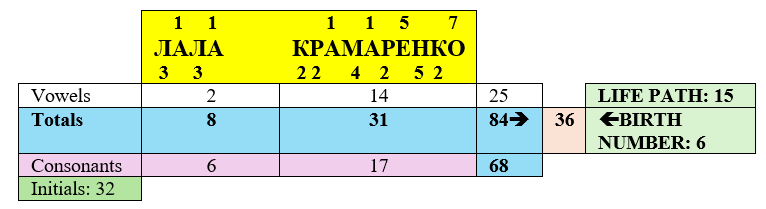
Lala Dmitrievna Kramarenko (Russian: Лала Дмитриевна Крамаренко, born December 6, 2004) is a Russian gymnast. In the summer of 2024, she became the victim of a severe medical mistake, which led to surgery on the wrong knee, causing significant damage. As a result, her athletic career now hangs by a thread.
Her numerology chart reveals strong numbers—3, 6, and 9—which undeniably enhance her athletic potential. Professional athletes, in general, endure numerous injuries and physical strain. But what insights can Chaldean numerologyoffer regarding this specific injury?
Unfortunately, I don’t have the exact date of her knee surgery, so I can only provide general insights. Her Total Name Number is 84, which reduces to 12 (8+4=12), a number often associated with sacrifice. While 12 harmonizes with her birth date (6) and her Goal Number (36), it is still considered an unfavorable number on its own. People with numbers in the 12 series are often advised to dedicate time to charity and spiritual practice, as this can help shift the energy of this number toward a more positive outcome.
Looking deeper, her consonant-level number is 68, which governs movement, limbs, and physical coordination. The interaction between 68 and 84 can indicate accidents and misfortune related to mobility, including sports injuries or even traffic accidents. Additionally, her surname’s consonant number is 17—a number linked to Saturn, which does not align well with 68. In numerology, Saturn is associated with joints, particularly the knees. The combination of 68, 84, and 17 suggests a predisposition to limb and joint-related issues.
Her annual energy numbers for 2024 also indicate potential challenges related to movement and mobility. However, numerology alone—without considering other aspects of fate, such as Chinese or Western astrology—does not necessarily predict that a knee injury must happen. Divine intervention can always play a role in critical moments.
Without diving too deeply into her numerology chart or analyzing her astrological chart, even small details like these show that Chaldean numerology is not to be taken lightly. A potential upside to the combination of 68, 84, and 17 is financial opportunity, suggesting that Lala Kramarenko may have some monetary potential. However, since both 84 and 68 are generally considered unlucky, this indicator should ideally be confirmed through astrological analysis. Ultimately, her chart contains too many unfortunate numbers, with 12 being the most dominant.
In such cases, many numerologists would consider changing her name to shift the numerological influence. However, balance in her chart can also be maintained through sincere spirituality, good deeds, and a strong connection to the Root and Earth chakras. This means spending time in nature, taking care of the body, developing bodily awareness, and even engaging in areas such as economics or business.
Alcoholism has been recognized as one of the most common forms of addiction for millennia. It’s no surprise that Chaldean numerologists and Hellenistic astrologers of ancient times (during the Hellenistic period and the Roman Empire) were already studying its connections. Back then, alcoholism was astrologically linked primarily to Mars and, to some extent, Libra. Later, some astrologers also considered the Moon, as it rules over liquids.
Numerologically, excessive drinking was associated with the number 9 (the number of Mars and soldiers). It was also likely linked to Saturn’s number of hardships – 8 – especially when combined with 9 or 15. In addition to these two numbers, almost all other numbers seemed to play a role in some way. For instance, 2 (fluids), 5 (youth), 3 and 4 (excess), and possibly even 1- though these numbers probably had to be in an unfavorable connection with either 8 or 9 to be significant.
In the 19th century, Western astrologers associated wine more with Jupiter, the ruling planet of Sagittarius and Pisces, rather than Mars. Once Neptune’s characteristics were defined, alcohol dependence was often attributed to the influence of both Jupiter and Neptune, which correspond to the numbers 3 and 7.
Chaldean numerologist Cheiro rejected these newer interpretations. To him, alcohol remained connected to Mars and the number 9, and he also suggested that addiction-related issues could appear with the number 4. Meanwhile, Pythagorean numerologist Florence Campbell, a contemporary of Cheiro, identified numbers 5 and 7 as being linked to addiction.
In 1973, Gerun Moore published a book that, under the lens of modern Western astrology, connected alcoholism to numbers 3 and 7, along with the karmic number 8.
My own research suggests that the foundation of alcoholism lies in the negative aspects of numbers 7, 8, and 9. These are followed by numbers 3, 5, and, in some cases, 4—but 4 and 5 only become problematic when they form an unfavorable combination with one of the first three numbers. My formula is as follows:
{ 7, 8, 9 } > 3 > { 4, 5 }
It’s important to note that not everyone with a strong presence of 7, 8, or 9 (or even 3) in their numerological chart will turn to alcohol as a coping mechanism. Free will always plays a role, and individuals can overcome these tendencies through self-awareness, relaxation techniques, and spiritual growth. The same applies to the interaction of two numbers within relationships.
However, people with the following number combinations may be more prone to alcoholism:
7 and 8: Emotional coldness, a tendency toward depression, and withdrawal from others can lead someone to seek solace in alcohol. Relationships between individuals with these numbers may also struggle with alcohol-related issues.
8 and 9: This combination, whether found in a personal chart or a relationship, can trigger patterns of aggression alternating with apathy. It may also bring feelings of misunderstanding and frustration.
7 and 9: Emotional crises can lead to alcohol dependence.
3 and 7: Emotional drama and relationship turmoil may arise. Alcohol may either be the cause of relationship problems or a consequence of them.
5 and 8, or 2, 5, and 8: Emotionally challenging relationships that cannot be overcome or rationalized may push individuals toward alcohol as a way to cope.
8 and 15: Difficulties in relationships and emotional attachment can drive a person toward excessive drinking.


 The Mystery of Numbers, Luck, Worlds and Planets