Compound Numbers from 10 to 99

Today I’m writing my first and last article in September, as I’ll be unavailable for several weeks. This post discusses compound numbers above 52. In Chaldean numerology, numbers above 9 are usually described only up to the value of 52.

When it comes to numbers higher than that, numerologists often differ quite a lot in their interpretations. Some even just add up the digits in the number—for example, 89 would be interpreted as 8+9=17. Others reverse the digits, claiming that 71 carries the same meaning as 17. But here lies a big trap! The number 34 does not share the same meaning as 43, nor does 25 equal 52. The number 32 is less favorable than 23. The number 31 contains digits that, when reversed, form 13. However, 31 does not carry the meaning of 13! So why should it be any different with numbers above 52? That’s why I advise against using such approaches.

Theoretically, one could also experiment with the extended Cheiro’s rule, which I wrote about in the article: Extended Cheiro’s rule for numbers above 52?

In practice, however, the meanings of numbers are usually as follows:

Favorable numbers:

19 (but sometimes not lucky), 21, 23, 24, 25, 27, 30, 33,

34, 36, 37 (but sometimes not lucky), 41, 42, 45, 46, 50,

60, 63, 66, 67 (but sometimes not lucky), 69, 72, 73, 74,

79, 91, 96

Numbers that, in relation to other numbers, generate favorable or unfavorable influences:

10, 13, 15, 17, 20, 40, 51, 55,

65, 68, 70, 78, 80, 90, 97, 98,

99

Unfavorable numbers:

11, 12, 14, 16, 18, 22, 26, 28,

29, 31, 32, 35, 38, 39, 43, 44,

47, 48, 49, 52, 53, 54, 56, 57,

58, 59, 61, 62, 64, 71, 75, 76,

77, 81, 82, 83, 84, 85, 86, 87,

88, 89, 92, 93, 94, 95.
Bridge Number as a Method of Determining the Total Name Number

The strongest technique for combining numbers in Chaldean name numerology is not addition, but rather the composition of digits.

Let’s recall: name numbers can be added by first reducing each number to a single digit. If needed, this step can be repeated. For example, in the name number 17, we add the digits 1 and 7 to get 8. In the surname number 38, we add 3+8 to get 11, and then 1+1 to get 2. Finally, we add 8 and 2 together, which gives us 10 as the Total Name Number (TNN).

Another way to calculate the TNN is to keep the numbers as they are and add them directly in a single step. In this case, 17 + 38 = 55.

The Bridge Number, on the other hand, is formed by reducing both the first name and surname each to a single digit. In our example, 17 reduces to 8, and 38 reduces to 2. Then we combine these digits, 8 and 2, into the Bridge Number 82.

In modern numerology, this method was briefly revealed by Cheiro, who in one example combined the numbers 6 and 9 into 69, though in reality this is a very old technique. Today, some Chaldean numerologists are once again using it more frequently.

When calculating the TNN, the other two techniques described above are still active in the background. So, in addition to the Bridge Number 82, the numbers 10 and 55 also exert a weaker influence.

Challenges with the Bridge Number technique:

  • Most Chaldean numerologists do not have reliable interpretations for numbers above 52.
  • The Bridge Number may function somewhat differently than an ordinary number. For instance, a TNN with a Bridge Number 34 from the name 21 and surname 13 is not particularly favorable.

I personally call this number the Bridge Number, to emphasize its role in connecting two numbers into a new entity, like a bridge between them. However, it could also be referred to with other terms, such as:

  • Contact Number, because it represents the contact of two energies that touch and create a new number.
  • Link Number, since the two numbers “link” together into a new entity.
  • Intermediary Number, because it serves as a mediator between two base numbers. It is neither the initial reduction of the name or surname, nor the final single-digit number.
  • Core Expression Number, since it expresses the essence of how two numbers work together within the TNN.

More Than Three Name Numbers in Given Names or Surnames?

This is a very common situation in many countries. The first thing to remember is that in the Chaldean numerology the names by which a person is most widely known carry the strongest energetic effect. For example, Donald John Trump is universally recognized simply as Donald Trump. Therefore, his primary vibrations are analyzed under that form.

That said, there are cases where someone is genuinely called by two given names or two surnames.

If a person has three or more name numbers—say, two given names and one surname—the same rules apply as with just one given name and one surname. The only difference is that creating the Total Name Number (TNN) involves one extra step.

For example: John Michael Wilson → numbers are 18, 22, and 25.

  1. First, we combine the given names:
    • John = 1+7+5+5 = 18 → 1+8 = 9
    • Michael = 4+1+3+5+1+5+3 = 22 → 2+2 = 4
      Together, they form the “combined number” of the given names: 94. This number has its own meaning, but it also reduces to 4.
  2. Next, we add the reduced value of the surname:
    • Wilson = 6+1+3+3+7+5 = 25 → 2+5 = 7.
      Combining the reduced value of “combined number” of  the given names (4) with the surname (7) gives us 47. This becomes the strongest number for this person.

Of course, other influences are also active in the background, such as:

  • 18 + 22 + 25 = 65
  • 9 + 4 + 7 = 20

These “combined numbers” may also include more than two given names, or more than two surnames.

In Search of the Compound TNN and Active Compound Number

What should we do in Chaldean numerology if a first name or surname reduces to a value below 10? Does that mean it carries no special meaning compared to compound numbers? The Danish (post-Chaldean) school approaches this with a method they call augmentation.

Others, however, take the name exactly as it is. I follow this second approach: even if a first name is a single digit, I don’t add anything to it. That name still has its own unique vibration—similar to how Tarot cards from I to IX carry distinct symbolic meaning.

What matters more is how the Total Name Number (TNN) is formed by adding the reduced values of the first name and surname into a complete number.

For example:

  • Al Snow → AL = 1+3 = 4; SNOW = 3+5+7+6 = 21 → 3.
  • 4 + 3 = 7, not a compound number!

Now we check the day of birth. If Al was born on the 3rd of the month, then 7 + 3 = 10. This is not the TNN itself, but it becomes a very active (compound) number, often even stronger than the TNN. However, this only works if the birthday is between the 1st and the 9th of the month.

If the birthday falls after the 9th, this method doesn’t apply. Still, the TNN is active in the background, since it is always created as a two-digit number from the full values of the name and surname. In this case: 4 and 3 combine to form 43 (with an additional influence from 4 + 21 = 25).

If the birthday is the 10th or later in the month, and the sum of the reduced first name and surname is below 10, we can move to the next step by adding the unreduced values of the first name and surname.

For Al Snow: 4 + 21 = 25. But the leading number still remains 43, created by combining the unreduced values of the name and surname.

The Chaldean Number Sequence/Number Code in Name Numerology

Changing one’s first or last name is just one of the possible ways we try to shift the energies within our personal makeup. Today, I want to introduce another method that can be used to partially resolve difficulties when dealing with unfavorable or challenging numbers in a name, surname, or their combined value.

I was inspired to write this after my friend told me that his lady is struggling with a serious kidney disease. Almost simultaneously, a reader of my blog reached out. He has been exploring how to activate the favorable energies of a name without actually changing the first or last name. Taken together, these were clear signs that it was time to write this article.

In short, this technique is based on a three-digit sequence derived from the first name and surname with the art of Chaldean numerology. What we need are:

  • the reduced single-digit value of the first name,
  • the reduced single-digit value of the surname,
  • and the reduced single-digit value of the Total name number (TNN).

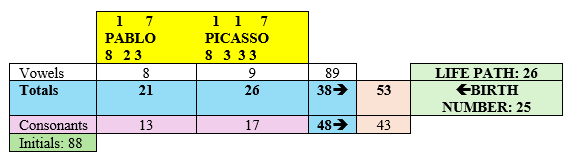
Example: Pablo Picasso

  • His first name Pablo equals 21, which reduces to 3.
  • His surname Picasso equals 26, which reduces to 8.
  • His total name number (TNN) is 38, which reduces to 11, and then to 2.

Step 1: Defining the Sequence Numbers

  • Outer level: Add the reduced numbers of the first name, surname, and TNN, then reduce to a single digit. For Picasso: 3 + 8 + 2 = 13 → 4.
  • Inner level: Use the TNN. For Picasso, that’s 38 → 11 → 2.

Alternative Ways to Arrive at the Same Sequence

  1. Outer level: sum of reduced TNN, total vowels, and total consonants. For Picasso: 8 + 3 + 2 = 13 → 4. Inner level remains the TNN (38 → 11 → 2).
  2. Outer levels can also be represented as a doubled TNN.

In every case, we arrive at the same personal sequence.

For Pablo Picasso, the resulting sequence is 4, 2, 4. This is his main balancing sequence, helping harmonize the energies of his name and surname.


The Numerological Theory Behind the Sequence

The reduced TNN (in the center of the sequence) acts as the core name number through which fresh energy flows into our system. This is true even with challenging numbers such as 4 and 8. In a sense, this central number connects us to prenatal levels of existence.

The outer numbers represent overall functioning, but they also contain the prenatal aspect of the TNN (since it is part of the sum that produces them). This creates a level of wholeness.

The TNN, appearing both at the center and hidden within the outer sums, ties the entire sequence together into unity and completeness.

Notice that the outer numbers are always a multiple of the central one. Picasso’s sequence is 4, 2, 4. If someone’s TNN were 8, its doubled value would reduce to 7 (8+8=16 → 7). Their sequence would be 7, 8, 7. This doubling holds the creative potential of duality.

The outer layer, as the field of total action and dual reflection, allows the frequency to move beyond the narrow frame of the body and aura, reaching into the wider world. Anyone familiar with energy manifestation knows: for an idea or message to manifest, it must leave the inner system and move outward.

So even though duality is at play, the presence of the TNN at all three levels, along with the sum of the outer numbers, expresses connection, unity, and wholeness.


Side Note: Consonant Sequence

You can also derive a consonant sequence. For Picasso, this is 6, 3, 6. But it works much more weakly than the main sequence, since the latter integrates both the whole-name numbers (first, surname, TNN) and the total vowel and consonant values.

Aramaic codes for Latin alphabet, used in Chaldean numerology

How to Use the Sequence

  • Visualization: Imagine a sphere in front of you, and inside it, sequentially project the numbers of the sequence. After the last number, pause briefly, then begin again. Practice consistently over time.
  • Repetition: Silently or softly whisper the sequence. After the last number, pause, then repeat. Again, regular practice is key.

Some people also write the sequence down. But there’s a catch: a written sequence remains as a sequence only while we perceive it that way. If written repeatedly, it may start to vibrate as a single number. For Picasso, 4, 2, 4 would collapse into 424 → 4+2+4=10 → 1. This could be problematic if 1 is not suitable for balancing the person’s chart. In such cases, the meaning of 10 would also need to be considered. Similarly, the sequence 787 would introduce the influence of 22, which is often highly challenging.


Final Thoughts

Practicing with sequences, depending on the individual, brings more wholeness, more prenatal influence, and more balance from harmonized numbers (especially important when dealing with unfavorable ones).

If you decide to try working with your main name sequence—good luck with your practice!

Flower of Life, Germ of Life and Chaldean Numerology (2)

Here is another possible connection between numbers and the Germ of Life. It likely doesn’t stem directly from the Chaldean tradition. It follows the doubling sequence: 1, 2, 4, 8, 7 (from 16), 5 (from 32 or 14)… but not in that exact order. Instead, it appears in the sequence defined, for example, by the formula:

1/7 = 0.142857

Opposing values add up to 9, which makes this a kind of “magic hexagon”—in a similar sense to how we also know “magic squares.”

Flower of Life, Germ of Life and Chaldean Numerology

Nowadays, the study of sacred geometry and the so-called Flower of Life has become very popular. It’s important to note, however, that sacred geometry operates within the basic matrix and the dualistic world—and it also contains certain hidden pitfalls.

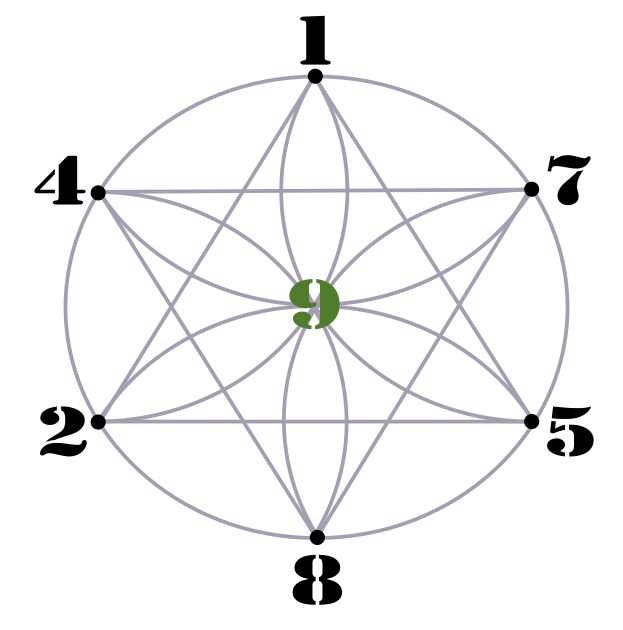
Within the Flower of Life lies the so-called Germ of Life, composed of six petals, which includes six points around the edge and one central point. These seven points are then associated with the planets.

In Arabic numerology, which in many ways is a successor to Chaldean numerology, there is also a solution of connecting the seven classical celestial bodies (the five planets, the Sun, and the Moon) with the seven points in the Germ of Life. I’m including an image of it that speaks more than a thousand words. This system was published nearly 100 years ago by the numerologist Mabel Louise Ahmad, wife of numerologist Sheikh Habeeb Ahmad.

You’ll notice that the planets—or rather, the seven luminaries—are divided into two triangles, except for the Sun, which is placed at the center. The luminaries are divided based on whether they move faster or slower across the sky than the Sun. The slower-moving lights are arranged in one direction around the circle, while the faster ones are arranged in the opposite direction.

Pablo Picasso and Chaldean Numerology

Pablo Picasso (October 25, 1881 – April 8, 1973) was a Spanish painter, sculptor, and designer whose artistic style left a lasting mark on global culture.

He was born on the 25th of the month, and his Total Name Number (TNN) was 38. Both numbers reduce to 7 and 2 respectively—numbers that are considered deeply artistic. His strongest numerological influences, however, come from the number 8 series, which includes his Life Path Number of 26. Among these eights, we find the numbers 17 and 89—the latter being a variant of 17. The number 17 is known for bringing fame, whether positive or negative, and it can also bestow artistic talents. The number 3, which also has strong associations with creativity and art, appears in the form of 21 and 48.

In Picasso’s name numbers, we find a recurring theme of construction and deconstruction—for example, the pair of numbers 21 (construction) and 26 (deconstruction), as well as 21 (again, construction) and 13 (deconstruction, which, according to his numerology chart, may also indicate the manifestation of very dark energies). A similar dynamic appears in his consonant number line: 13 and 17 suggest a shattering of unity, while 48 represents a unique and eccentric attempt at reconstruction.

This study of darker energies is not limited to the 13–21 relationship. Many of Picasso’s works carry a heavy emotional tone. Initially, his artistic expression was rooted in a neoclassical style, later evolving into surrealism. Yet it was precisely the disruptive dynamics symbolized by the relationships between 13 and 21, 13 and 17, and 48 that allowed him to forge the cubist style. In cubism, subjects are “broken apart” and reassembled in new ways—an artistic narrative that perfectly suits the life and work of the renowned Spanish painter who lived and created in France.

His harsh treatment of women can likely be traced to the relationship between numbers 26 and 38 (emotional wounds), as well as the challenging placement of 13 and 17. The interaction between the number 25 and numbers from the 3-series—specifically 21 and 48—also plays a role. While this dynamic isn’t without the potential for love, it more readily sets the stage for emotional drama and heartbreak.

Wikimedia Commons: File:Pablo Picasso, 1910, Girl with a Mandolin (Fanny Tellier), oil on canvas, 100.3 x 73.6 cm, Museum of Modern Art New York..jpg

Picasso’s political views were radical; he was even a member of the Communist Party. In his numerological profile, the number 13 (from the 4-series) represents revolutionary Uranus rather than the Sun, while 25 and 88 are associated more with Neptune than with the Moon or the South Lunar Node. In his chart, Uranus appears weakly placed and functions more as a planet of provocation and upheaval than as one of structured capitalism. His most dominant number is 8, Saturn’s number, which can represent the bourgeoisie in a positive sense, but in Picasso’s case, it leans more toward the working class. His TNN is 25—a Neptunian number tied to socialism and communism.

His final pinnacle number was 19, which belongs to the 1-series and activates other number 1 energies in his chart. While 19 is generally considered a fortunate number, Picasso had the misfortune of experiencing one of its more challenging forms. In his later years, the interaction between TNN 38 and Life Path 26 also activates the number 28—yet another 1-series number. This may have contributed to his death by heart attack, as numbers in the 1-series are often linked to the heart.

Thomas Louis Hanna and Chaldean Numerology: The Father of Modern Somatics

Thomas Louis Hanna (November 21, 1928 – July 29, 1990) was a philosophy teacher and a pioneer in the field of somatics, a discipline focused on muscle relaxation, movement, and Sensory Motor Amnesia (SMA).

According to his Chaldean numerology chart, no single number or pair of numbers dominates his profile. The number 7 (associated with analysis, wisdom, and philosophy) appears in his Life Path number (25), which—combined with the number 3 or 21 (philosophy) in his birth date and the number 5 (from 68) in his Total Name Number (TNN)—suggests a life oriented toward spiritual and philosophical exploration.

His TNN is 68, a number that represents movement. His core name numbers suggest a fusion of physical therapy and healing movement (24), along with challenges to health (17 with 15), expressed through the form of movement (68). The somatic practice he developed can be seen as a personal response to a need for balance and healing on the somatic level.

On the more physical plane (derived from the consonants in his name), the number 15 appears—typically associated with difficulties. This layer of the chart also includes the number 76, a variation of 13, which can indicate hardship, and the number 16, often considered a symbol of collapse. At this deeper level of analysis, it becomes clear that Hanna’s focus on observing the body, movement, and relaxation may have been driven by an attempt to resolve his own struggles, as well as those of the people around him.

The number 68 is a variation of 14 and is often linked to the risk of traffic accidents—especially when it intersects with the numbers 3 (present as 21) and 8 (present as 17). Tragically, Thomas Hanna died in a car accident in 1990.

His pinnacles reveal that during his youth and early adulthood, he was influenced by the number 32, which can be tied to the study of movement. This number also warns of the importance of thinking independently and trusting one’s own judgment—qualities Hanna clearly embodied. His final pinnacle was the number 22, which tends to bring significant challenges. In his chart, this number activated 76 (associated with the number 13, often symbolized as “Death”), and its connection to 68 above it is notable. The number 76 (or 13) reduces to 4—the number associated with machinery and vehicles—while 68, as a form of 14, also relates to traffic and transport.

Despite the tragic end, Hanna’s life continues to inspire. His story demonstrates how one can face and transform difficult numerological patterns through creativity and personal growth. This is the kind of vision we should all carry in our hearts: a commitment to breaking free from limiting life patterns and evolving into greater wholeness.

France Pirc and Chaldean Numerology

France Pirc (born January 22, 1899) was a Slovenian military pilot and aviation major general. He became a Yugoslav military pilot. During World War II, based on false intelligence, he was lured into a trap and landed his aircraft behind enemy lines, where he was briefly imprisoned by the Germans. Due to the circumstances, he was compelled to join the air force of the Croatian fascist state, but at the same time, he secretly collaborated with the resistance movement. Eventually, he defected to the partisans with his aircraft. In retaliation, Croatian fascists murdered his wife and daughter. He had already lost another daughter before that. France Pirc was later promoted to the rank of major general.

France Pirc in Flight Uniform. Circa 1930. File:France Pirc.jpg; Wikimedia Commons.

After the war, he refused to join the Yugoslav Communist Party, which effectively ended his military career. He later served as the Yugoslav ambassador to Argentina but was recalled after he dared to criticize the Communist regime for its human rights abuses. He returned to Yugoslavia before his death, which occurred under suspicious circumstances in 1954. The cause of death was concealed from his family, which led to speculation that he had been poisoned.

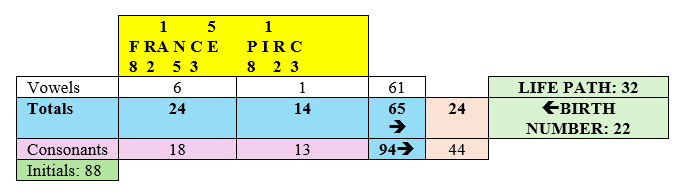
From a numerological standpoint, his chart shows a strong presence of the number 4. In Chaldean numerology, 4 is typically influenced by the Sun, but can also fall under the influence of Uranus or the North Node. In Pirc’s case, his chart indicates a dominant Uranian influence, which may explain his fascination with aviation. A strong presence of the number 5 alongside the number 4 may bring influences typically found in Aquarius and Gemini, both air signs. His consonants reveal a connection between the numbers 18 and 13, which are associated with war, explosions, death, and sudden reversals.

His Total Name Number (TNN) is 65, which can represent wounds and warfare but also the potential for social advancement. Although 65 reduces to 11 and then to 2, this 2 is particularly strong, indicating he had the inner strength to overcome fear. The high concentration of 5s in his chart points to a need for movement and change.

The Uranian 4 is often linked to sudden twists of fate. The number 22 can indicate a tendency toward naivety. It was this naivety that led him into the German trap at the start of WWII. His defection to the partisans prompted the Croatian fascists to murder his wife and young daughter. The Uranian number 4 is also associated with fighting for others’ rights, and paired with 22, it likely contributed to his open criticism of post-war Communist authorities—criticism that put him out of favor with the regime. The number 4 can also govern violent or suspicious deaths, including poisonings. While it’s uncertain whether he was poisoned, the circumstances of his death strongly resonate with the themes of 4 and 65.

Numbers like 24 and 65 in his chart indicate that family was very important to him. Based on the numerical relationships in his chart, his daughters correspond to the numbers 88 (a version of the unfortunate number 16, known as “The Fallen Tower”) and 65, which is frequently linked to wounds or health issues. This combination had a negative impact on the lives of his daughters.

His wife is represented by the numbers 65, 24, and 5 in his chart. Since these numbers also appear in his Total Name Number, Goal Number, and Life Path, she held a deeply important place in his life. It’s clear that he was never able to recover from her death or that of his daughter (again, linked to 65). Although his wife’s numerology chart includes some favorable numbers, war situations dangerously activate the 65, especially when combined with the daughter’s numbers, making the outcome even more perilous for both. Naturally, much more would depend on the individual numeroscopes of his wife and daughter.

Pirc grew up in a family nicknamed Zverinovi, which also brought Uranian influence into his life. Later on, he also went by the name Franjo, which carries a numerological value similar to France.

Interestingly, a similarly extraordinary yet tragic numerological profile can be found in the chart of American war hero Desmond Doss.