In Chaldean numerology, as in many other systems that deal with understanding pf human destiny, there are a variety of approaches among practitioners, some of which may even conflict with one another. A similar situation can be seen in Western astrology, where practitioners might use different house systems, such as equal houses based on the ascendant or the Placidus system, among others. Some interpret retrograde planetary motion traditionally, viewing it as a period of negative influence, while others see it as an opportunity for introspection. Similarly, planetary aspects might be analyzed through the lens of traditional texts, or alternatively, with insights from modern psychology.
So, where do we find the biggest differences in Chaldean numerology?
Some numerologists prioritize the favourable or unfavourable relationships between numbers over the intrinsic nature of a number itself. For instance, a generally “lucky” number might behave “unluckily” due to its interactions with other numbers. Others argue that, in most cases, a number retains its inherent “lucky” or “unlucky” qualities, but the intensity of those qualities may be amplified or diminished depending on its relationships with other numbers.
Cheiro, one of the most influential Chaldean numerologists, relied on ancient traditions when interpreting number relationships. However, numerologists who preceded him often did not assign much importance to these relationships. Others, meanwhile, place significant emphasis on planetary friendships, defining numerical relationships based on this criterion. Since Chaldean numerology has spread widely in India, it’s worth noting that jyotish (Vedic astrology) interprets planetary friendships differently than Western astrology. Applying these differing approaches to numbers naturally leads to divergent conclusions.
Many Chaldean numerologists use Cheiro’s system of alphanumeric coding, but some adhere to alternative methods, such as the traditional external (Cavendish) or internal approaches (Gibson, Johari).
In classical numerology, names or surnames with values below 10 were generally considered acceptable. Cheiro, however, sometimes added the single-digit value of a birthdate to a name or surname with a reduced total below 10 (in order to derive a key number for analysis). The Danish school applies a similar approach but does so for all names and surnames under the value of 10.
There is also considerable variation in how the Total Name Number is calculated. Some sum the base numbers of the name and surname, while others use compound numbers, or they combine the base digit of the name with the base digit of the surname.
Some Chaldean numerologists, such as Cheiro, never use the Life Path Number—the total sum of the birthdate (day, month, and year). Others, however, consider this number to be a crucial element in their analysis.
Another key difference among Chaldean numerologists lies in whether they conduct a specific analysis for vowels and consonants in addition to the general analysis. Some also include supplementary evaluations, such as analyses of initials, the influence of numbers on chakras, and similar methods.
There are even more variations in approach beyond those described here. Naturally, some methods yield better results than others. As for which system I use, some insights can be found in my published analyses.
I wish you much success as you explore the fascinating world of Chaldean numerology. 😊
Gerun Moore (1910–2010) was an American Chaldean numerologist and musician. He was born in March 1910 in New Orleans as Sterling Guerin. According to his own claims, he was born on March 10, but therapist John Ensminger, who visited him in a nursing home, explicitly noted that his last birthday was on Saturday, March 13, 2010. It is very likely that March 10 was simply a “new birthday” for Gerun Moore, as he, being a numerologist, advocated for changing the vibrations of one’s birthdate by celebrating on a favorable day close to the actual birthday. This favorable day would have a base number from the key of the original birthdate. In Moore’s case, the key numbers associated with his birthdate were said to be 1 and 7.
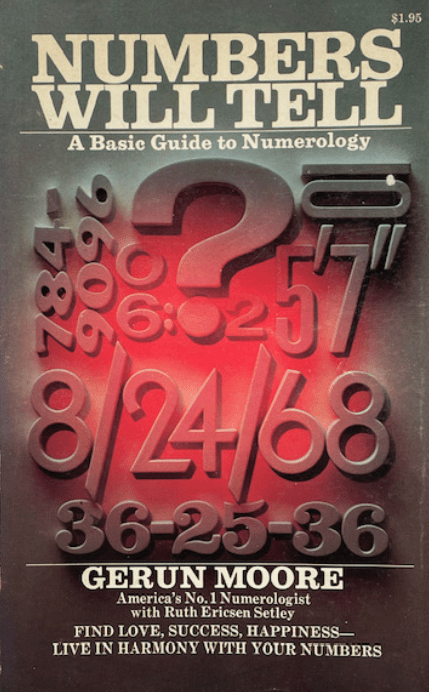
His father was also a musician. Gerun Moore followed in his footsteps and performed in a well-known jazz band Louis Prima Orchestra. Even before World War II, he began delving deeply into numerology. He initially explored Pythagorean numerology, too, but during the war, he became a strong advocate of the Chaldean school. Influenced by Cheiro’s teachings, Moore developed his own approach and changed his name to Gerun Moore. He started celebrating his birthday on March 10. Later, he wrote a book titled Numbers Will Tell. A Basic Guide to Numerology. He was known for his kindness, laughter, and joy.
Gerun Moore used alpha-numeric encoding as advocated by Cheiro
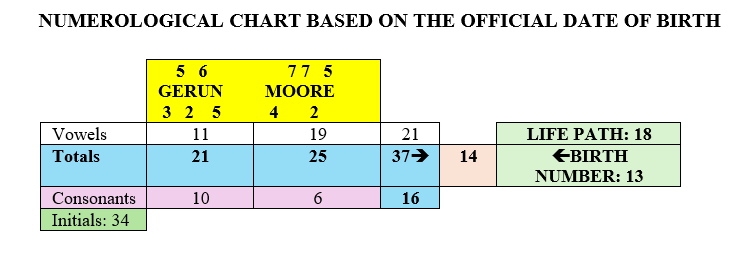
His birth numerology chart reveals a lot of negative energy. In his name, surname, and Total Name Number (TNN) as Sterling Guerin, we find difficult numbers: 26, 22, and 84 (or 12; 8+4=12). His Life Path Number was also an unfavorable 18, and in such circumstances, even a birthday on the 13th of the month represents challenges and negative influences. This numerology chart is very demanding, but Sterling Guerin’s consonants at least create somewhat more favorable numbers. However, the number 21, like the TNN 84, is not a number that aligns well with the number 13.
There are many numbers that can be associated with music and art. For example, 15 and 6, which gives stage art, and in the case of Sterling Guerin, 13 (Birth number) may be related. Sometimes the numbers 2 (consonants in personal name) and 7 (goal number) are associated with music. Likewise, the number 3 (TNN 84 and consonant total 21) can bring art, especially when it comes to stage performances. Sterling Guerin’s interest in the occult was probably related to the formation of the numbers 3&6&9, the birthday 13 and the number 7.
Despite the challenging vibrations in Sterling Guerin’s numerology chart, there are several spiritual indicators. If Guerin leaned on the power of faith and spiritual values, he could have greatly alleviated his life. The chart also brings some manifestation abilities and talent for public performances, whether in the media or on stage. Even difficult charts can reveal talents, and Sterling Guerin found his path to the stage.
After changing his name, Gerun Moore retained some indicators for manifestation and spiritual qualities and gained more vibrations of love. His new TNN was 37, which is a highly favorable number. Moore referred to the TNN as the “ruling name number.” Name numbers brought very strong and favorable vibrations, despite the consonant number being 16. When an unfavorable number is surrounded by many positive numbers, its harmful influence is greatly reduced. Whether we consider the 13th or 10th of March as his birthday, the new vibrations are very favorable. Numbers 37 and 13 are also interchangeable, bringing more completeness to life. Additionally, these numbers have an alignment that can bring a youthful spirit.
The new name contains the numbers 11, 25, 21 and 16, which may be associated with music. Also 1 in such a chart can be directed towards artistic talents, especially 37, which is his new TNN. Vibrations that may give an interest in the occult have also been retained (21, 25, 16, 11…).
The numerological change that Gerun Moore made was, therefore, favorable and brought more harmony and satisfaction into his life.
Although he greatly respected Cheiro, as a Chaldean numerologist, Gerun Moore did not believe in the validity of summing unreduced numbers. He rejected Cheiro’s complex method of finding the most powerful active compound number in a numerology chart. Furthermore, he did not trust Cheiro’s model of lucky numbers based on specific days of the year. After three decades of research, Moore developed the so-called “Name Number Chart.” This chart represents a system of “keys,” numbers that bring the most balance to a numerology chart. Almost every date has two such keys, and in three cases, dates have only one key. Moore believed that a name change should always include numbers found in these keys.
Personally, I do not use his keys, as any numerology chart can be studied in different ways. Additionally, there is no consensus among numerologists about which numbers bring the most luck based on specific days of the year. Cheiro presented his model of lucky numbers, and a few years after Gerun Moore, Lloyd Strayhorn, another influential modern Chaldean numerologist, did the same. Neither Cheiro, Linda Goodman, nor Gerun Moore emphasized the Life Path Number, nor the numbers of vowels and consonants. Various analyses show that these numbers should also be considered.
In his book, Gerun Moore also presented his findings on the relationship between numbers and musical instruments. His conclusions are likely quite accurate, as he was a musician who could study the numerology charts of many colleagues. Additionally, he demonstrated connections between numbers and plant species, as well as the relationship between numbers and sexuality.
One of Gerun Moore’s more notable ideas, as mentioned, was his advocacy of the idea that a birthday can be “changed” by celebrating it on a favorable day in the month. In reality, we cannot change our birthdate. What we are actually changing is the vibration. In Slovenia, this approach was adopted by a numerologist (then named Naca Jermanj), who observed in many cases that celebrating a birthday on a favorable day indeed brought good fortune. Certainly, Gerun Moore’s book should have a place in every Chaldean numerologist’s library.
Isidore Kozminsky was reportedly born on October 25, 1870. He grew up in a family of Australian Jews and jewelers. He was known as an astrologer, numerologist, and an expert on gemstones and the Kabbalah. Because he married outside of Jewish circles, he adopted the name Francis Coton and moved with his family from Australia to London in 1935. Isidore Kozminsky remained his pen name. He died during World War II, but the exact time and cause of his death are unclear. One account suggests he died after tripping down an escalator in the London underground, while another claims he succumbed to pneumonia.
Isidore Israel Kozminsky, born on 25th October 1870
His numerological chart for the name Isidore Kozminsky shows a strong and quite favorable alignment of energies. It includes the auspicious numbers 23 and 55, as well as the number 96, which can be unfavorable (depending on how often it encounters the numbers 4 and 8). His chart reveals a strong relationship between 1 and 6, which often suggests a love of luxury and likely influenced his interest in gemstones. Numbers 96 and 24 bring a certain level of material comfort. Numbers 1 and 5 are positioned in a way that enhances the role of intellect, knowledge, and information. Numbers 96, 17 and 25 indicate an interest in the occult, with 96 potentially invoking darker spiritual influences. Therefore, due to the number 96, he needed to be cautious of the darker aspects of spirituality and manipulation. Base number 5 (23, 32) also signifies an interest in numbers, giving him some potential for communication and writing.
The reader can see that I treat the letter Y as a consonant. There is no consensus among numerologists on this, but studying various cases shows that it is more appropriate to treat Y as a consonant.
In 1905, Kozminsky wrote Numbers, Their Magic and Mystery, where he advocated for the Chaldean-Hebrew system with the values C = 2, H = 8, and X = 6 (the external values method of alpha-numeric coding). In 1912, he published Numbers: Their Meaning and Magic. Being an Enlarged and Revised Edition, in which he shifted to a coding system where C = 2, H = 5 or 8, and X = 5. This approach had a significant influence on Cheiro.
The method Kozminsky used for summing numbers in the Total Name Number (TNN) is controversial and outdated. Based on a specific form of Kabbalistic astrology, which Sepharial also endorsed, he identified certain numbers from 1 to 28 as having “potency of their own,” as well as numbers 37, 43, 51, 55, 65, 69, and 71. According to this system, if a name or surname corresponds to a number with its own potency, it is not reduced to a basic value. If it does not have its own potency, the number must be reduced to the first number that does. For example, the name Napoleon Buonaparte (an earlier version of the famous French general’s name) vibrates at 41 & 41. Since 41 does not have its own potency in Sepharial’s system, it must be reduced to 5 (4+1=5).
Vintage Book- image published on WorthPoint
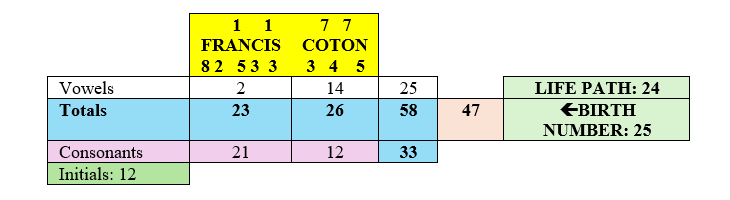
In the case of Isidore Kozminsky, we get the name value 23 and the surname value 5 (from 32, which is reduced as 3+2=5). The sum is 28, which has its own potency and therefore does not get reduced to 10. The number 28 is considered a key number and is regarded as an unfavorable one. For the name Francis (8+2+1+5+2+1+3) Coton (2+7+4+7+5), the name sums to 22 and the surname to 25. 22 is generally unlucky, while 25 was considered fortunate in older traditions. The total is 47, which does not have its own potency and must be reduced to 4+7=11. The TNN value is 11, which Kozminsky treated as neutral. Since he was born under base number 7, we get interchangeable numbers. Kozminsky likely believed that his new name, Francis Coton, would be lucky.
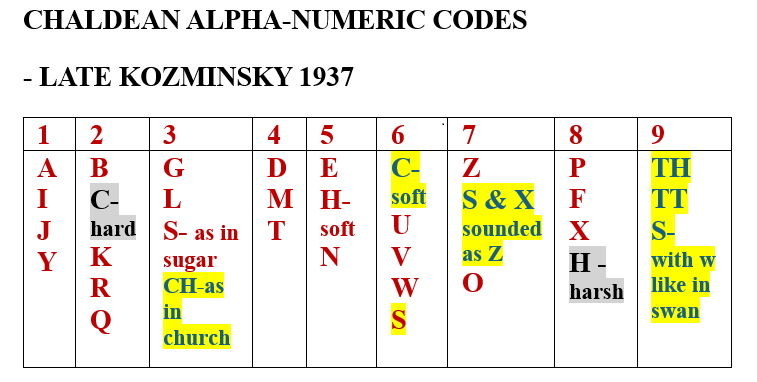
In horse racing, Kozminsky adopted phonetic numerology (books Numbers and Horse Racing, 1928, and My Key Treatise, 1936). He believed that for humans, the written name was influential, while for animals, the spoken name held more power. In 1937, he also published Numbers And Their Practical Application, in which he used a reformed Chaldean coding system for interpreting people’s numerological charts, diverging significantly from Cheiro’s model. He also provided weaker descriptionsof numbers compared to his earlier works.
According to his reformed alpha-numeric coding system, the name Isidore Kozminsky carried the values 26 and 35. In the new book, Kozminsky did not explain how to calculate the TNN. According to his earlier method in Numbers, Their Magic and Mystery, the number 35 is not given its own potency and is reduced to 8. The sum of 26+8=34. However, the name Francis Coton gives the name value 25 and the surname value 25. These combine to 50, which he considered his TNN. Nonetheless, the alpha-numeric coding used by Kozminsky in the final years of his life no longer had much influence.
According to the classic Chaldean alpha-numeric coding model (Cheiro’s approach), the name Francis Coton results in a numerological chart, which contains more unfavorable numbers. The chart is rather weak and shows conflicts between the numbers 23 and 26, 58 and 33, 26 and 58, and 33 and 28. This chart no longer indicates as much interest in gemstones, although some financial potential and interest in communication remain. The strong number 58 indicates a tendency toward eccentricity and reforms, which likely did not go in the right direction. We can see that Kozminsky’s numerological expertise declined in his later years. The information he disseminated lost touch with the Chaldean tradition and reliable interpretation.
Numbers 58 and 71 together emphasize the themes of death and difficulties. The surname Coton carries very unfavorable vibrations of 26 and 12, represented as a pillar. This might have influenced the spread of the story about the escalator accident. The numbers 8 (2+6=8) and 3 (1+2=3) can represent buildings, with 8 also symbolizing railways and underground structures. The number 12 can represent a pillar, which may symbolize ascending or descending via escalators. The conflict between 58 and 33, and between 23 and 26, could be connected to respiratory illnesses. Thus, both stories of his death have roots in his numerological chart. The interaction between number 58 and numbers 26 and 71 represents a conflict between base numbers 4 and 8. This pair often indicates significant difficulties and suffering. 58 is also an unfavorable TNN for period 6 (October, extended influence of Libra).
It becomes clear that in Isidore Kozminsky’s case, the name and surname change brought about unfortunate circumstances. Fortunately, Isidore Kozminsky continued to use his original name in his writing. The number 69 in the name Isidore Kozminsky also interacts with the number 58 in the name Francis Coton, adding to the negative influences. 69 reduces to 15, and 15, in its negative aspect, represents manipulation and even black magic. This might explain why Kozminsky’s books carry an unusual vibration. After reading them, I had to cleanse my aura several times. It would have been much better if Isidore Kozminsky had kept his original name in his everyday life. So, a word of caution: one must be careful when changing names. The goal of a name change should be to increase satisfaction or success in life, not to accumulate problems.
Anmarie Uber is an American numerologist of the last generation. She practices Chaldean numerology. She also specializes in astrology, tarot, massage, channeling, energy healing and Feng Shui. After changing her name to Anmarie Uber, she gained media presence, successfully published several books, and her workshops have become more popular. She has also written a book on manifesting, where she describes the techniques, she uses to overcome limitations and life challenges.
Anmarie Uber (born November 2)
With her new name, the base number from her Total Name Number (TNN) aligns with her Birth Number, 2. Both 2 and 7 are astrologically associated with the Moon and are interchangeable. When they appear together, the energetic power of such a person is significantly enhanced. Anmarie Uber has several numbers in her chart that indicate her visibility in the media. The Moon alone, when strong, can dominate the media. Additionally, there are other numbers in her chart that enhance her potential for public communication and manifestation, such as the numbers 15 and 24, which correspond to Venus. The base numbers 2, 4, and 7 are often significant in fields like occultism, astrology, and numerology. Moreover, Anmarie Uber’s chart includes several numbers that suggest a strong potential for energy healing and channeling.
Her main number for personal partnership is 7. In her chart, the number 7 appears in the compound number 16 (1+6=7). This number also corresponds to her initials, further amplifying its influence. Unfortunately, the number 16 is generally not favorable. Sepharial defined it as “XVI (16). Overthrow; ruin; catastrophe; accidents; falls; dangerous of the elements.” This number indicates that Anmarie Uber needs to put extra effort into her partnerships and be cautious of the disruptive effects of this number in both business and life. Thankfully, various techniques for manifestation and energetic clearing make this easier to manage today. Anmarie has even developed her own self-help method, which she describes in her book “Breaking Your Magnetic Patterns” (2017).
It’s also worth noting that her surname shows a connection between the numbers 15 and 4. This connection is inappropriate as it can bring trouble, strokes of fate, manipulation or manipulation by others, contact with negative entities or even black magic. This combination, along with the unfavorable nature of the numbers 11 and 4 at the consonant level, may also indicate health issues.
Anmarie Uber has thus chosen a name that emphasizes her work in the occult, her quest for knowledge about manifestation and healing, while also enhancing her intellect and potential for public recognition. However, this name also brings challenges that require Anmarie Uber to apply her knowledge and skills in practice—which can be a positive thing. There are many examples of people who have refined their potential through life’s trials.
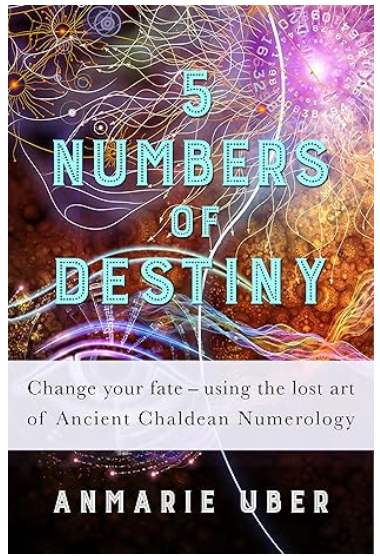
Her main work on numerology is titled “5 Numbers of Destiny” (2015), which is based on Cheiro’s system of numerology. I agree with Anmarie Uber on most of the correspondences between numbers, including Cheiro’s descriptions, which she summarizes.
Anmarie Uber uses alpha-numeric encoding as advocated by Cheiro
Anmarie Uber has placed much more emphasis than Cheiro on the number obtained from the Birth Number and from the TNN. This number is considered by some to be the Career Number or the Goal Number, but Anmarie Uber prefers to call it the Hidden Number. She has developed several rules that she believes should be used to correctly obtain this number.
She has also developed a specific system to determine what TNN and Hidden Number are appropriate for a person born on a particular day of the month. Unfortunately, it does not provide a theoretical basis for some cases that don’t align with the traditional method (for example, those born on the 28th of the month might choose TNN 31 with a corresponding hidden number of 14 – see “5 Numbers of Destiny”, pages 112-114). Personally, I do not place as much importance on the “Hidden Number.”
The big difference with my approach is certainly in the TNN analysis. I often prefer to use the technique of extracting TNNs by preserving the sovereignty of the base numbers of the first and last name- an ancient technique known and used by Cheiro. In Anmarie Uber’s case, her base numbers are 1 (1+9=10; 1+0=1) and 6 (1+5=6). If we preserve the sovereignty of these two numbers, the TNN would be 16.
Similarly, Anmarie Uber does not consider the analysis of consonants, so she has overlooked the contact between the number 15 and 4. It’s important to understand that no numerologist accounts for all key factors in their approach (and this applies to the author of this article as well!). Therefore, it’s crucial to follow some general guidelines when changing one’s first or last name.







 The Mystery of Numbers, Luck, Worlds and Planets