William John Warner, better known as Cheiro (November 1, 1866 – October 8, 1936), was also referred to by nicknames such as Count Louis Hamon and others. However, he is primarily remembered as Cheiro. He was a British astrologer, numerologist, and palm reader.
His birth name contains numbers—13 and 15 (the sum of 96; 9+6=15). The base numbers 4 and 6 govern his numerological chart. This chart reveals a strong desire for recognition and performance (particularly highlighted by 96, with 24 in Life Path and 15 as the base number in his surname), along with a drive for success in business. Cheiro’s official name also reflected a robust longing for friendship and love, from which he drew significant spiritual strength. Additionally, he enjoyed fairly favorable influences of numbers on the chakras, which may have contributed to his reputation as a successful medium for a time.
The combination of numbers 13 and 15 sparked his interest in the occult (both 13 and 15), reforms, pioneering approaches (13), and even magic (15, 41). The number 41, in particular, fosters a fascination with numerology, which is further emphasized by his nickname “Cheiro” (Mercury and 23). Due to the numbers 13 and 15, an individuals may either become a victim of manipulation and circumstances or turn into a manipulator themselves… The overall numerological chart is complex and can bring strokes of fate that often arrive unexpectedly.
Cheiro was convicted and imprisoned in Paris around 1910 for business fraud, and it is said that this scandal closed doors among the English elite, prompting his move to the morally less stringent United States. An analysis of his works reveals a tendency for manipulation and misinformation—claiming, for instance, that he had been offering numerological guidance based on his system since the late 19th century, or that number 9 was so sacred it couldn’t correspond to any letter. Moreover, he downplayed the contributions of his European sources, likeIsidore Kozminsky and Sepharial, while asserting he learned Chaldean numerology from an Indian brahmin.
It’s essential to recognize that relationships between 15 and 4, or between 15 and 8, should not be judged too harshly. Not everyone with such combinations inherently becomes a manipulator, criminal, or prisoner. An individual’s morals and self-awareness dictate whether they use their strengths for good or ill, and when, if ever, they will yield to temptation. Furthermore, numerological charts can point to which areas of life help to balance the individual. For Cheiro, these areas primarily involved seeking courage, forming a connection with God, and nurturing love and kindness.
Even in his nicknames—like “Count Louis Hamon” and “Count Leigh de Hamong“—the theme of number 13 is prominently featured. It seems Cheiro intentionally emphasized this number, perhaps because it brings uniqueness and combines with the interchangeable number 1 to form a whole.
His nickname “Cheiro” underscores intellectual depth, as it contains the numbers for Mercury and the Sun. The number 23 derived from the nickname is considered auspicious.
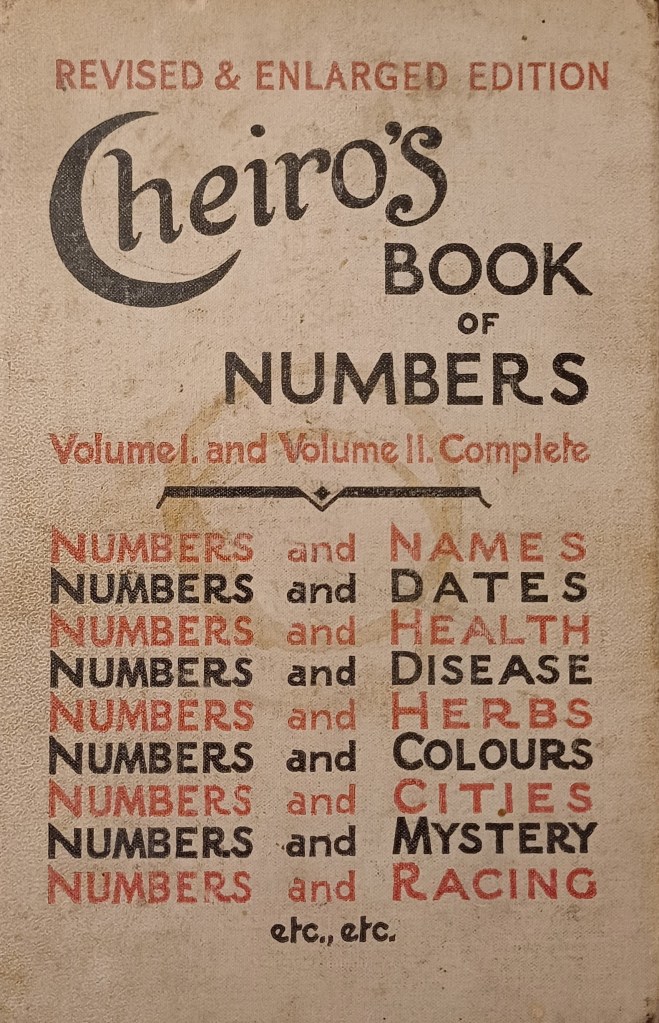
In 1926, Cheiro published a book titled Cheiro’s Book of Numbers. In it, he defined the meanings of numbers in Chaldean tarot from 1 to 52, based on older sources. He also defined the rules of matching and mismatching between numbers. For each of the numbers 4 and 8, he differentiated between karmically strong and weak numbers, determining various numbers that align with them. He described favorable and less favorable months, recommended specific herbs and foods, indicated favorable colors and gemstones, and identified ailments commonly associated with particular numbers.
It’s very likely that Cheiro drew the foundational idea of alpha-numeric coding from Isidore Kozminsky, who assigned the letter H a value of either 5 or 8, and the letter X a value of 5. Based on his research, Cheiro developed an alpha-numeric coding scheme in which letters H and X always hold a value of 5. He also altered the value of the letter C, assigning it a value of 3 instead of 2.
For Cheiro, the key to analysis lies in the birth date, or Birth Number. He believed that the Total Name Number (TNN) should align with the Birth Number; otherwise, an individual might encounter challenges throughout life. He further explored the numerological influences of each day of the year based on the specific day of the month. Around 1936, he published another book titled You and Your Star, in which he detailed favorable numbers for every day.
Cheiro’s ideas of such favorable numbers influenced numerologists like Gerun Moore and Lloyd Strayhorn, who developed their own systems based on these concepts.
In Cheiro’s Book of Numbers, he established special guidelines to identify the most important two-digit number in a numerological chart. This number frequently corresponds to TNN, but sometimes the most significant number is derived from adding the birth date and TNN together (Birth Number + TNN). Cheiro did not assign a name to this number, but I personally refer to it as the Goal Number (which differs from Goal Numbers in Pythagorean numerology). Anmarie Uber called it the “Hidden Number,” while some perceive it as an indicator of career success.
Cheiro’s book, Cheiro’s Book of Numbers, does not provide reliable techniques for predicting the future. It also contains inaccuracies, such as the assertion that the Chaldeans were unaware of letters with a value of 9. Nonetheless, despite not being a comprehensive manual, this work played a pivotal role in the evolution of numerology. In many ways, Cheiro is considered the father of modern Chaldean numerology.




 The Mystery of Numbers, Luck, Worlds and Planets