An Analysis of Donald Trump’s Bazi Chart: Do His Four Pillars of Destiny Point to a Successful Second Term and Victory in the Next Presidential Election?

This time, I’m publishing an article that isn’t exactly typical for me. My work usually focuses on numerology, and occasionally on mantras. In the case of U.S. President Donald Trump, however, we can compare his numerological cycle—which has become at least somewhat unfavorable this year—with Chinese Bazi astrology, also known as the Four Pillars of Destiny. By comparing these two systems, we can sometimes arrive at more precise predictions.
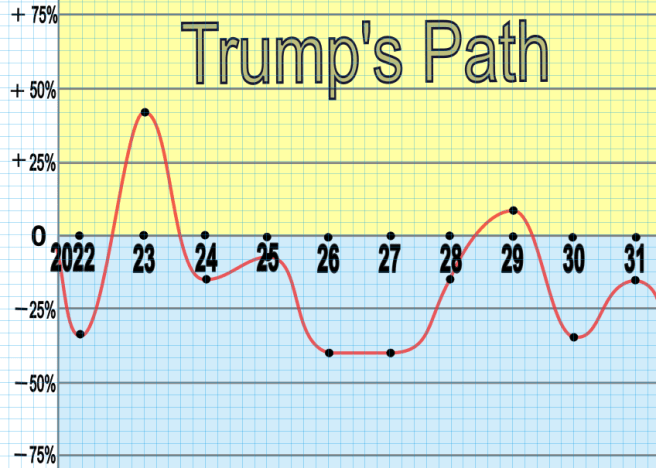
Trump’s numerological cycles indicate some difficulties in 2026 and 2027

In very general terms, Bazi astrology analyzes the five elements (wood, fire, earth, metal, and water), and from the relationships between them we can determine whether fate is more likely to bring challenges or opportunities for favorable developments.

One of the challenges with this form of Chinese astrology and president Donald Trump is that Donald Trump—along with Chinese President Xi Jinping—is likely one of the most influential figures on the planet, yet Bazi practitioners themselves do not agree on how his pillars of destiny should be interpreted.

We are currently living in a period of fire years: last year was governed by the Yi Si pillar (symbolized by the Wood Snake, in which fire is generated), 2026 is under the Bing Wu pillar (the Fire Horse), and the following year will be ruled by Ding Wei (the Fire Goat). Because Trump’s energies influence the entire world, we are looking for a way to determine which elements are favorable or unfavorable for him. Specifically, we are interested in whether the fire element is beneficial or detrimental in his case. This question offers strong insight into the likelihood of whether his second presidential term will be successful.

I haven’t been deeply involved in Chinese astrology for years, and for more detailed information about this system I recommend studying with experienced practitioners. Many good (and not-so-good) books have also been published, which is a major advantage compared to the time when I first encountered this method. Although I’ve never explored all the intricacies of Bazi, I do have some knowledge of the approach, so I’ll allow myself to conduct a brief analysis of how Trump’s pillars of destiny function.

Trump’s personal element is Ji, or yin earth, which is strongly supported by additional earth and very strong fire. Under normal circumstances, Ji earth represents fertile, moist soil; however, in Trump’s chart there is not enough water, so this reinforced Ji instead represents more of a desert with sand dunes. The wind may scatter some of the sand, but such a large quantity of Ji earth is highly resilient and retains its desert-like essence.
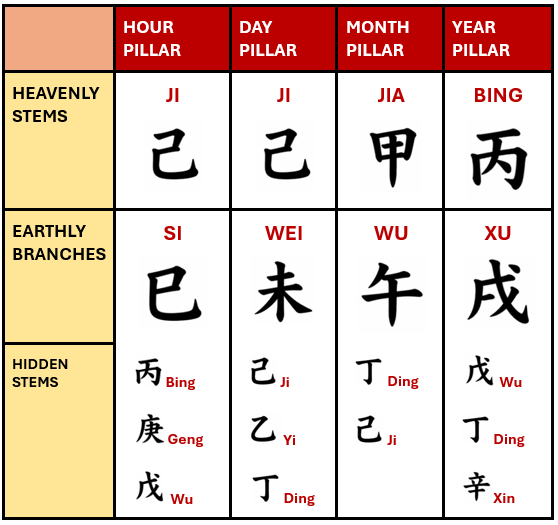
The Four Pillars of Destiny (Bazi) of President Donald Trump

Within the earthly branches Si, Wei, Wu, and Xu, we find the combination of Wu and Xu (a partial trine), as well as the combination of Si, Wu, and Wei (a directional combination), both of which generate additional fire. We also see the Wu – Wei combination (one of the Six Combinations aka. Liu He), which produces a “sixth element” (secondary fire). In the upper stems of the day and hour pillars, we find Ji (yin earth), forming what is known as the “Double Self,” which significantly strengthens the personal element.

The chart also contains a full combination between the Ji Wei and Jia Wu pillars, bringing personal strength and favorable development. In addition, the day stem Ji (yin earth) has hidden support from earth within the monthly branch Wu, while the month stem Jia (yang wood) has hidden support from wood within the day pillar. Earth energy is also exchanged crosswise between the heavenly stems and earthly branches of the hour and day pillars, indicating an ability to form alliances. This also contributes to a special relationship with his children.

Regardless of whether fire and earth are favorable or not, the “Double Self” further emphasizes a strong connection with his children. It is also worth noting that his personal pillar, Ji Wei (Earth Goat), belongs to the so-called “Six Talented Pillars” (Liu Xiu Ri), which gives him the potential to achieve fame and prosperity—provided the rest of the chart supports it.

The absence of water as the wealth element may therefore not be a problem, since a “No Wealth Situation” often creates the potential for wealth—such a person can acquire money and keep it hidden. Donald Trump has the “Golden Treasury” star (Jin Kui) present in the Wu branch, which can bring financial gain. Some argue that a clash or combination cancels out this star’s financial potential. The idea is likely that wealth needs to remain safely concealed, while clashes or combinations expose it.

However, special stars (Shen Sha) are generally derived in two ways: through relationships between elements or through positional relationships of the earthly branches. The “Golden Treasury” belongs to the latter category, which raises the question of whether its financial potential can truly disappear in a clash or combination. Moreover, the directional combination of Si, Wu, and Wei is also said to cancel out the effects of the “Prosperity” star (Lu) in the Si branch and the “Hidden Prosperity” (An Lu) in the day branch Wei. But is that really the case here? Or could such a combination instead represent a merging of financial potentials and the flow of wealth back and forth?

In any case, Trump’s pillars contain another important star—the “Monthly Nobleman” (Yuede Guiren) in the year stem Bing. This structure is significantly strengthened by the directional combination of Si, Wu, and Wei. This star grants him strong protection and considerable luck in life.

Although Ji earth is typically quite diplomatic, Trump’s chart includes the “Sword Star” (Yang Ren in Si and Wei), which is active and gives him a sharp edge. He also has the “General’s Star,” which further reinforces this quality. Trump is certainly not someone who is easily intimidated by his opponents.

Some practitioners of the Four Pillars system prefer not to rely on the wide array of these so-called “stars” or “spirits” (Shen Sha), and instead focus primarily on the basic “Ten Gods,” which represent the relationship between the yin or yang versions of the elements and the personal element. Trump’s chart seems to fall under the “Unconventional Resource” type (“Unconventional Resource” being one of the Ten Gods), which gives him an unconventional nature and, due to the strong earth, a highly challenging or provocative character. It is also possible that Bing, as the sole aspect of fire in the celestial stems, redirects part of the fire element from the earthly combination of Si-Wu-Wei toward its yang polarity.

There are three main ways practitioners interpret his chart. It may be a standard “Unconventional Resource” structure with a strong personal earth element; it may be a special structure known as “Child with Many Mothers”; or it may be a special structure dominated by earth.

Many would classify this chart as a dominant earth structure—that is, a special type of chart. This is how the late Master Jerry King interpreted Trump’s pillars. All of the pillars are saturated with fire and earth; wood appears only in the month stem Jia and in smaller amounts in the day branch Wei. However, this wood largely fuels the fire and indirectly further strengthens the fire–earth structure.

In such a dominant earth structure, the favorable elements are fire and earth, with metal—and possibly even wood—being partially beneficial. Water would be unfavorable, as in special or non-standard structures the focus is not on achieving temperature balance. The absence of water as the wealth element would therefore not be problematic. In a special structure, a “No Wealth situation“ very likely brings wealth. If the dominant earth interpretation is correct, the main remaining question would be whether this is a true dominant type or a somewhat lower-quality “fake dominant type”.

In the second case, this could represent the special “Child with Many Mothers” structure, since the “Double Self” appears as the only active earth element. All the other prominent elements—except for Jia—are fire. This would suggest a chart that grants a talent for working with information and excellent intuition. In such a structure, the favorable elements are fire and wood, while earth, metal, and water are unfavorable.

This “Child with Many Mothers” interpretation is supported by Master Lily Chung, one of the most insightful interpreters of destiny analysis. Her distinctive approach is that she does not focus on the strength of elements within the chart, but instead seeks to identify the flow of energy through the pillars. She also calculates certain pillars using the lunar (and not solar) calendar.

It is worth noting that a true “Child with Many Mothers” structure is itself a special configuration—one so strong that it significantly alters how elements function as favorable or unfavorable. In this case, earth would be unfavorable, while fire would be highly favorable.

In the third case, we would be dealing with a strong but conventional earth structure with an “Unconventional Resource” (Pian Yin). In standard chart types, maintaining temperature balance becomes very important. Under this interpretation, fire would likely be considered the least favorable element, followed by earth—since even Ji earth (fertile soil) can turn into dry, desert-like ground under such conditions, especially when it is excessive.

Water would be the most favorable element, followed by metal (which generates water), while wood might be more neutral or even somewhat unfavorable. This approach is used by Master Lillian Too of Malaysia, who is also known for calculating pillars according to the lunar calendar. According to her, fire and earth are unfavorable for Trump, while metal, water, and wood are favorable elements.

There are several reasons why this chart could indeed represent a conventional strong earth type. In particular, the earthly branches compete with one another to determine which combination will dominate. First, the partial fire combination between Wu and Xu is activated. However, the relatively strong combination between the Ji Wei and Jia Wu pillars in the earthly branches produces a “sixth element.” Finally, the directional combination attempts to assert itself.

As a result, the potential for combinations is dispersed, which reduces the overall amount of additional fire (wherever it may form). Moreover, this “secondary” fire does not have exactly the same quality as regular fire. At the same time, there is so much earth hidden within the chart that it raises the question of whether it can truly be classified as a “Child with Many Mothers” structure. This dispersion of competing influences may be enough to prevent the chart from transforming into a special structure. The “No Wealth situation” can still indicate the potential to accumulate wealth.

The differences in favorable and unfavorable elements across all three interpretations are so significant that, under such circumstances, the only remaining option is to examine Trump’s personal history.

The father is represented by the elements Gui and Jia, which suggests a person with ideas and—at least from Trump’s perspective—likely also a figure of authority and wealth. From this, we can infer that either water or wood may be favorable elements for Trump.

Furthermore, Donald Trump has a large number of supporters as well as many opponents; he is capable of generating extreme polarization in public opinion. Some people follow him almost blindly, while others constantly attack him. The element that represents both opponents and allies is primarily the personal element—in this case, earth. Given that the crosswise exchange of energies in his chart, along with the combination of the day and month pillars, creates opportunities for generally positive relationships with those close to him, earth may be considered a challenging element. But his confrontational nature may also stem from the “Unconventional Resource” (Pian Yin) structure and the presence of the Sword Star.

A third interesting point is that Trump inherited his involvement in real estate from his father. The exchange of earth elements within his pillars indicates that real estate does indeed represent an opportunity for him. However, this is a specific internal structure of the chart and does not necessarily mean that earth is otherwise a favorable element for him.

As President of the United States, operating during a period of global power transition from the U.S. to China—and in years dominated by stronger fire energy—fire is also likely to be considered a challenging element in his chart.

Based on these basic observations, we arrive at a tentative conclusion that this is most likely a conventional “Unconventional Resource” type with a strong personal earth element, where earth and fire are challenging elements, while water and metal are favorable. To gain a more precise understanding, we also need to examine the basic progression of his life path through the ten-year and five-year luck pillars.
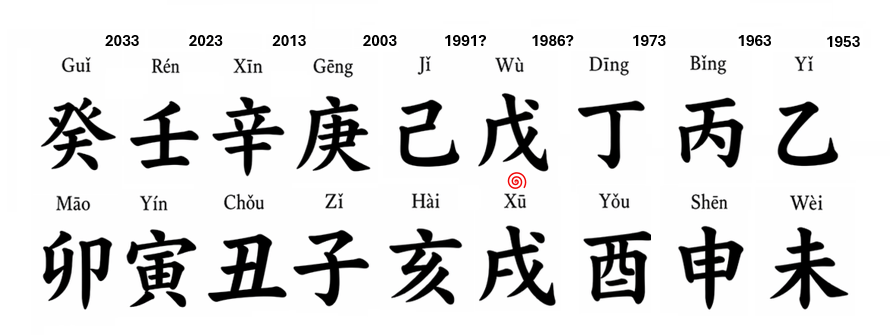
The 10-year and 5-year cycles of fortune in the case of Donald Trump

His early business years were not the most successful. In the 1970s, the Bing Shen luck pillar first comes into play. The Shen branch, which governs the early 1970s, is metallic, but together with the Si branch it also forms a partial fire punishment. Therefore, this period should be approached with caution, and we should avoid drawing conclusions too quickly at the outset of the analysis.

This is followed by the Ding You pillar. The fire stem Ding dominates roughly the years 1974–1978, while You becomes more influential later. The early years were not particularly successful (though still moderately so), while the later metal years of You were much more favorable. The earthly branch You becomes dominant from around 1979 onward, marking the beginning of Trump’s most favorable period. From this, we can conclude that metal is a favorable element for him.

The next major pillar is Wu Xu. This is a Fui Gong pillar, which brings special power and influence but also acts as a transformational vortex—turning favorable elements into unfavorable ones and vice versa. This vortex creates a strong pull that can even shift the time boundaries within which a pillar operates. Trump’s favorable period continues during this phase, suggesting that earth is actually an unfavorable element that Fui Gong transforms into favorable influences. The effect of Fui Gong is further strengthened by the year Wu Chen (1988), which also carries Fui Gong characteristics.

This favorable period appears to end around 1991–1992, when the Wu Xu Fui Gong begins to draw in the influence of the next pillar, Ji Hai (approximately 1991–2004). The early years were more difficult and influenced by earth (Ji). The year 1991, under the Xin Wei pillar, emphasizes a partial earth punishment (San Xing). That year, Trump experienced the bankruptcy of the Trump Taj Mahal in Atlantic City.

These energies likely also negatively affected the following year under the Ren Shen pillar. Shen (although metallic in nature), together with Si, forms a fire punishment, and combined with the earth influences of Ji, this brought Trump the bankruptcy of the Trump Plaza Hotel and Casino. From this, we can infer that fire and earth are unfavorable elements for him, since “San Xing” (the Three Punishments) tends to manifest as hardship particularly when it occurs within unfavorable elements (fire in the Yin–Si–Shen punishments, and earth in the Wei–Xu–Chou punishments). The later years of the Ji Hai pillar are influenced by water, but water is not strong enough to overcome the powerful fire structure in Trump’s chart.

In 2004, the Geng Zi pillar begins. The year 2004 itself is especially complex to interpret. It is governed by the Jia Shen year pillar, while the longer cycle is Geng. The fire stem Bing and wood stem Jia from the natal chart appear to weaken the metal Geng. In the Jia Shen year, Jia repeats in the stems, while Shen forms a partial fire punishment with Si. That year, Jia and Bing effectively clashed away the metal Geng element. Trump experienced the bankruptcy of Trump Hotels & Casino Resorts, which suggests that fire is not favorable for him, while metal is.

In 2009, the Ji Chou pillar brought strong earth influences, which, together with Wei and Xu, formed a complete set of earth punishments. That year, Trump experienced the bankruptcy of Trump Entertainment Resorts, further indicating that earth is an unfavorable element for him.

Between 2004 and 2018, metal and water elements are consistently present. These elements also contributed to his media resurgence through the television show The Apprentice (2004–2015), where his famous slogan “You’re fired!” originated. During this time, the “Trump” brand was significantly strengthened.

During the Xin Chou period (2014–2024), Trump reaches his peak and then experiences a temporary decline. Under the influence of the metal Xin and the metal years 2016–2018, he won the presidential election and successfully navigated the first part of his term—again indicating that metal is a favorable element. The heavenly stem Xin forms a combination with Bing.

In the later part of his term, Chou becomes more active, forming earth punishments together with Xu and Wei. Trump faced the COVID-19 pandemic and was unsuccessful in his bid for re-election. Although the year 2020 carried water influence, raising the question of whether water was acting favorably, it is possible that the Zi branch was not strong enough to control the fire in his natal chart.

What can be stated with more certainty is that earth is an unfavorable element for him, as the following years brought significant pressure and legal challenges. The wood years of 2022 and 2023 also appear to have been unfavorable, possibly because wood further fueled the fire.

In the fall of 2024, Trump entered the ten-year Ren Yin cycle, where the early years are dominated primarily by water, which brought him electoral victory. From this, we can conclude that water is a favorable element for him.

The year 2024 itself was governed by the Jia Chen pillar. Chen clashes with Xu from his natal pillars, and in that clash, earth becomes compressed. In addition, the first part of the year still falls under the ten-year Xin Chou cycle, so the earthly branches Xu and Chou also form partial earth punishments. This likely represents the part of his energy associated with strong political opponents (unfavorable earth). Jia is wood, which can act as a form of pressure on Ji earth.

During that year, there was also an assassination attempt on Trump during the campaign. In his chart, he has the “White Tiger” (Bai Hu) star in the month pillar, the “Heavenly Dog” (Tian Gou) in the hour pillar, and an active “Sword Star” in both the day and hour pillars—making him more exposed to such events during unfavorable periods. This is especially relevant after the age of 50, when the influence of the hour pillar traditionally becomes stronger, although some modern interpretations shift this threshold closer to age 60. Trump, being older, already has a strongly activated Sword Star in combination with the Heavenly Dog in his hour pillar.

In any case, by the fall of 2024, the ten-year cycle had shifted into the Ren Yin period, and the earth punishments subsided.

Based on this life-path analysis, I draw the following conclusions:

  • Earth is his most unfavorable element
  • Fire is also unfavorable most of the time
  • Wood appears to act as a slightly unfavorable transformer of energies, ultimately strengthening fire and then earth
  • Water and metal appear to be favorable elements

The overall conclusion is therefore:

  • The idea that Trump’s chart represents a dominant earth structure—where earth and fire would be favorable—is invalid
  • The idea that this is a “Child with Many Mothers” structure is also invalid, since fire is mostly unfavorable for him
  • The most consistent interpretation is that his chart represents (most of the time) a very strong personal earth supported by fire—i.e., a standard chart in which metal and water are favorable, while fire and earth are unfavorable. Since wood supports fire, it is somewhat unfavorable as well

Based on this, we can now look at Trump’s second term. At present, Trump is in a period influenced by the five-year dominance of the water stem Ren, which brings favorable effects. At the same time, 2025 is a demanding year due to strengthening fire influences. The years 2026 and 2027 are even more challenging, as they bring a very strong concentration of fire, which can lead to imbalance and health issues (for example, problems related to the heart, brain, blood, or blood pressure).

This fire influence appears somewhat stronger and more intense than the supportive water of Ren. In the background, there is also a weak presence of the Yin branch (symbolized by the Tiger), which together with Si already forms partial fire punishments.

Yin (the Tiger) represents the East, while fire represents the South, deserts, plastics, fertilizers, electronics, food, energy resources, and even traditional stock markets. Unfortunately, it is also associated with blood. The element of fire is ruled by the planet Mars, traditionally considered the planet of war.

Unfavorable fire manifests as Mars-like or terrestrial threats—such as tensions involving Denmark, Panama, and Canada; an attack on Venezuela (which was successful but occurred in winter, when water energies are stronger); an attack on Iran; and threats toward Cuba. By aligning with Israel and attacking Iran, Trump has strongly activated imbalanced fire energies in his chart.

Because the influence of his chart extends across the United States and even globally, this may manifest as a “desert crisis”, war with Iran, the destruction of desalination plants, an energy crisis, and potentially future crises involving fertilizers, food, microchips, and electronics. During this term, Trump may struggle a lot to repair the damage caused by the outbreak of a U.S.–Iran conflict. Still, we can hope for the best.

The years 2027 and 2028 are also linked to fire and earth. In 2028, Wu earth sits on the Shen branch, which—despite its metal base—forms a fire punishment together with Si. That year also draws in the Yin branch (the Tiger), representing the East and China. At the latest by then, major tensions between Trump and China could arise. These punishments are fiery. Fire corresponds to the South or desert. For China, fire may symbolize Taiwan. For the world, it may represent Iran, Israel, and the broader Arab region.

Unfavorable fire can also manifest as explosions of all kinds, aerial warfare, and firearms. The seasons that support fire are the “Chinese spring” (wood: February, March, April), followed by the “Chinese summer” (fire: May, June, July), and late summer extending into early Shen month (August).

Wood influences began strengthening in February 2026. February itself—marking the beginning of the Iran conflict—corresponds to the Yin branch, which can initiate fire punishments. In the early months, there are fortunately still supportive metal and water influences present. However, conditions become more unfavorable around May and June 2026, and even more so in July 2026.

This does not necessarily mean a continuation of the U.S.–Iran war (although it is quite possible). If that conflict does not continue, Trump may instead face other burdens—perhaps a resulting energy crisis or something similar.

Where do we find balance in Trump’s chart? In water and metal. This means the situation is not entirely black and white, as his longer-term cycle still includes supportive water influences. His Iran-related actions may shake both the U.S. and the world, but may not lead to total collapse.

Water and metal are also, in a sense, geographical elements of the United States itself. We can see that in some areas Trump is aligning with his favorable elements (tariffs, protection of the southern border), but moderation is of key importance. Tariff protection may only be reasonable up to about 10–15% of goods’ value, and the U.S. might also be better protected through other means—such as investing in education and major national projects.

It is also important to recognize that a moderate inflow of immigrants provides the workforce that helps sustain American strength. In this case, it is precisely Trump’s own “domestic” elements—fire and earth—that present the problem. Metal and water extend beyond borders, representing another dimension of these elements. In Trump’s chart, they symbolize foreigners, not just the United States itself.

Perhaps this is also why he chose two wives from abroad. His first wife was Czech, and his current wife is Slovenian. Both, however, come from Eastern Europe, which lies east of the United States. The East corresponds to the element of wood, which acts as a mediator between foreign and domestic environments.

In any case, foreigners as a workforce contribute to wealth, which in Trump’s chart is again represented by water. Water also corresponds to the North (Canada), while metal represents the West and, more broadly, the white race. It is not advisable to attack favorable elements (Canada, Greenland, foreigners as generators of wealth), as this further aggravates the imbalance of excessive earth and fire in Trump’s chart. Water is absorbed by wood, which in turn fuels fire. Wood represents the East, and wood that absorbs water corresponds more specifically to the Northeast—namely Russia.

Admiration for Putin’s Russia weakens both the United States and Trump’s energetic balance. Of course, much depends on Russia’s leadership, but in terms of the “global dynamics” of Trump’s chart, Russia as the Northeast ultimately supports the South. The “South” of Russia includes China, Iran, and India.

Europe, however, is influenced not only by the West (and partly, from the U.S. perspective, the East), but is also strongly associated with earth. In fact, Europe and Africa—not China—could be seen as the true Zhong Guo (“Middle Kingdom”) of the world. At the same time, Europe represents an eastern direction (wood) for Trump. Since earth partially generates metal, Europe is not energetically unfavorable for him, although it would be advisable for him to maintain a neutral and somewhat distanced relationship with it.

Given all of the above—and considering the actions already taken—it seems unlikely that Trump will successfully complete a second presidential term. If he remains in good health and adopts a strong strategy… perhaps. But it would require significant effort. More likely, he will be remembered in history as the figure who ultimately awakened the Asian tiger. Astrological planetary transitions between 2026 and 2032 point toward China rising to global dominance.

What advice could be offered to Trump? It seems that walking in northern, western, or northwestern directions would be beneficial, as well as residing in the northern, western, or northwestern part of a settlement. In this regard, consulting a Feng Shui practitioner would certainly be advisable. Water environments (lakes, rivers, sea) are also favorable for him.

According to Bazi, his personal colors (for clothing and bedding, but NOT for interior walls) are white, gray, dark blue, and black. He should avoid deserts, Arab regions, the colors red, yellow, and brown, as well as southern, southwestern, and northeastern directions. It is also not ideal for him to remain in one place for extended periods.

From a perspective of Chaldean numerology, his number five is associated with white and very light gray. His numbers six, three, and four share a foundation in blue, while four and five also share light gray. Trump is fortunate in that both systems point to overlapping beneficial colors—namely white, light gray, and dark blue.

Trump’s Chaldean Numeroscope primarily contain the “base numbers” three, four, five, and six.

Approaches to Fate Interpretation

There are many ways to interpret fate, including Aztec astrology, palmistry, Zi Wei Dou Shu, Nine Star Ki, Pythagorean numerology, Vedic numerology, and more. Some of these approaches are more suitable than others.

The first challenge in using any given method is to avoid treating it as the only infallible way to interpret fate. No single approach can fully encompass a person’s destiny. The only case in which relying on just one method is reasonable is when one possesses the ability to intuitively or energetically verify the accuracy of the proposed interpretations.

The second challenge is the opposite—avoiding getting lost in too many approaches and blindly trusting each one.

An interesting starting point for studying the influence of fate is to combine two or three approaches. Among the most significant methods of fate interpretation are:

  • Planetary astrology, though it is riddled with unresolved debates—such as whether to use fixed constellations or the Western zodiac, how to interpret houses, and how to evaluate aspects.
  • BaZi, or the Four Pillars of Destiny, which offers a simpler yet more robust theoretical foundation compared to methods like Zi Wei Dou Shu.
  • Chaldean numerology, which in most cases proves to be more powerful than Pythagorean numerology.

Chaldean Numerology and Alcoholism

Alcoholism has been recognized as one of the most common forms of addiction for millennia. It’s no surprise that Chaldean numerologists and Hellenistic astrologers of ancient times (during the Hellenistic period and the Roman Empire) were already studying its connections. Back then, alcoholism was astrologically linked primarily to Mars and, to some extent, Libra. Later, some astrologers also considered the Moon, as it rules over liquids.

Numerologically, excessive drinking was associated with the number 9 (the number of Mars and soldiers). It was also likely linked to Saturn’s number of hardships – 8 – especially when combined with 9 or 15. In addition to these two numbers, almost all other numbers seemed to play a role in some way. For instance, 2 (fluids), 5 (youth), 3 and 4 (excess), and possibly even 1- though these numbers probably had to be in an unfavorable connection with either 8 or 9 to be significant.

In the 19th century, Western astrologers associated wine more with Jupiter, the ruling planet of Sagittarius and Pisces, rather than Mars. Once Neptune’s characteristics were defined, alcohol dependence was often attributed to the influence of both Jupiter and Neptune, which correspond to the numbers 3 and 7.

Chaldean numerologist Cheiro rejected these newer interpretations. To him, alcohol remained connected to Mars and the number 9, and he also suggested that addiction-related issues could appear with the number 4. Meanwhile, Pythagorean numerologist Florence Campbell, a contemporary of Cheiro, identified numbers 5 and 7 as being linked to addiction.

In 1973, Gerun Moore published a book that, under the lens of modern Western astrology, connected alcoholism to numbers 3 and 7, along with the karmic number 8.

My own research suggests that the foundation of alcoholism lies in the negative aspects of numbers 7, 8, and 9. These are followed by numbers 3, 5, and, in some cases, 4—but 4 and 5 only become problematic when they form an unfavorable combination with one of the first three numbers. My formula is as follows:

{ 7, 8, 9 }  >  3  > { 4, 5 }

It’s important to note that not everyone with a strong presence of 7, 8, or 9 (or even 3) in their numerological chart will turn to alcohol as a coping mechanism. Free will always plays a role, and individuals can overcome these tendencies through self-awareness, relaxation techniques, and spiritual growth. The same applies to the interaction of two numbers within relationships.

However, people with the following number combinations may be more prone to alcoholism:

  • 7 and 8: Emotional coldness, a tendency toward depression, and withdrawal from others can lead someone to seek solace in alcohol. Relationships between individuals with these numbers may also struggle with alcohol-related issues.
  • 8 and 9: This combination, whether found in a personal chart or a relationship, can trigger patterns of aggression alternating with apathy. It may also bring feelings of misunderstanding and frustration.
  • 7 and 9: Emotional crises can lead to alcohol dependence.
  • 3 and 7: Emotional drama and relationship turmoil may arise. Alcohol may either be the cause of relationship problems or a consequence of them.
  • 5 and 8, or 2, 5, and 8: Emotionally challenging relationships that cannot be overcome or rationalized may push individuals toward alcohol as a way to cope.
  • 8 and 15: Difficulties in relationships and emotional attachment can drive a person toward excessive drinking.

Calendar Numbers and Numerology: An Analysis of 2025

Calendar numbers are often interpreted differently across various numerological approaches. In Chaldean numerology, composite numbers are typically interpreted differently than in Pythagorean numerology. It is important to recognize that, beyond numerology, the fate of the world is also influenced by astrological and other forces. Consequently, some years are easier to explain through numerology than others. That said, I must emphasize that I do not take responsibility for any harm resulting from the application of recommendations in this article.

The year 2025 has a base number of 9, associated with Mars, the planet of vitality, courage, and potentially anger, irritability, violence, and conflict. In tarot, number 9 is linked to The Hermit,” which imbues it with spiritual potential. The number 9 is further reinforced by the internal structure of 2025 – this year is a square of 45, which also has a base number of 9. Additionally, the first two digits (20) and the last two digits (25) of the year also add up to 45.

Each Mars year is unique, and 2025 is expected to be particularly volatile, marked by sudden and unexpected twists, unfavorable developments, and, regrettably, greater aggression compared to typical Mars years. The risk of aggression is also astrologically evident, as the year begins with retrograde Mars opposing Pluto. Since this alignment occurs at the start of the year, its effects are likely to persist throughout the year. From an astro-numerological perspective, it wouldn’t be surprising to see increased Chinese militarism alongside Russian aggression in 2025. However, this is just one possibility. Such influences could make it difficult to resolve ongoing wars (e.g., Sudan, Palestine, Ukraine) and may even spark new conflicts. Still, let us remain hopeful. Humanity is capable of learning lessons and transcending divisions, for peace is our supreme reality.

From a numerological standpoint, January and February are expected to be challenging, with energies stabilizing from March to June, turning distinctly negative from July to November, and remaining unfavorable in December.

On the less optimistic side, 2025 numerologically suggests the possibility of wars, deaths, sacrifices, conflicts, violence, uprisings, revolutions, crime, terrorism, and abrupt, drastic changes. In addition to Mars influences, the presence of the number 13 signifies “The Death” and transformation, while the number 12 represents “The Hanged Man” and sacrifice. This will undoubtedly be a challenging year, especially for key global leaders, some of whom may face political downfalls or crises. Solar eclipses on March 29 and September 21, 2025, may perhaps further strain global leaders. The most critical period numerologically will be from July to November 2025, making dialogue and constructive communication imperative.

On a more positive note, the intellectual sharpness of 2025 will increase. However, it may not be the best year for researchers and scientists unless they can embrace the instability of the year and focus on creativity instead of conflicts.

In spirituality, two paths emerge. One is less prominent but involves building a grounded spiritual practice. The other may lead to confronting spiritual “shadows” and illusions. Grounding is essential, and those working with kundalini energy or the microcosmic orbit will thrive. The number 9 is associated with “The Hermit” and offers the potential for grounded spiritual growth. Without grounding, this year could present spiritual traps, leaving seekers in a maze of illusions.

In general, cultivating love, softness, and dialogue is highly recommended to temper Mars’s aggressive tendencies and mitigate stress from sudden changes. Staying grounded is crucial, as this year may challenge those who build castles in the air. By staying informed and verifying information, we can navigate this year’s challenges more effectively.

Astrologically, the conjunction of Saturn, Neptune, and the North Lunar Node (Dragon’s Head) in 2025 highlights karmic influences. This conjunction could bring about a spread of misinformation with karmic consequences. According to André Barbault, conjunction between Saturn and Neptune historically aligns with Russia. In 2025, either tropical or sidereal astrology place Saturn and Neptune in Pisces, which could also symbolize China (socialism), pointing eastward. For both nations, 2025 appears to be a challenging year.

In the economy, 2025 is likely to be unpredictable. While the year has potential for successful ventures if approached methodically and grounded, it also carries risks of illusions and misjudgments that could lead to difficulties in business and stock markets. The “Russo-Chinese” conjunction of Saturn, Neptune, and the Dragon’s Head, particularly from May onward, may drive misinformation worldwide.

Uranus in Taurus could further disrupt our understanding of finance and trade, possibly destabilizing established patterns. From June 2025 onward, the sextiles between Neptune-Uranus and Uranus-Saturn (according to André Barbault, aspects between these two planets historically align with USA) will be fully active, potentially isolating countries associated with Neptune and Saturn. A similar situation for Neptune could be represented by its sextile with Pluto. The Neptunian Russians are likely to feel isolated this year, and the economic situation will probably affect them more adversely than other major players. Russia may respond with heightened nuclear threats, which is concerning given the country’s present state.

What exactly all this means remains to be seen, but it’s not just about the sanctions Russia has faced so far. Destructive effects will also be present in the United States, potentially indicating a reciprocal trade war between Russia and China on one side and the United States on the other. All these players could possibly become entangled in a trade war with Europe as well (which is also associated with Saturn). The likely trigger for all of this is Uranus, and through it, the United States.

Numerologically, the internal structure of 2025 indicates upheavals in major industries and multinational corporations, possibly revealing shocking economic news. Given the negative trends from July to November, we might anticipate disruptions in military conflicts, international trade, and stock markets during this period.

However, according to Chinese astrology, 2025 is the year of the Wood Snake (Yi Si), which contains strong fire elements. Fire, as per Raymond Lo, supports the stock market. Historically, years with strong fire elements tend to avoid severe economic crises. While the exact trajectory remains uncertain, staying informed about market conditions and monitoring investments will be crucial from May or July onward.

On general, the number 9, which is prominent in the year 2025, resonates well with the numbers 3, 5, 6, and 9. However, other numbers, such as 13, also play a role in 2025. Additionally, the composition of the year itself includes several distinct digits. As a result, 2025 may be somewhat challenging for individuals whose base numbers are 3, 6, and 9. It’s important to note that descriptions of dominant numbers are a broad level of analysis. Each person’s response to the numerological dynamics of the year is highly specific, depending on their unique numerological chart.

For general influences, you can refer to the descriptions below. Most people have one or two dominant numbers, which often align with numbers found in their Total Name Number, the Birth Number (day of the month), or their Life Path (day + month + year).

For individuals governed by base numbers 3, 6, and 9, some projects may succeed while others may not. Overall, the year isn’t expected to bring anything too dramatic. With effort and determination, these individuals can still achieve some successes. Those with the number 3 should focus on maintaining harmony in their relationships, and this is especially true for men with the number 9.

People with base numbers 1 and 2 are likely to have a slightly easier time. Due to their neutral positioning, their progress across most areas could lean toward either positive or negative outcomes. With at least a little effort, these individuals can steer their destiny in a favorable direction in many cases.

For those influenced by the numbers 4 and 8, this year may lack energetic support. Both are strongly karmic numbers and, for many, will attract significant challenges. People with the number 4 should take extra care of their health and may experience considerable career pressures. Women with this number might also face difficulties in relationships. Similarly, individuals with the number 8, particularly men, could encounter challenges in relationships, as well as trials in career, business, finances, and friendships. Those with dominant numbers 4 and 8 will need to rely on their experience, knowledge, and spiritual connection to turn these challenges into positive outcomes.

People with base numbers 5 and 7 can expect favorable influences in 2025. For those with the number 5, it’s an excellent time to invest effort in education, creativity, or public speaking. This is generally a positive year for partnerships, especially for women with the number 5. Similarly, the number 7 aligns well with education and creativity, and women with this number are also likely to experience greater success in partnerships. However, unlike those with the number 5, individuals with the number 7 may find this year more advantageous for career achievements.

Zodiac Signs and Chaldean Numerology

More than 2000 years ago, Chaldean numerology revealed clear correlations between numbers and planets. These correlations were later adopted in the 16th century by the Pythagorean numerologist Heinrich Cornelius Agrippa.

By the early 20th century, Chaldean numerologists linked planetary vibrations to zodiac signs through their ruling planets. For example, the numbers 1 and 4 are associated with the Sun, which has its domicile in Leo. Consequently, Leo is attributed the numbers 1 and 4. Similarly, Mercury has its domicile in Gemini and Virgo, so both signs are assigned the number 5. This gives us the following table:

Zodiac SignTraditional ValuesModern Additions
Aries9 
Taurus6 
Gemini5 
Cancer2 and 7 
Leo1 and 4 
Virgo5 
Libra 6 
Scorpio 90?
Sagittarius 3 
Capricorn 8 
Aquarius 84 (influences of Uranus)
Pisces 37 (influences of Neptune)

This correlation is very strong, as the nature of the planets is closely tied to their domicile signs, and as a result, the planetary numbers are also strongly connected to the signs. Furthermore, 500 years ago, Heinrich Cornelius Agrippa also demonstrated a direct connection between zodiac signs and numbers:

Aries7
Taurus6
Gemini3 and 12
Cancer5
Leo1
Virgo1 and 10
Libra 8
Scorpio 9
Sagittarius 4
Capricorn 3
Aquarius 2
Pisces 2 and  11

The origin of this table remains unknown. It is unclear whether it is Agrippa’s innovation, a Pythagorean enhancement of the Chaldean philosophy of numbers predating Agrippa, or whether Agrippa took this description from contemporary Chaldean numerologists.

These values are at least twice as weak as the indirect connection through the planets and domiciles. Most Chaldean numerologists do not use them. However, such values are present for each sign. The scheme of direct numerical connections to signs follows certain similar numerological principles that also underpin the foundational Chaldean correlations between numbers and planets. 

Matching Numbers in Chaldean Numerology and the Confusion of Interpretations

Traditional Chaldean numerology classifies number compatibility into two primary groups. The first group includes the numbers 1, 2, 4, and 7, while the second group consists of 3, 6, 8, and 9. The general principle is that numbers within the same group are compatible with one another but incompatible with numbers from the opposite group. For example, 1 is compatible with 2 but not with 9, while 6 is compatible with 9 but not with 4. The number 5 is considered superficially compatible with all numbers but should ideally avoid the influences of 3 and 8.

However, traditional exceptions to these rules exist. For instance, 8 and 9, though part of the same group, are often incompatible. Similarly, the number 15 is advised to avoid connections with 8, despite 15 reducing to 6, which belongs to the same group as 8. In certain scenarios, 8 may even align with 1. The relationship between 3 and 7 is generally destructive, yet under specific circumstances, it can be positive.

I am often struck by how far some numerologists stray from Chaldean traditions. The older generation of Chaldean numerologists, such as Cheiro, Gerun Moore, and Lloyd Strayhorn, has remained largely faithful to these traditional principles. However, many modern Chaldean numerologists, particularly those emerging after 2000, tend to develop their own systems of number compatibility and incompatibility.

These deviations can sometimes lead to significant confusion. In some instances, numerologists rely entirely on simplified astrological concepts of planetary friendships and enmities. Unfortunately, interpretations of these astrological relationships often vary widely. This approach doesn’t represent classical Chaldean numerology but, at best, a neo-Chaldean variant. I encourage readers to distinguish between traditional Chaldean methods, which are grounded in centuries of practice, and newer innovations that often depart drastically from the original teachings.

For casual numerology enthusiasts, deviations from traditional number-matching practices may not be a major concern, as long as no serious advice—like altering one’s name or surname—is being given. However, when working with a professional numerologist, adherence to proven methods becomes critical. Some teachers assert that if someone unknowingly causes harm through their practices, it does not generate karmic repercussions. Instead, they argue, the individual harmed is simply experiencing events dictated by their own energy patterns. But is such harm truly necessary?

What Are the Differences Among Chaldean Numerologists?

In Chaldean numerology, as in many other systems that deal with understanding pf human destiny, there are a variety of approaches among practitioners, some of which may even conflict with one another. A similar situation can be seen in Western astrology, where practitioners might use different house systems, such as equal houses based on the ascendant or the Placidus system, among others. Some interpret retrograde planetary motion traditionally, viewing it as a period of negative influence, while others see it as an opportunity for introspection. Similarly, planetary aspects might be analyzed through the lens of traditional texts, or alternatively, with insights from modern psychology.

So, where do we find the biggest differences in Chaldean numerology?

Some numerologists prioritize the favourable or unfavourable relationships between numbers over the intrinsic nature of a number itself. For instance, a generally “lucky” number might behave “unluckily” due to its interactions with other numbers. Others argue that, in most cases, a number retains its inherent “lucky” or “unlucky” qualities, but the intensity of those qualities may be amplified or diminished depending on its relationships with other numbers.

Cheiro, one of the most influential Chaldean numerologists, relied on ancient traditions when interpreting number relationships. However, numerologists who preceded him often did not assign much importance to these relationships. Others, meanwhile, place significant emphasis on planetary friendships, defining numerical relationships based on this criterion. Since Chaldean numerology has spread widely in India, it’s worth noting that jyotish (Vedic astrology) interprets planetary friendships differently than Western astrology. Applying these differing approaches to numbers naturally leads to divergent conclusions.

Many Chaldean numerologists use Cheiro’s system of alphanumeric coding, but some adhere to alternative methods, such as the traditional external (Cavendish) or internal approaches (Gibson, Johari).

In classical numerology, names or surnames with values below 10 were generally considered acceptable. Cheiro, however, sometimes added the single-digit value of a birthdate to a name or surname with a reduced total below 10 (in order to derive a key number for analysis). The Danish school applies a similar approach but does so for all names and surnames under the value of 10.

There is also considerable variation in how the Total Name Number is calculated. Some sum the base numbers of the name and surname, while others use compound numbers, or they combine the base digit of the name with the base digit of the surname.

Some Chaldean numerologists, such as Cheiro, never use the Life Path Number—the total sum of the birthdate (day, month, and year). Others, however, consider this number to be a crucial element in their analysis.

Another key difference among Chaldean numerologists lies in whether they conduct a specific analysis for vowels and consonants in addition to the general analysis. Some also include supplementary evaluations, such as analyses of initials, the influence of numbers on chakras, and similar methods.

There are even more variations in approach beyond those described here. Naturally, some methods yield better results than others. As for which system I use, some insights can be found in my published analyses.

I wish you much success as you explore the fascinating world of Chaldean numerology. 😊

Number 51 – The Royal Star of Aquarius and Chaldean Numerology

“The Royal Star of Aquarius,” or “The Royal star of the Waterman”, also known as Markab, should more accurately be called the “Royal Star of Pegasus,” as there is no bright star located at 20 degrees of Aquarius. If we travel from 20 degrees of Aquarius on the ecliptic along the celestial meridian, which is perpendicular to the celestial equator, we reach the vicinity of the bright star Markab to the north and the star Fomalhaut to the south, a very luminous star in the constellation Piscis Austrinus (the Southern Fish).

Fomalhaut is traditionally associated with communication and attracting attention. Its nature is gentler, often tied to business affairs, but it can also be connected with a less favorable disposition. However, it is not associated with danger or war, which are traditional themes in Chaldean numerology.

This leaves us with Markab, a bright star located to the north of Aquarius. As a royal star, Markab symbolizes brilliance, honor, and authority, as well as warriors, intelligence, and, unfortunately, war, conflicts, injuries, and danger. Number 51 is not just linked to this royal star but also to the ruling planet associated with the number.

Pegasus and Markab. Source: Wikimedia Commons: File:1776 – John Flamsteed – Pegase, Le Petit Cheval, Le Dauphin (Pegasus, Pisces and Equuleus).jpg

Astrologers who influenced the development of modern Chaldean numerology did not believe in the general interpretation that the conjunction between Markab and Venus would only bring unreliable friends, a negative impact on business, or lead to excessive drinking; rather, they believed that this aspect signifies warriors, fame, honor, and the potential for injuries in battle or during an attack. In Tarot, this royal star is referred to as the King of Swords, which also governs warfare and danger.

Chaldean numerologists of the late 19th and early 20th centuries followed this astrological interpretation through the star Markab, maintaining much of the traditional meaning of the number.

Sepharial provided the following explanation of the number:

LI (51). Royal star of Aquarius. Fortuitous elevation; martial tendencies; powerful enemies; troubles through Mars men.

Cheiro described the number as follows:

“51. This number has a very powerful potency of its own. It represents the nature of the warrior; it promises sudden advancement in whatever one undertakes; it is especially favourable for those in military or naval life and for leaders in any cause. At the same time it threatens enemies, danger, and the likelihood of assassination.


Sources:

Cheiro (1935). The Cheiro’s Book of Numbers. London, Herbert Jenkins Limited.

Sepharial (revised edition from 1909). Your Fortune in Your Name or Kabalistic Astrology.

Number 37 – The Royal Star of the Bull or The Royal star of Taurus

Number 37 is known as the “Royal Star of the Bull,” “Royal star of Taurus” or Aldebaran, also referred to as Facula. The Roman astrologer Ptolemy once wrote, “Of the stars in the head, that one of the Hyades which is bright and ruddy, and called Facula, has the same temperament as Mars.”

Taurus with Aldebaran. Source: Wikimedia Commons. File:Sidney Hall – Urania’s Mirror – Taurus.jpg

Based on this, Aldebaran is often interpreted as a star of honors and successes, but also as a star of disputes and violence. Number 37 is not only a royal star, but it is also associated with the leading luminary that governs this number. Number 37 has a base number of 1, which represents the Sun. Following the standard astrological interpretation, the conjunction of Mars with the Sun leads to the following interpretation: disputes or violence, danger of wounds, and violent deaths. At the same time, it must be considered that Aldebaran, being the “royal star,” also brings honors and success. Given the generally unstable nature of political positions, we may arrive at the idea that with the conjunction of Aldebaran and the Sun, success and fame are often followed by downfall and disgrace.

It’s important to note that due to its status as a highly favorable royal star, Chaldean numerology has regarded Aldebaran for centuries as a more favorable influence of Mars. According to this interpretation, the star brings positive developments, brilliance, and influence. Individuals associated with this star are courageous, unafraid of their adversaries, and usually emerge victorious in battles against them. Their ability to fight for their goals stems from the martial nature of this star. They often act for the greater good, and it is rare for them to suffer wounds from opponents (which contrasts with the general interpretation!).

As a conjunction of the Sun with “positive Mars”/Aldebaran, number 37 can indeed bring some disputes and conflicts, yet individuals with this number typically emerge as winners. This conjunction also brings business triumphs, enabling a person to secure both their prosperity and beneficial partnerships. Due to the intrinsic nature of Aldebaran, it is advisable to avoid connections with aggressive numbers, such as 18. Modern interpretations by Chaldean numerologists in the latter half of the 19th century and the early 20th century follow this “Chaldean” astrological reasoning, largely preserving the traditional meaning of the number.

Chaldean numerology and astrology were utilized in the 15th century for the Italian interpretation of tarot cards. Thus, Aldebaran appears as the “King of Cups,” and, in addition to courage and honor, brings pleasant emotions, friendship, and love. This aligns with the traditional nature of number 37.

King of Cups. Source: Wikimedia Commons, File:KC Tarot.png

Sepharial provided the following explanation of the number: “XXXVII (37). Royal star of Taurus. Union; marriage; protection of ladies in position; goodwill; sincere friendship; success through associations with the opposite sex.”

Cheiro described the number as follows: “37. This number has a distinct potency of its own. It is a number of good and fortunate friendships in love, and in combinations connected with the opposite sex. It is also good for partnerships of all kinds. It is a fortunate indication if it appears in connection with future events.”


Sources:

Cheiro (1935). The Cheiro’s Book of Numbers. London, Herbert Jenkins Limited.

Firmici Materni Matheseos: Liber Sextus, II.

Ptolemaios (2nd century AD): Tertrabiblos, chapter IX: The influence of the fixed stars.

Sepharial: Your Fortune in Your Name or Kabalistic Astrology‘ (revised edition from 1909).

Fixed Stars and Constellations in Chaldean Numerology

Although Western astrology is based on the seasons (tropical system), Chaldean numerology also explores connections with fixed stars and constellations. The development of Chaldean numerology was undoubtedly influenced by Egyptian sidereal astronomy (circa 3000 BCE) and later, during the Hellenistic period, by Egyptian sidereal astrology (ancient decans).

There is ongoing debate about whether an ancient Chaldean astrology (around the 5th to 4th century BCE), was based on sidereal or tropical astrology. My personal opinion is that the shared astro-numerological foundation was sidereal, although I won’t delve into proving this here. If true, Chaldean numerology is, in a way, closer to Indian astrology (which is sidereal) than to Western astrology (which is tropical).

The basic fixed stars in Chaldean numerology include the four so-called “royal stars,” associated with the following numbers:
23 – The Royal Star of the Lion, or Regulus
37 – The Royal Star of the Bull, or Aldebaran
51 – The Royal Star of Aquarius, or Markab (contrary to the common notion that Fomalhaut is the royal star in this sign)
65 – The Royal Star of Scorpio, or Antares

These four stars can also be combined with planets represented by specific numbers. For instance, 23 represents Mercury in conjunction with Regulus, 37 represents the Sun in conjunction with Aldebaran, and 51 represents Venus in conjunction with the star Markab. The conjunction between the Moon and Antares symbolizes the number 65.

Chaldean numerology can be used to designate additional stars. Various criteria exist for categorizing stars numerologically, and according to one criterion, the following fixed stars can be defined:
21 – Polaris
82 – Arcturus
91 – Sirius

Some constellations include:
11 – Virgo and Leo
17 – Andromeda
37 and 111– Pleiades
13 and 43 – Draco

Other interpretations are also possible.