There are many ways to interpret fate, including Aztec astrology, palmistry, Zi Wei Dou Shu, Nine Star Ki, Pythagorean numerology, Vedic numerology, and more. Some of these approaches are more suitable than others.
The first challenge in using any given method is to avoid treating it as the only infallible way to interpret fate. No single approach can fully encompass a person’s destiny. The only case in which relying on just one method is reasonable is when one possesses the ability to intuitively or energetically verify the accuracy of the proposed interpretations.
The second challenge is the opposite—avoiding getting lost in too many approaches and blindly trusting each one.
An interesting starting point for studying the influence of fate is to combine two or three approaches. Among the most significant methods of fate interpretation are:
Planetary astrology, though it is riddled with unresolved debates—such as whether to use fixed constellations or the Western zodiac, how to interpret houses, and how to evaluate aspects.
BaZi, or the Four Pillars of Destiny, which offers a simpler yet more robust theoretical foundation compared to methods like Zi Wei Dou Shu.
Chaldean numerology, which in most cases proves to be more powerful than Pythagorean numerology.
Alcoholism has been recognized as one of the most common forms of addiction for millennia. It’s no surprise that Chaldean numerologists and Hellenistic astrologers of ancient times (during the Hellenistic period and the Roman Empire) were already studying its connections. Back then, alcoholism was astrologically linked primarily to Mars and, to some extent, Libra. Later, some astrologers also considered the Moon, as it rules over liquids.
Numerologically, excessive drinking was associated with the number 9 (the number of Mars and soldiers). It was also likely linked to Saturn’s number of hardships – 8 – especially when combined with 9 or 15. In addition to these two numbers, almost all other numbers seemed to play a role in some way. For instance, 2 (fluids), 5 (youth), 3 and 4 (excess), and possibly even 1- though these numbers probably had to be in an unfavorable connection with either 8 or 9 to be significant.
In the 19th century, Western astrologers associated wine more with Jupiter, the ruling planet of Sagittarius and Pisces, rather than Mars. Once Neptune’s characteristics were defined, alcohol dependence was often attributed to the influence of both Jupiter and Neptune, which correspond to the numbers 3 and 7.
Chaldean numerologist Cheiro rejected these newer interpretations. To him, alcohol remained connected to Mars and the number 9, and he also suggested that addiction-related issues could appear with the number 4. Meanwhile, Pythagorean numerologist Florence Campbell, a contemporary of Cheiro, identified numbers 5 and 7 as being linked to addiction.
In 1973, Gerun Moore published a book that, under the lens of modern Western astrology, connected alcoholism to numbers 3 and 7, along with the karmic number 8.
My own research suggests that the foundation of alcoholism lies in the negative aspects of numbers 7, 8, and 9. These are followed by numbers 3, 5, and, in some cases, 4—but 4 and 5 only become problematic when they form an unfavorable combination with one of the first three numbers. My formula is as follows:
{ 7, 8, 9 } > 3 > { 4, 5 }
It’s important to note that not everyone with a strong presence of 7, 8, or 9 (or even 3) in their numerological chart will turn to alcohol as a coping mechanism. Free will always plays a role, and individuals can overcome these tendencies through self-awareness, relaxation techniques, and spiritual growth. The same applies to the interaction of two numbers within relationships.
However, people with the following number combinations may be more prone to alcoholism:
7 and 8: Emotional coldness, a tendency toward depression, and withdrawal from others can lead someone to seek solace in alcohol. Relationships between individuals with these numbers may also struggle with alcohol-related issues.
8 and 9: This combination, whether found in a personal chart or a relationship, can trigger patterns of aggression alternating with apathy. It may also bring feelings of misunderstanding and frustration.
7 and 9: Emotional crises can lead to alcohol dependence.
3 and 7: Emotional drama and relationship turmoil may arise. Alcohol may either be the cause of relationship problems or a consequence of them.
5 and 8, or 2, 5, and 8: Emotionally challenging relationships that cannot be overcome or rationalized may push individuals toward alcohol as a way to cope.
8 and 15: Difficulties in relationships and emotional attachment can drive a person toward excessive drinking.
Calendar numbers are often interpreted differently across various numerological approaches. In Chaldean numerology, composite numbers are typically interpreted differently than in Pythagorean numerology. It is important to recognize that, beyond numerology, the fate of the world is also influenced by astrological and other forces. Consequently, some years are easier to explain through numerology than others. That said, I must emphasize that I do not take responsibility for any harm resulting from the application of recommendations in this article.
The year 2025 has a base number of 9, associated with Mars, the planet of vitality, courage, and potentially anger, irritability, violence, and conflict. In tarot, number 9 is linked to “The Hermit,” which imbues it with spiritual potential. The number 9 is further reinforced by the internal structure of 2025 – this year is a square of 45, which also has a base number of 9. Additionally, the first two digits (20) and the last two digits (25) of the year also add up to 45.
Each Mars year is unique, and 2025 is expected to be particularly volatile, marked by sudden and unexpected twists, unfavorable developments, and, regrettably, greater aggression compared to typical Mars years. The risk of aggression is also astrologically evident, as the year begins with retrograde Mars opposing Pluto. Since this alignment occurs at the start of the year, its effects are likely to persist throughout the year. From an astro-numerological perspective, it wouldn’t be surprising to see increased Chinese militarism alongside Russian aggression in 2025. However, this is just one possibility. Such influences could make it difficult to resolve ongoing wars (e.g., Sudan, Palestine, Ukraine) and may even spark new conflicts. Still, let us remain hopeful. Humanity is capable of learning lessons and transcending divisions, for peace is our supreme reality.
From a numerological standpoint, January and February are expected to be challenging, with energies stabilizing from March to June, turning distinctly negative from July to November, and remaining unfavorable in December.
On the less optimistic side, 2025 numerologically suggests the possibility of wars, deaths, sacrifices, conflicts, violence, uprisings, revolutions, crime, terrorism, and abrupt, drastic changes. In addition to Mars influences, the presence of the number 13 signifies “The Death” and transformation, while the number 12 represents “The Hanged Man” and sacrifice. This will undoubtedly be a challenging year, especially for key global leaders, some of whom may face political downfalls or crises. Solar eclipses on March 29 and September 21, 2025, may perhaps further strain global leaders. The most critical period numerologically will be from July to November 2025, making dialogue and constructive communication imperative.
On a more positive note, the intellectual sharpness of 2025 will increase. However, it may not be the best year for researchers and scientists unless they can embrace the instability of the year and focus on creativity instead of conflicts.
In spirituality, two paths emerge. One is less prominent but involves building a grounded spiritual practice. The other may lead to confronting spiritual “shadows” and illusions. Grounding is essential, and those working with kundalini energy or the microcosmic orbit will thrive. The number 9 is associated with “The Hermit” and offers the potential for grounded spiritual growth. Without grounding, this year could present spiritual traps, leaving seekers in a maze of illusions.
In general, cultivating love, softness, and dialogue is highly recommended to temper Mars’s aggressive tendencies and mitigate stress from sudden changes. Staying grounded is crucial, as this year may challenge those who build castles in the air. By staying informed and verifying information, we can navigate this year’s challenges more effectively.
Astrologically, the conjunction of Saturn, Neptune, and the North Lunar Node (Dragon’s Head) in 2025 highlights karmic influences. This conjunction could bring about a spread of misinformation with karmic consequences. According to André Barbault, conjunction between Saturn and Neptune historically aligns with Russia. In 2025, either tropical or sidereal astrology place Saturn and Neptune in Pisces, which could also symbolize China (socialism), pointing eastward. For both nations, 2025 appears to be a challenging year.
In the economy, 2025 is likely to be unpredictable. While the year has potential for successful ventures if approached methodically and grounded, it also carries risks of illusions and misjudgments that could lead to difficulties in business and stock markets. The “Russo-Chinese” conjunction of Saturn, Neptune, and the Dragon’s Head, particularly from May onward, may drive misinformation worldwide.
Uranus in Taurus could further disrupt our understanding of finance and trade, possibly destabilizing established patterns. From June 2025 onward, the sextiles between Neptune-Uranus and Uranus-Saturn (according to André Barbault, aspects between these two planets historically align with USA) will be fully active, potentially isolating countries associated with Neptune and Saturn. A similar situation for Neptune could be represented by its sextile with Pluto. The Neptunian Russians are likely to feel isolated this year, and the economic situation will probably affect them more adversely than other major players. Russia may respond with heightened nuclear threats, which is concerning given the country’s present state.
What exactly all this means remains to be seen, but it’s not just about the sanctions Russia has faced so far. Destructive effects will also be present in the United States, potentially indicating a reciprocal trade warbetween Russia and China on one side and the United States on the other. All these players could possibly become entangled in a trade war with Europe as well (which is also associated with Saturn). The likely trigger for all of this is Uranus, and through it, the United States.
Numerologically, the internal structure of 2025 indicates upheavals in major industries and multinational corporations, possibly revealing shocking economic news. Given the negative trends from July to November, we might anticipate disruptions in military conflicts, international trade, and stock markets during this period.
However, according to Chinese astrology, 2025 is the year of the Wood Snake (Yi Si), which contains strong fire elements. Fire, as per Raymond Lo, supports the stock market. Historically, years with strong fire elements tend to avoid severe economic crises. While the exact trajectory remains uncertain, staying informed about market conditions and monitoring investments will be crucial from May or July onward.
On general, the number 9, which is prominent in the year 2025, resonates well with the numbers 3, 5, 6, and 9. However, other numbers, such as 13, also play a role in 2025. Additionally, the composition of the year itself includes several distinct digits. As a result, 2025 may be somewhat challenging for individuals whose base numbers are 3, 6, and 9. It’s important to note that descriptions of dominant numbers are a broad level of analysis. Each person’s response to the numerological dynamics of the year is highly specific, depending on their unique numerological chart.
For general influences, you can refer to the descriptions below. Most people have one or two dominant numbers, which often align with numbers found in their Total Name Number, the Birth Number (day of the month), or their Life Path (day + month + year).
For individuals governed by base numbers 3, 6, and 9, some projects may succeed while others may not. Overall, the year isn’t expected to bring anything too dramatic. With effort and determination, these individuals can still achieve some successes. Those with the number 3 should focus on maintaining harmony in their relationships, and this is especially true for men with the number 9.
People with base numbers 1 and 2 are likely to have a slightly easier time. Due to their neutral positioning, their progress across most areas could lean toward either positive or negative outcomes. With at least a little effort, these individuals can steer their destiny in a favorable direction in many cases.
For those influenced by the numbers 4 and 8, this year may lack energetic support. Both are strongly karmic numbers and, for many, will attract significant challenges. People with the number 4 should take extra care of their health and may experience considerable career pressures. Women with this number might also face difficulties in relationships. Similarly, individuals with the number 8, particularly men, could encounter challenges in relationships, as well as trials in career, business, finances, and friendships. Those with dominant numbers 4 and 8 will need to rely on their experience, knowledge, and spiritual connection to turn these challenges into positive outcomes.
People with base numbers 5 and 7 can expect favorable influences in 2025. For those with the number 5, it’s an excellent time to invest effort in education, creativity, or public speaking. This is generally a positive year for partnerships, especially for women with the number 5. Similarly, the number 7 aligns well with education and creativity, and women with this number are also likely to experience greater success in partnerships. However, unlike those with the number 5, individuals with the number 7 may find this year more advantageous for career achievements.
More than 2000 years ago, Chaldean numerologyrevealed clear correlations between numbers and planets. These correlations were later adopted in the 16th century by the Pythagorean numerologist Heinrich Cornelius Agrippa.
By the early 20th century, Chaldean numerologists linked planetary vibrations to zodiac signs through their ruling planets. For example, the numbers 1 and 4 are associated with the Sun, which has its domicile in Leo. Consequently, Leo is attributed the numbers 1 and 4. Similarly, Mercury has its domicile in Gemini and Virgo, so both signs are assigned the number 5. This gives us the following table:
Zodiac Sign
Traditional Values
Modern Additions
Aries
9
Taurus
6
Gemini
5
Cancer
2 and 7
Leo
1 and 4
Virgo
5
Libra
6
Scorpio
9
0?
Sagittarius
3
Capricorn
8
Aquarius
8
4 (influences of Uranus)
Pisces
3
7 (influences of Neptune)
This correlation is very strong, as the nature of the planets is closely tied to their domicile signs, and as a result, the planetary numbers are also strongly connected to the signs. Furthermore, 500 years ago, Heinrich Cornelius Agrippa also demonstrated a direct connection between zodiac signs and numbers:
Aries
7
Taurus
6
Gemini
3 and 12
Cancer
5
Leo
1
Virgo
1 and 10
Libra
8
Scorpio
9
Sagittarius
4
Capricorn
3
Aquarius
2
Pisces
2 and 11
The origin of this table remains unknown. It is unclear whether it is Agrippa’s innovation, a Pythagorean enhancement of the Chaldean philosophy of numbers predating Agrippa, or whether Agrippa took this description from contemporary Chaldean numerologists.
These values are at least twice as weak as the indirect connection through the planets and domiciles. Most Chaldean numerologists do not use them. However, such values are present for each sign. The scheme of direct numerical connections to signs follows certain similar numerological principles that also underpin the foundational Chaldean correlations between numbers and planets.
Traditional Chaldean numerology classifies number compatibility into two primary groups. The first group includes the numbers 1, 2, 4, and 7, while the second group consists of 3, 6, 8, and 9. The general principle is that numbers within the same group are compatible with one another but incompatible with numbers from the opposite group. For example, 1 is compatible with 2 but not with 9, while 6 is compatible with 9 but not with 4. The number 5 is considered superficially compatible with all numbers but should ideally avoid the influences of 3 and 8.
However, traditional exceptions to these rules exist. For instance, 8 and 9, though part of the same group, are often incompatible. Similarly, the number 15 is advised to avoid connections with 8, despite 15 reducing to 6, which belongs to the same group as 8. In certain scenarios, 8 may even align with 1. The relationship between 3 and 7 is generally destructive, yet under specific circumstances, it can be positive.
I am often struck by how far some numerologists stray from Chaldean traditions. The older generation of Chaldean numerologists, such as Cheiro, Gerun Moore, and Lloyd Strayhorn, has remained largely faithful to these traditional principles. However, many modern Chaldean numerologists, particularly those emerging after 2000, tend to develop their own systems of number compatibility and incompatibility.
These deviations can sometimes lead to significant confusion. In some instances, numerologists rely entirely on simplified astrological concepts of planetary friendships and enmities. Unfortunately, interpretations of these astrological relationships often vary widely. This approach doesn’t represent classical Chaldean numerology but, at best, a neo-Chaldean variant. I encourage readers to distinguish between traditional Chaldean methods, which are grounded in centuries of practice, and newer innovations that often depart drastically from the original teachings.
For casual numerology enthusiasts, deviations from traditional number-matching practices may not be a major concern, as long as no serious advice—like altering one’s name or surname—is being given. However, when working with a professional numerologist, adherence to proven methods becomes critical. Some teachers assert that if someone unknowingly causes harm through their practices, it does not generate karmic repercussions. Instead, they argue, the individual harmed is simply experiencing events dictated by their own energy patterns. But is such harm truly necessary?
In Chaldean numerology, as in many other systems that deal with understanding pf human destiny, there are a variety of approaches among practitioners, some of which may even conflict with one another. A similar situation can be seen in Western astrology, where practitioners might use different house systems, such as equal houses based on the ascendant or the Placidus system, among others. Some interpret retrograde planetary motion traditionally, viewing it as a period of negative influence, while others see it as an opportunity for introspection. Similarly, planetary aspects might be analyzed through the lens of traditional texts, or alternatively, with insights from modern psychology.
So, where do we find the biggest differences in Chaldean numerology?
Some numerologists prioritize the favourable or unfavourable relationships between numbers over the intrinsic nature of a number itself. For instance, a generally “lucky” number might behave “unluckily” due to its interactions with other numbers. Others argue that, in most cases, a number retains its inherent “lucky” or “unlucky” qualities, but the intensity of those qualities may be amplified or diminished depending on its relationships with other numbers.
Cheiro, one of the most influential Chaldean numerologists, relied on ancient traditions when interpreting number relationships. However, numerologists who preceded him often did not assign much importance to these relationships. Others, meanwhile, place significant emphasis on planetary friendships, defining numerical relationships based on this criterion. Since Chaldean numerology has spread widely in India, it’s worth noting that jyotish (Vedic astrology) interprets planetary friendships differently than Western astrology. Applying these differing approaches to numbers naturally leads to divergent conclusions.
Many Chaldean numerologists use Cheiro’s system of alphanumeric coding, but some adhere to alternative methods, such as the traditional external (Cavendish) or internal approaches (Gibson, Johari).
In classical numerology, names or surnames with values below 10 were generally considered acceptable. Cheiro, however, sometimes added the single-digit value of a birthdate to a name or surname with a reduced total below 10 (in order to derive a key number for analysis). The Danish school applies a similar approach but does so for all names and surnames under the value of 10.
There is also considerable variation in how the Total Name Number is calculated. Some sum the base numbers of the name and surname, while others use compound numbers, or they combine the base digit of the name with the base digit of the surname.
Some Chaldean numerologists, such as Cheiro, never use the Life Path Number—the total sum of the birthdate (day, month, and year). Others, however, consider this number to be a crucial element in their analysis.
Another key difference among Chaldean numerologists lies in whether they conduct a specific analysis for vowels and consonants in addition to the general analysis. Some also include supplementary evaluations, such as analyses of initials, the influence of numbers on chakras, and similar methods.
There are even more variations in approach beyond those described here. Naturally, some methods yield better results than others. As for which system I use, some insights can be found in my published analyses.
I wish you much success as you explore the fascinating world of Chaldean numerology. 😊
“The Royal Star of Aquarius,” or “The Royal star of the Waterman”, also known as Markab, should more accurately be called the “Royal Star of Pegasus,” as there is no bright star located at 20 degrees of Aquarius. If we travel from 20 degrees of Aquarius on the ecliptic along the celestial meridian, which is perpendicular to the celestial equator, we reach the vicinity of the bright star Markab to the north and the star Fomalhaut to the south, a very luminous star in the constellation Piscis Austrinus (the Southern Fish).
Fomalhaut is traditionally associated with communication and attracting attention. Its nature is gentler, often tied to business affairs, but it can also be connected with a less favorable disposition. However, it is not associated with danger or war, which are traditional themes in Chaldean numerology.
This leaves us with Markab, a bright star located to the north of Aquarius. As a royal star, Markab symbolizes brilliance, honor, and authority, as well as warriors, intelligence, and, unfortunately, war, conflicts, injuries, and danger. Number 51 is not just linked to this royal star but also to the ruling planet associated with the number.
Pegasus and Markab. Source: Wikimedia Commons: File:1776 – John Flamsteed – Pegase, Le Petit Cheval, Le Dauphin (Pegasus, Pisces and Equuleus).jpg
Astrologers who influenced the development of modern Chaldean numerology did not believe in the general interpretation that the conjunction between Markab and Venus would only bring unreliable friends, a negative impact on business, or lead to excessive drinking; rather, they believed that this aspect signifies warriors, fame, honor, and the potential for injuries in battle or during an attack. In Tarot, this royal star is referred to as the King of Swords, which also governs warfare and danger.
Chaldean numerologists of the late 19th and early 20th centuries followed this astrological interpretation through the star Markab, maintaining much of the traditional meaning of the number.
Sepharialprovided the following explanation of the number:
“LI (51). Royal star of Aquarius. Fortuitous elevation; martial tendencies; powerful enemies; troubles through Mars men.“
“51. This number has a very powerful potency of its own. It represents the nature of the warrior; it promises sudden advancement in whatever one undertakes; it is especially favourable for those in military or naval life and for leaders in any cause. At the same time it threatens enemies, danger, and the likelihood of assassination.“
Sources:
Cheiro (1935). The Cheiro’s Book of Numbers. London, Herbert Jenkins Limited.
Sepharial (revised edition from 1909). Your Fortune in Your Name or Kabalistic Astrology.
Number 37 is known as the “Royal Star of the Bull,” “Royal star of Taurus” or Aldebaran, also referred to as Facula. The Roman astrologer Ptolemy once wrote, “Of the stars in the head, that one of the Hyades which is bright and ruddy, and called Facula, has the same temperament as Mars.”
Taurus with Aldebaran. Source: Wikimedia Commons. File:Sidney Hall – Urania’s Mirror – Taurus.jpg
Based on this, Aldebaran is often interpreted as a star of honors and successes, but also as a star of disputes and violence. Number 37 is not only a royal star, but it is also associated with the leading luminary that governs this number. Number 37 has a base number of 1, which represents the Sun. Following the standard astrological interpretation, the conjunction of Mars with the Sun leads to the following interpretation: disputes or violence, danger of wounds, and violent deaths. At the same time, it must be considered that Aldebaran, being the “royal star,” also brings honors and success. Given the generally unstable nature of political positions, we may arrive at the idea that with the conjunction of Aldebaran and the Sun, success and fame are often followed by downfall and disgrace.
It’s important to note that due to its status as a highly favorable royal star, Chaldean numerology has regarded Aldebaran for centuries as a more favorable influence of Mars. According to this interpretation, the star brings positive developments, brilliance, and influence. Individuals associated with this star are courageous, unafraid of their adversaries, and usually emerge victorious in battles against them. Their ability to fight for their goals stems from the martial nature of this star. They often act for the greater good, and it is rare for them to suffer wounds from opponents (which contrasts with the general interpretation!).
As a conjunction of the Sun with “positive Mars”/Aldebaran, number 37 can indeed bring some disputes and conflicts, yet individuals with this number typically emerge as winners. This conjunction also brings business triumphs, enabling a person to secure both their prosperity and beneficial partnerships. Due to the intrinsic nature of Aldebaran, it is advisable to avoid connections with aggressive numbers, such as 18. Modern interpretations by Chaldean numerologists in the latter half of the 19th century and the early 20th century follow this “Chaldean” astrological reasoning, largely preserving the traditional meaning of the number.
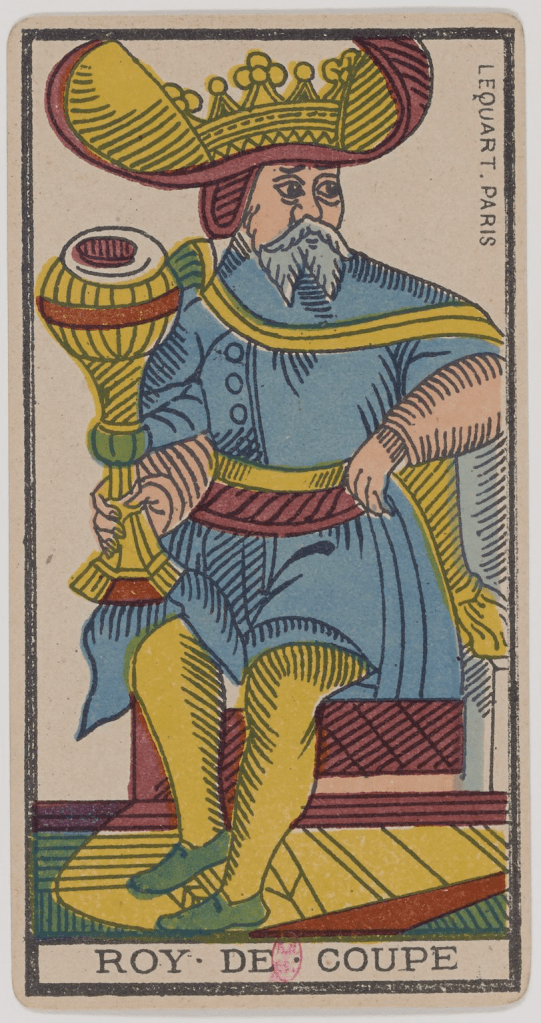
Chaldean numerology and astrology were utilized in the 15th century for the Italian interpretation of tarot cards. Thus, Aldebaran appears as the “King of Cups,” and, in addition to courage and honor, brings pleasant emotions, friendship, and love. This aligns with the traditional nature of number 37.
King of Cups. Source: Wikimedia Commons, File:KC Tarot.png
Sepharial provided the following explanation of the number: “XXXVII (37). Royal star of Taurus. Union; marriage; protection of ladies in position; goodwill; sincere friendship; success through associations with the opposite sex.”
Cheiro described the number as follows: “37. This number has a distinct potency of its own. It is a number of good and fortunate friendships in love, and in combinations connected with the opposite sex. It is also good for partnerships of all kinds. It is a fortunate indication if it appears in connection with future events.”
Sources:
Cheiro (1935). The Cheiro’s Book of Numbers. London, Herbert Jenkins Limited.
Firmici Materni Matheseos: Liber Sextus, II.
Ptolemaios (2nd century AD): Tertrabiblos, chapter IX: The influence of the fixed stars.
Sepharial: Your Fortune in Your Name or Kabalistic Astrology‘ (revised edition from 1909).
Although Western astrology is based on the seasons (tropical system), Chaldean numerology also explores connections with fixed stars and constellations. The development of Chaldean numerology was undoubtedly influenced by Egyptian sidereal astronomy (circa 3000 BCE) and later, during the Hellenistic period, by Egyptian sidereal astrology (ancient decans).
There is ongoing debate about whether an ancient Chaldean astrology (around the 5th to 4th century BCE), was based on sidereal or tropical astrology. My personal opinion is that the shared astro-numerological foundation was sidereal, although I won’t delve into proving this here. If true, Chaldean numerology is, in a way, closer to Indian astrology (which is sidereal) than to Western astrology (which is tropical).
These four stars can also be combined with planets represented by specific numbers. For instance, 23 represents Mercury in conjunction with Regulus, 37 represents the Sun in conjunction with Aldebaran, and 51 represents Venus in conjunction with the star Markab. The conjunction between the Moon and Antares symbolizes the number 65.
Chaldean numerology can be used to designate additional stars. Various criteria exist for categorizing stars numerologically, and according to one criterion, the following fixed stars can be defined: • 21 – Polaris • 82 – Arcturus • 91 – Sirius
Some constellations include: • 11 – Virgo and Leo • 17 – Andromeda • 37 and 111– Pleiades • 13 and 43 – Draco
November 1st marks an ancient holiday of Celtic origin, closely associated with the transition between the world of the living and the world of the dead. On the eve of this holiday, many celebrate what we know as “Halloween,” which has its roots in the mythology surrounding November 1st.
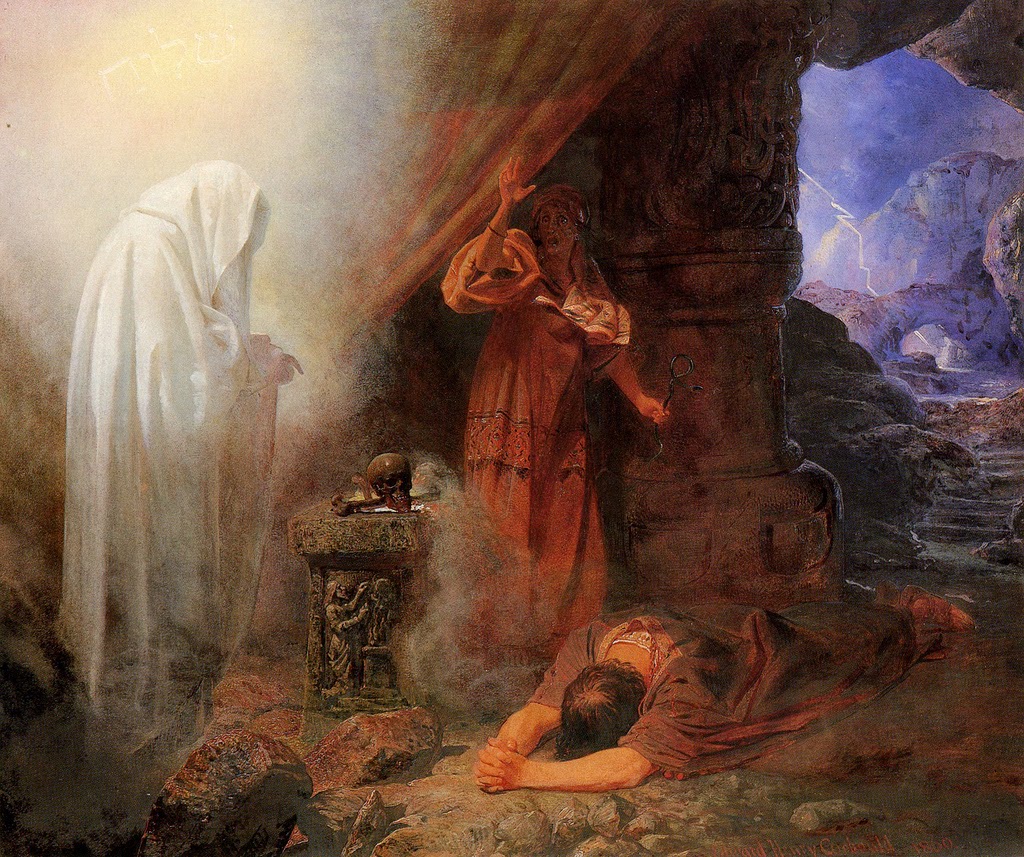
In various cultures, such as in China, the spirits of ancestors are especially honored. There, rituals often involve invoking the spirits of the deceased for guidance and protection. In contrast, Jewish tradition typically discourages any contact with spirits from the afterlife. As stated in the Bible: “Do not turn to the spirits of the dead and do not seek familiar spirits to become unclean by them. I am the Lord your God” (Leviticus 19:31). However, in times of distress, it seems calling upon the spirits of holy individuals might have been acceptable. For instance, Saul visited the Witch of Endor to summon the spirit of Samuel for advice (1 Sam 28).
»Saul and the Witch of Endor«. Author: Edward HenryCorbould, 19th century
Many Christians hold the belief that it is permissible to call upon the spirits of saints, including apostles and the Virgin Mary. Personally, I tread carefully around the idea of invoking the souls of the deceased. So, why is November 1st significant in this context?
The Celtic calendar celebrates the changing seasons with significant dates: summer on August 1st, winter on February 1st, spring on May 1st, and autumn on November 1st. As Celtic culture spread from Portugal to Eastern Europe and from Ireland to parts of Turkey, these dates evolved into important pagan festivals throughout Europe.
The Celts referred to the November 1st celebration as Samhain. This festival signified the autumn transition from summer to winter. The Celts believed that during Samhain, the barrier between the living and the dead was especially thin, allowing spirits to return to the realm of the living. The Celts performed various rituals to honor their ancestors (the benevolent spirits) and to protect themselves from potentially malevolent forces.
Autumn truly represents a shift from the world of the living to the world of the dead. Harvests are gathered, fields lie fallow, and nature begins to quiet down. In ancient farming communities, work slowed down, livestock were brought in from pastures, and wolves started to approach settlements. Additionally, travel routes, while still accessible, became vulnerable to bandits and invaders, posing a serious risk to neighboring tribes. Thus, this period was characterized by a search for safety, but also by danger, conflict, and death.
Spiritually speaking, the autumn transition serves as a passage into the other world, akin to crossing through a portal into the afterlife. The Celts and many others believed that during this time, the boundary between living and the dead blurred. This symbolism extends to our relationship with the other side, suggesting that among the spirits of the departed, one could encounter both benevolent guardian spirits and malevolent entities.
Can this symbolism be connected to Chaldean numerology? While Chaldean numerology developed in a very different cultural context than Celtic traditions, there is a fascinating link between the significance of November 1st and numerological symbolism. November is associated with the astrological sign of Scorpio, which governs the mysterious and the occult. Additionally, November aligns with the 8th house in astrology, which concerns issues of illness and death. The planetary rulers of Scorpio are the assertive Mars and, in modern astrology, Pluto, the lord of the underworld.
The first day of the month embodies the energy of the Sun, symbolizing life. This energy meets the energies of the underworld and the spirits of the deceased. The Sun in Scorpio also serves as a reminder that it is important to seek peace and distance from aggression in our lives. Ultimately, God remains the true Guide, even in the shadowy realms. Through peace and love, we can find protection from malevolent forces. In this way, we can discover salvation in this world and in the afterlife and let our hope shine like a beacon into the other world.


 The Mystery of Numbers, Luck, Worlds and Planets