Many individuals have date numbers that inherently bring challenges, and in some cases, changing their name or surname cannot fully resolve these issues. Both name numbers and date numbers operate on multiple levels. When a solution is found on one level, it can sometimes disrupt harmony on another.
When selecting a name or surname, perfectionism is not advisable. An ideal solution is rarely achievable. Instead, we should aim for options that are reasonably good, even if they cannot be perfect. Some people adopt an interdisciplinary approach, attempting to align name changes with palmistry, astrology, and an analysis of how a person’s chakras and aura respond. And that’s it.
Choosing a new name or surname, or following numerological advice about which areas of life to activate, is similar to recommendations in astrology or feng shui. There is always some risk that the change will introduce complications or undesirable side effects. Moreover, such measures are generally not a magical fix but rather tools to help improve the quality of life.
This concept is similar to going to the beach and packing a swimsuit and a towel. It’s undoubtedly more comfortable to wear a swimsuit in a warm, sunny location than jeans or a blazer.
However, it’s up to us to decide how to use these tools. One person might spend the entire vacation on the beach but never swim. Another might spend all their time in the water. For both, the swimsuit and towel are useful tools for enhancing their experience. Yet another person might stay in their air-conditioned room, reading books all day. For this individual, the swimsuit probably isn’t the best solution.
Calendar numbers are often interpreted differently across various numerological approaches. In Chaldean numerology, composite numbers are typically interpreted differently than in Pythagorean numerology. It is important to recognize that, beyond numerology, the fate of the world is also influenced by astrological and other forces. Consequently, some years are easier to explain through numerology than others. That said, I must emphasize that I do not take responsibility for any harm resulting from the application of recommendations in this article.
The year 2025 has a base number of 9, associated with Mars, the planet of vitality, courage, and potentially anger, irritability, violence, and conflict. In tarot, number 9 is linked to “The Hermit,” which imbues it with spiritual potential. The number 9 is further reinforced by the internal structure of 2025 – this year is a square of 45, which also has a base number of 9. Additionally, the first two digits (20) and the last two digits (25) of the year also add up to 45.
Each Mars year is unique, and 2025 is expected to be particularly volatile, marked by sudden and unexpected twists, unfavorable developments, and, regrettably, greater aggression compared to typical Mars years. The risk of aggression is also astrologically evident, as the year begins with retrograde Mars opposing Pluto. Since this alignment occurs at the start of the year, its effects are likely to persist throughout the year. From an astro-numerological perspective, it wouldn’t be surprising to see increased Chinese militarism alongside Russian aggression in 2025. However, this is just one possibility. Such influences could make it difficult to resolve ongoing wars (e.g., Sudan, Palestine, Ukraine) and may even spark new conflicts. Still, let us remain hopeful. Humanity is capable of learning lessons and transcending divisions, for peace is our supreme reality.
From a numerological standpoint, January and February are expected to be challenging, with energies stabilizing from March to June, turning distinctly negative from July to November, and remaining unfavorable in December.
On the less optimistic side, 2025 numerologically suggests the possibility of wars, deaths, sacrifices, conflicts, violence, uprisings, revolutions, crime, terrorism, and abrupt, drastic changes. In addition to Mars influences, the presence of the number 13 signifies “The Death” and transformation, while the number 12 represents “The Hanged Man” and sacrifice. This will undoubtedly be a challenging year, especially for key global leaders, some of whom may face political downfalls or crises. Solar eclipses on March 29 and September 21, 2025, may perhaps further strain global leaders. The most critical period numerologically will be from July to November 2025, making dialogue and constructive communication imperative.
On a more positive note, the intellectual sharpness of 2025 will increase. However, it may not be the best year for researchers and scientists unless they can embrace the instability of the year and focus on creativity instead of conflicts.
In spirituality, two paths emerge. One is less prominent but involves building a grounded spiritual practice. The other may lead to confronting spiritual “shadows” and illusions. Grounding is essential, and those working with kundalini energy or the microcosmic orbit will thrive. The number 9 is associated with “The Hermit” and offers the potential for grounded spiritual growth. Without grounding, this year could present spiritual traps, leaving seekers in a maze of illusions.
In general, cultivating love, softness, and dialogue is highly recommended to temper Mars’s aggressive tendencies and mitigate stress from sudden changes. Staying grounded is crucial, as this year may challenge those who build castles in the air. By staying informed and verifying information, we can navigate this year’s challenges more effectively.
Astrologically, the conjunction of Saturn, Neptune, and the North Lunar Node (Dragon’s Head) in 2025 highlights karmic influences. This conjunction could bring about a spread of misinformation with karmic consequences. According to André Barbault, conjunction between Saturn and Neptune historically aligns with Russia. In 2025, either tropical or sidereal astrology place Saturn and Neptune in Pisces, which could also symbolize China (socialism), pointing eastward. For both nations, 2025 appears to be a challenging year.
In the economy, 2025 is likely to be unpredictable. While the year has potential for successful ventures if approached methodically and grounded, it also carries risks of illusions and misjudgments that could lead to difficulties in business and stock markets. The “Russo-Chinese” conjunction of Saturn, Neptune, and the Dragon’s Head, particularly from May onward, may drive misinformation worldwide.
Uranus in Taurus could further disrupt our understanding of finance and trade, possibly destabilizing established patterns. From June 2025 onward, the sextiles between Neptune-Uranus and Uranus-Saturn (according to André Barbault, aspects between these two planets historically align with USA) will be fully active, potentially isolating countries associated with Neptune and Saturn. A similar situation for Neptune could be represented by its sextile with Pluto. The Neptunian Russians are likely to feel isolated this year, and the economic situation will probably affect them more adversely than other major players. Russia may respond with heightened nuclear threats, which is concerning given the country’s present state.
What exactly all this means remains to be seen, but it’s not just about the sanctions Russia has faced so far. Destructive effects will also be present in the United States, potentially indicating a reciprocal trade warbetween Russia and China on one side and the United States on the other. All these players could possibly become entangled in a trade war with Europe as well (which is also associated with Saturn). The likely trigger for all of this is Uranus, and through it, the United States.
Numerologically, the internal structure of 2025 indicates upheavals in major industries and multinational corporations, possibly revealing shocking economic news. Given the negative trends from July to November, we might anticipate disruptions in military conflicts, international trade, and stock markets during this period.
However, according to Chinese astrology, 2025 is the year of the Wood Snake (Yi Si), which contains strong fire elements. Fire, as per Raymond Lo, supports the stock market. Historically, years with strong fire elements tend to avoid severe economic crises. While the exact trajectory remains uncertain, staying informed about market conditions and monitoring investments will be crucial from May or July onward.
On general, the number 9, which is prominent in the year 2025, resonates well with the numbers 3, 5, 6, and 9. However, other numbers, such as 13, also play a role in 2025. Additionally, the composition of the year itself includes several distinct digits. As a result, 2025 may be somewhat challenging for individuals whose base numbers are 3, 6, and 9. It’s important to note that descriptions of dominant numbers are a broad level of analysis. Each person’s response to the numerological dynamics of the year is highly specific, depending on their unique numerological chart.
For general influences, you can refer to the descriptions below. Most people have one or two dominant numbers, which often align with numbers found in their Total Name Number, the Birth Number (day of the month), or their Life Path (day + month + year).
For individuals governed by base numbers 3, 6, and 9, some projects may succeed while others may not. Overall, the year isn’t expected to bring anything too dramatic. With effort and determination, these individuals can still achieve some successes. Those with the number 3 should focus on maintaining harmony in their relationships, and this is especially true for men with the number 9.
People with base numbers 1 and 2 are likely to have a slightly easier time. Due to their neutral positioning, their progress across most areas could lean toward either positive or negative outcomes. With at least a little effort, these individuals can steer their destiny in a favorable direction in many cases.
For those influenced by the numbers 4 and 8, this year may lack energetic support. Both are strongly karmic numbers and, for many, will attract significant challenges. People with the number 4 should take extra care of their health and may experience considerable career pressures. Women with this number might also face difficulties in relationships. Similarly, individuals with the number 8, particularly men, could encounter challenges in relationships, as well as trials in career, business, finances, and friendships. Those with dominant numbers 4 and 8 will need to rely on their experience, knowledge, and spiritual connection to turn these challenges into positive outcomes.
People with base numbers 5 and 7 can expect favorable influences in 2025. For those with the number 5, it’s an excellent time to invest effort in education, creativity, or public speaking. This is generally a positive year for partnerships, especially for women with the number 5. Similarly, the number 7 aligns well with education and creativity, and women with this number are also likely to experience greater success in partnerships. However, unlike those with the number 5, individuals with the number 7 may find this year more advantageous for career achievements.
In older traditions, the number 37 was recognized as highly fortunate. In later Chaldeantraditions, it became known as the “Royal Star of the Bull” or Aldebaran, as well as the “King of Cups.” Generally, it exerts a positive influence, fostering favorable connections, harmonious partnerships, courage, love, status, and professional success.
When the number 37 is doubled, it yields 74, one of the rare relatively fortunate numbers in the 2 series (7+4=11; 1+1=2). Multiplying 37 by 3 results in 111, which is considered the number of the Pleiades—a predominantly lucky number, similar to 21.
Multiples of 37 also exhibit fascinating numerical properties. When 37 is multiplied by any integer, the result will always numerologically correspond to that multiplier. For example, summing the digits of the multiplier and the result yields the same base number. Consider 37 x 14 = 518: the digits of 14 sum to 1+4=5, and the digits of 518 sum to 5+1+8=14; 1+4=5.
When the digits of the multipliers add up to 3, 6, or 9, the products of numbers from 111 to 999 will always result in a number made up of three identical digits. For example, 37 x 3 = 111, 37 x 6 = 222, 37 x 9 = 333…
The number 333 is widely revered today as a number of manifestation and spiritual reconnection. It represents the first multiplication of 37 (base number 1) by a multiplier with a base number of 9. Numerologically, 1 signifies a beginning, and 9 signifies an end. In the Pythagorean tradition, this relationship symbolizes the Alpha and Omega—a sense of wholeness.
When 37 is multiplied by 18, a number associated with war and materialism, the result is 666. In its negative aspect, 666 symbolizes war, devastation, beasts, and egoism. Numerologically, 37 can signify a military leader, while 18 represents war. In Christian tradition, 666 is the number of man and the beast. According to the Genesis creation narrative, God created man on the sixth day, and 666, being a tripled six, symbolizes humans. Moreover, the digits in 666 sum to 18, the number of war, beasts, and aggression.
When 37 is multiplied by 24, the result is 888. The number 37 represents love and harmonious relationships, while 24 typically brings luck and prosperity. The digits in 888 also sum to 24. In Christian-Pythagorean tradition, influenced by Chaldean numerology, 888 is considered the number of the Redeemer. The Greek name for Jesus, Ιησους (Iesous), carries the numerical values 888. However, in Chaldean numerology, the number 888 can also have a nuanced and challenging meaning related to how the digit 8 operates—a topic for another discussion.
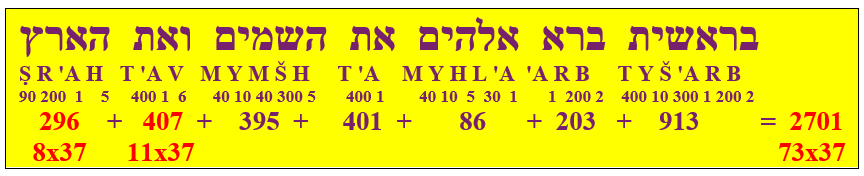
The opening sentence of the Bible, “In the beginning, God created the heavens and the earth” (Bereshit bara Elohim et hashamayim ve’et ha’aretz) has a total numerical value of 2,701 in Hebrew gematria:
When 37 is multiplied by its mirrored counterpart, 73, the result is also 2,701. Additionally, summing 2,701 with its mirrored counterpart, 1,072, yields 3,773—a number that seems to unify numbers 37 and 73.
The Hebrew word ha’aretz (הארץ), meaning “the earth,” has a numerical value of 295, which is the product of 37 (love and strength) and 8 (Saturn, associated with the element of earth). The word ve’et (ואת), signifying connection (specifically between heaven and earth), has a value of 407. This number is the product of 37 and 11 (base number 2, representing connection or separation). Genesis 1:1 thus establishes the foundation of creation: seven Hebrew words correlate with the seven days of creation, with love (2,701) as the core principle. The created earth (296) exists in a realm of love and is connected to the higher world through love (407). Additional interpretations connect the number 2,701 to Jesus Christ, which can be explored further online.
More than 2000 years ago, Chaldean numerologyrevealed clear correlations between numbers and planets. These correlations were later adopted in the 16th century by the Pythagorean numerologist Heinrich Cornelius Agrippa.
By the early 20th century, Chaldean numerologists linked planetary vibrations to zodiac signs through their ruling planets. For example, the numbers 1 and 4 are associated with the Sun, which has its domicile in Leo. Consequently, Leo is attributed the numbers 1 and 4. Similarly, Mercury has its domicile in Gemini and Virgo, so both signs are assigned the number 5. This gives us the following table:
Zodiac Sign
Traditional Values
Modern Additions
Aries
9
Taurus
6
Gemini
5
Cancer
2 and 7
Leo
1 and 4
Virgo
5
Libra
6
Scorpio
9
0?
Sagittarius
3
Capricorn
8
Aquarius
8
4 (influences of Uranus)
Pisces
3
7 (influences of Neptune)
This correlation is very strong, as the nature of the planets is closely tied to their domicile signs, and as a result, the planetary numbers are also strongly connected to the signs. Furthermore, 500 years ago, Heinrich Cornelius Agrippa also demonstrated a direct connection between zodiac signs and numbers:
Aries
7
Taurus
6
Gemini
3 and 12
Cancer
5
Leo
1
Virgo
1 and 10
Libra
8
Scorpio
9
Sagittarius
4
Capricorn
3
Aquarius
2
Pisces
2 and 11
The origin of this table remains unknown. It is unclear whether it is Agrippa’s innovation, a Pythagorean enhancement of the Chaldean philosophy of numbers predating Agrippa, or whether Agrippa took this description from contemporary Chaldean numerologists.
These values are at least twice as weak as the indirect connection through the planets and domiciles. Most Chaldean numerologists do not use them. However, such values are present for each sign. The scheme of direct numerical connections to signs follows certain similar numerological principles that also underpin the foundational Chaldean correlations between numbers and planets.
Vianna Stibal (born January 2, 1963) is an American spiritual teacher and the founder of the ThetaHealing technique.
Her numerology chart, based on Chaldean numerology, reveals some fascinating insights. Her birthdate, 12, aligns with her Total Name Number (TNN) 15 and her Goal Number 63, creating a trio of base numbers: 3, 6, and 9. These numbers are strongly associated with manifestation as well as spiritual energy. Vianna’s chart also shows additional indicators of prosperity and spiritual connection.
However, introducing the vibrations of love into her life requires intentional effort, as it’s not something that comes automatically. Her TNN 15 (33) suggests a potential desire for recognition. At the same time, she faces a choice: she can act out of love or resort to manipulation. Many spiritual masters have similar choices in their numerology charts, presenting paths of either light or darkness.
The numbers 12 (her birthdate) and 15 (her TNN) generally don’t resonate well with the number 1. In Vianna’s case, the number 1 appears as part of her consonant total, 73, which might point to challenges related to the heart, circulation, or blood pressure. The placement of 73 specifically highlights both her pericardium and her heart. Vianna herself has reported experiencing heart failure.
Additionally, the number 12 is considered an “unlucky” number, associated with victimhood or adverse circumstances. When combined with 14, it may lead to movement issues or problems with the arms or legs- something that aligns with Vianna’s leg issues. This combination also warns of potential risks related to accidents. Remarkably, Vianna was able to overcome her health challenges through spiritual healing.
To fully activate and amplify her spiritual and healing potential, Vianna is encouraged to cultivate love and engage in acts of kindness. It is highly recommended that she dedicate some time or resources to freely helping others or donating at least 10% of her income to charitable causes. Above all, staying deeply connected to God is vital for her growth. Following these suggestions can help transform the “unlucky” number 12 into a favorable one, while harmonizing conflicts between base numbers such as 5 and 3, 3 and 7, or 1 and 3.
Vianna can also find balance by inspiring others to connect with the Earth, manifest abundance, and activate their courage and inner strength.
I wish Vianna Stibal further success on her spiritual journey and in her work! 😊
Numerology is a metaphysical discipline that examines the holistic influence of numbers on one’s character and destiny.
It does not include “healing codes” (numerical sequences representing timelines of numbers) with specific influences, which some use to resolve problems. Like numerology, there are multiple approaches to these sequences. However, in numerology, the focus is on long-term influences, where the numbers corresponding to individual letters and digits are added together over time.
Numerology is not a genie in a bottle, ready to solve all problems or provide quick, miraculous solutions. Its contribution lies in showing how to enhance someone’s talents and balance their energies. Whether one chooses to develop their talents, set concrete goals, or strive to achieve them is beyond the scope of numerology. Nevertheless, numerology can serve as a guide, making it easier to achieve these goals and overcome obstacles.
Additionally, numerology is not an all-powerful tool for interpreting every detail of life or predicting specific events. While intuitive individuals might use numerology as a supplementary tool for fortune-telling, numerology itself does not foretell the future. First, no one likely knows all the intricate numerological formulas necessary for precise predictions. Second, numerology often works in conjunction with other methods for determining destiny. Third, as humans, we are co-creators of our lives. Finally, divine support and cosmic energies also play a role.
About 15 years ago, I participated in a group meditation session aimed at supporting a teenager who had attempted suicide due to unrequited love. He was in a coma for a long time but awoke the moment we collectively felt that the session had been effective. This experience highlights that astrology, and numerology should not be overestimated.
While many numerologists often claim that numerology is a science of numbers, it does not fall within the realm of traditional science. There is no concrete research that other researchers have replicated. This may be due to the diverse approaches among numerologists, as well as their reluctance to disclose the complete methodologies behind their findings. Therefore, numerology is more accurately classified as a pseudoscience or a branch of metaphysical knowledge.
Numerology is often grouped with astrology and magic under the category of occult knowledge. The term “occult” refers to anything secretive or difficult to access. In the past, this was even more accurate, as ancient texts were often encoded to keep knowledge hidden. Sometimes, this secrecy was necessary to avoid condemnation or persecution, particularly from the Christian Church. Today, the basics of numerology are accessible to everyone, and there is no longer a need for secrecy. However, it is true that some numerologists still keep certain knowledge to themselves.
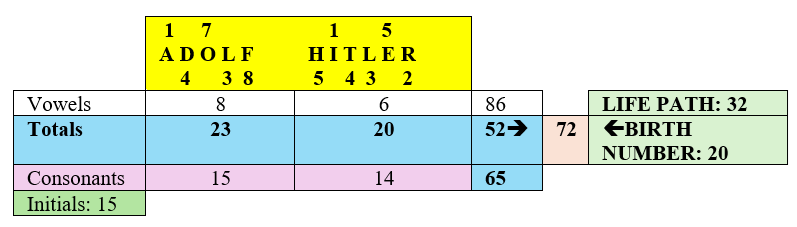
Adolf Hitler, born on April 20, 1889, was a German leader, ideologist, and painter who led his nation into a world war and devastation. An analysis of his birth date suggests that strong fives in his name numbers might have balanced his chart. Instead, his name numbers prominently feature the powerful yet ill-fated number seven.
This dominance of seven, combined with base numbers 2 is often linked to artistic traits, further amplified by the number 15. Hitler’s engagement with painting reflects this influence. Numbers with base number 2 also connect with 5 and 8, which can indicate emotional challenges. These complexities are heightened by the number 52 and the interplay between 65 and 15. Hitler’s numerological chart reveals that many of his name numbers carried negative energies, suggesting that without spiritual growth, a person in a leadership position with such numbers could cause significant harm.
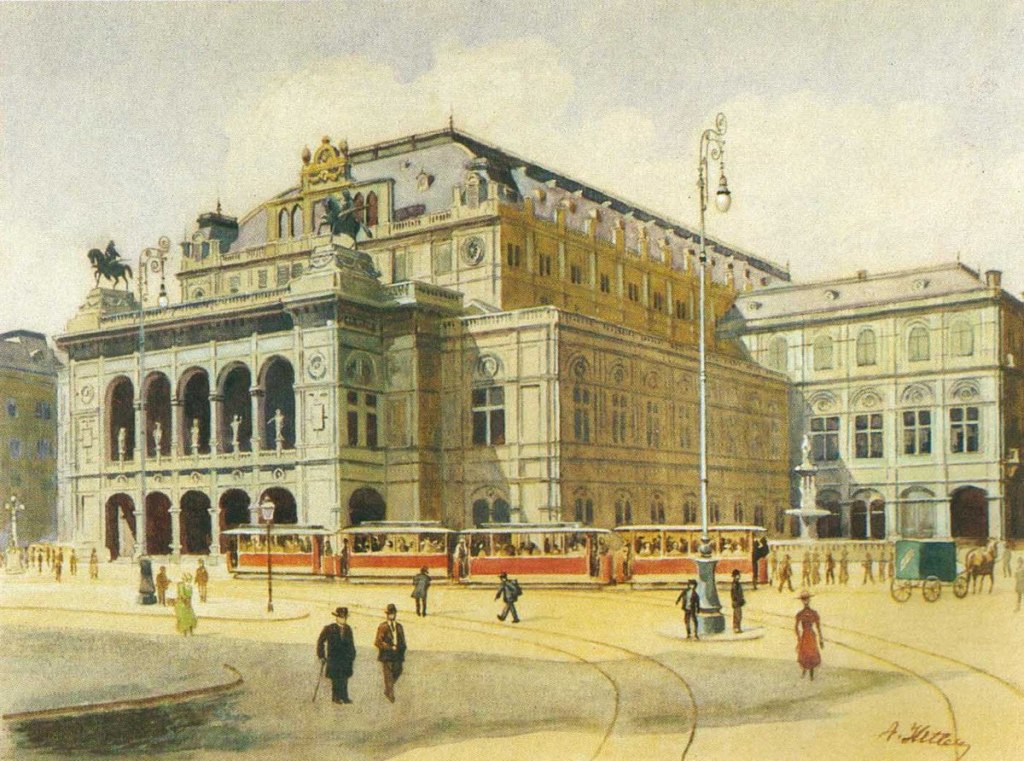
“Wiener Staatsoper” by Adolf Hitler (1912). Source: Wikimedia Commons; File: Adolf Hitler – Wien Oper.jpg
The number 15 often signifies artistic potential, while numbers like 20 can enhance communication skills. Base 5 numbers such as 23, 32, and 14 further support communication. The dual nature of the number 2, ranging from shyness to assertiveness, depends on the individual. Hitler’s chart shows connections between numbers 2, 7, and 9, which can signify strength, combativeness, and leadership potential. However, when threatened, these combinations may lead to harshness or aggression, depending on the specific numbers involved. Numerologically, Hitler’s ability to communicate was not hindered by shyness.
His leadership potential is bolstered by numbers associated with kings and queens in Tarot, such as 23, 52, and 65. However, 52, when present in the Total Name Number (TNN), can symbolize war, danger, and conflict, akin to number 43. Alongside the 52, Hitler’s chart includes the number 20, which in mundane numerology can represent apocalyptic themes like disease, death, or hospital recoveries. This spiritual number is unfavorable for individuals with materialistic ambitions. 52 is linked to the number 65, associated with wounds and health risks. Indeed, Hitler led Germany into an apocalyptic war with immense casualties and suffering on all sides.
Individuals with numbers like 43 or 52 must avoid wars and conflicts to prevent massive destruction. For context, such numbers are also found in the numerological charts of figures like Palestinian leader Yahya Al-Sinwar and Israeli Prime Minister Benjamin Netanyahu, both accused of war crimes. Sinwar has been linked to the October 7, 2023, attacks, while Netanyahu faces growing accusations of genocide against Palestinians. Under Netanyahu’s leadership, Israel continues a policy of segregation against Palestinians reminiscent of South African apartheid, and increasingly resembling Hitler’s anti-Semitic activities. The Israeli-Palestinian conflict provokes Arab and broader Muslim populations, while Israel enjoys support from the United States and many of its allies, entangling a third of the world’s population in indirect involvement. If this conflict intertwines unfavorably with other global tensions in Ukraine, Korea, and Taiwan, the consequences could be catastrophic.
Returning to Adolf Hitler: according to Western astrology, he was a Taurus, while Indian astrology identifies him as an Aries. Both signs can exhibit strong nationalist tendencies. Number 2 often signifies vulnerability or ties to home, family, or even broader societal connections. Hitler’s combination of 2, 7, and 9, as previously mentioned, may indicate aggression rooted in perceived threats. The number 2, representing attachment, interacts with the combative 9 and the negative aspects of 7 (associated with 52, which can lead to illusions and conspiracies). Number 9 appears prominently in his Aries sign and in his goal number, as well as in one other personal number not typically shown in general charts.
Hitler’s numerological chart has another notable aspect: the sum of consonants and the TNN are tied to inauspiciousnumbers that should avoid wars, revolutions, and violence. Otherwise, individuals with such numbers often meet disastrous ends.
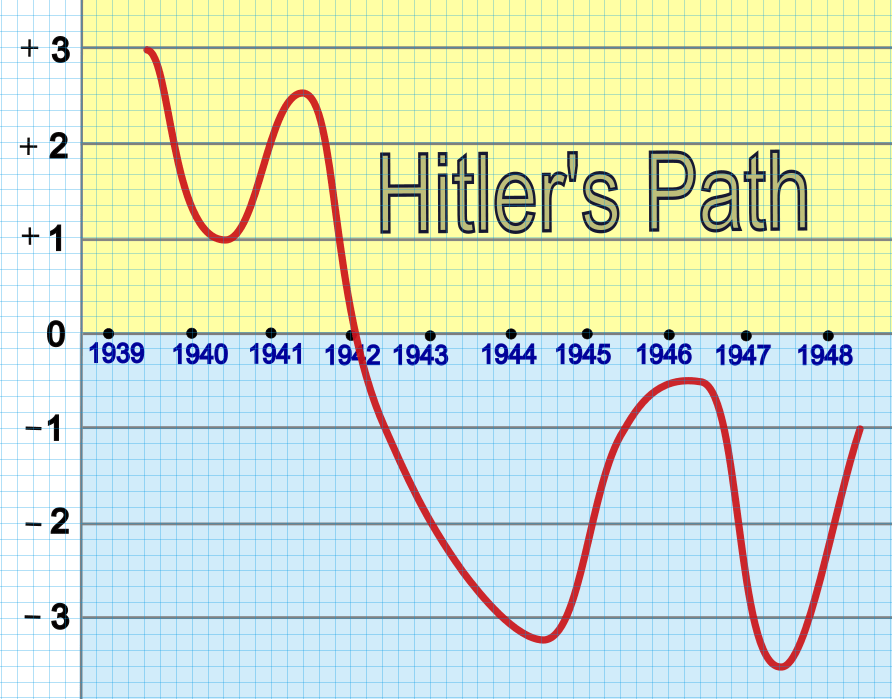
Examining World War II through Hitler’s numerological chart and yearly influences reveals intriguing correlations. Different factors influence yearly effects, and numerologists vary in their approaches. Here, only yearly data is considered, excluding monthly analyses. Some criteria are shared with my study ofU.S. presidential campaigns, with additional factors included. The results for 1939–1948 are summarized in the accompanying graph.
It’s important to note that personal numbers differ from general mundane numerology. Nevertheless, it’s striking that Hitler’s personal numbers indicate favorable years from 1939 to 1941, aligning with Germany’s significant military successes and territorial expansion. His yearly influences worsened in the spring of 1942, corresponding to Germany’s stalled expansion. The years 1943, 1944 and early 1945,were marked by extremely negative influences, and during this time, the power of Germany was broken. Although 1945 showed slightly better influences, they remained unfavorable, culminating in Hitler’s military and personal defeat.
It’s crucial to stress that Hitler’s yearly numerological influences alone cannot predict the start or end of a world war. Factors like monthly energies and the charts of key adversaries likely played roles, as did other systems such as Western and Chinese astrology. Thus, based on the energies of Destiny, real Hitler’s year 1945 was undoubtedly very unfavorable, as it ended in both military and personal defeat.
Interestingly, numerological energies suggest that Hitler’s Germany might have fared better had he initiated peace negotiations in 1941, securing international recognition of some territorial gains and perhaps some war reparations. Yet, given the unfavorable trends in his numerological system, his hypothetical postwar career in Nazi Germany remains questionable.
Continuing the war beyond 1942 was undoubtedly an unwise decision. Not to mention, from the perspective of an enlightened individual, the era of wars is a remnant of spiritually fallen or underdeveloped humanity. In an alternate reality, there are no divisions between Palestinians, Americans, Germans, and Jews. In such a reality, there are no dualistic conflicts, no entanglement in emotional and mental dramas. Why not strive to live in such a reality?
Traditional Chaldean numerology classifies number compatibility into two primary groups. The first group includes the numbers 1, 2, 4, and 7, while the second group consists of 3, 6, 8, and 9. The general principle is that numbers within the same group are compatible with one another but incompatible with numbers from the opposite group. For example, 1 is compatible with 2 but not with 9, while 6 is compatible with 9 but not with 4. The number 5 is considered superficially compatible with all numbers but should ideally avoid the influences of 3 and 8.
However, traditional exceptions to these rules exist. For instance, 8 and 9, though part of the same group, are often incompatible. Similarly, the number 15 is advised to avoid connections with 8, despite 15 reducing to 6, which belongs to the same group as 8. In certain scenarios, 8 may even align with 1. The relationship between 3 and 7 is generally destructive, yet under specific circumstances, it can be positive.
I am often struck by how far some numerologists stray from Chaldean traditions. The older generation of Chaldean numerologists, such as Cheiro, Gerun Moore, and Lloyd Strayhorn, has remained largely faithful to these traditional principles. However, many modern Chaldean numerologists, particularly those emerging after 2000, tend to develop their own systems of number compatibility and incompatibility.
These deviations can sometimes lead to significant confusion. In some instances, numerologists rely entirely on simplified astrological concepts of planetary friendships and enmities. Unfortunately, interpretations of these astrological relationships often vary widely. This approach doesn’t represent classical Chaldean numerology but, at best, a neo-Chaldean variant. I encourage readers to distinguish between traditional Chaldean methods, which are grounded in centuries of practice, and newer innovations that often depart drastically from the original teachings.
For casual numerology enthusiasts, deviations from traditional number-matching practices may not be a major concern, as long as no serious advice—like altering one’s name or surname—is being given. However, when working with a professional numerologist, adherence to proven methods becomes critical. Some teachers assert that if someone unknowingly causes harm through their practices, it does not generate karmic repercussions. Instead, they argue, the individual harmed is simply experiencing events dictated by their own energy patterns. But is such harm truly necessary?
Liam James Payne (August 29, 1993 – October 16, 2024) was a member of the band One Direction, a solo singer, and a songwriter. On October 16, 2024, he passed away in Buenos Aires after falling from a third-floor hotel balcony.
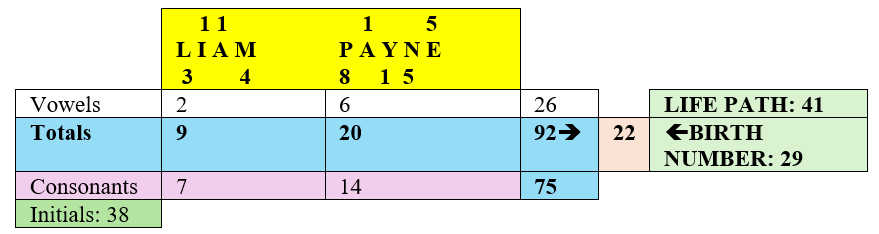
In his numerology chart, Payne had a strong presence of the number 2 (29, 92), which indicates a sensitive personality with deep emotions. Numbers 29 and 92 are often associated with separations or instability in relationships. As we know, Liam Payne struggled to establish a stable partnership.
Many individuals with the number 2 are too shy and passive for public performances. However, Payne’s Total Name Number and Birth Number both contained the number 2. Additionally, the consonants in his name revealed masculine number 75, while the number 2 was surrounded by numbers that encouraged the development of public expression skills. When the number 11 (as seen in 29 and 92) is strongly positioned, it can help overcome fears and develop fighting abilities. Payne was bullied by peers in school, which led him to take up boxing. In Tarot, the number 11, when strongly positioned, is referred to as “The Force.” The number 2, in his case, likely also pointed to an affinity for music and singing.
Liam James Payne. Wikimedia Commons, Soccer Aid for UNICEF: File:Liam Payne for UNICEF 2023.png
In his chart, alongside the dominant number 2 (which can symbolize heights—and falls from them), there was a conflict between movement (14) and sacrifice (75; 7+5=12). This suggests a potential connection to a fall from a height, though the situation wasn’t as directly apparent as in the case of Vladimir Shklyarov. Number 75, when combined with the number 7, was positioned in an unfavorable environment. Such combinations of threes and sevens often face challenges with excessive alcohol consumption, something Payne publicly acknowledged. While his chart didn’t strongly indicate alcoholism, this suggests that its roots might lie in other destiny studies or the context of his life (e.g., the success and fame of singers and actors in general).
On the day of the tragic fall, Liam Payne’s chart revealed the presence of numbers associated with victims (12) and a fall from a building (16). These numbers can also sometimes point to alcohol or even other substances.
Number XVI (16) in Tarot
Let me reiterate, as I’ve mentioned before in the case of Shklyarov: numerology does not predict or foresee the future. It only provides indicators that could suggest various outcomes. Life events are influenced by other destiny-reading techniques as well as free will and spiritual protection. Personally, I avoid analyzing numbers tied to specific future dates, either for myself or others. Dwelling on such numbers can lead a person to manifest their own misfortune.
Vladimir Andreyevich Shklyarov(Владимир Андреевич Шкляров; February 9, 1985 – November 16, 2024), known as Vladimir Shklyarov, was a Russian ballet dancer who tragically passed away on November 16, 2024, after falling from a fifth-floor balcony.
Numbers with base 2 (such as 47 and 29) and base 7 (such as 25, 16, and 34) are often associated with artistic talent. Since 3 and 9 are linked to the physical body, one possible interpretation of the combination of 2, 7, and 9 is “art through the body“—a perfect description of ballet. The number 3, which appears strongly in vowels and is positioned near the number 47, may further contribute to such talent. Additionally, the numbers 17 and 89 in Shklyarov’s numerological chart are positioned in a way that can bring fame, though fame may sometimes feel overwhelming. Shklyarov also possessed certain spiritual potentials.
The relationship between total name numberof 2 and a birth date number of 9 is typically challenging; Such a combination can make achieving inner harmony more difficult however, In Shklyarov’s case, it may have been less disturbing.
Shklyarov is believed to have experienced back issues, which is not uncommon in ballet, where spinal injuries or strain are frequent. In numerology, the back can be associated with numbers tied to the base number 8. Shklyarov’s chart includes the numbers 17 and 89, both connected to this base number.
Whatever caused the fatal fall, certain numbers are often associated with risks of falling. These include numbers representing motion (e.g., 14) and height (e.g., numbers with base 1 or base 2). When such numbers interact with numbers connected to the earth or the base number 8, the risk can increase. Particularly noteworthy are the numbers 44 and 16, which may represent falls from buildings. In tarot, the number 16 is known as “The Tower” and is depicted as a tower struck by lightning, with two figures falling from it. Additionally, numbers associated with “Death,” such as 13, 43, and 71, or generally accident-prone numbers, are relevant. Shklyarov’s chart includes numbers like 19 (height), 16 (fall from height), and 17 (earth, or potentially a building), which appear on the consonant level.
Number XVI (16) in Tarot
Examining the date of his death with numerological techniques reveals that 2024 was a challenging year for Shklyarov, potentially tied to back problems. November 2024 could have brought additional difficulties with movement. On November 16, 2024, his chart included numbers associated with accidents, and the day itself, marked by the number 16, carries connotations of misfortune. It’s important to note, however, that unfavorable or accident-prone numbers in a date do not necessarily predict misfortune. In numerology, dates are not about fortune-telling but rather provide insight into the energies of a given day.





 The Mystery of Numbers, Luck, Worlds and Planets