Chaldean Numerology: Numerological Chart or Numeroscope

A numerological chart or numeroscope (from Latin numerus = “number” and Greek σκόπος = “observer, watcher”) is a comprehensive display of name and date numbers associated with one’s destiny. There is no unified approach among numerologists regarding what exactly a numeroscope should include or how it should be visually represented. Each numerologist designs the numerological chart in their own way.

In Chaldean numerology, for many practitioners, the numerological chart includes only the name number, surname number, Total Name Number (TNN), and Birth date number. Some add the Life Path number and a special Goal number, which is derived from the Birth date number and the TNN (also referred to as the Career number or Hidden number). Chaldean numerologists rarely consider the number derived from the day and month of birth.

Complex numeroscopes first appeared in modern Pythagorean numerology after World War I. These numeroscopes are also the most standardized. They display name numbers, which are divided into vowel numbers (Soul Urge, Soul or Heart’s Desire), consonant numbers (Personality, Body or Quiescent Self), and whole numbers (Expression, Mind). For date numbers, the Life Path is primarily considered, while predictions use Pinnacles, Challenges, letter transits, and universal and personal years, months, and days. A special Goal number is also used, derived from the TNN and Life Path. In the last 20 years, the interpretation of so-called Arrows has also become widespread.

There are, of course, mutual influences and shared foundations between Chaldean and Pythagorean numerology. The differences between the two schools are not as significant as some claim. Unfortunately, some Chaldean numerologists have gone so far as to uncritically adopt all Pythagorean techniques for designing and interpreting numerological charts. For example, personal years, months, and days have such a minimal effect that their use causes more confusion than clarity.

In Chaldean numerology, vowel and especially consonant numbers are crucial for proper interpretation and, in my opinion, should be included in the numerological chart. In fact, these numbers were already known in 19th-century Chaldean numerology, but this knowledge faded into obscurity. After World War II, Chaldean numerologists began using them again under the influence of the Pythagorean school. The Life Path number should also be considered, even though it does not hold as much significance as the day of the month number.

My style of numerology chart using Nikola Tesla as an example.

Some modern numerologists (both Chaldean and Pythagorean) have gone a step further by introducing various other numbers. In Chaldean numerology, the growth of the Danish numerology school (August Darius Danielsson, Johannes and Estel Ehwass, Novalee Wilder) is especially notable. This school connects name and date numbers in a special way with the Kabbalistic Tree of Life, which is typically represented in the shape of a rhombus.

August Darius Danielsson, apparently the founder of this school, calls the basic numerological Tree of Life (represented as rhombus) “The Human Self,” while the basic date matrix is represented as a triangle, which he calls “The Higher Self.” Date numbers also create a parallel with “The Human Self,” forming an additional Tree of Life. Danielsson refers to this rhombus as “The Highest Self.” Each of these sections contains a multitude of numbers.

The Ehwass duo presents a similar structure for the numerological chart. They call “The Human Self” the “Name Chart,” and “The Highest Self” the “Psychic Chart.” They retain the name “The Higher Self.” For consonant numbers, they design their Tree of Life/rhombus as the “Personality Chart,” and for vowel numbers as the “Vocation Chart.”

The Danish school, therefore, introduced advanced standardized numerological charts. However, it diverges significantly from the traditional understanding of how to calculate name numbers. Practitioners of this school create composite numbers from non-composite name or surname numbers, which then become the actual name or surname numbers. They do something similar with date numbers in “The Highest Self”/”Psychic Chart.” Members of this school also calculate so-called year ranks and day ranks, which they use for prediction. Personally, I do not belong to the Danish school. I have reservations both about their application of the Tree of Life and their method of calculating name numbers.

Some Sources:

Trump and the Assassination Attempts Against Him


Presidential candidate Donald Trump has apparently survived one assassination attempt and a second incident that nearly resulted in another attempt within a span of three months. The assassination attempt took place on July 13, 2024. On Sunday, September 15, 2024, there was another incident in Florida, where the potential attacker was neutralized before they could shoot.

Trump’s numerology chart, based on the principles of Chaldean numerology, shows the significant influence of the number 8 in his chart. There are also strong presences of the numbers 3 and 5. With such a chart, it’s important to avoid numbers with base numbers 4 and 8, as well as the number 15 in all its variations.

From a numerological perspective, the year 2024 brings energies of change for Donald Trump, which can often be negative. We can see that these energies might even be life-threatening for him. July 13, 2024, is connected with the number 4, which is positioned in a way that could represent weapons, gunfire, or explosions. The day was marked by potential conflicts, as well as a quest for authority. In fact, the assassination attempt occurred at a campaign rally where Donald Trump was indeed playing the role of an authority figure. The incident on September 15, 2024, occurred under extremely strong presence of number 4, which was present in the form of the number 13. In Tarot this number is called “Death.”

It’s important to note that numerology does not predict assassinations, death, or any specific events, but rather highlights favorable and unfavorable influences and the potential areas where these influences may manifest. Often, it’s also challenging to determine the intensity of an energy’s influence.

Some people who, in addition to numerology, are well-versed in astrology and highly intuitive may be able to foresee many events. However, this can be a trap, as it’s not advisable to offer predictions to clients. If clients direct their emotions and energy toward these predictions, it can become difficult to alter the course of events.

The number 6 is one of the numbers, associated with the Russia-Ukraine war, and the number 4 is strongly connected to the United States. This combination might have been a contributing factor in the preparation of the attack on the presidential candidate. The suspect is a strong supporter of Ukraine, while Trump is willing to quickly end the Russia-Ukraine war, which could endanger Ukrainian interests or benefit Russian imperial policy.


Related article:

Prince Harry and Chaldean Numerology

Prince Harry (Henry Charles Albert David), the Duke of Sussex, is the son of King Charles II. Recently, he’s been known for his public feud with the royal family, which gained widespread attention after the release of his book, Spare. Born on the 15th of the month, his birthdate aligns with Venus, a number often associated with a desire for fame and attention. His chart also includes other numbers that amplify these tendencies—such as the numbers 24 and 11, which give him a gift for communication. However, this gift might come at a cost—success in the public eye may be tied to challenges, such as pressure or sacrifices in personal relationships.

Prince Harry (born 15 September 1984)

Prince Harry’s chart is dominated by less favorable numbers. Chaldean numerology doesn’t concern itself with whether someone is born into a royal family, a political dynasty, or a wealthy household. Rather, it reflects the opportunities and pressures revealed in a person’s numerological profile. Someone with less fortunate numbers, like Prince Harry, must rely on inner strength, regardless of their social background. This inner resilience offers an opportunity for personal growth. Therefore, changing one’s name isn’t necessarily the key to improving life quality.

In Prince Harry’s case, the dynamic between the Birth Number 15 and his Total Name Number (TNN) 62 is especially significant. This combination brings challenges, confrontations, either with negativity from others or his own internal struggles. The number 15 in conjunction with the number 8 can involve manipulation or even the risk of depressive states. Individuals with this number are often subject to manipulation by others or, in some cases, manipulate others themselves.

Prince Harry. Source: Minerva97 (2020): File:Prince Harry, Duke of Sussex 2020 cropped 02.jpg. Wikimedia Commons.

The TNN 62 is associated with Saturn, which typically brings difficulties in relationships. People with this number should be cautious about whom they trust, as they could face significant challenges in love, business, or career. Numbers 11, 62, and 86 form a chain of base numbers 2, 5, and 8, representing an emotional intensity that can be difficult to manage.

In Western astrology, Jyotish, and Chinese astrology (Ziwei Doushu), close personal relationships are often represented by various “houses” (or “palaces” in Ziwei Doushu). In Chinese Bazi astrology, known as the Four Pillars of Destiny, each of the so-called “ten gods” corresponds to a different relationship. In numerology, certain numbers can similarly represent the people closest to us.

For Prince Harry, the numbers 1 and 6 are prominent (as is partially the number 8). These two numbers, interestingly, also represent his brother. It’s important to note that just because someone’s chart contains numbers symbolizing a partner, sibling, or child doesn’t mean they’ll necessarily have those relationships. However, if they do, these numbers can offer insight into how the relationship might function.

The numbers 1 and 6 in the vowels of Harry’s chart suggest a deep spiritual and genuine connection between him and his brother, Prince William, especially during their younger years, when people tend to be less guarded. Over time, though, the conflict between the numbers 10 and 18 has grown, which could signify a rift, as the number 10, with a base number of 1, also represents a brother. Nevertheless, the chart indicates that their relationship could improve over time. If Prince Harry seeks inner strength, he may find a way to restore the positive connection represented by the numbers 1 and 6.

The experiences Prince Harry has had with his brother could be applied to his relationship with his wife, Meghan Markle. Interestingly, the numbers 1 and 6 also represent his wife, suggesting that wisdom is needed to navigate this relationship. However, indicators for Meghan are more scattered and include the numbers 5 and 8 as well. Meghan’s chart differs from Prince William’s, so the dynamics aren’t exactly the same. It seems Harry and Meghan are working toward common goals, which is a positive sign.

This analysis is based on Harry’s chart alone. If we look at Meghan Markle’s chart, she has a TNN of 58, a birthdate of 4, and a Life Path 4. This makes her strongly associated with the number 4, which can bring more positive karma than usual 4. However, the numbers 4 and 15 are in opposition, as 15 should not intersect with 4.

The active energy between the two TNNs is the key here. Meghan’s TNN 58 and Harry’s 62 create a connection between the numbers 4 and 8, which typically results in tension and challenges. However, partnerships often operate under different rules, and people with base numbers 4 and 8 are generally drawn to one another. When their relationship is deep enough, they can achieve great things together and provide strong mutual support.

Yet, the karma of numbers 4 and 8 remains unpredictable. Combined with the challenging relationship between numbers 4 and 15, the chart suggests that both partners need to find inner strength to overcome the destructive aspects of their fates.

Harry’s father is represented by the number 9, specifically 18 (1+8=9), which is generally not a favorable number. Through the number 24, Harry has a positive connection with his father, but the number 10 could lead to conflict. The numbers with base numbers 1, 6, and 9 form a triangle representing the relationships between His Majesty, Prince William, and Princ Harry.

Prince Harry’s mother is primarily symbolized by the number 2, specifically 11 (1+1=2), a highly emotional and often unhappy number that governs issues like love struggles, disappointments, and separations. The numbers 11 (mother) and 18 (father) are not compatible, though this dynamic is not strongly emphasized and would need to be confirmed through the parents’ charts. In addition to number 2, his mother might also be represented by numbers 5 and 8. The number 62 (6+2=8) warns against overwhelming emotions, and the number 86 (8+6=14; 1+4=5) can signify travel or the risk of car accidents (number 14!).

Much of this hinges on Lady Diana’s own numerological chart and astrological profiles. Lady Diana, also known as Lady Di, has two significant charts. Her chart as Lady Diana is dominated by the number 12, often representing the role of the caregiver or martyr. As Lady Di, there’s a conflict between numbers 95 and 84, which are related to the numbers 14 and 12. This conflict could suggest sacrifice (12) through a car accident (14).

We can see, therefore, how the numbers in a person’s chart affect the lives of his or her loved ones. As a rule, the basic destiny is seen in one’s own chart. However, if the charts of his or her loved ones support an unfavourable or favourable situation, there is a higher probability of its manifestation. This is well known among astrologers, but not among numerologists, at least in general. At least not among those who do not practise astrology.   

Prince Harry’s title, “Prince,” represents the more active component of his chart, while his name “Harry” combines active and passive elements. The passive aspect (usually represented by a surname, but in Harry’s case by his personal name) connects him to his family roots. Within the name Harry, we find the numbers 11 and a less favorable form of 10, signifying that his family roots may weigh heavily on him.

Interestingly, on a soul level, Prince Harry’s chart is dominated by “feminine numbers,” which enhance emotional communication, emphasized by the combination of numbers 2, 5, and 8.

On a more physical level, he possesses the masculine numbers 1 and 9. The relationship between the numbers 18 (base number 9) and 10 (base number 1) suggests conflict and tension, yet these numbers are also key indicators for a military career, which Harry appears to have navigated successfully. Due to this relationship and the nature of number 18, there’s a risk of accidents or military conflicts, a prediction reflected in Harry’s participation in the war in Afghanistan.

Prince Harry’s chart also contains several indicators of business potential. While these may not be very strong, and success might come with certain sacrifices, it’s worth pursuing. Developing a sense of authority and setting clear goals is essential to bring balance to his chart. However, he should be cautious of pride. All these can lead to an easier, more fulfilling life.

Chaldean Numerologists: On Modern Classics

Every student of Chaldean numerology should be familiar with key modern Chaldean numerologists such as Sepharial, Isidore Kozminsky, Cheiro, Pandit Sethuraman, Richard Cavendish, Gerun Moore, Lloyd Strayhorn, and Linda Goodman. All of these numerologists were also astrologers.

Sepharial (Walter Gorn Old) played a crucial role in transitioning from the older Chaldean school of “Kabbalistic astrologers” to modern numerology. He also introduced classical descriptions of numbers from Kabbalistic astrology, where the highest number described in this approach is 71. He later wrote a very popular book, “Kabala of Numbers” (1911).

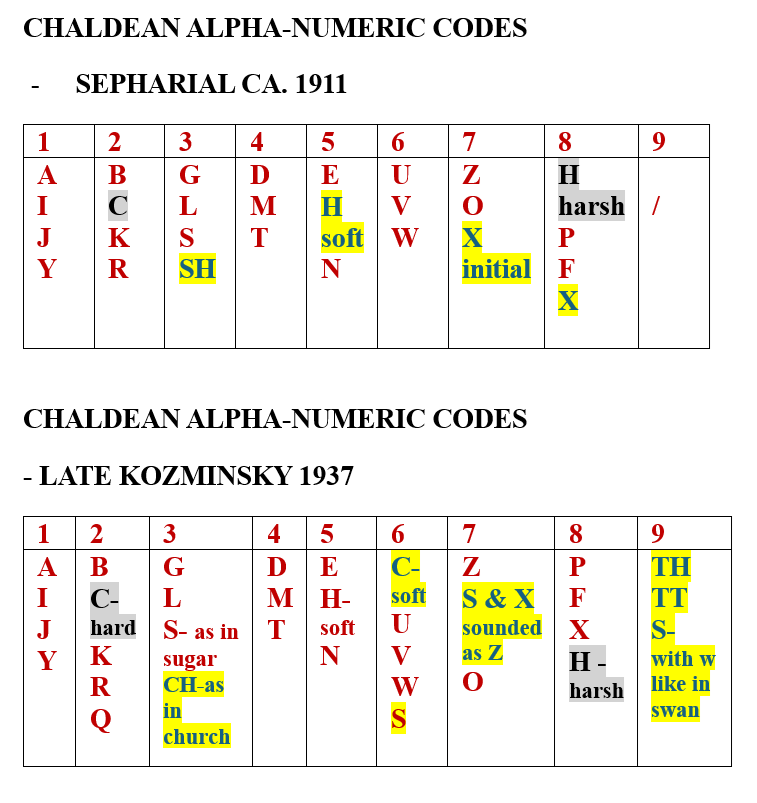
In his development, he initially used an external method of alphanumeric coding of the Latin alphabet (C = 2, H = 8, X = 6). Later, he tested several different alphanumeric approaches but ultimately decided on phonetic numerology.

Isidore Kozminsky, like Sepharial, experimented with various methods of alphanumeric coding. At the latest, in an updated edition of “Numbers: Their Meaning and Magic” in 1911, he was the first modern numerologist to predict that we should, in some cases, treat the letter H as 5.  He also assigned the number 5 to the letter X. Like Sepharial, he described all the numbers he believed to have a “distinct potency of its own.” All other numbers he reduced to a number with such potency. His approach of dealing with name numbers is now considered outdated.

Cheiro (William John Warner) is regarded as the father of modern Chaldean numerology. He wrote several books covering numerology, with the most famous being “Cheiro’s Book of Numbers” (1926), where he advocated for the value of 3 for the letter C, 5 for the letter H, and 5 for the letter X.

Cheiro. Source: Wikimedia Commons, File:Cheiroy.jpg .

He emphasized the importance of the Birth number (the day of the month one is born) and its connection to the Name number (that is, Total Name Number, aka TNN). He was one of the first to focus on the compatibility of numbers. He adopted Sepharial’s number descriptions, sometimes expanding them, so they corresponded to some very old descriptions. However, he described numbers only up to 52. He also wrote a book called “You and Your Star”, where he described the most suitable numbers for each day of the year based on astrological techniques.

Pandit Sethuraman, in his book “Science of Fortune” (1954), adopted Cheiro’s alphanumeric coding but summed the unreduced numbers of the first and last names. He also deviated from Cheiro’s views on number compatibility. Sethuraman expanded Cheiro’s descriptions based on his own insights and described numbers up to 108. Unlike Cheiro, he considered numbers 39 and 48 to be unfavorable.

Richard Cavendish, in his 1967 book “The Black Arts” (which has quite an inappropriate book title, especially in connection to astrology and numerology), introduced the classical internal method of alphanumeric coding (with C = 3, H = 8, X = 6), although he seems to have arrived at this through his own research. He emphasizes the importance of considering the numbers of vowels and consonants, a concept long neglected in Chaldean numerology.

Gerun Moore wrote a book in 1973 titled “Number Will Tell”. He adopted Cheiro’s alphanumeric coding system but made several changes and additions to the descriptions of numbers and the rules of compatibility. Notably, he described numbers 39 and 48 as the unlucky number 12.

He also rejected Cheiro’s model of favorable numbers for each day of the year. Instead, he created his own system, where each day of the year is generally assigned two suitable numbers (though in some cases, only one number is given). He labeled these numbers as “keys.” According to him, name numbers matching a person’s key numbers bring luck and harmony.

Lloyd Strayhorn wrote his book “Numbers and You: A Numerology Guide for Everyday Living” no later than 1980. He adopted Cheiro’s alphanumeric coding system. Although he prefers Chaldean numerology, he also considers Pythagorean numerology. Based on his research, Strayhorn introduced his own system of number compatibility, which differs somewhat from Cheiro’s model.

He also rejected Cheiro’s model of favorable numbers for each day of the year, offering instead his own astrological model with lucky numbers. He later published “Lloyd’s Numbers and You Relationship Guide: A Cosmic Blueprint to Happiness & Joy”, in which he distances himself significantly from older Chaldean approaches.

Linda Goodman published a book “Linda Goodman’s Star Signs” in 1987, which also introduces Chaldean numerology. She adopted Cheiro’s alphanumeric coding system and significantly enhanced the descriptions of numbers. However, her method of determining the TNN deviates from those of her predecessors.

Linda Goodman concludes the list of modern classics in Chaldean numerology. I believe that this list provides an appropriate foundation for studying contemporary Chaldean numerology.

There are also a few Chaldean numerologists who have uncritically incorporated Pythagorean methods of interpreting numbers and relationships. While some ideas from the Pythagorean system can be adopted, not all Pythagorean techniques are suitable for Chaldean numerology.

Friday the 13th and Chaldean Numerology

There is a widespread belief that Friday the 13th is an unlucky day. In tradition, the number 13 is considered unlucky because there were 13 people present at the Last Supper (Jesus and the 12 apostles). In Norse mythology, the mischievous Loki, as the 13th guest, brought misfortune to the gods (the death of Balder). However, the negative connotations of the number 13 have even older roots, which can be found in Chaldean numerology.

Some take the connection between Friday and the number 13 even further, seeing it as representing the 13 lunar months. Both the Moon and Venus (the planet associated with Friday) are considered feminine planets. Based on this, the promotion of Friday the 13th as an unlucky day has been interpreted as a patriarchal attack on the feminine archetype and motherhood.

It’s also possible that the association between Friday the 13th and bad luck in Europe and the U.S. stems from the belief that Jesus died on Friday the 13th of Nisan. Regardless of the actual origin of the fear surrounding this day, we can explore what Chaldean numerology has to say about it. Some Chaldean numerologists warn that it is indeed a dangerous day because Friday is ruled by Venus, which corresponds to the number 6. In numerology, 6 and 13 (base number 4) are considered incompatible.

In reality, it’s difficult to definitively label Friday the 13th as either lucky or unlucky. Under certain conditions, there is even a possibility of favorable numerological interactions between the numbers 6 and 4. Besides 13 and 6, there are other numbers that influence a particular day. For example, the “Life Path” number of the specific day is also in play, along with several other numbers.

Additionally, the day of the week holds less significance than the day of the month. We are still dealing mainly with the 13th of the month. The relationship between the day of the week and the day of the month is not crucial for an individual (in predictions!). What’s more important are the interactions between one’s personal numbers and the day of the week, as well as the interactions between one’s numbers and the day of the month. For instance, If our two key numbers are 1 and 5, then Friday the 13th is more likely to have a positive influence, at least based on the basic factors. However, if we have only one key number and that number is 4, Friday the 13th may not be an ideal day.

On an individual level, there are several ways to determine the personal influences of a particular day. Some personalization techniques have a stronger influence than others. The personal impacts of the day are affected by the birth date numbers, and to a lesser extent, by name numbers.

So, is Friday the 13th an auspicious or inauspicious day for you? According to Chaldean numerology, this is an inappropriate or overly general question. Based on individual influences, Friday the 13th could be a lucky day, a neutral day, or a day that brings challenges. To such a broad question, only a general answer is possible.

The use of the Latin alphabet in Chaldean numerology

In contrast to Pythagorean numerology, the first examples of the use of the Latin alphabet in Chaldean numerology are only found in the modern era. Initially, two methods of alpha-numeric encoding were used, which are shown below with values by greater cannon (units, tens and hundreds) and lesser cannon (ordinal values) and with reduced values from 1 to 9. I call the first of these methods the internal values method of alpha-numeric encoding and the second the external values method of alpha-numeric encoding.

There are differences between the two methods for two letters. The letter “C” has a value of 3 in the internal method and 2 in the external method, while the letter “H” has a value of 5 in the internal method and 8 in the external method. The internal values approach was a closely guarded secret, so most numerologists only knew the values C = 2, H = 8. In modern Chaldean numerology we also see a reformation of the internal method as early as the 19th century, in which the letter “X” is assigned a value of 5 instead of 6.

The classical internal method with C = 3, H = 5 and X = 6 was introduced to the modern world in 1967 by Richard Cavendish in his book “The Black Arts“, but he seems to have been unaware of the somewhat older Chaldean alphabetic tradition. He seems to have discovered the value of the inner method based on his own findings.  

Both approaches assign vowels similarly to those in the Greek alphabet (which was influenced by Semitic alphabets and Semitic numerologies). The letter “A” is associated with the letter alpha and with a value of 1, the letter “E” is associated with the first letter of the “E”-voice, i.e. with the letter eta and with a value of 5. The letter “I” is associated with the letter iota and with the values 10 and 1, respectively. The letter “O” is associated with the first letter for the voice “O”, namely omicron with the values 70, 16 and 7. The letter “U” has a deviation and is associated with the Semitic letter waw with the value 6, and indirectly with the Greek letter digamma.

Aramaic/Semitic Original

Additionally, under the influence of the Jewish Kabbalah, some people have started to assign different values to the vowels “E” and “O” and to the corresponding letters (10 and 1 for “E” and 6 for “O”). This approach is popular among some Freemasons.

The use of phonetic numerology is also widespread among Freemasons and in certain other circles, with various approaches known. Among these, the school of Habeeb Ahmad stands out. Habeeb Ahmad published a book on the subject in 1903 entitled “The Mysteries of Sound and Number“. Phonetic numerology ignores the fact that the Hebrew alphabet was no longer entirely phonetic. They also ignore the findings of European magic that written words, and thereby letters, have the power of manifestation.

Without knowledge of the existence of the internal method, Isidore Kozminsky began to reform the outer method at the beginning of the 20th century, assigning the value 5 to the letter “X” and to the letter “H” sometimes a value of 5 and sometimes a value of 8.. These reforms are included, at the latest, in the updated edition of the book “Numbers: Their Meaning and Magic” from 1911. Kozminsky later developed his own alphanumeric Chaldean coding specifically for analyzing people’s names and surnames. Sepharial has also been exploring his own coding method.

Kozminsky’s early reforms seem to have been taken up by Cheiro, who then assigned the letter “C” a value of 3 and the letters “H” and “X” a value of 5 in his version of alpha-numeric coding. Thus, Cheiro’s approach arrived at a reformed internal method by another route. The approach was published in 1926 in the book “Cheiro’s Book of Numbers” and soon became a leading method in the field. After the Second World War it was supported and used by many numerologists such as Pandit Sethuraman, Gerun Moore, Linda Goodman, Anmarie Uber and August Darius Danielssonn. This is also the coding I use.

Few Chaldean numerologists still follow the external method. For example, Walter B. Gibson, but in more recent times this method has been supported, for example, by the Indian numerologist Harish Johari.

Extended Cheiro’s rule for numbers above 52?

Cheiro described a system of numbers up to 52. For numbers above 52, it’s incorrect to apply the rule of reversed digits (for example, 71, the number “Reaper,” is not the same as 17, the number “Star”), and the rule of adding digits doesn’t always work (65, “Royal Star of the Scorpion,” is not the usual 11, “Force,” but rather a special form of 11).

This raises the question of how Cheiro approached numbers above 52. There are two possibilities. The first is that the Chaldean tarot, which describes the first 78 numbers, does not provide reliable interpretations for numbers beyond 52, so Cheiro may have simply left them out. The second possibility is that numbers above 52. According to the second possibility, numbers above 52 are explained by a series of numbers with the same base number, which follow each individual number with a “distinct potency of its own.” This approach also provides an explanation for numbers from 79 to 99.

Cheiro explained that number “_ has the same meaning as the number _ , which is next to it in its own series of compound numbers.”  However, Cheiro extends the influence of numbers with a distinct potency of their own to numbers from 42 onwards. According to Cheiro’s rule of the Chaldean tarot, each number without a “distinct potency of its own” takes on the meaning of the nearest preceding number that has this distinct potency, based on the series of numbers with the same base number. This rule applies up to number 52.

It’s important to note that Cheiro also acknowledged some numbers above 52 that have a “distinct potency of their own.” He used the numbers 55 (“Sword“) and 69 (“The Crown of Mars“), which he took from Kabbalistic astrology. Thus, he was certainly aware of the significance of numbers 65 and 71, too. If we extend Cheiro’s rule about numbers having a nature similar to that of a number with a distinct potency of its own to numbers above 52, we obtain the following pattern:

Base number 1: 28; 37 ≈ 46; 55 ≈ 64 ≈ 73 ≈ 82 ≈ 91;

Base number 2: 29 ≈ 38≈ 47≈ 56; 65 ≈ 74 ≈ 83 ≈ 92;

Base number 3: 30 ≈ 39 ≈ 48 ≈ 57 ≈ 66 ≈ 75 ≈ 84 ≈ 93;

Base number 4: 31 ≈ 40 ≈ 49 ≈ 58 ≈ 67 ≈ 76 ≈ 85 ≈ 94;

Base number 5: 23; 32 ≈ 41 ≈ 50 ≈ 59 ≈ 68 ≈ 77 ≈ 87 ≈ 95;

Base number 6: 24 ≈ 33 ≈ 42; 51 ≈ 60; 69 ≈ 78 ≈ 87 ≈ 96;

Base number 7: 25 ≈ 34; 43 ≈ 52 ≈ 61 ≈ 70 ≈ 79 ≈ 88 ≈ 97;

Base number 8: 26 ≈ 35 ≈ 44 ≈ 53 ≈ 62; 71 ≈ 80 ≈ 89 ≈ 98;

Base number 9: 27 ≈ 36 ≈ 45 ≈ 54 ≈ 63 ≈ 72 ≈ 81 ≈ 90 ≈ 99.

Compared to traditional Chaldean numerology, these values don’t always align. Even within numbers up to 52, there are questionable examples. For instance, the numbers 39 and 48 carry a strong influence from the number 12 and seem more closely related to the characteristics of 12 than to the number 30. Notably, numerologists Pandit Sethuraman and Gerun Moore reverted to the association with the number 12 for these two numbers. I also consider their nature to be that of the number 12. Similar cases can be found among numbers above 52.

Therefore, approach Cheiro’s expanded rule with caution. As mentioned, this is just one of two possible ways Cheiro may have dealt with numbers above 52. Personally, I don’t trust this approach and don’t use it. It is presented here as a third option, alongside the rule of reversed digits and the rule of adding digits.

Chaldean Numerology and Pavel Durov

Pavel Durov (Pavel Valeryevich Durov; Russian: Па́вел Вале́рьевич Ду́ров) is a Russian-Ukrainian entrepreneur who founded the social network VKontakte and later created the messaging platform Telegram. He is a strong advocate for internet freedom without government control. Opinions on his work are divided. His social networks have facilitated communication among Russian protesters, connections between Belarusian activists, the organization of the Euro-Maidan protests in Ukraine, and have been used in protests in Iran.

Durov in 2012. NickLubushko (2012): File:Pavel Durov sitting portrait.jpg. Wikimedia Commons

On the other hand, both Ukrainian and Russian authorities, as well as organized crime and pedophile networks, have exploited Telegram for their own purposes. Some view Durov as a victim of Putin’s regime, while others see him as a secret Russian agent. His recent arrest in France has caused a stir in international public opinion.

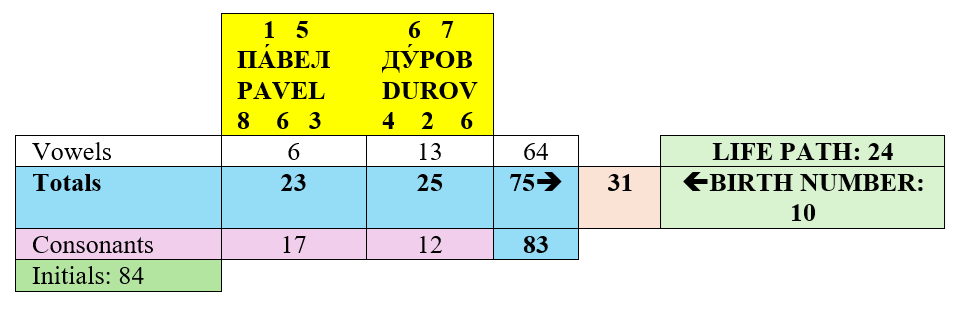
What does numerology say about him? He was born on the 10th of the month (base number 1), and his Total Name Number (TNN) in Chaldean numerology is 75 (base number 3). These are strong, masculine numbers. He also has the numbers 11 and 83 (base number 2), a Life Path Number of 24 (base number 6), and other numbers that bring some softer energies, too.

Like Donald Trump and Mike Lynch, Pavel Durov also has a number chain of 3, 5, and 8, which can represent money (and very rarely financial difficulties). The TNN, Life Path, and birth date represent a combination of powerful numbers 1, 3, and 6, governed by the benefics Sun, Jupiter, and Venus. This suggests a potential for financial stability. However, from a numerological perspective, this alone may not be enough to bring someone immense wealth. We must always remember that alongside numerology, a person’s life is influenced by other aspects of fate and various other factors. Moreover, exceptional achievements are often not traceable in fate analyses; rather, fate analyses reflect character and fundamental interests.

Pavel Durov’s numerological chart is also a karmic one, as it contains the numbers 12 and 75 (whose digits also sum to 12;7+5=12). Sepharial interpreted the number 12 as: “Reversal of position; culpability; chastisement; loss of honour; danger of violent death; either enforced or voluntary; dangers from women; catastrophe.”

These numbers, 12 and 75, connect with some others in a way that creates very strong spiritual tendencies. It is said that Pavel Durov is a vegetarian (or at least doesn’t consume meat from supermarkets) and lives a relatively ascetic life for a wealthy man. The spiritual power of the number 12 can be channeled into good deeds and seeking good karma, which can enhance the positive aspects of his chart. Thus, the number 12 is not always negative. Of course, Durov must still be careful not to become a victim or to victimize others.

The combination of the numbers 23 and 75 can generate an interest in software and computing. Numbers like 11, 86, and 24 increase interest in social life, as do the number 23 and the number chain with base numbers 1, 5, and 6.

However, the repeated number 12 (75, 84) still indicates that a person can become a victim, especially if he or she also sacrifice others. As mentioned, 12 is a karmic number. The number 11 (83) can represent legal disputes or opponents, too. Cheiro described the number 11 as: “It gives warning of hidden dangers, trial, and treachery from others.” The number 10 from his birth date can represent swings of fate, both upward and downward. It is known that Pavel Durov sold his company VKontakte, allegedly under pressure and for a lower price. Soon after, he fled Putin’s regime, relocating to a safer environment and focusing on developing Telegram. But even then, there were difficulties—on August 24, 2024, he was arrested in France for allegedly allowing criminal organizations to connect on Telegram.

Pavel Durov mentioned that he had changed his name in his French passport to Paul du Rove, which is meant to be a humorous translation of his name. However, if this is true, the new name (which he only uses in France) may not have done him much good—TNN is 93, which corresponds to the number 12 (and this 12 is strongly reinforced by other 12s in his numerology chart), while the name itself has the number 18. Together, this could indicate being a victim in legal proceedings. Additionally, the name was not changed according to numerological rules and has retained much of the essence of his widely known name, Pavel Durov.

If we look at the energy trends in Pavel Durov’s life, we can see that in July and August 2024, the energies of the numbers reached an energetic low. The day of August 24, 2024, by the criteria I use, brought unfortunate energies. On that day, Durov was arrested in France. Since the energies in his prognostic chart then improve, it will be interesting to see what happens in the coming months and the next year.

I should point out that classical techniques for personal year, month, and day, which are strongly present especially in Pythagorean numerology, are generally not reliable. On August 24, 2024, Durov’s personal year is 1+0+1+0+2+0+2+4= 10, his personal month is 10+8= 18, and his personal day is 18+2+4=24. The number 18, in contact with the annual number 10, can bring severe legal disputes, but it is somewhat balanced by the number 24, which is one of the luckiest numbers in numerology. Cheiro describes this number as: “Fortunate; it promises the assistance and association of those of rank and position with one’s plans; it also denotes gain through love and the opposite sex; it is a favourable number when it comes out in relation o future events.” However, it is unusual to expect someone to be arrested on a fortunate personal day with number 24 (!).

From a numerological perspective, Durov remains an enigma: Is this man merely a victim, or does he occasionally sacrifice others? What are the actual consequences of a free internet? From 2017 to 2021, Durov was at an energetic peak. The current years bring legal troubles but also analytical abilities. Soon, years marked by the relationship between numbers 9 and 7 (possible intrigue, spies, covert actions, crime) will arrive, likely meaning that the issues currently stirring global public opinion will resurface in a few years.

What can Pavel Durov do to improve his prospects? He must always strive to maintain authority and develop courage. Additionally, he has an increased ability to approach life in a spiritual way and to improve his karma through good deeds. This way, he can reduce the unfavorable influences in his fate and enhance the favorable ones.

Mike Lynch and Chaldean Numerology

Mike Lynch (Michael Richard Lynch, born 16 June 1965) was a British entrepreneur and the founder of Autonomy, a software company. He later established the investment firm Invoke Capital, through which he also oversaw Darktrace, a cybersecurity company.

In Chaldean numerology, Lynch’s Total Name Number (TNN) and birth date contain the numbers 2 (38) and 7 (16). These two numbers are interchangeable and strongly connected. While they are associated with the Moon, their simultaneous presence and connection also grant Lynch a certain power. The number 38 is composed of the numbers 12 (base number 3) and 17 (base number 8), which are often linked to money. The strong relationship between base numbers 3 and 8, along with the connection between base numbers 2 and 7, makes his TNN a more potent form of the number 11, which symbolizes “Force.”

Numbers 3 and 8 are also associated with the number 68, creating a link similar to that found in Donald Trump’s numerology, involving the base numbers 3, 5, and 8. These three numbers often signify money matters and business involvement. Business success is also favored by the connections between the numbers 0, 3, and 6. The number 68 can be associated with computer software, and the numbers 5 and 7 combine to form the number 57, which can also be partially linked to software.

Lynch’s last name contains the letter Y, which many Chaldean numerologists believe should always be considered a vowel. The letter Y originates from the letter Yod, and in its original vibration, it is actually a consonant. Because Y can represent both a vowel and a consonant, its fundamental nature, due to its original vibration, remains primarily that of a consonant. Although the distinction between these influences isn’t entirely clear, practical results suggest that Y should fundamentally be analyzed as a consonant, even when associated with the “ee” sound. In Lynch’s case, analyzing Y as a vowel would loose indicators pointing to his work with software, leading to an incorrect analysis.

Unfortunately, the numbers 38 and 12 can also indicate legal disputes, and the number 16 can bring an unexpected loss of influence and power. After selling Autonomy, Mike Lynch was sued by Hewlett-Packard for alleged fraud. He was arrested and, in 2022, extradited to the United States. In June 2024, when his personal energies were somewhat more favorable (though still slightly unfavorable, but at a peak after 18 months), he was acquitted of all charges and released. His energies worsened in July, so he was fortunate that the court’s decision was made in June.

In August, his energies strengthened again, though they still retained a negative tone. This aligns with Lynch celebrating his freedom (energy strengthening) and then tragically dying in a sailing accident (reflecting the overall negative energy level). It’s important to understand that numerology cannot provide precise predictions (just as other systems for determining one’s fate cannot). It does not predict events such as death or marriage but rather indicates whether the energies of a specific day, month, or year are more challenging or more favorable.

Of course, much depends on which predictive model is used. My current approach also doesn’t provide perfect results, and it’s difficult to account for astrological and other influences that may improve or worsen a situation.

Specifically, August 19, 2024, brought Lynch, according to my approach, a very negative form of the number 15, known as “The Devil.” Sepharial ascribed the following meaning to the number 15: “Fate; inevitable; dangers to offspring and marital strife; luxury.” On that day, the number 15 was strongly connected with water, and his birthdate of the 16th, which also governs water and accidents, was strongly activated.

It’s also worth noting that the classic method for calculating personal years, months, and days gives a personal year of 1+6+6+2+0+2+4=21, a personal month of 21+8=29, and a personal day of 29+1+9=39 for August 19, 2024. The numbers 29 and 39 are considered unlucky and are associated with water. The number 29 can represent division or conflict, and the number 39 is a form of the number 12, which is called “The Victim.” Sepharial ascribed the following meaning to the number 12: “Reversal of position; culpability; chastisement; loss of honour; danger of violent death; either enforced or voluntary; dangers from women; catastrophe.” In this case, this approach aligns well with the events. Unfortunately, this is an exception to the rule—the established method for determining personal years, months, and days usually misses the mark.

The Letters U, W, J, and Y and Chaldean Numerology

The ancient Latin alphabet did not include the letters U, W, and J and question could be raised of how to associate these letters with Chaldean numerology. It is clear that the letter U developed from the letter V, which in turn originated from the Semitic letter waw, which has the value of 6. It is also evident that U is always used as a vowel.

The letter W also evolved from the letter V. Its original notation was V V, or UU, with a numerical value of 6+6=12. Over time, a new representation of this consonant (W) became established, which, due to its connection with the letter waw and the sound “w,” has the value of 6.

The letter J developed from the consonant yod. Although this letter is pronounced differently by different peoples, it therefore carries the vibration 10, or the reduced value of 1.

The letter Y, which also originates from the Semitic letter yod with values of 10 and 1, was present in the original Latin alphabet, unlike the letters mentioned above. The question arises as to when it should be considered a vowel and when a consonant.

Some Chaldean numerologists are now convinced that the letter Y should always be considered as a vowel. In the name “New York,” for example, Y would be considered when calculating vowels, even though it represents a consonant in this case.

Since the letter Y originates from the letter Yod, its original vibration is actually that of a consonant. While Y can be used to represent both a vowel and a consonant, its fundamental nature, due to the original vibration of the letter, remains primarily that of a consonant.

The distribution of these effects is not entirely clear, but the concrete results suggest that Y should fundamentally always be analyzed as a consonant, even when Y is associated with the vowel sound “ee.” In the case of Mike Lynch, for example, analyzing the letter Y as a vowel would lead to the loss of all indicators pointing to work with software, resulting in an incorrect analysis.