Kamala Harris is an American politician, lawyer, and author. She belongs to the upper class and is a presidential candidate for the elections on November 5, 2024, where she will compete against Donald Trump. She currently serves as the Vice President of the United States and previously worked as a senator and, before that, as an attorney.
In her numerology chart, the numbers 3 and 5 stand out prominently, while the numbers 2 and 8 are also very active. Although 3 and 5 typically find themselves in a conflicting relationship, in her chart, they are positioned in a way that allows for more favorable aspects. This combination of numbers is inclined towards communication, writing, or finance. The Moon number (2) might be the additional number that leads her into the realm of writing. The active part of her chart reveals potential goals in the areas of leadership (82; 8+2=1) and politics (93; 9+3=12; 1+2=3; 35; 3+5=8). The combination of numbers 3 and 8 also represents real estate or law, as well as finance. Together with 5, this creates a combination that can represent speaking and law. It’s easy to picture her as a lawyer or attorney.
Her birth date is 20, which falls under the base number 2. This adds sensitivity and a touch of tenderness to her character. She likely expresses this emotionality primarily in her relationships with ancestors and family members, while in public life, she displays more “masculine” fighting traits (numbers 1 and 3). She must accept that her life is therefore also full of opponents and challenging situations. The energies of her Total Name Number (35) and her Birth Number (20) do not align with each other, which can lead to additional challenges in life.
Her chart reveals that she has some spiritual aspirations, likely focused on self-improvement and becoming a more well-rounded person. Interestingly, despite this potential, she seems to balance her numerology chart primarily through communication and a practical or realistic approach to life. If she keeps her feet on the ground and enhances her communication skills, this will positively affect the balance of her entire numerology chart.
I invite you to try this meditation or activation by Darren Starwynn. The meditation creates very interesting energies and is one of the ways to activate what is known as the »Light body« or Merkaba. Transitional reactions may occur, but over time, gentle, light, soft, and vibrant life energies prevail.
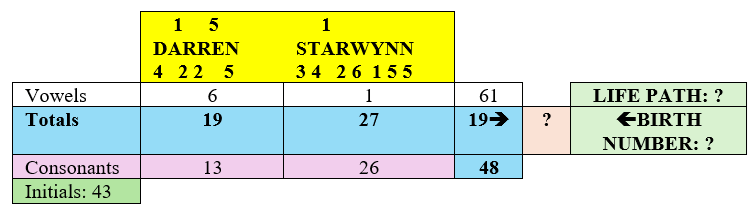
Darren Starwynn is a spiritual teacher, healer (Quantum Healing), TCM practitioner and founder of his church of lightworkers, and a media personality. He is also the inventor of a healing device that operates on the principle of microcurrents. Since I do not have information about his birth date, I can only comment on the numbers in his first and last names. According to Chaldean numerology Darren Starwynn has a highly pronounced base number 1 (19) in his chart, which in favorable configurations can represent leaders. This number also embodies a pioneering spirit, supported by the consonantal number 13. The connection between 19 and 13 can also represent reformers. In this context, we can likely find an inventive streak (the connection among base numbers 1, 4, and 9) and a need to establish his own spiritual approach.
The relationship between 1 and 9 may also represent a connection between higher consciousness and the external world (1) and the earth (6 and 9), which has contributed to his passion for hiking. In his youth, he worked as a carpenter (numbers 19 and 48) and as a volunteer (influenced by the number 48). He also learned to play the guitar and performed in rock bands. In numerology, the guitar is represented by the numbers 3, 5, 8, and 9. Additionally, it can be supported by the number 1. Darren Starwynn has a significant presence of such numbers (except perhaps for numbers with base number 5). Classic rock and roll is represented by the numbers 1 and 3, and we find these numbers (in the forms of 19 and 48) within him.
The placement of the numbers 1 and 9 suggests a desire for spiritual growth, founded on the basis of a higher self and unity. There is also a very spiritual number 48 present, which, together with 19 and 61, brings a tendency to develop values of love and friendship, along with the desire to help others. On a secondary level, he has many numbers that give him the potential for a strong spiritual connection. However, there are also energy placements that may connect him to certain lower energy realms. In his case, it is particularly true that it is very important which inner wolf he feeds, good or bad. Especially later in life, these numbers connect with 89, which can signify a certain spiritual success and recognition.
The numbers with base numbers 8 and 9 are arranged in a way that gives him a very strong business sense. Darren Starwynn has been practicing as a healer for a long time. He began his journey as an acupuncturist in 1982. His potential for healing arises from some combinations of numbers in his name, though it may also be found in birth data that unfortunately is not accessible. Undoubtedly, he is motivated by a desire to achieve unity and wholeness, both spiritually and physically. There may also be a potential for seeking redemption. However, this depends on the numbers in the birth date. Interestingly, his spiritual potential and healing potential align with his business potential.
Without birth data, it is practically impossible to verify life periods. We can generally say, however, that a significant spiritual breakthrough is likely to occur in his chart after the age of 54, as the numbers 48, 19, and 61 become more active in the period following this year. For Darren Starwynn, this major shift happened around the year 2016 (unfortunately, I do not have more precise data).
His consonants create a challenging combination of the numbers 13, 26, and 48. Such frequently pronounced consonants often bring health issues, which Darren Starwynn likely prevents or alleviates through his healing and spiritual connection.
Darren had a difficult childhood and also experienced a notable period of struggle about eight years ago. In a video, he mentioned that prior to this time, he faced many challenges in life. This is likely influenced not only by the numbers 13, 26, and 48 in the consonants but also by the relationship between 19 and 27. The base numbers 1 and 9 often do not align well, and this relationship depends on karma and awareness. The number 1 is associated with the Sun, while 9 is linked to Mars. People with karmic burdens may experience this relationship through disputes, anger, or frustration. Darren Starwynn knows best how he experiences the relationship between the numbers 1 and 9.
Certainly, the flow of love, the search for a spiritual connection, and good deeds can activate a higher form of this relationship, representing unity and wholeness. Darren Starwynn likely does not need to be advised on such matters, as many people can feel and verify the quality and intensity of the spiritual energy he transmits through his publicly accessible meditations over the past few years.
Pandit Sethuraman (1925-1997) was an Indian numerologist, astrologer, palmist, and occultist who adopted Cheiro’salpha-numeric codingof the Latin alphabet and enhanced his system with his own approach. In his youth, he entered military service, during which he began to intensely explore the workings of Chaldean numerology. He claimed that the English alphabet was the correct system for addressing Indian names in modern times. This could be true at least until recently, as post-colonial India was still significantly influenced by the English script. Throughout his life, Pandit Sethuraman also studied astrology, palmistry, yoga, mesmerism, and the energetic system of humans.
He was born on the 31st of the month, and his Life Path number is 26. The base numbers of these two figures are 4 (3+1=4) and 8 (2+6=8), which are considered karmic numbers. They often bring complications and blows of fate. However, Sethuraman has a strong name numbers 5, particularly in his Total Name Numerology (TNN), which totals 59 (5+9=14; 1+4=5). This active five calms both the 4 and 8 from his birth date numbers and offers some form of escape from karmic limitations.
The main feature of this numerology chart is the relationship between the numbers 5 and 9, or the relationship between Mercury and Mars, which provides good intellect and a certain sense of military. Despite this, Pandit Sethuraman’s numerology chart contains many numbers that are softer or more feminine in nature. Therefore, he was not a typical soldier; he embodied both the energies of clear goals and a sense of softness. Pandit Sethuraman also had “money numbers,” notably involving connections between the numbers 3, 5, and 8. In addition, he had some other indicators pointing in this direction.
The number 9 in his chart was positioned in such a way that it played a very important role in his business and spiritual development. It was associated with 3 and 6, and also with 5. In Sethuraman’s chart it brings an interest in bio-energy, astrology, yoga, and mesmerism. With such numbers, Pandit Sethuraman could have also engaged with Feng Shui or Vastu Shastra. The relationship between the numbers 5 and 9 in this configuration particularly highlights numerology and palmistry as vocational options.
In 1954, he wrote a book titled “Science of Fortune,” in which he revealed some of his insights about numerology. While he adopted Cheiro’s numerological model, he also incorporated Indian traditions, his insights, and messages that he claimed to have received from the Hindu goddess Gayatri.
It can be noted that Pandit Sethuraman rejected the complex rules that Cheiro employed to determine the key compound number in someone’s numerology chart. Instead, Pandit Sethuraman simply added the unreduced numbers of the first and last names. When considering the relationships between numbers, a significant influence of the theory of interchangeable numbers is evident. Personally, I use slightly different principles for matching numbers. I can agree with him that, in analyzing partnerships, certain deviations from the general rules of number matching are necessary, although I differ with him on some specific solutions.
His book also contains interesting warnings regarding the use of gemstones to balance someone’s fate and regarding how changing the names and surnames of others can attract unresolved karma from that people. Additionally, Pandit Sethuraman developed his own method for checking the compatibility of a new name and surname with a client’s life energy when intending to change their name.
Using numerology, Pandit Sethuraman predicted the outcomes of military conflicts and the likelihood of someone’s death. He also used numerology for a time when betting on horse races and for financial investments. All of this could quickly lead someone to the edge of ethics, which Pandit Sethuraman was fortunately aware of.
Interestingly, he did not differentiate between strong and weak 8s or between strong and weak 4s; he believed that these two numbers always had the same favorable or unfavorable numbers available. Some rules regarding matching and mismatching between numbers are surprising— for example, he defined the relationship between the numbers 3 and 6 as generally unfavorable.
He listed the meanings of the numbers from 1 to 108, claiming that this was the first book on Chaldean numerology that described numbers beyond 52. However, this is not true. Classical Chaldean/Hebrew numerology has even defined some numbers above 108, and in modern numerology, well before Pandit Sethuraman, accepted descriptions of the numbers 55, 65, 69, and 71 can be found. During World War II, one of the Chaldean numerologists adopted the interpretations of numbers presented by the Pythagorean numerologist Mary Adams. Her definitions cover numbers up to and including 65, in addition to the numbers 69, 71, and 73.
Some of Sethuraman’s descriptions of numbers are also questionable— for instance, he defined the number 12 as lucky. Conversely, he classified the numbers 39 and 48 as unlucky forms of the number 12, where he diverged from Cheiro’s descriptions, too. Furthermore, the classical meaning of the number 77 is generally unfavorable, while Pandit Sethuraman defined it as a favorable number.
Regardless, his book offers a wealth of interesting information and provides a researcher of Chaldean numerology with the opportunity for comparative analysis, thus allowing for the search for refined knowledge and new insights.
William John Warner, better known as Cheiro (November 1, 1866 – October 8, 1936), was also referred to by nicknames such as Count Louis Hamon and others. However, he is primarily remembered as Cheiro. He was a British astrologer, numerologist, and palm reader.
His birth name contains numbers—13 and 15 (the sum of 96; 9+6=15). The base numbers 4 and 6 govern his numerological chart. This chart reveals a strong desire for recognition and performance (particularly highlighted by 96, with 24 in Life Path and 15 as the base number in his surname), along with a drive for success in business. Cheiro’s official name also reflected a robust longing for friendship and love, from which he drew significant spiritual strength. Additionally, he enjoyed fairly favorable influences of numbers on the chakras, which may have contributed to his reputation as a successful medium for a time.
The combination of numbers 13 and 15 sparked his interest in the occult (both 13 and 15), reforms, pioneering approaches (13), and even magic (15, 41). The number 41, in particular, fosters a fascination with numerology, which is further emphasized by his nickname “Cheiro” (Mercury and 23). Due to the numbers 13 and 15, an individuals may either become a victim of manipulation and circumstances or turn into a manipulator themselves… The overall numerological chart is complex and can bring strokes of fate that often arrive unexpectedly.
Cheiro was convicted and imprisoned in Paris around 1910 for business fraud, and it is said that this scandal closed doors among the English elite, prompting his move to the morally less stringent United States. An analysis of his works reveals a tendency for manipulation and misinformation—claiming, for instance, that he had been offering numerological guidance based on his system since the late 19th century, or that number 9 was so sacred it couldn’t correspond to any letter. Moreover, he downplayed the contributions of his European sources, likeIsidore Kozminsky and Sepharial, while asserting he learned Chaldean numerology from an Indian brahmin.
It’s essential to recognize that relationships between 15 and 4, or between 15 and 8, should not be judged too harshly. Not everyone with such combinations inherently becomes a manipulator, criminal, or prisoner. An individual’s morals and self-awareness dictate whether they use their strengths for good or ill, and when, if ever, they will yield to temptation. Furthermore, numerological charts can point to which areas of life help to balance the individual. For Cheiro, these areas primarily involved seeking courage, forming a connection with God, and nurturing love and kindness.
Even in his nicknames—like “Count Louis Hamon” and “Count Leigh de Hamong“—the theme of number 13 is prominently featured. It seems Cheiro intentionally emphasized this number, perhaps because it brings uniqueness and combines with the interchangeable number 1 to form a whole.
His nickname “Cheiro” underscores intellectual depth, as it contains the numbers for Mercury and the Sun. The number 23 derived from the nickname is considered auspicious.
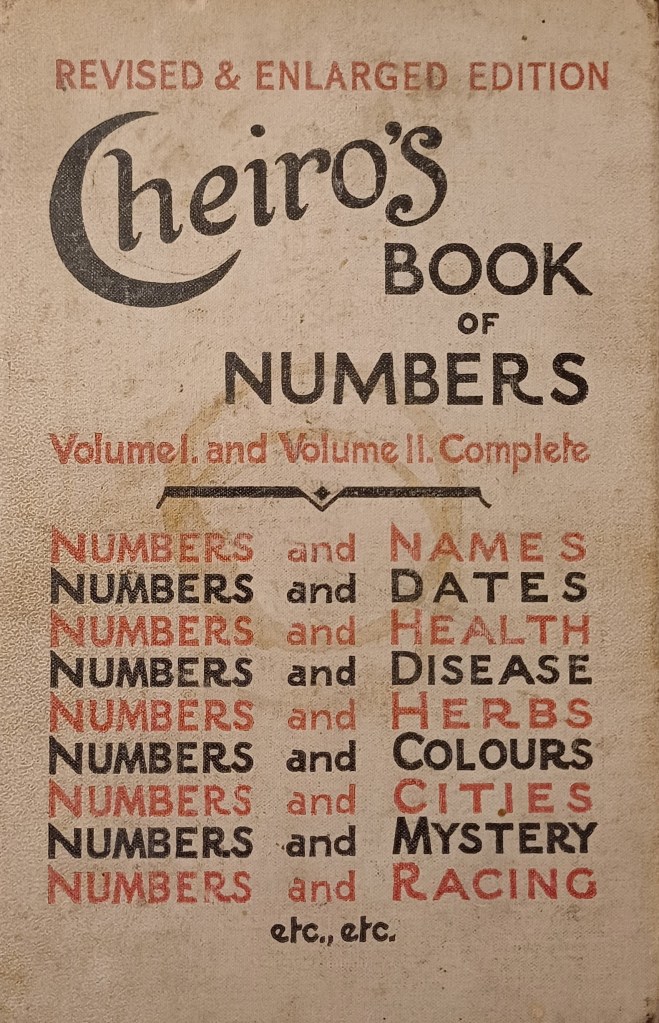
In 1926, Cheiro published a book titled Cheiro’s Book of Numbers. In it, he defined the meanings of numbers in Chaldean tarot from 1 to 52, based on older sources. He also defined the rules of matching and mismatching between numbers. For each of the numbers 4 and 8, he differentiated between karmically strong and weak numbers, determining various numbers that align with them. He described favorable and less favorable months, recommended specific herbs and foods, indicated favorable colors and gemstones, and identified ailments commonly associated with particular numbers.
It’s very likely that Cheiro drew the foundational idea of alpha-numeric coding from Isidore Kozminsky, who assigned the letter H a value of either 5 or 8, and the letter X a value of 5. Based on his research, Cheiro developed an alpha-numeric coding scheme in which letters H and X always hold a value of 5. He also altered the value of the letter C, assigning it a value of 3 instead of 2.
For Cheiro, the key to analysis lies in the birth date, or Birth Number. He believed that the Total Name Number (TNN) should align with the Birth Number; otherwise, an individual might encounter challenges throughout life. He further explored the numerological influences of each day of the year based on the specific day of the month. Around 1936, he published another book titled You and Your Star, in which he detailed favorable numbers for every day.
Cheiro’s ideas of such favorable numbers influenced numerologists like Gerun Moore and Lloyd Strayhorn, who developed their own systems based on these concepts.
In Cheiro’s Book of Numbers, he established special guidelines to identify the most important two-digit number in a numerological chart. This number frequently corresponds to TNN, but sometimes the most significant number is derived from adding the birth date and TNN together (Birth Number + TNN). Cheiro did not assign a name to this number, but I personally refer to it as the Goal Number (which differs from Goal Numbers in Pythagorean numerology). Anmarie Uber called it the “Hidden Number,” while some perceive it as an indicator of career success.
Cheiro’s book, Cheiro’s Book of Numbers, does not provide reliable techniques for predicting the future. It also contains inaccuracies, such as the assertion that the Chaldeans were unaware of letters with a value of 9. Nonetheless, despite not being a comprehensive manual, this work played a pivotal role in the evolution of numerology. In many ways, Cheiro is considered the father of modern Chaldean numerology.
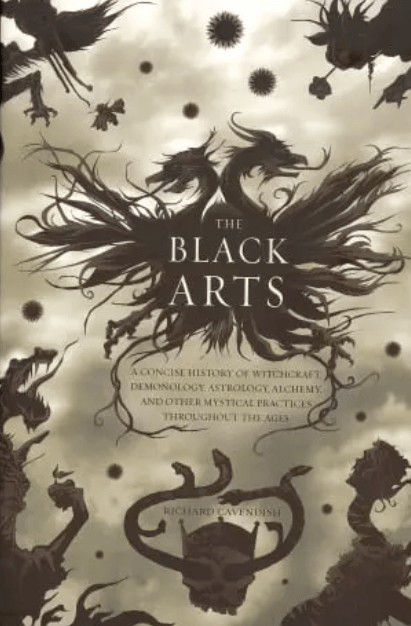
Richard Cavendish (August 12, 1930 – October 21, 2016) was a British historian who studied mythology, religion, witchcraft, and the occult. He did not consider himself an occultist but primarily explored these fields. However, at least in the case of numerology, one might question whether he truly did not practice it himself. Cavendish didn’t just describe Chaldean or Hebrew numerology but developed his own alphanumeric coding of Latin Alphabet based on the Greek and Hebrew alphabets.
A centuries-old method of alphanumeric coding, which Richard Cavendish also arrived at in his own way. This system differs from Cheiro’s model only in the numeration of the letter X.
This kind of coding had been used centuries before, but it’s clear that despite his historical knowledge, Cavendish did not have access to all historically relevant information. Therefore, he was unaware of the existence of such alphanumeric coding. His numerology is thus a blend of tarot card descriptions, the mentioned alphanumeric coding, and the Pythagorean approach to vowels and consonants. He published his knowledge of numerology in 1967 in the book The Black Arts: A Concise History of Witchcraft, Demonology, Astrology, and Other Mystical Practices Throughout the Ages.
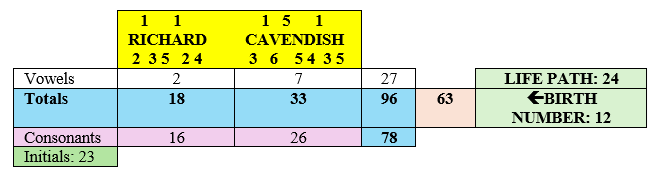
In his numerological chart, we find his birthdateon the 12th, whose base number is 3. The number 3 represents the significance of tradition, values, law, and history. The number 6 (33, 96, 78, 24) is strongly expressed, representing home, while the number 18 in his name and the number 63 as the Goal number sociologically point to the concept of war. With all these numbers, it’s no wonder he became a historian. All of this is further strengthened by the connection between the numbers 3, 6, and 9.
His Total Name Number (TNN) is 96, and his consonant total is 78. These two numbers add up to 15. The number 96 is aligned and can bring good fortune in performances or lectures. The number 78 is connected with the number 8 (26; 2+6=8). When the number 15 meets the number 8, there’s a likelihood of manipulation (such a person can either be a victim of manipulation or manipulate others), and often such a person has a peculiar relationship with the occult. As we can see, the number 15 is only partially exposed to this—the problematic part is the placement of the number 78. In all cases, 15 can represent magic, and in combination with the number 8, it can even signify witchcraft or black magic. It was precisely the number 15 that led Cavendish to his desire to research mythology, magic, and the occult in general.
Gerun Moore (1910–2010) was an American Chaldean numerologist and musician. He was born in March 1910 in New Orleans as Sterling Guerin. According to his own claims, he was born on March 10, but therapist John Ensminger, who visited him in a nursing home, explicitly noted that his last birthday was on Saturday, March 13, 2010. It is very likely that March 10 was simply a “new birthday” for Gerun Moore, as he, being a numerologist, advocated for changing the vibrations of one’s birthdate by celebrating on a favorable day close to the actual birthday. This favorable day would have a base number from the key of the original birthdate. In Moore’s case, the key numbers associated with his birthdate were said to be 1 and 7.
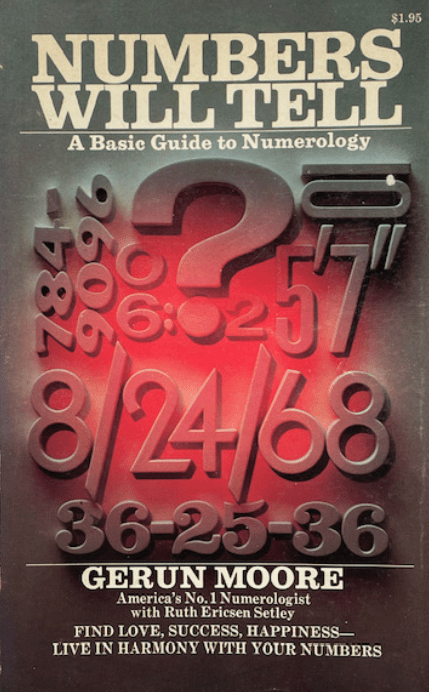
His father was also a musician. Gerun Moore followed in his footsteps and performed in a well-known jazz band Louis Prima Orchestra. Even before World War II, he began delving deeply into numerology. He initially explored Pythagorean numerology, too, but during the war, he became a strong advocate of the Chaldean school. Influenced by Cheiro’s teachings, Moore developed his own approach and changed his name to Gerun Moore. He started celebrating his birthday on March 10. Later, he wrote a book titled Numbers Will Tell. A Basic Guide to Numerology. He was known for his kindness, laughter, and joy.
Gerun Moore used alpha-numeric encoding as advocated by Cheiro
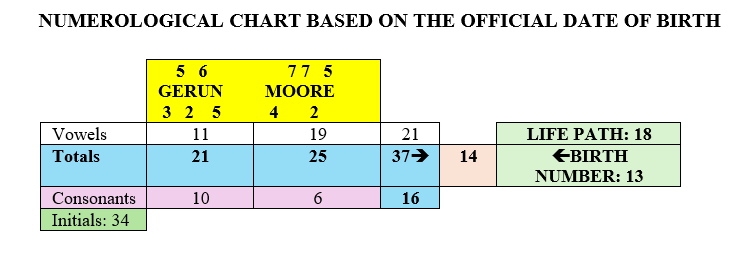
His birth numerology chart reveals a lot of negative energy. In his name, surname, and Total Name Number (TNN) as Sterling Guerin, we find difficult numbers: 26, 22, and 84 (or 12; 8+4=12). His Life Path Number was also an unfavorable 18, and in such circumstances, even a birthday on the 13th of the month represents challenges and negative influences. This numerology chart is very demanding, but Sterling Guerin’s consonants at least create somewhat more favorable numbers. However, the number 21, like the TNN 84, is not a number that aligns well with the number 13.
There are many numbers that can be associated with music and art. For example, 15 and 6, which gives stage art, and in the case of Sterling Guerin, 13 (Birth number) may be related. Sometimes the numbers 2 (consonants in personal name) and 7 (goal number) are associated with music. Likewise, the number 3 (TNN 84 and consonant total 21) can bring art, especially when it comes to stage performances. Sterling Guerin’s interest in the occult was probably related to the formation of the numbers 3&6&9, the birthday 13 and the number 7.
Despite the challenging vibrations in Sterling Guerin’s numerology chart, there are several spiritual indicators. If Guerin leaned on the power of faith and spiritual values, he could have greatly alleviated his life. The chart also brings some manifestation abilities and talent for public performances, whether in the media or on stage. Even difficult charts can reveal talents, and Sterling Guerin found his path to the stage.
After changing his name, Gerun Moore retained some indicators for manifestation and spiritual qualities and gained more vibrations of love. His new TNN was 37, which is a highly favorable number. Moore referred to the TNN as the “ruling name number.” Name numbers brought very strong and favorable vibrations, despite the consonant number being 16. When an unfavorable number is surrounded by many positive numbers, its harmful influence is greatly reduced. Whether we consider the 13th or 10th of March as his birthday, the new vibrations are very favorable. Numbers 37 and 13 are also interchangeable, bringing more completeness to life. Additionally, these numbers have an alignment that can bring a youthful spirit.
The new name contains the numbers 11, 25, 21 and 16, which may be associated with music. Also 1 in such a chart can be directed towards artistic talents, especially 37, which is his new TNN. Vibrations that may give an interest in the occult have also been retained (21, 25, 16, 11…).
The numerological change that Gerun Moore made was, therefore, favorable and brought more harmony and satisfaction into his life.
Although he greatly respected Cheiro, as a Chaldean numerologist, Gerun Moore did not believe in the validity of summing unreduced numbers. He rejected Cheiro’s complex method of finding the most powerful active compound number in a numerology chart. Furthermore, he did not trust Cheiro’s model of lucky numbers based on specific days of the year. After three decades of research, Moore developed the so-called “Name Number Chart.” This chart represents a system of “keys,” numbers that bring the most balance to a numerology chart. Almost every date has two such keys, and in three cases, dates have only one key. Moore believed that a name change should always include numbers found in these keys.
Personally, I do not use his keys, as any numerology chart can be studied in different ways. Additionally, there is no consensus among numerologists about which numbers bring the most luck based on specific days of the year. Cheiro presented his model of lucky numbers, and a few years after Gerun Moore, Lloyd Strayhorn, another influential modern Chaldean numerologist, did the same. Neither Cheiro, Linda Goodman, nor Gerun Moore emphasized the Life Path Number, nor the numbers of vowels and consonants. Various analyses show that these numbers should also be considered.
In his book, Gerun Moore also presented his findings on the relationship between numbers and musical instruments. His conclusions are likely quite accurate, as he was a musician who could study the numerology charts of many colleagues. Additionally, he demonstrated connections between numbers and plant species, as well as the relationship between numbers and sexuality.
One of Gerun Moore’s more notable ideas, as mentioned, was his advocacy of the idea that a birthday can be “changed” by celebrating it on a favorable day in the month. In reality, we cannot change our birthdate. What we are actually changing is the vibration. In Slovenia, this approach was adopted by a numerologist (then named Naca Jermanj), who observed in many cases that celebrating a birthday on a favorable day indeed brought good fortune. Certainly, Gerun Moore’s book should have a place in every Chaldean numerologist’s library.
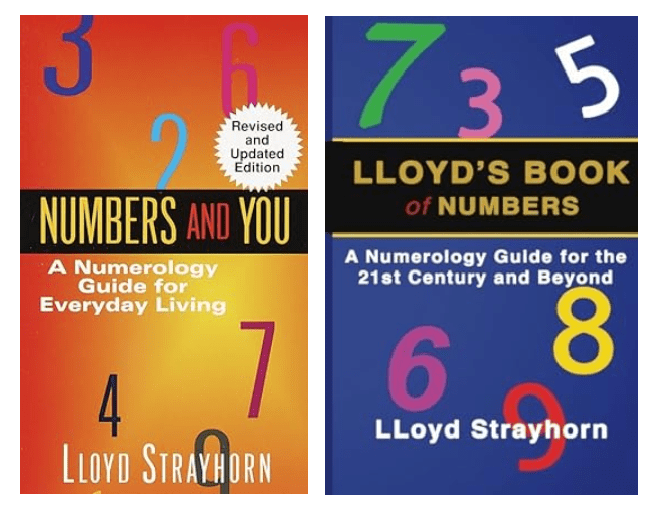
Lloyd Strayhorn is an American numerologist and astrologer known for his numerology book Numbers and You: A Numerology Guide for Everyday Living. The first editions of this book were published around 1980. In it, he primarily advocates Chaldean numerology(based on Cheiromethod), although he also uses it alongside Pythagorean numerology. So, a part of the book is also dedicated to the latter system. Lloyd Strayhorn has been present in the American public for over 40 years and has influenced many Chaldean numerologists.
Lloyd Strayhorn uses alpha-numeric encoding as advocated by Cheiro
In the mentioned book, he identified which numbers govern certain sports, musical instruments, and gifts based on Chaldean calculations of individual words. This approach was likely adopted from some Pythagorean numerologists and, in my opinion, is largely misguided. It overlooks the universal vibration of a sport, instrument, or gift.
More interesting are his studies on the connection of numbers with specific zodiac signs and numbers, compatibility between partners’ numbers, the relationship between numbers and sexuality, the dynamics between parents and children, the connection between numbers and childbirth, and similar topics. In this book, Strayhorn also mentions a special Rosicrucian approach to life cycles, where the year is divided into 7 periods of 52 days each. Interestingly, in this book, he does not address compound numbers.
He also attempts to establish the principle of a personal week. He supports the Pythagorean approach to universal and personal years, months, and days. I won’t say that this approach has no influence, but my research on days, months, and years has led me to the conclusion that this Pythagorean method yields, at best, very weak results.
His descriptions of relationships between numbers slightly differ from those of Cheiro. Like Gerun Moore, he created his own table of lucky numbers for each day of the year (while Gerun Moore speaks of key numbers). In his book Lloyd’s Numbers and You Relationship Guide: A Cosmic Way To Better Understanding, in the chapter on relationships (Chapter Two), he slightly diverges from the usual approach in Chaldean numerology. In some cases, I use similar approaches myself, but some solutions leave me surprised and skeptical.
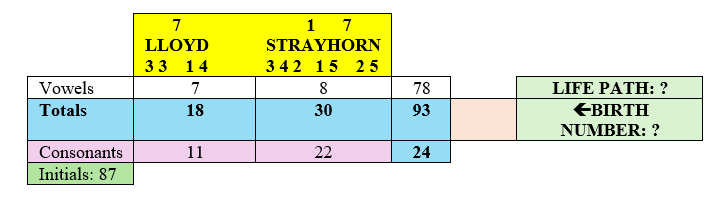
Unfortunately, I don’t have data on his birth date, but we can look at his numerological chart based on his name and surname. In my calculation of vowels and consonants, you may also notice from other examples that I treat the letter Y as a consonant. Personally, I believe that treating this letter in this way yields the best results in analysis.
We particularly notice a multitude of numbers that add up to base numbers 3, 6, and 9. This is a triad of powerful numbers that often bring material success or an interest in business, the ability to manifest, or spiritual interest. The placement of numbers 24 and 15 (78; 7+8=15) is such that it brings a sense of communication, public presence, and performance. Lloyd Strayhorn has written several books and also appears in the media. The occult search is brought about by the numbers 7, 78, 30, 39, 11 and 22, and probably also by the heavenly 7 in the vowels.
Although much depends on his birth numbers, a significant feature of his name and surname numerological chart is that the energies can work in a positive or negative direction, depending on what Lloyd Strayhorn chooses. Recommendations for him include: no manipulation (78), balanced help to others, tithing, and praying to God. In this way, numbers like 93 (and 12; 9+3=12) and 15 are balanced. The name Lloyd Strayhorn can bring certain complications, unfortunate circumstances, or an undesired sacrifice in life. However, it can also lead to a higher purpose, good deeds, and inner fulfillment.
Walter Gorn Old, also known as Sepharial (born March 20, 1864, died December 23, 1929), was an occultist, astrologer, numerologist, and theosophist who also studied medicine, psychology, and oriental languages. He was a friend of Helena Blavatsky and one of the founding members of the Theosophical Society. Around 1894, he parted ways with Blavatsky.
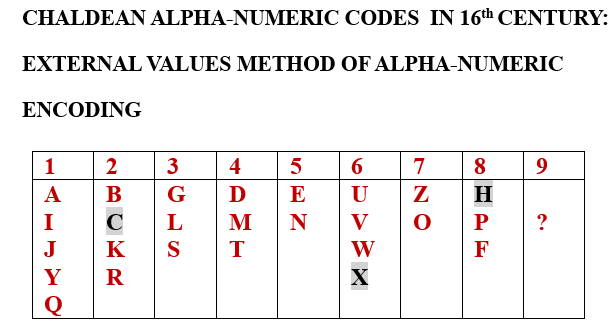
He was born Walter Richard Old on March 20 and later changed his name to Walter Gorn Old (also Gornold or Gorn-Old). This change is believed to have occurred in 1895, the same year he published Kabalistic Astrology, or Your Fortune in Your Name, a book on Kabbalistic astrology (type of Chaldean numerology). Initially, he worked as a Kabbalistic astrologer, utilizing the “external values method of alpha-numeric coding.”
In this form of astrology—though it is more accurately described as a peculiar type of astro-numerology—numbers are closely connected with the tarot. The numbers from I to XXII (the Major Arcana) hold special power. In addition, there are the so-called Royal Stars, which represent the four kings of the suits of wands, cups, swords, and pentacles: the Royal Star of Leo (XXIII), the Royal Star of Taurus (XXXVII), the Royal Star of Aquarius (LI), and the Royal Star of Scorpio (LXV). Likewise, the ace of wands (also known as the ace of sceptres; XXVII), ace of swords (LV), and ace of pentacles (LXIX), along with numbers XLIII and VXXI, are said to hold special potency. Sepharial added meanings for numbers XXIV, XXV, XXVI, and XXVIII to these already established values, greatly influencing Kozminsky and Cheiro. This leads us to the interpretations of numbers in Sepharial’s numerological tarot.
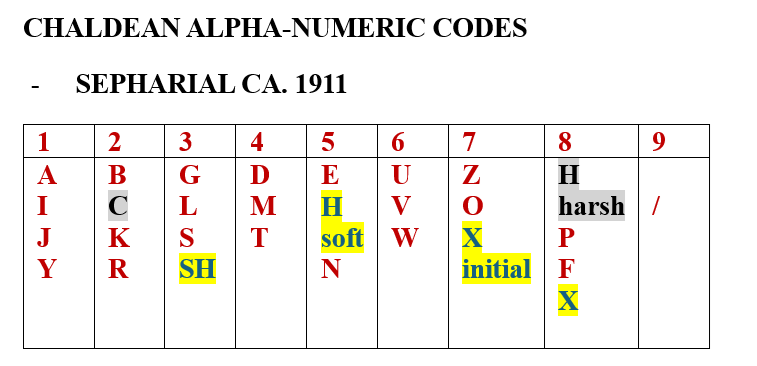
Around 1911, influenced by Isidore Kozminsky and Habeeb Ahmad, Sepharial developed his own alpha-numeric coding system in Chaldean numerology. He also explored phonetic numerology. His most well-known work on numerology is The Kabala of Numbers from 1911.
His original name, Walter Richard Old, results in a Total Name Number (TNN) of 35 and 17, with a base number of 8. This is the number of Saturn and does not align with his birth date of the 20th, which has a base number of 2. For a person with this combination of numbers like Sepharial, there is a possibility that the relationship between the numbers 8 and 2 can be somewhat alleviated, redirecting the energies into creative communication or even manifestation. The challenge with this card lies in the presence of too many unfavorable numbers, which diminish the quality of life and thus limit the possibility of fully resolving the relationship between 2 and 8.
The key number in Walter Richard Old’s numerology chart is the base number 2. The number 2 represents psychology and can also indicate an interest in the occult sciences. Additionally, the number 2 is often associated with nurses and hospitals, and Sepharial did study medicine. His talent for languages is suggested by his inclination toward creative communication, especially in the numbers 2 and 4. This potential is partially reinforced by the numbers 1 and 7.
His new name, Walter Gorn Old, has a TNN of 16 or 34 with base number 7. The dominant influence of these TNNs, along with his interest in psychology and the occult, brings certain complications and blows of fate. At the same time, the connection between the birth date of the 20th and the TNN creates a link between the numbers 2 and 7. These are interchangeable numbers, strengthening each other and giving the person a unique power. Numbers with base numbers 7 and 5 are arranged in a special intellectual structure, which indicates a gift for intellectual work and research. Children are represented by the numbers 23 and 24 in the date numbers, and generally by base numbers 5, 6, and 8. Sepharial had many of these numbers and also had many children. However, it is not guaranteed that someone with child-related numbers in their chart will actually have children. If they do, such numbers help explain family relationships.
With his new name, Sepharial retained some potential for manifestation, but his numerology chart carried predominantly negative energies. Throughout his life, Sepharial faced occasional financial difficulties, often having to move with his family and take on additional jobs beyond astrological counseling.
His pen name was Sepharial. This name carries the primary vibration of the number 29. In older European Kabbalistic traditions, this number reduces to 11, which represents the Arcana XI, or “Force.” It is considered an ambivalent number of fighters. However, in very old traditions and by most modern Chaldean numerologists, this number is regarded as unlucky, as it brings conflicts and emotional suffering.
Sepharial’s life challenges, the change of his name, and the use of an unfortunate pen name can serve as an example of what can happen when a name change is not suitable. Changing a name should enhance one’s quality of life, but this was not the case for Sepharial.
Some sources:
Sepharial (1895): Kabalistic Astrology, or Your Fortune in Your Name
Isidore Kozminsky was reportedly born on October 25, 1870. He grew up in a family of Australian Jews and jewelers. He was known as an astrologer, numerologist, and an expert on gemstones and the Kabbalah. Because he married outside of Jewish circles, he adopted the name Francis Coton and moved with his family from Australia to London in 1935. Isidore Kozminsky remained his pen name. He died during World War II, but the exact time and cause of his death are unclear. One account suggests he died after tripping down an escalator in the London underground, while another claims he succumbed to pneumonia.
Isidore Israel Kozminsky, born on 25th October 1870
His numerological chart for the name Isidore Kozminsky shows a strong and quite favorable alignment of energies. It includes the auspicious numbers 23 and 55, as well as the number 96, which can be unfavorable (depending on how often it encounters the numbers 4 and 8). His chart reveals a strong relationship between 1 and 6, which often suggests a love of luxury and likely influenced his interest in gemstones. Numbers 96 and 24 bring a certain level of material comfort. Numbers 1 and 5 are positioned in a way that enhances the role of intellect, knowledge, and information. Numbers 96, 17 and 25 indicate an interest in the occult, with 96 potentially invoking darker spiritual influences. Therefore, due to the number 96, he needed to be cautious of the darker aspects of spirituality and manipulation. Base number 5 (23, 32) also signifies an interest in numbers, giving him some potential for communication and writing.
The reader can see that I treat the letter Y as a consonant. There is no consensus among numerologists on this, but studying various cases shows that it is more appropriate to treat Y as a consonant.
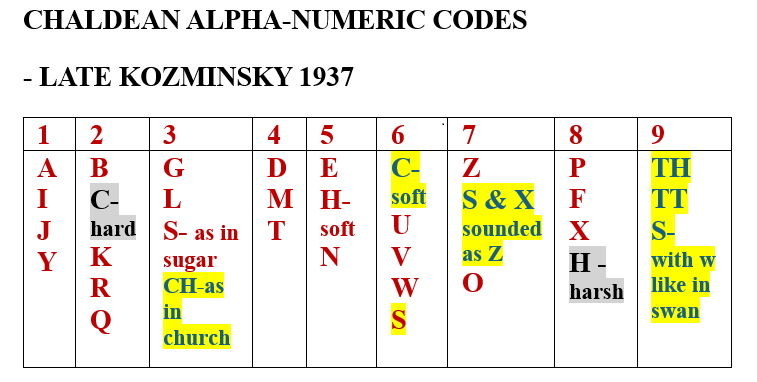
In 1905, Kozminsky wrote Numbers, Their Magic and Mystery, where he advocated for the Chaldean-Hebrew system with the values C = 2, H = 8, and X = 6 (the external values method of alpha-numeric coding). In 1912, he published Numbers: Their Meaning and Magic. Being an Enlarged and Revised Edition, in which he shifted to a coding system where C = 2, H = 5 or 8, and X = 5. This approach had a significant influence on Cheiro.
The method Kozminsky used for summing numbers in the Total Name Number (TNN) is controversial and outdated. Based on a specific form of Kabbalistic astrology, which Sepharial also endorsed, he identified certain numbers from 1 to 28 as having “potency of their own,” as well as numbers 37, 43, 51, 55, 65, 69, and 71. According to this system, if a name or surname corresponds to a number with its own potency, it is not reduced to a basic value. If it does not have its own potency, the number must be reduced to the first number that does. For example, the name Napoleon Buonaparte (an earlier version of the famous French general’s name) vibrates at 41 & 41. Since 41 does not have its own potency in Sepharial’s system, it must be reduced to 5 (4+1=5).
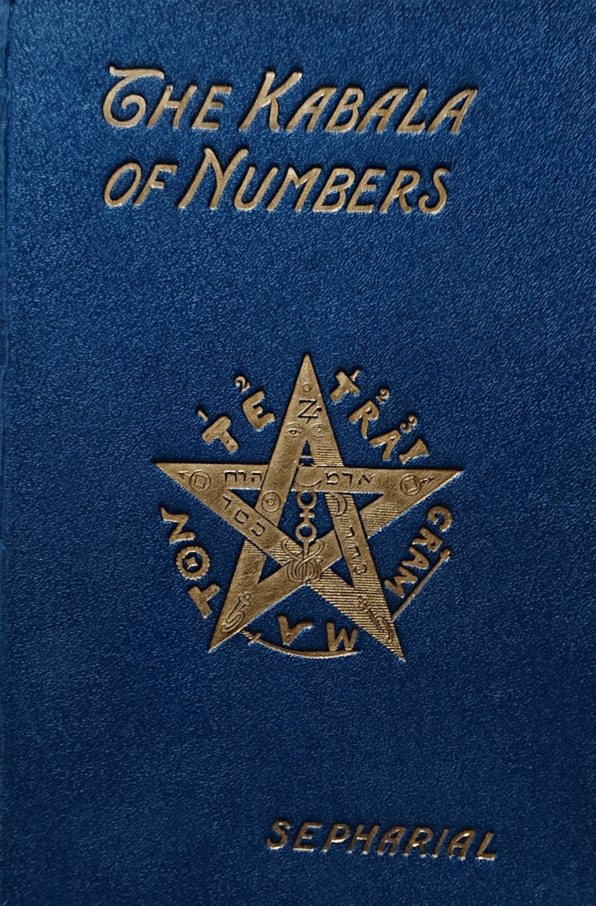
Vintage Book- image published on WorthPoint
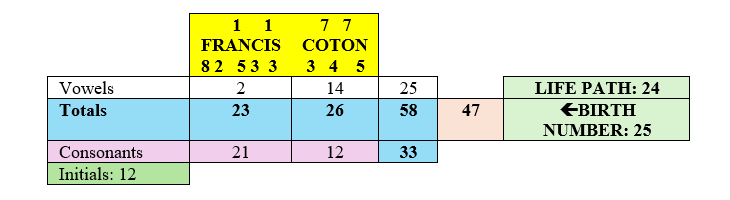
In the case of Isidore Kozminsky, we get the name value 23 and the surname value 5 (from 32, which is reduced as 3+2=5). The sum is 28, which has its own potency and therefore does not get reduced to 10. The number 28 is considered a key number and is regarded as an unfavorable one. For the name Francis (8+2+1+5+2+1+3) Coton (2+7+4+7+5), the name sums to 22 and the surname to 25. 22 is generally unlucky, while 25 was considered fortunate in older traditions. The total is 47, which does not have its own potency and must be reduced to 4+7=11. The TNN value is 11, which Kozminsky treated as neutral. Since he was born under base number 7, we get interchangeable numbers. Kozminsky likely believed that his new name, Francis Coton, would be lucky.
In horse racing, Kozminsky adopted phonetic numerology (books Numbers and Horse Racing, 1928, and My Key Treatise, 1936). He believed that for humans, the written name was influential, while for animals, the spoken name held more power. In 1937, he also published Numbers And Their Practical Application, in which he used a reformed Chaldean coding system for interpreting people’s numerological charts, diverging significantly from Cheiro’s model. He also provided weaker descriptionsof numbers compared to his earlier works.
According to his reformed alpha-numeric coding system, the name Isidore Kozminsky carried the values 26 and 35. In the new book, Kozminsky did not explain how to calculate the TNN. According to his earlier method in Numbers, Their Magic and Mystery, the number 35 is not given its own potency and is reduced to 8. The sum of 26+8=34. However, the name Francis Coton gives the name value 25 and the surname value 25. These combine to 50, which he considered his TNN. Nonetheless, the alpha-numeric coding used by Kozminsky in the final years of his life no longer had much influence.
According to the classic Chaldean alpha-numeric coding model (Cheiro’s approach), the name Francis Coton results in a numerological chart, which contains more unfavorable numbers. The chart is rather weak and shows conflicts between the numbers 23 and 26, 58 and 33, 26 and 58, and 33 and 28. This chart no longer indicates as much interest in gemstones, although some financial potential and interest in communication remain. The strong number 58 indicates a tendency toward eccentricity and reforms, which likely did not go in the right direction. We can see that Kozminsky’s numerological expertise declined in his later years. The information he disseminated lost touch with the Chaldean tradition and reliable interpretation.
Numbers 58 and 71 together emphasize the themes of death and difficulties. The surname Coton carries very unfavorable vibrations of 26 and 12, represented as a pillar. This might have influenced the spread of the story about the escalator accident. The numbers 8 (2+6=8) and 3 (1+2=3) can represent buildings, with 8 also symbolizing railways and underground structures. The number 12 can represent a pillar, which may symbolize ascending or descending via escalators. The conflict between 58 and 33, and between 23 and 26, could be connected to respiratory illnesses. Thus, both stories of his death have roots in his numerological chart. The interaction between number 58 and numbers 26 and 71 represents a conflict between base numbers 4 and 8. This pair often indicates significant difficulties and suffering. 58 is also an unfavorable TNN for period 6 (October, extended influence of Libra).
It becomes clear that in Isidore Kozminsky’s case, the name and surname change brought about unfortunate circumstances. Fortunately, Isidore Kozminsky continued to use his original name in his writing. The number 69 in the name Isidore Kozminsky also interacts with the number 58 in the name Francis Coton, adding to the negative influences. 69 reduces to 15, and 15, in its negative aspect, represents manipulation and even black magic. This might explain why Kozminsky’s books carry an unusual vibration. After reading them, I had to cleanse my aura several times. It would have been much better if Isidore Kozminsky had kept his original name in his everyday life. So, a word of caution: one must be careful when changing names. The goal of a name change should be to increase satisfaction or success in life, not to accumulate problems.









 The Mystery of Numbers, Luck, Worlds and Planets