With the year 2026, according to the widely accepted Anno Domini calendar, a new 81-year period begins, governed by the number 26. This period spans the years 2026–2106, and it can quite reasonably be called the “Chinese Century.” This Saturnian number is said to rule the northern lands stretching roughly from Russia to China, and the flow of energy moves in that direction as well. This suggests that Russia will likely benefit less from this period—if at all—while China, judging by indicators of its development, will benefit the most.
During this period, the United States will not be a region that develops without difficulty. In fact, the United States as an empire no longer has any support in the 81-year macro-numerological cycles. How large the decline of the American empire will be depends on indicators in mundane astrology. Europe, given its uncertain trajectory, will likely fall somewhere between the United States and Russia. Numerologically speaking, the era of Western dominance—and perhaps also the era of Europe’s major influence (from the Atlantic to the Urals, including Russia)—has therefore come to an end.
The numerological system described here is a loose framework. On the one hand, it represents only a small fragment of the broader mosaic involved in studying numerological and astrological mundane influences. Developing a comprehensive and verified system linking numbers with the directions of the heavens is still a task awaiting numerologists. Perhaps then it will also be possible to define more precisely the influence of such macro-periods on Latin America, Africa, and Oceania.
The year 2026 will be remembered as the year when the American era—and the broader Western era of world history—came to an end. Following the period of Spanish-Portuguese expansion, the world economy was for some time dominated by the Netherlands, then by Great Britain, and finally by the United States. This represents 500 years of Western dominance, which about 200 years ago also succeeded in destroying the economies of India and China. Western powers built their global supremacy through a combination of military terror, technological advancement, and aggressive commercial policy.
The last global emperor from the Western world was the United States. Domestically, this country has a rich democratic tradition. On the global level, however—especially in the non-Western world—the United States is often perceived as a tyranny or an unelected super-authority. Venezuelans did not elect Trump. Iranians did not elect him either. For them, the United States represents a rogue state.
In international affairs after the Second World War, the United States (primarily) pursued its economic and military interests, showing little concern for what was happening with governments in its vassal states. Many times it overthrew democratically elected governments and installed dictatorships. This was also the case in Iran, where, together with the British, it established the tyrannical rule of the Shah as an extension of American and British interests. The Americans and the British opposed the nationalization of the Persian oil industry. The rise of Iranian Islamist politics was therefore a slap in the (post)colonial face of the Western powers.
Although there is no proof that Iran is producing nuclear weapons, some observers point out that the fatwa prohibiting nuclear weapons in Iran mainly forbids their use, not necessarily their production. However, it was the United States that withdrew from the nuclear agreement with Iran. If the possession of nuclear weapons represents such an evil that it justifies risking a wider regional war, then Israel and the United States should destroy their own nuclear weapons as soon as possible. Otherwise, they have no real argument for why Iran should not possess such weapons as well.
A belt of wars now stretches from Ukraine, Israel, and the Arabian Peninsula through Iran to Afghanistan and Pakistan. The Iranian-American conflict has strongly destabilized the region of Southwest Asia. Many thinkers warn about the possibility of the outbreak of a Third World War, while some claim that the current conflict could end in a nuclear confrontation.
From a numerological perspective, the year 2026 – at least according to the criteria familiar to me – does not display a particular structure suggesting the outbreak of a Third World War in the sense of a prolonged global conflict or a large-scale nuclear confrontation. Yes, the entire century will be marked by the number 0, which is associated with nuclear Pluto. In this year, the energies of the martial number 18 are also strong; this number governs fire, explosions, enemies, and potentially wars of all kinds. As I indicated in the description of the year 2026, the danger of the outbreak of a major war this year is almost unavoidable.
Iran, the United States, and Israel all contain the number 13 in their structures on February 28, 2026—the number of “Death,” whose essence, 4, is associated with Uranus. Thus, this year is not among the most “nuclear,” but due to the numbers 18 and 13, we unfortunately cannot rule out a local and limited nuclear clash. Much depends on human wisdom and awareness.
In the description of the numbers governing the war between Iran on one side and the United States and Israel on the other, it is evident that destruction will reach both Israel and Iran. The United States will be the least affected, but its reputation in the world will be severely shaken. This war will exhaust both the United States and Israel, while the blockade of the Strait of Hormuz will likely severely affect America’s vassal states in Europe.
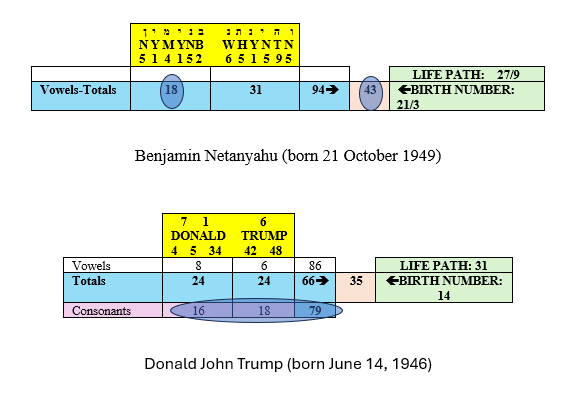
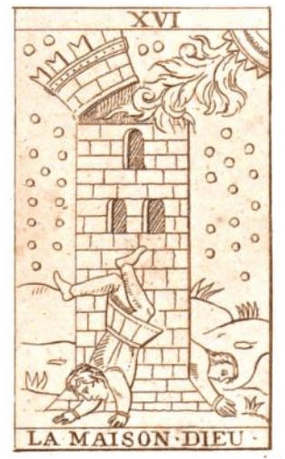
Benjamin Netanyahu’s numerological chart shows the dominance of the military numbers 18 and 43 and a very poor relationship between the numbers 3 and 7, which significantly worsens the qualities of 18 and 43. Donald Trump has the numbers 16, 18, and 79 in his chart, as well as the same poor relationship between 3 and 7. The numbers 79 and 43 can have similar effects and may represent wars. The numbers 16 and 79 also represent the “Falling Tower.” This can symbolize destroyed buildings. Considering the war with Iran, the “Falling Tower” also aptly symbolizes the fire following the attack on the Dubai skyscraper Burj Al Arab. Finally, in recent years Trump’s ownership of his own Trump Tower has also been threatened.
Astrologically, we live in a time of conjunction between Saturn and Neptune, which partly represents China and perhaps also the modern Islamic world. At the same time, this relationship can manifest as a union between earth or hardship (Saturn) and oil or gas (especially Neptune). In my opinion, the weak sextile between these two planets and Pluto represents difficulties for Europe (although traditional interpretations generally see a sextile as always favorable). We cannot exclude the possibility that, in the event of a nuclear confrontation, a nuclear bomb could also explode in a European country. However, it is more likely that Europe will “cleanse its karma” in a different way because of this aspect – karma it accumulated in its relationship with Southwest Asia. This applies mainly to Europe west of the former Iron Curtain. Most likely, this will take the form of an oil shock.
Overall, the current war has several consequences:
It represents a catastrophe for Iran and Israel. Both countries will be heavily devastated. If Israeli authorities do not fundamentally change their foreign policy and their policy toward the Palestinians, the very existence of the Israeli state may become seriously threatened.
The golden era of the United Arab Emirates has likely ended, at least for some time.
American military power in Southwest Asia has weakened, and the United States can no longer guarantee security for this region.
Southwest Asia will therefore lean even more heavily toward China.
This may soon lead to the end of the petrodollar.
In the Arab world, this war could soon lead to the collapse of some Arab regimes, with new governments likely to be more anti-American and anti-Western.
Because of the consequences of the war, a regime change in Iran may occur, but the new authorities will likely remain anti-American and anti-Western.
Europe may sink into a new economic—and possibly refugee—crisis. In some places, European regimes could be replaced by new neo-fascist governments. In any case, the survival of the EU and NATO is now in question. Europe, which has already lost much of its global influence, will become even more marginal.
The United States will never again play the same global role it had before 2026. If the petrodollar collapses, the American financial system could also be shaken.
China, which had already surpassed the United States technologically in many areas before 2026, has—no later than this war in 2026—become the world’s greatest global power. Its power may not compare with that of the United States after the Second World War, but in a multipolar world with a relatively weak Chinese hegemony, all states will from now on have to consider and respect Beijing’s power. And that power will likely grow somewhat further in the future. The shift in global power from the United States to China is likely to be complete around 2032 at the latest (according to french mundane astrologer Barbault).
With Iran devastating American interests in Arabia, China has scored a major victory on the global chessboard, while the power of the West has collapsed like a house of cards. If the West fails to find a way to strengthen its domestic industry and technological development, it may become a region of crisis – and in the worst case a new Third World. The other world, however, may move along a brighter path.
What represents a catastrophe for the West – and at least temporarily for Southwest Asia -represents the beginning of a great (and final) liberation from centuries of Western tyranny for much of the rest of the world. Latin America is perhaps the least fortunate in this regard, as the declining United States will likely cling to it for some time.
An oil shock may of course also affect Asia, but in the long run India, Indonesia, and other countries—led by China—will shift the center of global politics toward Asia.
If we want to survive, we will have to learn to respect one another in the new world. Asia, with China at its forefront, now carries great responsibility for the fate of the entire world. Compared with Great Britain and the United States, the “Middle Kingdom” (Zhong Guo) is far less inclined toward direct military interventions outside its cultural sphere. Despite the possibility of attacks on Mongolia or Taiwan, China could therefore gradually achieve greater peace in the world.
The groundwork for a new era has been laid. This will not be an age without conflicts, dangers, or crises. Nor will it be an age in which great powers act selflessly. A particular challenge is the use of AI for malicious or military purposes, or for excessive surveillance. Nevertheless, the foundations for the development of this new era suggest that we can begin building a completely different world—one in which we learn to live without a global sheriff. This new freedom will require a different consciousness, and the present moment could become, for humanity, a time of hope.
Renée Nicole Macklin Good was shot on January 7, 2026, during protests in Minneapolis by United States Immigration and Customs Enforcement (ICE).
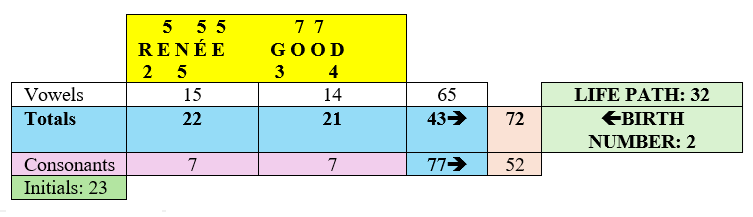
In her chart, there is a very strong combination of the numbers 43 and 52. Chaldean tarot interprets the number 52 as the Queen of Swords and warns of wars and death. Cheiro therefore associated this number with43. The number 43, like the number 13, is called “Death” or “The Reaper” and is traditionally linked with war and upheaval.
Sepharial defines the number XLIII (43) as: “Point of Reaper. Destruction; abortive enterprises; things brought to nothing; annihilation.”Cheiro, however, defines the number 43 as follows: “This is an unfortunate number. It is symbolised by the signs of revolution, upheaval, strife, failure and prevention, and is not a fortunate number, if it comes out in calculations relating to future events.”
Many people have such a number in their numerological charts, yet most are not shot or do not experience an accident. However, a chart dominated by unfavorable numbers increases the likelihood of extreme events. In this particular numerological chart, the favorable numbers are 23 and 24, and probably 72. The number 21, like 2, is more neutral. Everything else is challenging in one way or another.
On January 7, 2026, scattered but negative numbers prevailed in her system. Somewhat more emphasized was the relationship between the number 15 and the unfavorable essence 4. Within this essence we find the number 13, which signifies “Death.” An unfavorably positioned 17 contributed to the spread of unfavorable news—the news of her own death.
As in the case of Alex Pretti, another victim in the ongoing American protests, it must be emphasized that numerology does not predict the future. It affects us to the extent that we remain within the dual matrix, of which the workings of Chaldean numerology are also a part. Renée Good possessed within herself a certain strength for seeking spiritual wholeness and intuition. With some luck, she might perhaps have avoided the fatal scenario.
From: Wikimedia Commons; File:Renee Good DHS agent perspective.jpg
Greetings. Numerology and astrology do not predict the future; they merely reflect the intensity of the spiritual weaknesses of the person or nation being observed. When we abide in inner strength and are an active reflection of the Divine, fate loses its influence over us, or that influence is significantly softened.
With this reservation in mind, let us look at today’s energies, as a major war has begun in the Persian Gulf. There may be Chaldean numerologists who have developed more or less reliable models for forecasting global events. Personally, at least for now, I do not. When I study mundane events—if I study them at all—I mainly examine them after they have already occurred. The same applies today.
Numbers are interesting. The attacks were initiated by Israel, for whom less favorable numbers prevail today. This could mean that through this military intervention, the country may inflict considerable damage upon itself. Three situations stand out. The number 51 governs dangers and soldiers and can also bring the risk of injury or even death. The number 16 governs destroyed buildings and difficulties. Then there is the connection between 13 and 15, which governs manipulation and sometimes even harmful or evil deeds. The number 13 represents death. In Israel’s numerological chart for this day, 13 primarily indicates troubles and fatalities on Israeli soil. This war will be exhausting for Israel, and if it evolves into a prolonged conflict across a wider region, Israel could even become existentially threatened because of it. That is likely not the goal of the Israelis.
The United States holds somewhat better cards, especially if the war is short-lived. If the situation grows into a longer and more extensive conflict, it could become unmanageable for the Americans. In the American numeroscope for this day, the unfavorable 13—representing death and difficulties—is active. The military 9 has both favorable and unfavorable placements. Even if the American president declares a swift victory in this war, it seems that the United States will emerge weakened in one way or another, with its international reputation diminished. That is likely not the goal of the Americans.
Iran has in its numerological chart for this day the number 12, which governs victims; the number 13, which governs death; and the number 47, which can bring emotions, conflicts, and fears. Regardless of numerological influences, the Iranian military is certainly weaker than the combined American–Israeli forces. However, it is on home ground and acting in defense. The numbers in this chart are not as unfavorable as Israel’s and display interconnected strength. This power structure through the number 3 may point to the potential for Iran to receive concrete external (Chinese?) support. It may also suggest that, because of the war, the regime in Tehran could once again become stronger and more consolidated. Nevertheless, the numbers indicate that in prolonged fighting, the foundations of Iranian society could be destroyed. That is likely not the goal of the Iranians.
What is the lesson of this story? If we engage in lower frequencies, we may become subject to lower energetic trends. At least from a numerological perspective, it is not clear how this war would benefit the United States—let alone Iran, and especially not Israel. From the perspective of higher truth and Divine love, no war can truly be beneficial. But we must still rise to that level.
Masculine numbers symbolize strength, concentration, and the ability to lead, and they are associated with male planets. Feminine numbers represent dispersion, adaptability, and the ability to please, and are connected with female planets. In Chaldean numerology, the numbers 1, 3, and 9 are considered the most masculine. Cheiro said of them that they are associated with martial music, thereby indirectly revealing their masculine nature.
The number 1 is the male aspect of the Sun and represents concentration, power, and leadership. It therefore possesses all the attributes of masculinity. At the same time, however, the number 1 encompasses all that exists, and thus it also contains certain feminine traits within itself. The number 9 is the number of warriors and is therefore fundamentally masculine. Yet in the lunar system, the number 9 represents the second day of the second week and is under the sign of the Moon. In the background, this number too contains some feminine qualities.
What about the number 3? The number 3 represents expansive Jupiter, which is a masculine number. In the lunar system, the number 3 corresponds to Tuesday and Mars. Warlike Mars, alongside Jupiter, is another masculine planet. Based on the above criteria, the number 3 can indeed be defined as the most masculine number.
However, one should be cautious, as there may be other criteria that ought to be taken into account. For ordinary numerological practice, it is entirely sufficient to classify the numbers 1, 3, and 9 as masculine.
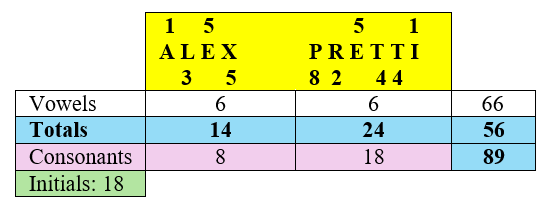
On January 24, 2026, during a protest in Minneapolis, United States Border Patrol agents shot and killed an intensive care unit nurse, Alex Jeffrey Pretti, known as Alex Pretti. Footage of the incident and images of the unfortunate man spread around the world. Since his birth data are not available, we will analyze only his name.
In this partial numeroscope, the numbers 2, 6, and 8 are very strong. They indicate a gentle, kind, and somewhat more emotional character. The initials 18 and the consonant total of 18 in the surname also bring Martian energies, such as accidents and associations with weapons—thus certain aspects of aggression. A bright spot in his numeroscope is the number 24, which helped guide him toward a medical profession. Together with the Total Name Number (TNN) 56, it is clear that he was driven by a sincere desire to help others. Some people with a similar numeroscopemight also be drawn to massage therapy or bioenergetics work.
The problem with his name numbers is that unlucky numbers predominate, and unlucky numbers tend to bring a difficult fate, complications, and even accidents. Of course, we must always keep in mind that date numbers provide important additional information, as do astrological influences. Ultimately, numerology holds true only to the extent that we are embedded in the matrix (and to the extent that a given numerological system is valid). In a state of deep meditation, for example, we are calm and step outside our mental and emotional limitations. In such a state, the influence of numerology and astrology weakens.
Is it visible in the partial numerological chart of Alex Pretti that he could become a victim of a shooting? Yes. His TNN is a form of the number 11, which can sometimes represent violence—though often it does not. However, in his consonant numbers, the numbers 8 (and 89) as well as 18 are present. Eight and 89 are Saturnian numbers, and Saturn rules physical defects, difficulties or limitations, illness, and physical or emotional suffering. 18 is a Martian number and as such can represent weapons, bleeding, accidents, gunfire, fire, explosions, and the like. This combination can also manifest through demanding situations such as “gunshot wounds,” “burns,” or a “damaged body.” The number 89, when combined with another 8, may not function favorably. We can expect that 89, as a number from the 17 series, may bring “negative news” or “negative fame.”
In numerological systems that carry real weight, the configurations in numerological charts should, in most cases, be reflected in real life—and vice versa. In this specific case, it appears that, at least regarding name numbers, only analysis at the consonant level establishes a clearer connection with gunfire and gunshot wounds. Standard Chaldean numerology analysis based on the overall numbers of the first name, last name, and TNN overlooks such configurations and is therefore less effective. Numerological classics such as Cheiro, Isidore Kozminsky, and Gerun Moore should therefore not be overly idealized. Their role in the development of modern Chaldean numerology should be acknowledged, but additional approaches must then be examined as well.
Source: Wikimedia Commons, File:Alex Pretti – VA portrait (enhanced).jpg
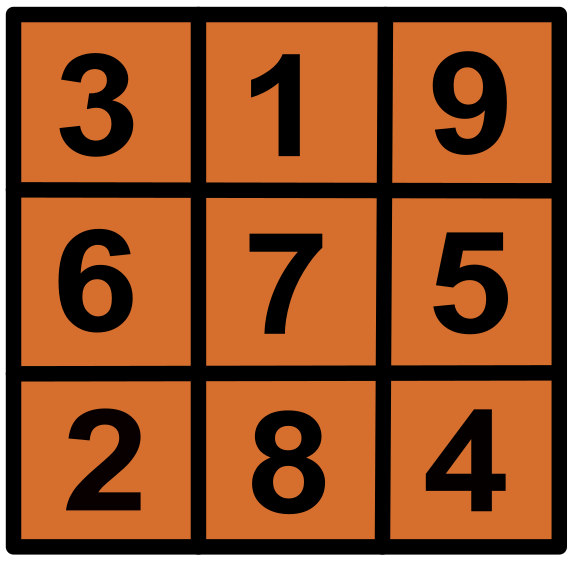
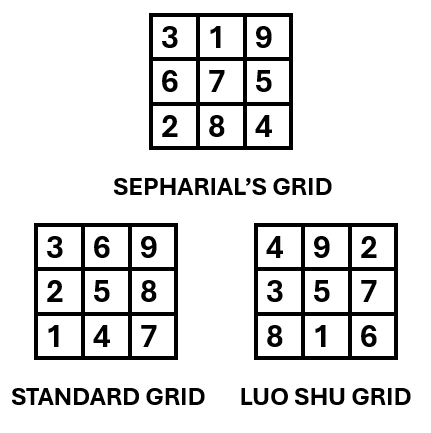
In his book The Kabala of Numbers (1909), Sepharial published a special arrangement of numbers in a 3×3 matrix:
Based on my research, this is not necessarily Sepharial’s own invention, but it clearly belongs to the Chaldean tradition. However, since this grid was first published by Sepharial, I refer to it as “Sepharial’s Grid.”
This grid is derived from the Chaldean triangular groups:
1, 5, 7 3, 6, 9 2, 4, 8
These three groups originate in ancient Chaldean numerology and were published in modern times in 1908 by the Pythagorean numerologist Luo Clement in The Ancient Science of Numbers. It appears that someone may have combined this knowledge with the concept of the most masculine numbers -1 (the Sun), 3 (Jupiter), and 9 (Mars). As a result, the positions within the triangles 3–6–9 and 1–5–7 had to be adjusted, specifically by exchanging the positions of the numbers 1 and 6.
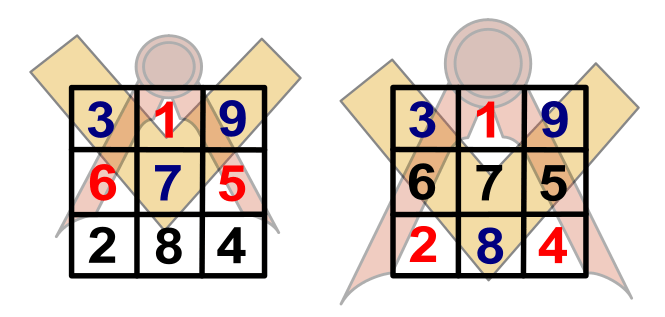
This grid may be of very ancient origin (a possibility I am currently investigating). It is also possible that Sepharial encountered it through Freemasonry, since the numerical arrangement of this grid can be interpreted through the Masonic symbol of the compass and the square. In the top row, the lowest number is placed in the center, with two higher numbers on the sides. In the second and third rows, the relationship is reversed. This produces the following pattern:
By connecting the first and second rows, we can draw the shapes of the letters V and Λ (Lambda). The letter V is formed by the numbers 3, 7, and 9, while the letter Λ is formed by 6, 1, and 5. Together, these shapes correspond to the Masonic image of the compass and the square. The same can be done with the first and third rows: here, the letter V is formed by the numbers 3, 8, and 9, and Λ by the numbers 2, 1, and 4.
Within this grid, Sepharial analyzed planetary conjunctions. He placed the digits of a person’s birth date (day, month, and the last two digits of the year) into the matrix. If two adjacent cells in the matrix were activated by the digits of the birth date, the relationship was interpreted as a conjunction between two planets. For example, the relationship between 4 and 8 was interpreted as a conjunction between the Sun and Saturn, while the relationship between 1 and 3 was interpreted as a conjunction between the Sun and Jupiter.
By the 21st century at the latest, Sepharial’s “Masonic” grid had become widespread in modern neo-Vedic numerology. Since older Indian sources from the 20th century do not mention this grid, we can conclude that its use in Indian numerology began only relatively recently, under the influence of Sepharial. It appears that Indian practitioners combined Sepharial’s 3×3 matrix with the concept of arrows, introduced into Pythagorean numerology in 1940 by Hettie Templeton. Following the example of Jyotish, the formations of these arrows were called yogas. Over time, some additional configurations were also classified as yogas, even though they do not appear in this matrix as straight arrows.
To activate the root chakra and the perineum, the Indian mantra LAM is commonly used. In China, the mantra BIN or BING is also used for this area. Another option is the mantra PAI, which has a broader effect, extending from the lower torso downward through the legs.
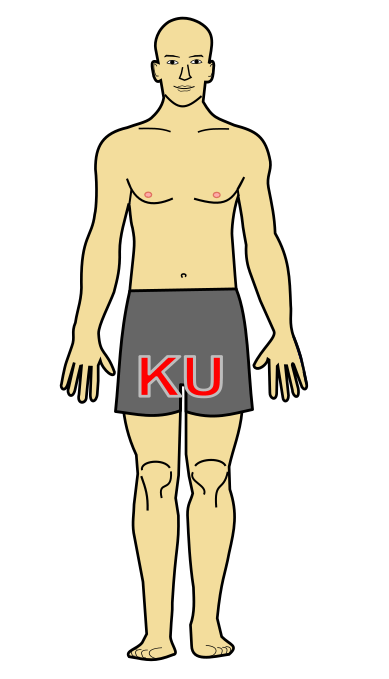
The mantra KU can also be used to stimulate the root chakra and the perineum. When this sound is used, the energy tends to move upward, which means it also partially affects the genital area, the abdomen, and the parts of the legs closest to these chakras. The effects of this mantra are therefore less focused on a single point and more distributed across a wider area.
At the end of 2025, Peruvian shamans predicted that Venezuelan politician Maduro would be removed from power in 2026, and they also predicted that US President Donald Trump would become seriously ill.
What is my comment on all this? The US president is in his eighties, and few elderly people at this age are free of age-related problems. From a numerological perspective, the year 2026 brings him the numbers 58 (death, illness, challenge, or transformation), 51 (wounds, danger), 48 (sacrifice), and the unfavorable 4 (obstacles caused by a tendency to lead). Therefore, numerologically, we can allow for the possibility of health problems developing.
According to Chinese astrology, we will soon enter the Year of the Fire Horse. Trump’s four pillars of destiny (the Chinese Bazi method) contain a lot of fire and very little personal earth, which basically cannot tolerate such an amount of fire. Such pillars are very difficult to interpret. There are ideas that this is a case of Follow the Resources, where fire is a favorable element and earth is unfavorable, and further ideas that this is a Dominant type, in which both earth and fire are favorable. But such weak earth cannot really be dominant. It is more of a pact between fire and earth: earth gives way to fire, and fire lets it live in return. Trump is under the less favorable influence of water from multi-year cycles, while at the same time this year has extremely concentrated fire energy. Could this pose health problems for an older person? Resources and water represent the immune system, while fire represents, for example, blood, the heart, the brain, and the circulatory system.
Let me put it this way. Neither numerology, astrology, nor energy readings can truly predict what will happen to a person or activity. They can only predict a certain probability that things will go in a certain direction. But nothing more than that. Today, people use advanced medical solutions, relaxation techniques, physiotherapy, bioenergy, energy training, and some continue to push forward with strong personal will, inner faith, and awareness… Therefore, as a rule, I do not engage in personal analysis of possible future events. Such predictions can also cause unfavorable self-fulfilling prophecies in unstable individuals. What exists beyond the limitations of this matrix? Perhaps it is time to consider how much we are truly limited by given situations.
I wish us all a glimpse of eternity in our lives. Best regards.
The word AMEN can certainly be used as a mantra. It is well known that some people use this word as a substitute for the Indian mantra OM or AUM. The root AM is phonetically very similar to AUM. At the same time, the use of the sounds M and N is similar to words such as MANI and MANEE, which are associated with the brain and the head.
For this reason, AMEN is expected to have an effect on the crown chakra, Lalāṭa (the third eye), and Ajna (the brow chakra). We can therefore say that this word may be used at least as a mantra for the head area, provided that one simultaneously focuses attention on this region. Instead of AMEN, one may also use AMN or AMUN, with practically the same effects. Interestingly, AMEN/AMUN is also the Egyptian name of the Creator God.
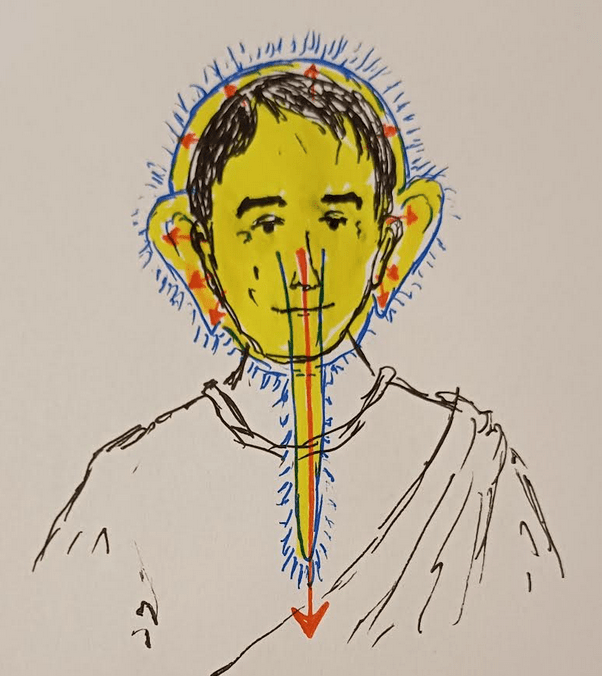
The sound AM causes a strengthening of fresh energy in the head and its expansion outward, while EN causes a downward movement of energy, which typically flows down the front along the central line. Such expansion and movement of energy can create an elephant-like energetic structure in the aura—expanded ears, an enlarged head, and a downward flow that may take the form of an elephant’s trunk. Although I am not a Hindu, I therefore sometimes refer to this mantra as the “mantra of Ganesha”.
When using this mantra in the head area, caution is necessary, as with any form of energetic work involving the head. People with high blood pressure, heart conditions, or mental health issues should not practice it, or should at least ensure that after using the mantra the energy is sufficiently directed downward, at least to the abdomen, so that no sensation of pressure remains in the head.


 The Mystery of Numbers, Luck, Worlds and Planets