The year 2026 will be remembered as the year when the American era—and the broader Western era of world history—came to an end. Following the period of Spanish-Portuguese expansion, the world economy was for some time dominated by the Netherlands, then by Great Britain, and finally by the United States. This represents 500 years of Western dominance, which about 200 years ago also succeeded in destroying the economies of India and China. Western powers built their global supremacy through a combination of military terror, technological advancement, and aggressive commercial policy.
The last global emperor from the Western world was the United States. Domestically, this country has a rich democratic tradition. On the global level, however—especially in the non-Western world—the United States is often perceived as a tyranny or an unelected super-authority. Venezuelans did not elect Trump. Iranians did not elect him either. For them, the United States represents a rogue state.
In international affairs after the Second World War, the United States (primarily) pursued its economic and military interests, showing little concern for what was happening with governments in its vassal states. Many times it overthrew democratically elected governments and installed dictatorships. This was also the case in Iran, where, together with the British, it established the tyrannical rule of the Shah as an extension of American and British interests. The Americans and the British opposed the nationalization of the Persian oil industry. The rise of Iranian Islamist politics was therefore a slap in the (post)colonial face of the Western powers.
Although there is no proof that Iran is producing nuclear weapons, some observers point out that the fatwa prohibiting nuclear weapons in Iran mainly forbids their use, not necessarily their production. However, it was the United States that withdrew from the nuclear agreement with Iran. If the possession of nuclear weapons represents such an evil that it justifies risking a wider regional war, then Israel and the United States should destroy their own nuclear weapons as soon as possible. Otherwise, they have no real argument for why Iran should not possess such weapons as well.
A belt of wars now stretches from Ukraine, Israel, and the Arabian Peninsula through Iran to Afghanistan and Pakistan. The Iranian-American conflict has strongly destabilized the region of Southwest Asia. Many thinkers warn about the possibility of the outbreak of a Third World War, while some claim that the current conflict could end in a nuclear confrontation.
From a numerological perspective, the year 2026 – at least according to the criteria familiar to me – does not display a particular structure suggesting the outbreak of a Third World War in the sense of a prolonged global conflict or a large-scale nuclear confrontation. Yes, the entire century will be marked by the number 0, which is associated with nuclear Pluto. In this year, the energies of the martial number 18 are also strong; this number governs fire, explosions, enemies, and potentially wars of all kinds. As I indicated in the description of the year 2026, the danger of the outbreak of a major war this year is almost unavoidable.
Iran, the United States, and Israel all contain the number 13 in their structures on February 28, 2026—the number of “Death,” whose essence, 4, is associated with Uranus. Thus, this year is not among the most “nuclear,” but due to the numbers 18 and 13, we unfortunately cannot rule out a local and limited nuclear clash. Much depends on human wisdom and awareness.
In the description of the numbers governing the war between Iran on one side and the United States and Israel on the other, it is evident that destruction will reach both Israel and Iran. The United States will be the least affected, but its reputation in the world will be severely shaken. This war will exhaust both the United States and Israel, while the blockade of the Strait of Hormuz will likely severely affect America’s vassal states in Europe.
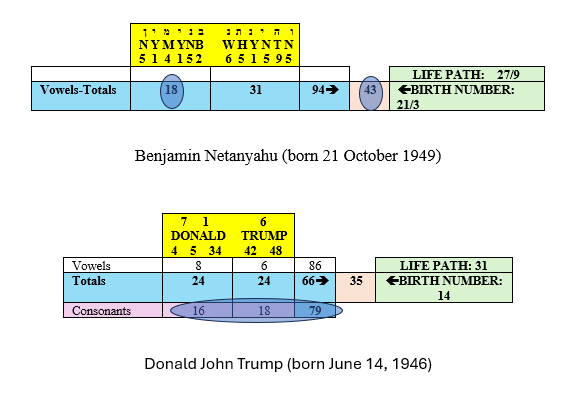
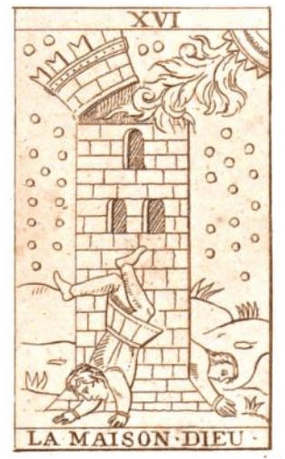
Benjamin Netanyahu’s numerological chart shows the dominance of the military numbers 18 and 43 and a very poor relationship between the numbers 3 and 7, which significantly worsens the qualities of 18 and 43. Donald Trump has the numbers 16, 18, and 79 in his chart, as well as the same poor relationship between 3 and 7. The numbers 79 and 43 can have similar effects and may represent wars. The numbers 16 and 79 also represent the “Falling Tower.” This can symbolize destroyed buildings. Considering the war with Iran, the “Falling Tower” also aptly symbolizes the fire following the attack on the Dubai skyscraper Burj Al Arab. Finally, in recent years Trump’s ownership of his own Trump Tower has also been threatened.
Astrologically, we live in a time of conjunction between Saturn and Neptune, which partly represents China and perhaps also the modern Islamic world. At the same time, this relationship can manifest as a union between earth or hardship (Saturn) and oil or gas (especially Neptune). In my opinion, the weak sextile between these two planets and Pluto represents difficulties for Europe (although traditional interpretations generally see a sextile as always favorable). We cannot exclude the possibility that, in the event of a nuclear confrontation, a nuclear bomb could also explode in a European country. However, it is more likely that Europe will “cleanse its karma” in a different way because of this aspect – karma it accumulated in its relationship with Southwest Asia. This applies mainly to Europe west of the former Iron Curtain. Most likely, this will take the form of an oil shock.
Overall, the current war has several consequences:
- It represents a catastrophe for Iran and Israel. Both countries will be heavily devastated. If Israeli authorities do not fundamentally change their foreign policy and their policy toward the Palestinians, the very existence of the Israeli state may become seriously threatened.
- The golden era of the United Arab Emirates has likely ended, at least for some time.
- American military power in Southwest Asia has weakened, and the United States can no longer guarantee security for this region.
- Southwest Asia will therefore lean even more heavily toward China.
- This may soon lead to the end of the petrodollar.
- In the Arab world, this war could soon lead to the collapse of some Arab regimes, with new governments likely to be more anti-American and anti-Western.
- Because of the consequences of the war, a regime change in Iran may occur, but the new authorities will likely remain anti-American and anti-Western.
- Europe may sink into a new economic—and possibly refugee—crisis. In some places, European regimes could be replaced by new neo-fascist governments. In any case, the survival of the EU and NATO is now in question. Europe, which has already lost much of its global influence, will become even more marginal.
- The United States will never again play the same global role it had before 2026. If the petrodollar collapses, the American financial system could also be shaken.
- China, which had already surpassed the United States technologically in many areas before 2026, has—no later than this war in 2026—become the world’s greatest global power. Its power may not compare with that of the United States after the Second World War, but in a multipolar world with a relatively weak Chinese hegemony, all states will from now on have to consider and respect Beijing’s power. And that power will likely grow somewhat further in the future. The shift in global power from the United States to China is likely to be complete around 2032 at the latest (according to french mundane astrologer Barbault).
With Iran devastating American interests in Arabia, China has scored a major victory on the global chessboard, while the power of the West has collapsed like a house of cards. If the West fails to find a way to strengthen its domestic industry and technological development, it may become a region of crisis – and in the worst case a new Third World. The other world, however, may move along a brighter path.
What represents a catastrophe for the West – and at least temporarily for Southwest Asia -represents the beginning of a great (and final) liberation from centuries of Western tyranny for much of the rest of the world. Latin America is perhaps the least fortunate in this regard, as the declining United States will likely cling to it for some time.
An oil shock may of course also affect Asia, but in the long run India, Indonesia, and other countries—led by China—will shift the center of global politics toward Asia.
If we want to survive, we will have to learn to respect one another in the new world. Asia, with China at its forefront, now carries great responsibility for the fate of the entire world. Compared with Great Britain and the United States, the “Middle Kingdom” (Zhong Guo) is far less inclined toward direct military interventions outside its cultural sphere. Despite the possibility of attacks on Mongolia or Taiwan, China could therefore gradually achieve greater peace in the world.
The groundwork for a new era has been laid. This will not be an age without conflicts, dangers, or crises. Nor will it be an age in which great powers act selflessly. A particular challenge is the use of AI for malicious or military purposes, or for excessive surveillance. Nevertheless, the foundations for the development of this new era suggest that we can begin building a completely different world—one in which we learn to live without a global sheriff. This new freedom will require a different consciousness, and the present moment could become, for humanity, a time of hope.

 The Mystery of Numbers, Luck, Worlds and Planets