Changing one’s first or last name is just one of the possible ways we try to shift the energies within our personal makeup. Today, I want to introduce another method that can be used to partially resolve difficulties when dealing with unfavorable or challenging numbers in a name, surname, or their combined value.
I was inspired to write this after my friend told me that his lady is struggling with a serious kidney disease. Almost simultaneously, a reader of my blog reached out. He has been exploring how to activate the favorable energies of a name without actually changing the first or last name. Taken together, these were clear signs that it was time to write this article.
In short, this technique is based on a three-digit sequence derived from the first name and surname with the art of Chaldean numerology. What we need are:
- the reduced single-digit value of the first name,
- the reduced single-digit value of the surname,
- and the reduced single-digit value of the Total name number (TNN).
Example: Pablo Picasso
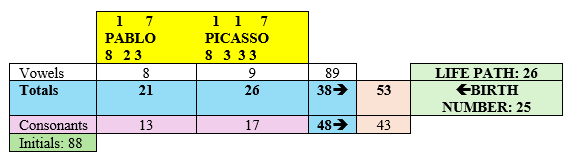
- His first name Pablo equals 21, which reduces to 3.
- His surname Picasso equals 26, which reduces to 8.
- His total name number (TNN) is 38, which reduces to 11, and then to 2.
Step 1: Defining the Sequence Numbers
- Outer level: Add the reduced numbers of the first name, surname, and TNN, then reduce to a single digit. For Picasso: 3 + 8 + 2 = 13 → 4.
- Inner level: Use the TNN. For Picasso, that’s 38 → 11 → 2.
Alternative Ways to Arrive at the Same Sequence
- Outer level: sum of reduced TNN, total vowels, and total consonants. For Picasso: 8 + 3 + 2 = 13 → 4. Inner level remains the TNN (38 → 11 → 2).
- Outer levels can also be represented as a doubled TNN.
In every case, we arrive at the same personal sequence.
For Pablo Picasso, the resulting sequence is 4, 2, 4. This is his main balancing sequence, helping harmonize the energies of his name and surname.
The Numerological Theory Behind the Sequence
The reduced TNN (in the center of the sequence) acts as the core name number through which fresh energy flows into our system. This is true even with challenging numbers such as 4 and 8. In a sense, this central number connects us to prenatal levels of existence.
The outer numbers represent overall functioning, but they also contain the prenatal aspect of the TNN (since it is part of the sum that produces them). This creates a level of wholeness.
The TNN, appearing both at the center and hidden within the outer sums, ties the entire sequence together into unity and completeness.
Notice that the outer numbers are always a multiple of the central one. Picasso’s sequence is 4, 2, 4. If someone’s TNN were 8, its doubled value would reduce to 7 (8+8=16 → 7). Their sequence would be 7, 8, 7. This doubling holds the creative potential of duality.
The outer layer, as the field of total action and dual reflection, allows the frequency to move beyond the narrow frame of the body and aura, reaching into the wider world. Anyone familiar with energy manifestation knows: for an idea or message to manifest, it must leave the inner system and move outward.
So even though duality is at play, the presence of the TNN at all three levels, along with the sum of the outer numbers, expresses connection, unity, and wholeness.

Side Note: Consonant Sequence
You can also derive a consonant sequence. For Picasso, this is 6, 3, 6. But it works much more weakly than the main sequence, since the latter integrates both the whole-name numbers (first, surname, TNN) and the total vowel and consonant values.

How to Use the Sequence
- Visualization: Imagine a sphere in front of you, and inside it, sequentially project the numbers of the sequence. After the last number, pause briefly, then begin again. Practice consistently over time.
- Repetition: Silently or softly whisper the sequence. After the last number, pause, then repeat. Again, regular practice is key.
Some people also write the sequence down. But there’s a catch: a written sequence remains as a sequence only while we perceive it that way. If written repeatedly, it may start to vibrate as a single number. For Picasso, 4, 2, 4 would collapse into 424 → 4+2+4=10 → 1. This could be problematic if 1 is not suitable for balancing the person’s chart. In such cases, the meaning of 10 would also need to be considered. Similarly, the sequence 787 would introduce the influence of 22, which is often highly challenging.
Final Thoughts
Practicing with sequences, depending on the individual, brings more wholeness, more prenatal influence, and more balance from harmonized numbers (especially important when dealing with unfavorable ones).
If you decide to try working with your main name sequence—good luck with your practice!

 The Mystery of Numbers, Luck, Worlds and Planets