The strongest technique for combining numbers in Chaldean name numerology is not addition, but rather the composition of digits.
Let’s recall: name numbers can be added by first reducing each number to a single digit. If needed, this step can be repeated. For example, in the name number 17, we add the digits 1 and 7 to get 8. In the surname number 38, we add 3+8 to get 11, and then 1+1 to get 2. Finally, we add 8 and 2 together, which gives us 10 as the Total Name Number (TNN).
Another way to calculate the TNN is to keep the numbers as they are and add them directly in a single step. In this case, 17 + 38 = 55.
The Bridge Number, on the other hand, is formed by reducing both the first name and surname each to a single digit. In our example, 17 reduces to 8, and 38 reduces to 2. Then we combine these digits, 8 and 2, into the Bridge Number 82.
In modern numerology, this method was briefly revealed by Cheiro, who in one example combined the numbers 6 and 9 into 69, though in reality this is a very old technique. Today, some Chaldean numerologists are once again using it more frequently.
When calculating the TNN, the other two techniques described above are still active in the background. So, in addition to the Bridge Number 82, the numbers 10 and 55 also exert a weaker influence.
Challenges with the Bridge Number technique:
Most Chaldean numerologists do not have reliable interpretations for numbers above 52.
The Bridge Number may function somewhat differently than an ordinary number. For instance, a TNN with a Bridge Number 34 from the name 21 and surname 13 is not particularly favorable.
I personally call this number the Bridge Number, to emphasize its role in connecting two numbers into a new entity, like a bridge between them. However, it could also be referred to with other terms, such as:
Contact Number, because it represents the contact of two energies that touch and create a new number.
Link Number, since the two numbers “link” together into a new entity.
Intermediary Number, because it serves as a mediator between two base numbers. It is neither the initial reduction of the name or surname, nor the final single-digit number.
Core Expression Number, since it expresses the essence of how two numbers work together within the TNN.
This is a very common situation in many countries. The first thing to remember is that in the Chaldean numerology the names by which a person is most widely known carry the strongest energetic effect. For example, Donald John Trump is universally recognized simply as Donald Trump. Therefore, his primary vibrations are analyzed under that form.
That said, there are cases where someone is genuinely called by two given names or two surnames.
If a person has three or more name numbers—say, two given names and one surname—the same rules apply as with just one given name and one surname. The only difference is that creating the Total Name Number (TNN) involves one extra step.
For example: John Michael Wilson → numbers are 18, 22, and 25.
First, we combine the given names:
John = 1+7+5+5 = 18 → 1+8 = 9
Michael = 4+1+3+5+1+5+3 = 22 → 2+2 = 4 Together, they form the “combined number” of the given names: 94. This number has its own meaning, but it also reduces to 4.
Next, we add the reduced value of the surname:
Wilson = 6+1+3+3+7+5 = 25 → 2+5 = 7. Combining the reduced value of “combined number” of the given names (4) with the surname (7) gives us 47. This becomes the strongest number for this person.
Of course, other influences are also active in the background, such as:
18 + 22 + 25 = 65
9 + 4 + 7 = 20
These “combined numbers” may also include more than two given names, or more than two surnames.
What should we do in Chaldean numerology if a first name or surname reduces to a value below 10? Does that mean it carries no special meaning compared to compound numbers? The Danish (post-Chaldean) school approaches this with a method they call augmentation.
Others, however, take the name exactly as it is. I follow this second approach: even if a first name is a single digit, I don’t add anything to it. That name still has its own unique vibration—similar to how Tarot cards from I to IX carry distinct symbolic meaning.
What matters more is how the Total Name Number (TNN) is formed by adding the reduced values of the first name and surname into a complete number.
For example:
Al Snow → AL = 1+3 = 4; SNOW = 3+5+7+6 = 21 → 3.
4 + 3 = 7, not a compound number!
Now we check the day of birth. If Al was born on the 3rd of the month, then 7 + 3 = 10. This is not the TNN itself, but it becomes a very active (compound) number, often even stronger than the TNN. However, this only works if the birthday is between the 1st and the 9th of the month.
If the birthday falls after the 9th, this method doesn’t apply. Still, the TNN is active in the background, since it is always created as a two-digit number from the full values of the name and surname. In this case: 4 and 3 combine to form 43 (with an additional influence from 4 + 21 = 25).
If the birthday is the 10th or later in the month, and the sum of the reduced first name and surname is below 10, we can move to the next step by adding the unreduced values of the first name and surname.
For Al Snow: 4 + 21 = 25. But the leading number still remains 43, created by combining the unreduced values of the name and surname.
Changing one’s first or last name is just one of the possible ways we try to shift the energies within our personal makeup. Today, I want to introduce another method that can be used to partially resolve difficulties when dealing with unfavorable or challenging numbers in a name, surname, or their combined value.
I was inspired to write this after my friend told me that his lady is struggling with a serious kidney disease. Almost simultaneously, a reader of my blog reached out. He has been exploring how to activate the favorable energies of a name without actually changing the first or last name. Taken together, these were clear signs that it was time to write this article.
In short, this technique is based on a three-digit sequence derived from the first name and surname with the art of Chaldean numerology. What we need are:
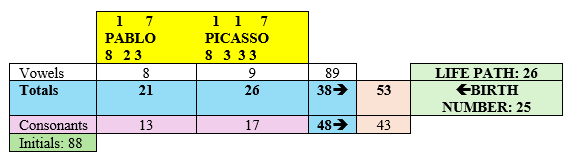
His first name Pablo equals 21, which reduces to 3.
His surname Picasso equals 26, which reduces to 8.
His total name number (TNN) is 38, which reduces to 11, and then to 2.
Step 1: Defining the Sequence Numbers
Outer level: Add the reduced numbers of the first name, surname, and TNN, then reduce to a single digit. For Picasso: 3 + 8 + 2 = 13 → 4.
Inner level: Use the TNN. For Picasso, that’s 38 → 11 → 2.
Alternative Ways to Arrive at the Same Sequence
Outer level: sum of reduced TNN, total vowels, and total consonants. For Picasso: 8 + 3 + 2 = 13 → 4. Inner level remains the TNN (38 → 11 → 2).
Outer levels can also be represented as a doubled TNN.
In every case, we arrive at the same personal sequence.
For Pablo Picasso, the resulting sequence is 4, 2, 4. This is his main balancing sequence, helping harmonize the energies of his name and surname.
The Numerological Theory Behind the Sequence
The reduced TNN (in the center of the sequence) acts as the core name number through which fresh energy flows into our system. This is true even with challenging numbers such as 4 and 8. In a sense, this central number connects us to prenatal levels of existence.
The outer numbers represent overall functioning, but they also contain the prenatal aspect of the TNN (since it is part of the sum that produces them). This creates a level of wholeness.
The TNN, appearing both at the center and hidden within the outer sums, ties the entire sequence together into unity and completeness.
Notice that the outer numbers are always a multiple of the central one. Picasso’s sequence is 4, 2, 4. If someone’s TNN were 8, its doubled value would reduce to 7 (8+8=16 → 7). Their sequence would be 7, 8, 7. This doubling holds the creative potential of duality.
The outer layer, as the field of total action and dual reflection, allows the frequency to move beyond the narrow frame of the body and aura, reaching into the wider world. Anyone familiar with energy manifestation knows: for an idea or message to manifest, it must leave the inner system and move outward.
So even though duality is at play, the presence of the TNN at all three levels, along with the sum of the outer numbers, expresses connection, unity, and wholeness.
Side Note: Consonant Sequence
You can also derive a consonant sequence. For Picasso, this is 6, 3, 6. But it works much more weakly than the main sequence, since the latter integrates both the whole-name numbers (first, surname, TNN) and the total vowel and consonant values.
Aramaic codes for Latin alphabet, used in Chaldean numerology
How to Use the Sequence
Visualization: Imagine a sphere in front of you, and inside it, sequentially project the numbers of the sequence. After the last number, pause briefly, then begin again. Practice consistently over time.
Repetition: Silently or softly whisper the sequence. After the last number, pause, then repeat. Again, regular practice is key.
Some people also write the sequence down. But there’s a catch: a written sequence remains as a sequence only while we perceive it that way. If written repeatedly, it may start to vibrate as a single number. For Picasso, 4, 2, 4 would collapse into 424 → 4+2+4=10 → 1. This could be problematic if 1 is not suitable for balancing the person’s chart. In such cases, the meaning of 10 would also need to be considered. Similarly, the sequence 787 would introduce the influence of 22, which is often highly challenging.
Final Thoughts
Practicing with sequences, depending on the individual, brings more wholeness, more prenatal influence, and more balance from harmonized numbers (especially important when dealing with unfavorable ones).
If you decide to try working with your main name sequence—good luck with your practice!
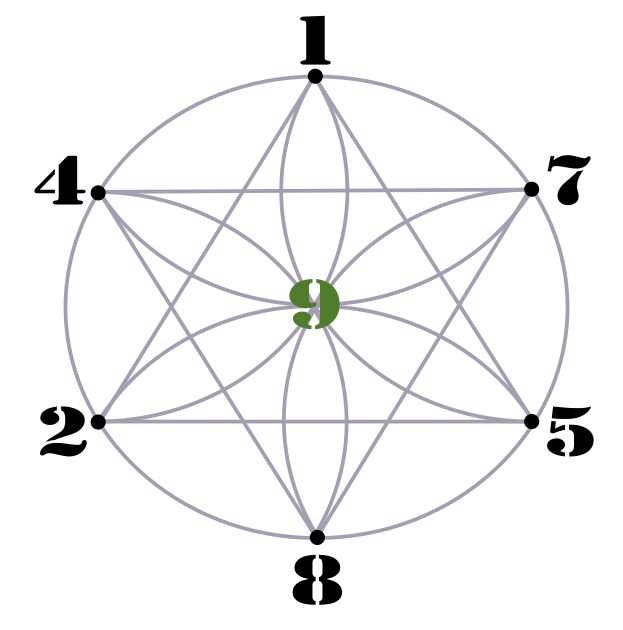
Here is another possible connection between numbers and the Germ of Life. It likely doesn’t stem directly from the Chaldean tradition. It follows the doubling sequence: 1, 2, 4, 8, 7 (from 16), 5 (from 32 or 14)… but not in that exact order. Instead, it appears in the sequence defined, for example, by the formula:
1/7 = 0.142857…
Opposing values add up to 9, which makes this a kind of “magic hexagon”—in a similar sense to how we also know “magic squares.”
Nowadays, the study of sacred geometry and the so-called Flower of Life has become very popular. It’s important to note, however, that sacred geometry operates within the basic matrix and the dualistic world—and it also contains certain hidden pitfalls.
Within the Flower of Life lies the so-called Germ of Life, composed of six petals, which includes six points around the edge and one central point. These seven points are then associated with the planets.
In Arabic numerology, which in many ways is a successor to Chaldean numerology, there is also a solution of connecting the seven classical celestial bodies (the five planets, the Sun, and the Moon) with the seven points in the Germ of Life. I’m including an image of it that speaks more than a thousand words. This system was published nearly 100 years ago by the numerologist Mabel Louise Ahmad, wife of numerologist Sheikh Habeeb Ahmad.
You’ll notice that the planets—or rather, the seven luminaries—are divided into two triangles, except for the Sun, which is placed at the center. The luminaries are divided based on whether they move faster or slower across the sky than the Sun. The slower-moving lights are arranged in one direction around the circle, while the faster ones are arranged in the opposite direction.



 The Mystery of Numbers, Luck, Worlds and Planets