Chaldean Numerologists: Darja Bohiinc

Darja Bohiinc is a Slovenian numerologist specializing in Chaldean numerology. I am not personally familiar with the exact alphanumeric coding system she uses. In a 2019 article, she mentioned that letters correspond to values ranging from 1 to 8.[1] Since she trained under Chaldean numerologist Emily Enveritas, it would be reasonable to assume she adopted Cheiro‘s alphanumeric system. However, in another article discussing house numbers, journalist Sara Lipovšek illustrated Darja Bohiinc’s explanations using a coding approach advocated by Andrej Kikelj.[2]

Regardless, Darja Bohiinc has publicly shared the painful experience that followed her name change. It’s evident from her case what surname changes can entail. While her birth number is not known to me, even her name numbers can reveal a great deal. Below, I present her numerological charts based on Cheiro’s alphanumeric coding.

Originally, her name was Darja Tavčar,[3] with a total name number (TNN) of 98 (or 17 and 26 on a secondary level). The base number for these was 8, associated with Saturn. Darja Bohiinc herself has stated that this name was consistent with her birth data. According to her teacher Emily Enveritas, an 8 is favorable for individuals with the numbers 3, 7, 8, or 9 in their birth dates.[4]

In this chart, the total sum of consonants and the total name number correspond to base numbers 4 and 8, which is difficult to interpret. Most people are not happy with such a combination, but it all depends on karma and awareness – for some individuals, this combination can bring good fortune. The remaining numbers suggest that Darja Tavčar might carry vibrations that could partially lean in this direction. At the consonant level, there is a relationship between 15 and 76, and the number 15 from the consonants is also connected to the surname number 17. Since 15 should not meet base numbers 4 or 8, this could be unfavorable. The question is how much the other numbers in this chart have managed to soften such a relationship

After marriage, she adopted her husband’s surname, Bohinc. Half a year later, in 1998, she was involved in a devastating traffic accident that claimed the life of her two-year-old son, and leaving her with severe injuries and permanent damage. With this surname change, her TNN shifted to 95 (and on secondary levels, to 14 and 32). The base number for these is 5, associated with Mercury. The old TNN of 8 didn’t disappear instantly but instead clashed with the new TNN of 5, which sought dominance. Much depends on birth date numbers; if her date contains base numbers 3 or 8, it adds further tension with the number 5.

Name changes often result in temporary energetic turbulence, as old energies depart, and new ones settle in. The number 5 governs movement, while the number 8 often brings challenges or illness. Together, they may signify limitations in movement or even an accident in motion, like a car crash. The number 95 falls to the number 14 series, which sometimes suggests the risk of traffic accidents. If Darja Bohiinc was born with base numbers 3 or 8, this could additionally provoke vehicle accidents or accidents while in motion.

At the consonant level, the numbers 7 and 15 combine to 76, which is considered a form of the number 13. The numbers 13 and 15 should not intersect, as when they do, they can signify negative energies—representing “the devil” (15) and “death” (13). Here, 76 or 13 doesn’t carry luck but rather signifies misfortune, an accident, or a harsh trial. Its base number is 4. This number stands next to the number 95, which, in combination with the number 8, can indicate car accidents (or other traffic accidents). Furthermore, the internal relationship between base numbers 5 and 4 is moderately favorable, slightly easing the situation.

Given the strong presence of the number 5 in her new name, and the idea that, for a woman, the number 5 can also symbolize sons, this suggests the symbol of a car accident (or traffic accident on general) could extend to her son. In contrast, for son’s 5, base number 4 represents an external relationship, typically neutral. However, since the number 13 is unfortunate, this interaction ultimately becomes unfavorable. Of course, much depends on her son’s numerology chart and his other astrological indicators (such as Western astrology or Chinese astrology, like Bazi). Still, the Chaldean numerology of family members can reveal insights, as we’ve seen in discussions about Prince Harry and the tragic experiences of numerologist Linda Goodman, who suffered from the disappearance of her daughter.

Returning to Darja Bohiinc, many years after the tragedy, she met numerologist Emily Enveritas and added an extra “I” to her surname in an attempt to avoid numbers associated with the traffic accident and other issues that had restricted her movement for years. Only later did Bohiinc realize that this name change introduced disharmony, leading to emotional challenges, but she also became more gentle in nature.[5]

What does her current numerology chart reveal? Here, her TNN is now 96 (and on secondary levels, 15 and 33). The base number for these is 6, ruled by Venus, a feminine and softer planet. According to Emily Enveritas’s approach, TNN 8 (in her oldest chart) and TNN 6 align only with birth date numbers 3 and 9.[6] However, there remains a concern at the consonantal level, where the connection between “the devil” and “death” is still evident. The combination of number 15 with any four can also bring emotional wounds and depression. Since TNN 96 is another form of 15, this effect intensifies, impacting the most vital area of her numerological chart.

Darja Bohiinc has stated that she has learned to live with these new vibrations and wouldn’t change her name again. Yet, she cautions that changing a name or surname is risky, as it introduces new vibrations that can have unexpected effects. I agree with this view. My first article on my website addressed the potential pitfalls of changing a name or surname.

A few words about her hobbies, profession, and interests: she is drawn to esoteric knowledge, such as Access Bars, numerology, and astrology. She also enjoys dancing, cycling, swimming, and good food.[7] All three of her numerology charts contain indicators for spiritual and occult interests. All of her charts exhibit a relationship between 15 and 4, which governs the occult. When this combination is present, one must be cautious not to exploit others or become exploited. In her second chart, where she appears as Darja Bohinc, the prominent number 5 may indicate an interest in numerology. The number 5 also rules movement, while the number 6 governs dancing, exercise, spas, and good food.


Sources:

[1] Moia.in (february 27, 2019): Darja Bohiinc: Numerologija nas uči razumeti sebe in spoštovati drugačnost. https://www.moia.in/darja-bohiinc-numerologija-nas-uci-razumeti-sebe-in-spostovati-drugacnost/

[2] Lipovšek, Sara; Revija Jana (unknown year): Kakšno energijo v vaš dom prinaša hišna številka. The article was found on: https://www.numerologija-darja.si/mediji/

[3] Moia.in (february 27, 2019): Darja Bohiinc: Numerologija nas uči razumeti sebe in spoštovati drugačnost. https://www.moia.in/darja-bohiinc-numerologija-nas-uci-razumeti-sebe-in-spostovati-drugacnost/

[4] Veroti, Taja- Tjaša (now Emily Enveritas; 2005): (Po)moč numerologije. Vodnik po numerologiji. Page 70.

[5] Paukovič, Lara (unknown year). Numerologinja Darja Bohiinc: Karma je naše ogledalo. In: Zvezde so rojene. The article was found on: https://www.numerologija-darja.si/mediji/

[6] Veroti, Taja- Tjaša (now Emily Enveritas; 2005): (Po)moč numerologije. Vodnik po numerologiji. Page 70.

[7] Comino, Andrea (january 26, 2023): Numerologinja Darja Bohiinc: Radovedna od malega; https://obalaplus.si/numerologinja-darja-bohiinc-radovedna-od-malega/
Spiritual Teacher and Chaldean Numerology: Mooji

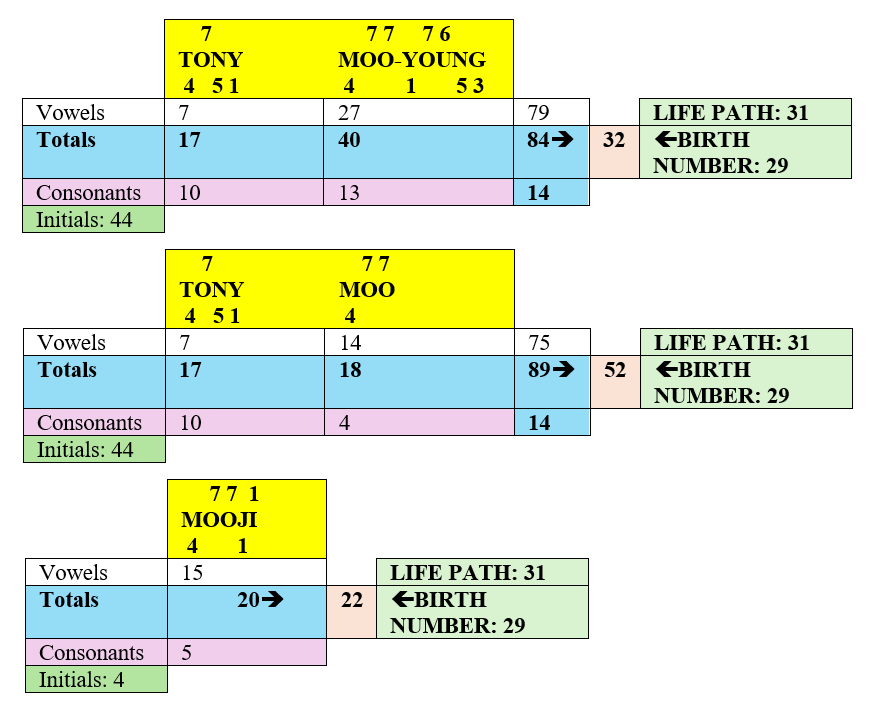
Mooji (born Anthony Paul Moo-Young, January 29, 1954) is a spiritual teacher based in Portugal, where he lives in the Monte Sahaja ashram and shares teachings rooted in Indian philosophy, specifically from the Advaita (non-dual) tradition. According to this philosophy, an individual’s self is intrinsically connected to the Supreme Being, or pure consciousness. Nature, too, is said to be interwoven with this pure consciousness, and the world of duality is viewed as an illusion. Mooji studied under the renowned spiritual master Papaji. A unique aspect of their school is the possibility of spiritual awakening through spontaneous laughter.

Mooji is known as Tony Moo-Young and also as Tony Moo, although he has long been most widely recognized by the name or nickname “Mooji.” In his numerology chart, there is a significant relationship between the numbers 3 and 7, which points toward a quest for spiritual enlightenment. He also possesses additional indicators aligned with this direction. Furthermore, the numbers 2 and 7 in his chart signify a desire for integration and unity. Another set of numbers—2, 3, and 5—indicates a focus on purification and self-cleansing. Mooji’s chart reveals certain placements suggesting he has a choice between following a path of genuine spirituality or one of illusion. Mooji has committed to the Advaita path, and vibrations in his name indicate support from spiritual forces in this pursuit.

His numerology chart also suggests a strong connection to communication, which may include speaking, recording, or writing books—and Mooji is known for all three. Born on the 29th, Mooji’s life path number is associated with the Moon, which, when favorably placed, enhances communication skills. His life path number, base 4, is also associated with Uranus, representing the public sphere, media, and television. These numbers in connection with his name encourage greater communication, publicity, and charisma.

Mooji. Source: Wikimedia Commons; File:Mooji biography.jpg

Mooji’s most powerful numbers are 2 and 4. He had a son who passed away from pneumonia in 1994. In numerological terms, his son may be associated with numbers 5, 6, or 8. Mooji’s chart shows a potentially challenging relationship between base numbers 5 and 8—where 5 can be linked to the respiratory system and 8 to illness in general. Reviewing his son’s numerology chart could offer additional insights.

In 1985, Mooji’s sister was paralyzed after being shot in a police raid. It’s likely that she is represented by the number 5 in Mooji’s chart, which faced challenges with the numbers 3 and 8, where 3 could represent law enforcement or authority, and 8 signifies karma or judgment. The number 5 often represents mobility or a limitation of it. It would be beneficial to examine his sister’s numerology chart for a fuller understanding. Generally, when examining the influence of someone’s chart on their relatives’ fates, it’s recommended to review their family members’ charts as well.

Returning to Mooji, his chart under the name “Tony Moo” shows several indicators of both fame and spirituality. It would be fascinating to explore how self-inquiry, meditative states, and spiritual practices, as well as the many satsangs he conducts, influence not only Mooji’s life path but also those close to him.

Tarot and Chaldean numerology

Shortly after the creation of the Italian tarot cards, numerous versions with incorrect numerological sequences emerged. The numerologically correct system is the Marseille tarot, as it maintains the appropriate links between the meanings of tarot cards and the ancient descriptions of numbers. Recently, inaccurate information has surfaced regarding how individual tarot cards are connected to the numbers as known in Chaldean numerology.

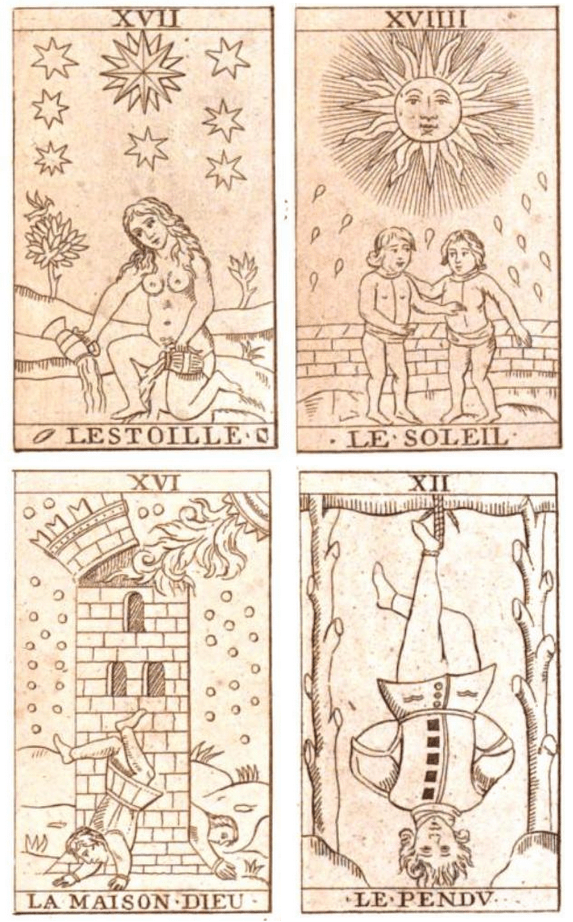
Without delving into the numerological philosophy of tarot, it can be stated that in the late 19th and early 20th centuries, Chaldean numerologists used connections between numbers and tarot cards, as illustrated below.

In some cases, the numerological names differ from the most established names. For example, the number 11 is called Lion Muzzled. The card The World is referred to as the Crown of the Magi. The Three of Cups and Three of Coins are called Reaper, as these cards share meanings with the card Reaper XIII. Many terms originate from French occultists of the 19th century, who sought the origins of tarot in ancient Egypt and named individual cards or numbers with pagan names.

The cards of the Major Arcana in Chaldean numerology are typically named as follows:

  • 1 – I. The Magician, the Juggler
  • 2 – II. The Door of Hidden Sanctuary, the High Priestess
  • 3 – III. The Empress, Isis-Urania
  • 4 – IV. The Stone Cube, the Emperor
  • 5 – V. The Master of the Arcana
  • 6 – VI. The Two Ways, the Lovers
  • 7 – VII. The Chariot of Osiris
  • 8 – VIII. The Justice, The Balance and Sword, Themis
  • 9 – IX. The Veiled Lamp, the Hermit
  • 10 – X. The Wheel of Fortune, the Wheel, Sphinx
  • 11 – XI. The Clenched Hand, the Lion Muzzled, the Force
  • 12 – XII. The Sacrifice, the Hangman, the Victim
  • 13 – XIII. The Reaper, the Death, the Scythe, the Reaping Skeleton
  • 14 – XIV. Temperance, the Two Urns, Solar Spirit
  • 15 – XV. Typhon or Devil (especially when associated with 4 or 8)
  • 16 – XVI. The Blasted Tower, the Ruined Tower, the Shattered Citadel
  • 17 – XVII. The Star of the Magi
  • 18 – XVIII. The Twilight, the Blood-stained Path
  • 19 – XIX. The Prince of Heaven, the Blazing Light
  • 20 – XX. The Awakening of the Dead, the Judgment
  • 21 – XXI. The Crown of the Magi, the Universe
  • 22 – XXII. Full, the Blind Fool, the Crocodile

Following are the Minor Arcana, which appears in four suits. The names of the four suits in tarot are usually wands, cups, swords, and coins/pentacles. In Chaldean numerology, we generally use the term scepters for wands, and coins for pentacles.

Unlike the Major Arcana, the meanings of the Minor Arcana cards, particularly the pip cards, unfortunately lack connection to their ancient numerological meanings. The number 43 or Three of Cups in Chaldean numerology is, for example, considered unlucky, whereas in the general modern interpretation of tarot, it has a favorable meaning. The interpretations of numbers also differ in content.

Therefore, I strongly advise against interpreting numbers in Chaldean numerology using modern French descriptions of the Minor Arcana and other descriptions of this arcana that stem from French interpretations.

Tarot is also a tool of a divination matrix – once we determine the meanings of a chosen card, that card will “bear” or “communicate” the meanings we have attributed to it. In interpreting numbers in Chaldean numerology, however, such an approach cannot be applied; instead, the meanings must be connected to the actual nature of the numbers. Therefore, we must take into account the exact sequence in the naming.

Minor Arcana:

  • 23- The Royal Star of Lion, King of Scepters
  • 24- The Queen of Scepters
  • 25 – The Knight of Scepters
  • 26 – The Page of Scepters
  • 27 – The Scepter, Ace of Scepters
  • 28 – Two of Scepters
  • 29 – Three of Scepters
  • 30 – Four of Scepters
  • 31 – Five of Scepters
  • 32 – Six of Scepters
  • 33 – Seven of Scepters
  • 34 – Eight of Scepters
  • 35 – Nine of Scepters
  • 36 – Ten of Scepters
  • 37 – The Royal Star of Bull, King of Cups
  • 38 – The Queen of Cups
  • 39 – The Knight of Cups
  • 40 – The Page of Cups
  • 41 – The Cup, Ace of Cups
  • 42 – Two of Cups
  • 43 – The Ripper, the Point of the Reaper, the Death Point, Three of Cups
  • 44 – Four of Cups
  • 45 – Five of Cups
  • 46 – Six of Cups
  • 47 – Seven of Cups
  • 48 – Eight of Cups
  • 49 – Nine of Cups
  • 50 – Ten of Cups
  • 51 – The Royal Star of Aquarius, the Royal Star of the Waterman, the King of Swords
  • 52 – The Queen of Swords
  • 53 – The Knight of Swords
  • 54 – The Page of Swords
  • 55 – The Sword, Ace od Swords
  • 56 – Two of Swords
  • 57- Three of Swords
  • 58- Four of Swords
  • 59 – Five of Swords
  • 60 – Six of Swords
  • 61 – Seven of Swords
  • 62 – Eight of Swords
  • 63 – Nine of Swords
  • 64 – Ten of Swords
  • 65 – The Royal Star of Scorpio, King of Coins
  • 66 – The Queen of Coins
  • 67 – The Knight of Coins
  • 68 – The Page of Coins
  • 69- The Mars Crowned, The Crown of Mars, the Coin, Ace of Coins
  • 70 – Two of Coins
  • 71 – The Ripper, Three of Coins
  • 72 – Four of Coins
  • 73 – Five of Coins
  • 74 – Six of Coins
  • 75 – Seven of Coins
  • 76 – Eight of Coins
  • 77 – Nine of Coins
  • 78 – Ten of Coins

Fixed Stars and Constellations in Chaldean Numerology

Although Western astrology is based on the seasons (tropical system), Chaldean numerology also explores connections with fixed stars and constellations. The development of Chaldean numerology was undoubtedly influenced by Egyptian sidereal astronomy (circa 3000 BCE) and later, during the Hellenistic period, by Egyptian sidereal astrology (ancient decans).

There is ongoing debate about whether an ancient Chaldean astrology (around the 5th to 4th century BCE), was based on sidereal or tropical astrology. My personal opinion is that the shared astro-numerological foundation was sidereal, although I won’t delve into proving this here. If true, Chaldean numerology is, in a way, closer to Indian astrology (which is sidereal) than to Western astrology (which is tropical).

The basic fixed stars in Chaldean numerology include the four so-called “royal stars,” associated with the following numbers:
23 – The Royal Star of the Lion, or Regulus
37 – The Royal Star of the Bull, or Aldebaran
51 – The Royal Star of Aquarius, or Markab (contrary to the common notion that Fomalhaut is the royal star in this sign)
65 – The Royal Star of Scorpio, or Antares

These four stars can also be combined with planets represented by specific numbers. For instance, 23 represents Mercury in conjunction with Regulus, 37 represents the Sun in conjunction with Aldebaran, and 51 represents Venus in conjunction with the star Markab. The conjunction between the Moon and Antares symbolizes the number 65.

Chaldean numerology can be used to designate additional stars. Various criteria exist for categorizing stars numerologically, and according to one criterion, the following fixed stars can be defined:
21 – Polaris
82 – Arcturus
91 – Sirius

Some constellations include:
11 – Virgo and Leo
17 – Andromeda
37 and 111– Pleiades
13 and 43 – Draco

Other interpretations are also possible.

Andrej Kikelj: “Radiesthesia School” of Chaldean Numerology and Exploring New-Old Meanings of Individual Letters

In 2010, Slovenian researcher Andrej Kikelj published a revised version of the Chaldean numerology method on his website astronumero.org. Through radiesthesia and study, he modified the encoding of individual letters, establishing new numerical correlations.[1] His interpretative approach incorporates Pythagorean principles, including vowel and consonant numbers,[2] master numbers,[3] personal days, months, years, and “pinnacles.”[4]

Kikelj’s general alpha-numeric table takes into account certain Central European pronunciations. In this Germanic-Slavic linguistic region, the letter “H” corresponds to the sound of the ancient letter ḥet, with a phonetic value of 8. The letter “T” can have phonetic values linked to the letters and sounds tau (4, 22, and 400) or ṭet (9), while the letter “S” is widely pronounced as the sound and letter samek (6, 15, and 60) across all Europe. Through radiesthesia, Kikelj assigned the letter “T” a value of 9 and attributed the number 9 to the letter “E” as well.

Chaldean Alphanumeric Encoding According to Andrej Kikelj

In addition to a general table for converting the English alphabet to numbers, he created tailored tables for the Slovenian[5] and Croatian[6] alphabets. For example, he associated the letters “Š” and “Ž” with the traditional Croatian and Slovenian interpretation, linking them to the letter shin with values of 3, 21, and 300, and the letter zayin with values of 7, 16, and 70. He sees a phonetic connection of the letters “Ć” and “Č” with the letter ṣadi, valued at 9. For the values of “,” “Đ,” “NJ,” and “LJ,” Kikelj couldn’t rely on established tradition and arrived at unusual results through radiesthesia.

Incorporating radiesthesia, aura readings, and similar methods into Chaldean numerology requires careful consideration of what we’re actually measuring. Are these the isolated vibrations of individual letters or the typical vibrations of letters within a word? Are we measuring the letters themselves or the sounds they represent? Without knowing exactly what we’re measuring, there’s a risk of methodological error.

It’s essential to understand that Chaldean numerology (also known as Aramaic or Ancient Hebrew numerology) was originally based on letter values rather than phonetics. In ancient Hebrew script, the final sounds “a,” “e,” and “o” were all recorded as the letter he, with a numerical value of 5.[7] So, the letters create their own alphabetic matrix, and European numerologists realized centuries ago that the letter “C” should have a value of 3, and the letter “H,” despite originating from the letter ḥet, should be valued at 5. They assigned the letter “E” a value of 5 and the letter “O” a value of 7, forming a letter-based matrix used for the Latin alphabet.[8]

I agree that in Central Europe, the letter “H” corresponds phonetically to the sound of the ancient letter ḥet, just as the European sound represented by the letter “S” could relate to the ancient letter samek, valued at 6, 15, and 60. Phonetically, the sound and letter “O” might align with the number 6 and the letter vaw, while the value of “E” could be closer to the letter yod, with values of 1 and 10.

Mixing alphabetic and phonetic matrices creates a variety of possible new matrices, each carrying at least some level of energy potential. However, not all matrices possess the same strength of energy potential. When testing names with Kikelj’s method, the results did not appear to me as consistent as those achieved using the classic Chaldean alphanumeric table, whether according to Cheiro’s guidelines or the older tradition as described by Richard Cavendish. Nonetheless, you can explore Kikelj’s approach and try it yourself using the information he provides on astronumero.org.

Classic Chaldean Alphanumeric Encoding

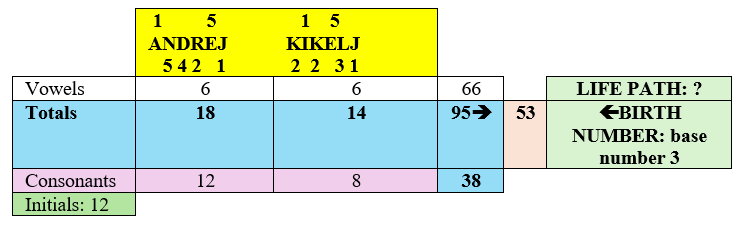
While full birth information is not available, Andrej Kikelj identifies as an Aquarius and base number 3 and shared that he became involved in bhakti yoga and meditation in his youth. His interest in spiritual knowledge has persisted throughout his life. He is also a professional translator interested in computers and programming.[9] Let’s examine Andrej Kikelj’s numerology chart, calculated using the classic method of converting letters into numbers:

His chart reveals a strong presence of the number chain 3 & 6 & 9, which often signifies an interest in spiritual life (and can also indicate a potential interest in business). Additionally, we see the chain 2 & 3 & 5, which suggests a desire to let go of old behavioral patterns. This could explain his interest in bhakti yoga (Hare Krishna) and meditation. A prominent number 5 is sometimes associated with computers and programming, and it also corresponds to Mercury, communication, and numbers.

The combination of 5 with the chain 3 & 6 & 9 partially accounts for his interest in numerology. Kikelj used to be involved in music as well, which is probably related to the sequence of numbers 3, 6, and 9. Regarding his career in translation, it’s likely connected to the association of the number 5 with 2 and 6. A fuller understanding of his interests and professions would likely require his full birth data and astrological chart.

Added on November 4, 2024: The relationship between the numbers 14 and 95 on one side and the birth base number 3 on the other could potentially lead to traffic accidents or other issues. However, in Kikelj’s numerology chart, these tendencies are balanced by the potential for spiritual growth and the release of old patterns. If he embraces these potentials, it can help to calm the energies reflected in his chart.


Some sources:

[1] Kikelj, Andrej: https://www.astronumero.org/numerology-charts/#chaldean-table-improved

[2] Kikelj, Andrej: https://www.astronumero.org/numerology-guide/name-numbers/

[3] Kikelj, Andrej: https://www.astronumero.org/what-are-the-master-numbers/

[4] Kikelj, Andrej: https://www.astronumero.org/numerology-guide/forecast-numbers/

[5] Kikelj, Andrej: https://www.astronumero.org/numerologija-tabela/

[6] Kikelj, Andrej: https://www.astronumero.org/numeroloska-tablica/

[7] Schmidt Brian B. (2015): Memorializing Conflict: Toward an Iron Age “Shadow” History of Israel’s Earliest Literature, page 87. From: Schmidt Brian B., editor (2015): Contextualizing Israel’s Sacred Writings: Ancient Literacy, Orality, and Literary production.SBL Press, USA.

[8] Lovrat, Boštjan: https://bostjanlovrat.com/2024/09/11/the-use-of-the-latin-alphabet-in-chaldean-numerology/

[9] Kikelj, Andrej: https://www.astronumero.org/about-us/

Decade Markers in Chaldean Numerology

In Chaldean numerology, each core number is associated with specific “decade markers,” which means that each decade of a person’s life can be influenced by unique energies or opportunities based on their numerology. These influences are even stronger if there are additional indicators in a person’s chart pointing toward similar outcomes.

Each decade marker spans ten years, but its effect is usually strongest at the start of the decade. For instance, the marker for ages 50 to 60 is most powerful at age 50 and may even begin to influence the individual slightly before their birthday.

For example, a person with the number 2 might, in their fifties (from age 50 to 60), find new opportunities to develop skills in public speaking and communication. Of course, the outcome depends on other factors, like their confidence level and whether they’re already in fields with opportunities for public presentation, such as radio, acting, or public speaking.

A person with the number 5 in their thirties (from age 30 to 40) might experience an opportunity to process and release certain unhelpful behavioral patterns.

Someone with the number 6 in their sixties may find opportunities to turn toward spiritual interests or improve their material well-being, possibly achieving greater success in business.

A person with the number 9 might experience a similar opportunity for career or financial advancement in their forties.

While this theory suggests general trends, in practice, some decade markers are stronger than others, and not every influence is equally powerful for everyone.

November 1st and Chaldean Numerology

November 1st marks an ancient holiday of Celtic origin, closely associated with the transition between the world of the living and the world of the dead. On the eve of this holiday, many celebrate what we know as “Halloween,” which has its roots in the mythology surrounding November 1st.

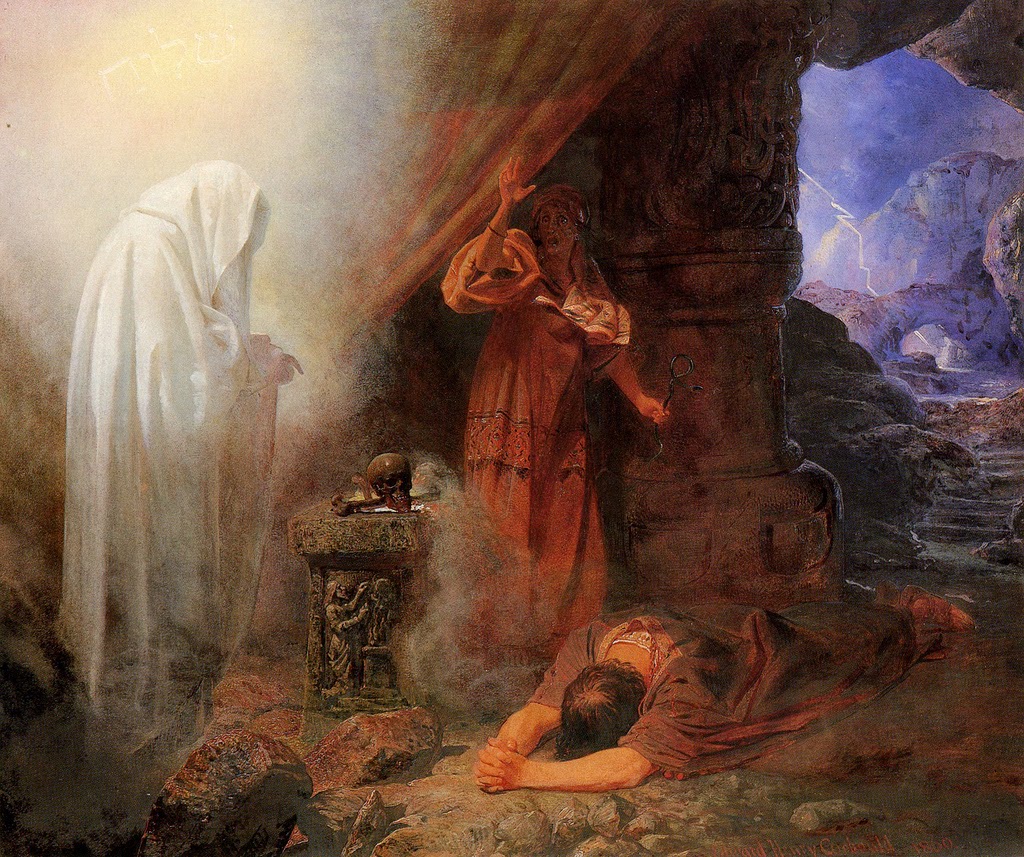
In various cultures, such as in China, the spirits of ancestors are especially honored. There, rituals often involve invoking the spirits of the deceased for guidance and protection. In contrast, Jewish tradition typically discourages any contact with spirits from the afterlife. As stated in the Bible: “Do not turn to the spirits of the dead and do not seek familiar spirits to become unclean by them. I am the Lord your God” (Leviticus 19:31). However, in times of distress, it seems calling upon the spirits of holy individuals might have been acceptable. For instance, Saul visited the Witch of Endor to summon the spirit of Samuel for advice (1 Sam 28).

»Saul and the Witch of Endor«. Author: Edward Henry Corbould, 19th century

Many Christians hold the belief that it is permissible to call upon the spirits of saints, including apostles and the Virgin Mary. Personally, I tread carefully around the idea of invoking the souls of the deceased. So, why is November 1st significant in this context?

The Celtic calendar celebrates the changing seasons with significant dates: summer on August 1st, winter on February 1st, spring on May 1st, and autumn on November 1st. As Celtic culture spread from Portugal to Eastern Europe and from Ireland to parts of Turkey, these dates evolved into important pagan festivals throughout Europe.

The Celts referred to the November 1st celebration as Samhain. This festival signified the autumn transition from summer to winter. The Celts believed that during Samhain, the barrier between the living and the dead was especially thin, allowing spirits to return to the realm of the living. The Celts performed various rituals to honor their ancestors (the benevolent spirits) and to protect themselves from potentially malevolent forces.

Autumn truly represents a shift from the world of the living to the world of the dead. Harvests are gathered, fields lie fallow, and nature begins to quiet down. In ancient farming communities, work slowed down, livestock were brought in from pastures, and wolves started to approach settlements. Additionally, travel routes, while still accessible, became vulnerable to bandits and invaders, posing a serious risk to neighboring tribes. Thus, this period was characterized by a search for safety, but also by danger, conflict, and death.

Spiritually speaking, the autumn transition serves as a passage into the other world, akin to crossing through a portal into the afterlife. The Celts and many others believed that during this time, the boundary between living and the dead blurred. This symbolism extends to our relationship with the other side, suggesting that among the spirits of the departed, one could encounter both benevolent guardian spirits and malevolent entities.

Can this symbolism be connected to Chaldean numerology? While Chaldean numerology developed in a very different cultural context than Celtic traditions, there is a fascinating link between the significance of November 1st and numerological symbolism. November is associated with the astrological sign of Scorpio, which governs the mysterious and the occult. Additionally, November aligns with the 8th house in astrology, which concerns issues of illness and death. The planetary rulers of Scorpio are the assertive Mars and, in modern astrology, Pluto, the lord of the underworld.

The first day of the month embodies the energy of the Sun, symbolizing life. This energy meets the energies of the underworld and the spirits of the deceased. The Sun in Scorpio also serves as a reminder that it is important to seek peace and distance from aggression in our lives. Ultimately, God remains the true Guide, even in the shadowy realms. Through peace and love, we can find protection from malevolent forces. In this way, we can discover salvation in this world and in the afterlife and let our hope shine like a beacon into the other world.