Isidore Kozminsky was reportedly born on October 25, 1870. He grew up in a family of Australian Jews and jewelers. He was known as an astrologer, numerologist, and an expert on gemstones and the Kabbalah. Because he married outside of Jewish circles, he adopted the name Francis Coton and moved with his family from Australia to London in 1935. Isidore Kozminsky remained his pen name. He died during World War II, but the exact time and cause of his death are unclear. One account suggests he died after tripping down an escalator in the London underground, while another claims he succumbed to pneumonia.

His numerological chart for the name Isidore Kozminsky shows a strong and quite favorable alignment of energies. It includes the auspicious numbers 23 and 55, as well as the number 96, which can be unfavorable (depending on how often it encounters the numbers 4 and 8). His chart reveals a strong relationship between 1 and 6, which often suggests a love of luxury and likely influenced his interest in gemstones. Numbers 96 and 24 bring a certain level of material comfort. Numbers 1 and 5 are positioned in a way that enhances the role of intellect, knowledge, and information. Numbers 96, 17 and 25 indicate an interest in the occult, with 96 potentially invoking darker spiritual influences. Therefore, due to the number 96, he needed to be cautious of the darker aspects of spirituality and manipulation. Base number 5 (23, 32) also signifies an interest in numbers, giving him some potential for communication and writing.
The reader can see that I treat the letter Y as a consonant. There is no consensus among numerologists on this, but studying various cases shows that it is more appropriate to treat Y as a consonant.

In 1905, Kozminsky wrote Numbers, Their Magic and Mystery, where he advocated for the Chaldean-Hebrew system with the values C = 2, H = 8, and X = 6 (the external values method of alpha-numeric coding). In 1912, he published Numbers: Their Meaning and Magic. Being an Enlarged and Revised Edition, in which he shifted to a coding system where C = 2, H = 5 or 8, and X = 5. This approach had a significant influence on Cheiro.
The method Kozminsky used for summing numbers in the Total Name Number (TNN) is controversial and outdated. Based on a specific form of Kabbalistic astrology, which Sepharial also endorsed, he identified certain numbers from 1 to 28 as having “potency of their own,” as well as numbers 37, 43, 51, 55, 65, 69, and 71. According to this system, if a name or surname corresponds to a number with its own potency, it is not reduced to a basic value. If it does not have its own potency, the number must be reduced to the first number that does. For example, the name Napoleon Buonaparte (an earlier version of the famous French general’s name) vibrates at 41 & 41. Since 41 does not have its own potency in Sepharial’s system, it must be reduced to 5 (4+1=5).

In the case of Isidore Kozminsky, we get the name value 23 and the surname value 5 (from 32, which is reduced as 3+2=5). The sum is 28, which has its own potency and therefore does not get reduced to 10. The number 28 is considered a key number and is regarded as an unfavorable one. For the name Francis (8+2+1+5+2+1+3) Coton (2+7+4+7+5), the name sums to 22 and the surname to 25. 22 is generally unlucky, while 25 was considered fortunate in older traditions. The total is 47, which does not have its own potency and must be reduced to 4+7=11. The TNN value is 11, which Kozminsky treated as neutral. Since he was born under base number 7, we get interchangeable numbers. Kozminsky likely believed that his new name, Francis Coton, would be lucky.
In horse racing, Kozminsky adopted phonetic numerology (books Numbers and Horse Racing, 1928, and My Key Treatise, 1936). He believed that for humans, the written name was influential, while for animals, the spoken name held more power. In 1937, he also published Numbers And Their Practical Application, in which he used a reformed Chaldean coding system for interpreting people’s numerological charts, diverging significantly from Cheiro’s model. He also provided weaker descriptions of numbers compared to his earlier works.
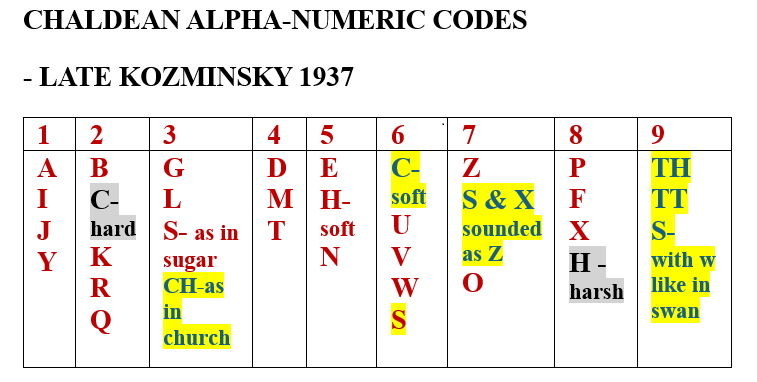
According to his reformed alpha-numeric coding system, the name Isidore Kozminsky carried the values 26 and 35. In the new book, Kozminsky did not explain how to calculate the TNN. According to his earlier method in Numbers, Their Magic and Mystery, the number 35 is not given its own potency and is reduced to 8. The sum of 26+8=34. However, the name Francis Coton gives the name value 25 and the surname value 25. These combine to 50, which he considered his TNN. Nonetheless, the alpha-numeric coding used by Kozminsky in the final years of his life no longer had much influence.
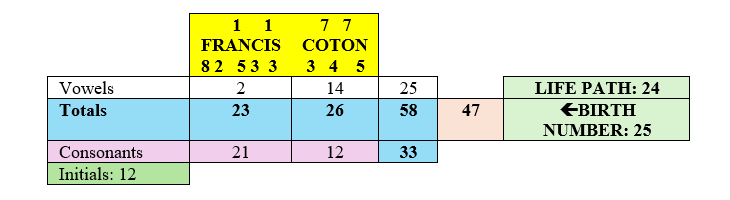
According to the classic Chaldean alpha-numeric coding model (Cheiro’s approach), the name Francis Coton results in a numerological chart, which contains more unfavorable numbers. The chart is rather weak and shows conflicts between the numbers 23 and 26, 58 and 33, 26 and 58, and 33 and 28. This chart no longer indicates as much interest in gemstones, although some financial potential and interest in communication remain. The strong number 58 indicates a tendency toward eccentricity and reforms, which likely did not go in the right direction. We can see that Kozminsky’s numerological expertise declined in his later years. The information he disseminated lost touch with the Chaldean tradition and reliable interpretation.
Numbers 58 and 71 together emphasize the themes of death and difficulties. The surname Coton carries very unfavorable vibrations of 26 and 12, represented as a pillar. This might have influenced the spread of the story about the escalator accident. The numbers 8 (2+6=8) and 3 (1+2=3) can represent buildings, with 8 also symbolizing railways and underground structures. The number 12 can represent a pillar, which may symbolize ascending or descending via escalators. The conflict between 58 and 33, and between 23 and 26, could be connected to respiratory illnesses. Thus, both stories of his death have roots in his numerological chart. The interaction between number 58 and numbers 26 and 71 represents a conflict between base numbers 4 and 8. This pair often indicates significant difficulties and suffering. 58 is also an unfavorable TNN for period 6 (October, extended influence of Libra).
It becomes clear that in Isidore Kozminsky’s case, the name and surname change brought about unfortunate circumstances. Fortunately, Isidore Kozminsky continued to use his original name in his writing. The number 69 in the name Isidore Kozminsky also interacts with the number 58 in the name Francis Coton, adding to the negative influences. 69 reduces to 15, and 15, in its negative aspect, represents manipulation and even black magic. This might explain why Kozminsky’s books carry an unusual vibration. After reading them, I had to cleanse my aura several times. It would have been much better if Isidore Kozminsky had kept his original name in his everyday life. So, a word of caution: one must be careful when changing names. The goal of a name change should be to increase satisfaction or success in life, not to accumulate problems.
Some sources:
- https://harpermcalpineblack.blogspot.com/2017/03/isidore-kozminsky-magic-and-science-of.html
- https://www.astro.com/astro-databank/Kozminsky,_Isidore
- Hannah Finne (2012): Foreword. From: Isidore Kozminsky: Crystals, Jewels, Stones: Magic & Science. Nicolas-Hays, Inc.,
- Kozminsky, isidore (1911 or 1912): Numbers: Their Meaning and Magic. Being an Enlarged and Revised Edition.
- Kozminsky, Isidore (1937): Numbers And Their Practical Application.

 The Mystery of Numbers, Luck, Worlds and Planets