The ancient Latin alphabet did not include the letters U, W, and J and question could be raised of how to associate these letters with Chaldean numerology. It is clear that the letter U developed from the letter V, which in turn originated from the Semitic letter waw, which has the value of 6. It is also evident that U is always used as a vowel.
The letter W also evolved from the letter V. Its original notation was V V, or UU, with a numerical value of 6+6=12. Over time, a new representation of this consonant became established, which, due to its connection with the letter waw and the sound “w,” has the value of 6.
The letter J developed from the consonant yod. Although this letter is pronounced differently by different peoples, it therefore carries the vibration 10, or the reduced value of 1.
The letter Y, which also originates from the Semitic letter yod with values of 10 and 1, was present in the original Latin alphabet, unlike the letters mentioned above. The question arises as to when it should be considered a vowel and when a consonant.
Some Chaldean numerologists are now convinced that the letter Y should always be considered as a vowel. In the name “New York,” for example, Y would be considered when calculating vowels, even though it represents a consonant in this case.
Since the letter Y originates from the letter Yod, its original vibration is actually that of a consonant. While Y can be used to represent both a vowel and a consonant, its fundamental nature, due to the original vibration of the letter, remains primarily that of a consonant.
The distribution of these effects is not entirely clear, but the concrete results suggest that Y should fundamentally always be analyzed as a consonant, even when Y is associated with the vowel sound “ee.” In the case of Mike Lynch, for example, analyzing the letter Y as a vowel would lead to the loss of all indicators pointing to work with software, resulting in an incorrect analysis.
The traditional method of calculating personal years, months, and days, based on birth data, has been in use for approximately a century. This method involves considering the digits of the day and month, and then adding the digits of the current year to calculate the personal year. Subsequently, the digits of the current month are added to this result to determine the number for the personal month, and finally, by adding the digits of the current day, the personal day is obtained. Unfortunately, the method for determining personal years, months, and days mostly doesn’t provide accurate results.
As an example, let’s consider the day of Pavel Durov’s arrest—August 24, 2024. According to the traditional method, on this date, Durov would have a personal year of 1+0+1+0+2+0+2+4 = 10, a personal month of 10+8 = 18, and a personal day of 18+2+4 = 24. The number 18 can bring legal disputes. On the one hand it is favorably influenced by the number 24, which is otherwise one of the luckiest numbers in numerology. However, it is also influenced by the negative relationship with the annual number 10. Although the period could be said to work, an arrest would be expected on an inauspicious day. Yet 24 is a lucky number. How can someone be arrested on a lucky day?
In contrast, Chaldean numerology provides a precise analysis of compound numbers in the personal year, month, and day. This approach offers a powerful tool for scrutinizing established hypotheses and sheds light on the fact that not all teachings from the traditional method are universally true. It is intriguing to note that despite its strong prevalence and propagation in Pythagorean numerology, many Chaldean numerologists do not adopt this approach of personal years, months, and days.
Exploring different numerological perspectives unveils the rich complexity and potential inconsistencies within this field, prompting further contemplation and critical examination of established methods and beliefs.
In 1926, Cheiro published the “Book of Numbers,” in which he defined compound numbers (also known as fadic numbers) from 10 to 52. The descriptions I summarize here are taken from the English edition published in 1935.
The descriptions correspond in large part to very old writings on Chaldean numerology, and in part to the theory of the Tarot. However, these are not modern Tarot descriptions like those found in the works of Etteilla and others, but rather a sort of Chaldean Tarot. Some of the descriptions are also taken from the writings of Isidore Kozminsky. Based on some of Cheiro’s statements about ancient traditions, there is a reasonable suspicion that Cheiro was not the author of these descriptions. Cheiro was primarily a numerologist, astrologer and palmist, and does not seem to have dealt with the tarot in any depth. Moreover, the Tarot descriptions extend up to 78. In the modern Chaldean tradition and in the Chaldean tarot, we also know of descriptions of numbers beyond 52, specifically 55, 65, 69 and 71 (see Sepharial’s descriptions of numbers).
All the above increases the doubt about his authorship of these descriptions. On the other hand, Cheiro indicates in some of his writings that he knows at least the specific meaning of the numbers 55 and 69. The fact is that Cheiro’s descriptions have no connection with Indian tradition, although Cheiro made exaggerated claims to have received his knowledge of numerology from Indian Brahmins. In fact, all the numbers described are found in the traditions of Antiquity and in the Tarot.
So, the question of who the actual author might have been remains open. On the one hand, it could have been a person from the English high society who, due to his or her good name, did not want to become publicly associated with numerology. Engaging in occult sciences was considered inappropriate among the English nobility. Or it could simply have been a somewhat shy person who did not wish to be publicly exposed. There is some possibility, however, that this was a hidden passion of Cheiro’s, and that he therefore made the choice of descriptions in the first place.
In any case, these descriptions have been an important guide for most Chaldean numerologists since 1926. Some of these descriptions may not be the most accurate, and some numbers that are defined as lucky may be unlucky in some situations. Nevertheless, these descriptions are an important starting point when one is learning modern Chaldean numerology.
Many of today’s Chaldean numerologists seek strange solutions for numbers above 52. Where possible, it is suggested that the digits of the numbers simply be reversed and the meaning of the reversed numbers up to 52 be applied. For example, 53 is like 35 (and thus 26), 54 to 45 (and thus 27) … This is a completely misguided approach, as even the descriptions of numbers up to 52 do not allow for such digit reversals. The number 12 does not have the same meaning as the number 21, nor does the number 31 have the same meaning as 13. Likewise, 15 and 51 are different, as are 25 and 52, and 34 and 43. When reversing digits does not yield numbers with a value between 10 and 52, it is suggested that the digits simply be added together. Thus, 65 would be the usual 11, and 69 would be the usual 15. However, the modern Chaldean tradition shows that the number 65 has a somewhat different nature than the usual number 11, and the same is true for the relationship between the numbers 69 and 15.
In any case, you can check Cheiro’s descriptions in the continuation of this article.
***
Source: Cheiro (1935). The Cheiro’s Book of Numbers. London, Herbert Jenkins Limited. Pages 126-133.
10. Symbolised as the “Wheel of Fortune.” It is a number of honour, of faith and self-confidence, of rise and fall; one’s name will be known for good or evil, according to one’s desires; it is a fortunate number in the sense that one’s plans are likely to be carried out.
11. This is an ominous number to occultists. It gives warning of hidden dangers, trial, and treachery from others. It has a symbol of “a Clenched Hand,” and “aLion Muzzled,” and of a person who will have great difficulties to contend against.
12. The symbolism of this number is suffering and anxiety of mind. It is also indicated as “the Sacrifice” or “the Victim” and generally foreshadows one being sacrificed for the plans or intrigues of others.
13. This is a number indicating change of plans, place, and such-like, and is not unfortunate, as is generally supposed. In some of the ancient writings it is said, “He who understands the number 13 will be given power and dominion.” It is symbolised by the picture of “a Skeleton” or “Death,” with a scythe reaping down men, in a field of new-grown grass where young faces and heads appear cropping up on every side. It is a number of upheaval and destruction. It is a symbol of ” Power” which if wrongly used will wreak destruction upon itself. It is a number of warning of the unknown or unexpected, if it becomes a “compound” number in one’s calculations.
14. This is a number of movement, combination of people and things, and danger from natural forces, such as tempests, water, air, or fire. This number is fortunate for dealings with money, speculation, and changes in business, but there is always a strong element of risk and danger attached to it, but generally owing to the actions and foolhardiness of others. If this number comes out in calculations of future events the person should be warned to act with caution and prudence.
15. This is a number of occult significance, of magic and mystery; but as a rule it does not represent the higher side of occultism, its meaning being that the persons represented by it will use every art of magic they can to carry out their purpose. If associated with a good or fortunate single number, it can be very lucky and powerful, but if associated with one of the peculiar numbers, such as a 4 or an 8, the person it represents will not scruple to use any sort of art, or even ” black magic,” to gain what he or she desires. It is peculiarly associated with “good talkers,” often with eloquence, gifts of Music and Art and a dramatic personality, combined with a certain voluptuous temperament and strong personal magnetism. For obtaining money, gifts, and favours from others it is a fortunate number.
16. This number has a most peculiar occult symbolism. It is pictured by “a Tower Struck by Lightning from which a man is falling with a Crown on his head.” It is also called “the Shattered Citadel.” It gives warning of some strange fatality awaiting one, also danger of accidents and defeat of one’s plans. If it appears as a “compound” number relating to the future, it is a warning sign that should be carefully noted and plans made in advance in the endeavour to avert its fatalistic tendency.
17. This is a highly spiritual number, and is expressed in symbolism by the 8-pointed Star of Venus: a symbol of “Peace and Love.” It is also called “the Star of the Magi” and expresses that the person it represents has risen superior in spirit to the trials and difficulties of his life or his career. It is considered a “number of immortality” and that the person’s name “lives after him.” It is a fortunate number if it works out in relation to future events, provided it is not associated with the single numbers of fours and eights.
18. This number has a difficult symbolism to translate. It is pictured as “a rayed moon from which drops of blood are falling; a wolf and a hungry dog are seen below catching the falling drops of blood in their opened mouths, while still lower a crab is seen hastening to join then.” It is symbolic of materialism striving to destroy the spiritual side of the nature. It generally associates a person with bitter quarrels, even family ones, also with war, social upheavals, revolutions; and in some cases it indicates making money and position through wars or by wars. It is, however, a warning of treachery, deception by others, also danger from the elements, such as storms, danger from water, fires and explosions. When this ‘’compound” number appears in working out dates in advance, such a date should be taken with a great amount of care, caution, and circumspection.
19. This number is regarded as fortunate and extremely favourable. It is symbolised as “the Sun” and is called “the Prince of Heaven.” It is a number promising happiness, success, esteem and honour, and promises success in one’s plans for the future.
20. This number is called “the Awakening”; also “the Judgment.” It is symbolised by the figure of a winged angel sounding a trumpet, while from below a man, a woman, and a child are seen rising from a tomb with their hands clasped in prayer. This number has a peculiar interpretation: the awakening of new purpose, new plans, new ambitions, the call to action, but for some great purpose, cause or duty. It is not a material number and consequently is a doubtful one as far as worldly success is concerned. If used in relation to a future event, it denotes delays, hindrances to one’s plans, which can only be conquered through the development of the spiritual side of the nature.
21. This number is symbolised by the picture of “the Universe,” and it is also called “the Crown of the Magi.” It is a number of advancement, honours, elevation in life, and general success. It means victory after a long tight, for “the Crown of the Magi” is only gained after long initiation and tests of determination. It is a fortunate number of promise if it appears in any connection with future events.
22. This number is symbolised by “a Good Man blinded by the folly of others, with a knapsack on his back full of Errors.” In this picture he appears to offer no defence against a ferocious tiger which is attacking him. It is a warning number of illusion and delusion, a good person who lives in a fool’s paradise; a dreamer of dreams who awakens only when surrounded by danger. It is also a number of false judgment owing to the influence of others. As a number in connection with future events its warning and meaning should be carefully noted.
23. This number is called “the Royal Star of the Lion.” It is a promise of success, help from superiors and protection from those in high places. In dealing with future events it is a most fortunate number and a promise of success for one’s plans.
24. This number is also fortunate; it promises the assistance and association of those of rank and position with one’s plans; it also denotes gain through love and the opposite sex; it is a favourable number when it comes out in relation o future events.
25. This is a number denoting strength gained through experience, and benefits obtained through observation of people and things. It is not deemed exactly “lucky,” as its success is given through strife and trials in the earlier life. It is favourable when it appears in regard to the future.
26. This number is full of the gravest warnings for the future. It foreshadows disasters brought about by association with others; ruin, by bad speculations, by partnerships, unions, and bad advice. If it comes out in connection with future events one should carefully consider the path one is treading.
27. This is a good number and is symbolised as “the Sceptre.” It is a promise of authority, power, and command. It indicates that reward will come from the productive intellect; that the creative faculties have sown good seeds that will reap a harvest. Persons with this “compound” number at their back should carry out their own ideas and plans. It is a fortunate number if it appears in any connection with future events.
28. This number is full of contradictions. It indicates a person of great promise and possibilities who is likely to sec all taken away from him unless he carefully provides for the future. It indicates loss through trust in others, opposition and competition in trade, danger of loss through law, and the likelihood of having to begin life’s road over and over again. It is not a fortunate number for the indication of future events.
29. This number indicates uncertainties, treachery, and deception of others; it foreshadows trials, tribulation, and unexpected dangers, unreliable friends, and grief and deception caused by members of the opposite sex. It gives grave warning if it comes out in anything concerning future events.
30. This is a number of thoughtful deduction, retrospection, and mental superiority over one’s fellows, but, as it seems to belong completely to the mental plane, the persons it represents are likely to put all material things on one side – not because they have to, but because they wish to do so. For this reason it is neither fortunate nor unfortunate, for either depends on the mental outlook of the person it represents. It can be all powerful, but it is just as often indifferent according to the. will or desire of the person.
31. This number is very similar to the preceding one, except that the person it represents is even more self-contained, lonely, and isolated from his fellows. It is not a fortunate number from a worldly or material standpoint.
32. This number has a magical power like the single 5, or the “compound” numbers 14 and 23. It is usually associated with combinations of people or nations. It is a fortunate number if the person it represents holds to his own judgment and opinions; if not, his plans are likely to become wrecked by the stubbornness and stupidity of others. It is a favourable number if it appears in connection with future events.
33. This number has no potency of its own, and consequently has the same meaning as the 24- which is also a 6- and the next to it in its own series of “compound” numbers.
34. Has the same meaning as the number 25, which is the next to it in its own series of “compound” numbers.
35. Has the same meaning as the number 26, which is the next to it in its own series of “compound” numbers.
36. Has the same meaning as the number 27, which is the next o it in its own series of “compound” numbers.
37. This number has a distinct potency of its own. It is a number of good and fortunate friendships in love, and in combinations connected with the opposite sex. It is also good for partnerships of all kinds. It is a fortunate indication if it appears in connection with future events.
38. Has the same meaning as the number 29, which is the next to it in its own series of “compound” numbers.
39. Has the same meaning as the number 30, which is the next to it in its own series of “compound” numbers.
40. Has the same meaning as the number 31, which is next to it in its own series of “compound” numbers.
41. Has the same meaning as the number 32, which is next to it in its own series of “compound” numbers.
42. Has the same meaning as the number 24.
43. This is an unfortunate number. It is symbolised by the signs of revolution, upheaval, strife, failure, and prevention, and is not a fortunate number if it comes out in calculations relating to future events.
44. Has the same meaning as 26.
45. Has the same meaning as 27.
46. Has the same meaning as 37.
47. Has the same meaning as 29.
48. Has the same meaning as 30.
49. Has the same meaning as 31.
50. Has the same meaning as 32.
51. This number has a very powerful potency of its own. It represents the nature of the warrior; it promises sudden advancement in whatever one undertakes; it is especially favourable for those in military or naval life and for leaders in any cause. At the same time it threatens enemies, danger, and the likelihood of assassination.
In a previous article, we explored the differences between Pythagorean and Chaldean numerology. We examined 14 criteria and found that, in most cases, the differences were largely imaginary.
However, there is at least a 15th criterion. According to this criterion, Chaldean and Pythagorean numerology differ in that Pythagorean numerologists analyze the official name given at birth, while Chaldean numerologists take the established name in use at a certain time.
For example, Desmond Doss had the official name Desmond Thomas Doss, and according to the Pythagorean approach the whole name should be analyzed, including the second personal name Thomas. Under the Chaldean approach, only the established name Desmond Doss would be analyzed. Donald Trump has the official name Donald John Trump, and the Pythagoreans would analyze this whole name. Chaldean numerologists, on the other hand, would analyze primarily the established name Donald Trump.
THE STATEMENT IS CORRECT TO SOME EXTENT. While Pythagoreans generally analyze the birth name, Chaldean numerologists typically analyze the name currently in use. However, even among Pythagorean numerologists, some consider the common or established name. Historically, Chaldean numerology also primarily considered the birth name, arguing that it was connected to the moment of birth and the natal astrological chart. Isidore Kozminskyanalyzed current name, and he was likely the first Chaldean numerologist to advocate for analyzing a name change. Later, Cheiro also analyzed the common or established name.
In my experience, analyzing an established name in Chaldean numerology yields very good results. The birth name also resides in the energy matrix of humanity, so it certainly has some background influence. The same applies to name changes. It is rare for the energies of an old name to leave a person entirely. Often, the vibrations of the old name remain hidden in subconscious patterns locked in the muscles, fasciae, and organs of the body. However, as a rule, the old name loses its real power within a few years at the latest.
Desmond Thomas Doss (1919-2006) was commonly known as Desmond Doss. He served as a combat medic during the Second World War. He served unarmed because he claimed conscientious objection on religious grounds. He was wounded several times in combat and managed to rescue between 50 and 100 wounded men to safety at the Battle of Hacksaw Ridge. He was also decorated for his heroism. In 2016, his military career was the subject of a film entitled Hacksaw Ridge, in which he was portrayed by actor Andrew Garfield.
After the war, he could no longer work as a carpenter due to an injury to his left arm. He contracted tuberculosis and later went deaf for a while. As a disabled veteran, he lived with his family on a small farm.
Desmond Doss (born 7 February 1919)
Total Name Number (TNN) of 58 has a base number of 4 according to Chaldean numerology. In numerology, 58 is sometimes considered a variation of the number 13, which symbolizes “Death.” Although the number 4 is in principle associated with the Sun and with complex individuality, in Desmond’s case the number 4 must be associated with Uranus, an unpredictable planet. The number 58 conveys an unusual character and independence. Birth Number 7 is called “Chariot” and can bring successes or failures in war. Birth Number7 is strongly associated with Life Path 29 (base number 2). Therefore, in the event of war, Number 7 feels a great need to help others (29). Birth Number has a quite neutral attitude towards TNN, while Life path has a slightly better attitude.
Desmond Doss had a link between base numbers 1, 3 and 7 at the vowel level, and these numbers also appear at other levels. This combination represents love and faith, which influenced both Desmond’s decision to become a vegetarian and his decision to exercise his right to become a soldier who can refuse to bear arms. In his personal name he has a line of numbers 12, 32 and 20. The base numbers of the numbers are 3 (1+2=3), 5 (3+2=5) and 2 (2+0= 2). The connection between the numbers 2, 3, and 5 may highlight the importance of personal morality.
Before the war, Desmond worked as a carpenter, which is particularly associated with the consonant numbers 20, 10 and 21. The Life Path number is 29, and some of the other numbers in the chart also activate the number 20 in the consonants. The number 20, referred to as “Judgement,” can symbolize hospitals or the rescue of people on the brink of death. The base number of both number 20 and 29 is 2. People with the number 2 often work as medics or as nurses. This is how Desmond got the opportunity to serve in the army as a medic. The strong 2 in conjunction with some other numbers such as 17 in the surname brought Desmond public recognition.
During the war, he severely injured his arm. He lost part of his lungs to tuberculosis soon after the war and later went deaf for a while. The negative trend in his life is indicated on the one hand by the connection between the numbers 58, 21 and 7, and on the other hand by the relationship between the numbers 17 and TNN 58, which attracted the blows of fate into his life. The number 58 in such a configuration brings misfortune. It could represent issues (58; 5+8=13) with the limbs (32), particularly since 32 is not compatible with 17. The base numbers are 5 (3+2=5) and 8 (1+7=8). 5 represents the limbs, 8 represents the problems or illness. 5 also represents the respiratory system. 32 and 17 from the personal name and last name and 20 from the consonant level indicate emotional attachments- a combination of base numbers 2, 5 and 8. But 20 (in connection with 5 and 8) also represents microbes, which may represent a respiratory infection. This interpretation is reinforced by the challenging relationship between TNN 58 and the total consonant number 21. Temporary hearing loss may be associated with base numbers 2, 5, 7 and 8.
Caution should be exercised when analyzing health and life problems using numerology. Numerology has never been a branch of medicine. People with similar numbers and similar relationships between numbers often have similar tendencies to develop health problems and diseases, but everyone is influenced by additional factors (environment, astrology, etc.). Therefore: numerology alone does not give health predictions.
Anmarie Uber is an American numerologist of the last generation. She practices Chaldean numerology. She also specializes in astrology, tarot, massage, channeling, energy healing and Feng Shui. After changing her name to Anmarie Uber, she gained media presence, successfully published several books, and her workshops have become more popular. She has also written a book on manifesting, where she describes the techniques, she uses to overcome limitations and life challenges.
Anmarie Uber (born November 2)
With her new name, the base number from her Total Name Number (TNN) aligns with her Birth Number, 2. Both 2 and 7 are astrologically associated with the Moon and are interchangeable. When they appear together, the energetic power of such a person is significantly enhanced. Anmarie Uber has several numbers in her chart that indicate her visibility in the media. The Moon alone, when strong, can dominate the media. Additionally, there are other numbers in her chart that enhance her potential for public communication and manifestation, such as the numbers 15 and 24, which correspond to Venus. The base numbers 2, 4, and 7 are often significant in fields like occultism, astrology, and numerology. Moreover, Anmarie Uber’s chart includes several numbers that suggest a strong potential for energy healing and channeling.
Her main number for personal partnership is 7. In her chart, the number 7 appears in the compound number 16 (1+6=7). This number also corresponds to her initials, further amplifying its influence. Unfortunately, the number 16 is generally not favorable. Sepharial defined it as “XVI (16). Overthrow; ruin; catastrophe; accidents; falls; dangerous of the elements.” This number indicates that Anmarie Uber needs to put extra effort into her partnerships and be cautious of the disruptive effects of this number in both business and life. Thankfully, various techniques for manifestation and energetic clearing make this easier to manage today. Anmarie has even developed her own self-help method, which she describes in her book “Breaking Your Magnetic Patterns” (2017).
It’s also worth noting that her surname shows a connection between the numbers 15 and 4. This connection is inappropriate as it can bring trouble, strokes of fate, manipulation or manipulation by others, contact with negative entities or even black magic. This combination, along with the unfavorable nature of the numbers 11 and 4 at the consonant level, may also indicate health issues.
Anmarie Uber has thus chosen a name that emphasizes her work in the occult, her quest for knowledge about manifestation and healing, while also enhancing her intellect and potential for public recognition. However, this name also brings challenges that require Anmarie Uber to apply her knowledge and skills in practice—which can be a positive thing. There are many examples of people who have refined their potential through life’s trials.
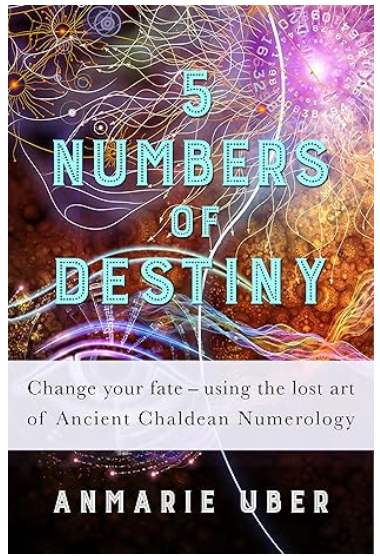
Her main work on numerology is titled “5 Numbers of Destiny” (2015), which is based on Cheiro’s system of numerology. I agree with Anmarie Uber on most of the correspondences between numbers, including Cheiro’s descriptions, which she summarizes.
Anmarie Uber uses alpha-numeric encoding as advocated by Cheiro
Anmarie Uber has placed much more emphasis than Cheiro on the number obtained from the Birth Number and from the TNN. This number is considered by some to be the Career Number or the Goal Number, but Anmarie Uber prefers to call it the Hidden Number. She has developed several rules that she believes should be used to correctly obtain this number.
She has also developed a specific system to determine what TNN and Hidden Number are appropriate for a person born on a particular day of the month. Unfortunately, it does not provide a theoretical basis for some cases that don’t align with the traditional method (for example, those born on the 28th of the month might choose TNN 31 with a corresponding hidden number of 14 – see “5 Numbers of Destiny”, pages 112-114). Personally, I do not place as much importance on the “Hidden Number.”
The big difference with my approach is certainly in the TNN analysis. I often prefer to use the technique of extracting TNNs by preserving the sovereignty of the base numbers of the first and last name- an ancient technique known and used by Cheiro. In Anmarie Uber’s case, her base numbers are 1 (1+9=10; 1+0=1) and 6 (1+5=6). If we preserve the sovereignty of these two numbers, the TNN would be 16.
Similarly, Anmarie Uber does not consider the analysis of consonants, so she has overlooked the contact between the number 15 and 4. It’s important to understand that no numerologist accounts for all key factors in their approach (and this applies to the author of this article as well!). Therefore, it’s crucial to follow some general guidelines when changing one’s first or last name.
Linda Goodman (1925-1995) was an astrologer, numerologist, radio talk show host, poet, writer and palm reader. She established herself as one of America’s best-known astrologers and as one of the pioneers of modern Chaldean numerology. In her private life, she was marked by the disappearance of her daughter Sally Snyder and was convinced that the body discovered in the police investigation did not belong to her daughter. She searched for her daughter until her death. Another of her daughters had died as a young child.
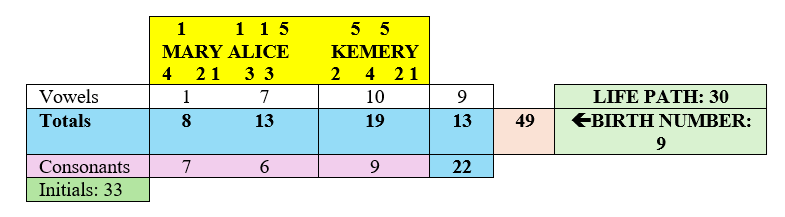
Mary Alice Kemery (born April 9, 1925)
She was born Mary Alice Kemery. The relationship between total name number (TNN) 4 and birth number 9 indicates a strong and impulsive personality who is very likely to like to be original, but for whom events in life may suddenly take an unfavorable turn. Her birthday is on the 9th of the month. This number bears the tarot name “Hermit“, bringing an interest in the occult and spiritual. The tendency towards the occult is intensified by the number 4. The relationship between 4, 6 and 7 in the names Mary and Alice may bring an interest in palmistry. Another peculiarity of her numbers is the strong predominance of the masculine numbers 1, 3 and 9, which is not very appropriate for women. These numbers have given her even more fight and determination. She also has several combinations of numbers in her first and last name, which indicate an interest in the business side of things. Other combinations indicate warmth and friendship.
When she hosted a radio show during World War II, she took the nickname Linda and, after her partner, she took his last name Goodman. She went on to publish several books under pen name Linda Goodman and to appear on radio and television.
Interestingly, this new name again features the very strong number 4, but her TNN is 9, which is consistent with both her birthday and her life path. Also, in this “pen name” we find the overpowering numbers 1, 3 and 9 again. We also find similar numbers in occultism and a combination of the numbers 4, 6 and 7 (palmistry). The relationship between 5 and 9 has probably also increased her interest in numerology. Her interest in the business side of life is also preserved. The specialty of the name Linda Goodman is that it brings more warmth, more of the spiritual and a gift for media appearances.
For people who have base number 9 in their birthday, the base number 4 may represent artistic talents. For women with base number 9, base number 4 also represents a daughter. Linda Goodman had a strong number 4, which unfortunately did not correspond with her birthday and life path numbers. As a result, her relationship with her daughters was karmically loaded. One of her daughters died as a child and the other disappeared. Linda Goodman’s base number 4 numbers represent sudden and usually unfavourable twists of fate. It is interesting that, despite her numerological knowledge, Linda Goodman has persevered with numbers that have brought her public recognition and a certain success, but also much suffering.
Linda Goodman used alpha-numeric encoding as advocated by Cheiro
Linda Goodman’s numerological approach, described in her book Star Signs, did not use vowel and consonant analysis, but she described the individual numbers in more depth than her role model Cheiro did, and she did it very well. She also departed from Cheiro in the way she determined compound number in TNN (Goodman, Linda (1987). Star Signs. Pan Books. Pages 152, 157, 160, 162, 170-171). Her approach was to first add all the numbers in a person’s first or last name to the base number, and then add these numbers to the TNN. The exception is if the numbers 11 or 22 appear in the first or last name – then these two numbers are not added to the base number but are taken into account when adding them in the TNN. For example, the first name 11 and the last name 14 are added as 11+ 5= 16. The first name 15 and the last name 16 are added as 6+ 7= 13. In case the addition of the base numbers does not give a result greater than 9, the unreduced numbers are added. For example, if we have first name 12 and last name 13, then 3+4 gives 7 and this number has no power. Instead, we add 12+13=25. Personally, I do not use Linda Goodman’s approach. But I very much appreciate her descriptions of the numbers.
People who change names and surnames with the help of Chaldean numerology often pay little attention to the problematic relationship between the number 15 and any number whose digits add up to 4 or 8. The rules for appropriately changing a name or surname are quite complex. Nevertheless, in this article I will point out some of the pitfalls we make with the number 15.
The number 15 is considered a number that can bring success in public communication or performance. It is also associated with art, beauty, and magic. It can symbolize prosperity and fine clothing. For some people, the number 15 bestows physical beauty, though not always. Even when this isn’t the case, most people with the number 15 tend to possess a certain charisma.
Unfortunately, this number has a weak internal structure and is exposed to the action of the numbers 4 and 8. When such relationships between numbers occur, the number 15 very often starts to act negatively. This action is also shown in the Tarot card XV called “The Devil“. Sepharial therefore associated this number with the following themes: “Fate; the inevitable; dangers to the offsprings and struggles in the marriage state; luxury.” According to older traditions, the interaction between the number 15 and numbers 4 or 8 brings about an unbalanced ego, difficult influences, curses, spells, opponents, possible legal issues, depression, blows of fate, and even poverty. Most numerologists associate such a 15 with the danger of being manipulated or others being manipulated by someone with such numbers. This type of 15 is often found among black magicians and advocates of dubious spiritual movements.
Unfortunately, I know quite a few cases where people have changed their name or surname and included the number 15 in their analysis, which was connected with numbers 4 or 8. These individuals did not find happiness in their lives; on the contrary, they faced a series of challenges.
Here are some warnings to bear in mind:
1. If you were born in January (8), February (4 and 8) or August (4; and this is also the 8th month), then the number 15 should not be in the following positions in your numerology chart:
2. It is also not advisable to have the number 15 in these positions if you were born in October and December, and possibly even November, or if you were born in April (4th month).
3. Similarly, it is not advisable to have the number 15 in these positions if you were born on a Saturday (8) or Sunday (4).
4. In a name chart, the number 15 must not come into contact with any number 4 or 8 in a direct vertical or horizontal line:
5. Total name number (TNN), the whole name number, the whole surname number with the value 15 must not meet with the numbers of the birthday, life path and goal number which have the value 4 or 8. Similarly, a total of consonants with a value of 15 must not meet a birthday, life path and secondary goal number with a value of 4 or 8.
6. With TNN, we must check multiple methods for calculating TNN. For example, if your first name is 24 and your surname is 9, the traditional approach of adding them together gives 24 + 9 = 33. The number 15 does not appear here. However, it is present. 24 reduces to 6. 6 + 9 = 15. Similarly, the classical method creates the number 69, which also reduces to 15. Whenever you get the number 15, check whether it is in contact with numbers 4 or 8.
Unfortunately, this is not the whole story. Numbers 4 and 8 can be present in other ways. If you are changing your name or surname and your data includes the number 15, I recommend that you follow general guidelines to prevent your new name from having negative effects.
Although I have been using and studying Chaldean numerology for many years, I will also write some articles on Pythagorean numerology. Why would someone write anything about a “competing” method of numerology? One reason is that the Pythagorean method is based on the official sequence of the alphabet and is therefore located in the collective matrix. The question is whether the effects of Pythagorean numerology are tangible, or how strongly this pattern works in the matrix.
Based on a multitude of analyses, I am personally convinced by Chaldean numerology. I was disappointed with Pythagorean numerology, especially when studying the influence of the universal and personal years, months and days. However, two or three years ago I also became acquainted with a particular Pythagorean technique which seems to have a predictive validity of about 80% (more analysis would be needed). The Chaldean approach is undoubtedly the leading one when analyzing a personal chart. There are several pitfalls to be considered and known by the numerologist when changing a first or last name. In fact, this is why some Chaldean numerologists use the Pythagorean school as an additional aid in their analysis. This eclectic approach was pioneered by numerologist Lloyd Strayhorn. It is a kind of fine-tuning to get the most out of a change of first or last name.
So, what can we say about Pythagorean numerology? Its originator is said to have been Pythagoras, half mythological being and half philosopher. Some consider it to represent the combined “embodiment” of several philosophers. The most widely accepted interpretation is that he lived in the 6th century BC and that he formed a secret spiritual and philosophical school around 500 BC. There is no historical evidence that Pythagoras also used numerology. The first Pythagorean to use numerology is thought to have been the 5th century BC philosopher Philolaus. Pythagorean numerology had a unique interpretation of numbers in antiquity – the monad (1) was supposed to represent God and unity, the dyad (2) was supposed to represent duality, the tryad (3) represented perfection, and so on. For some, the number 10 represents the tetractys, a special and sacred number.
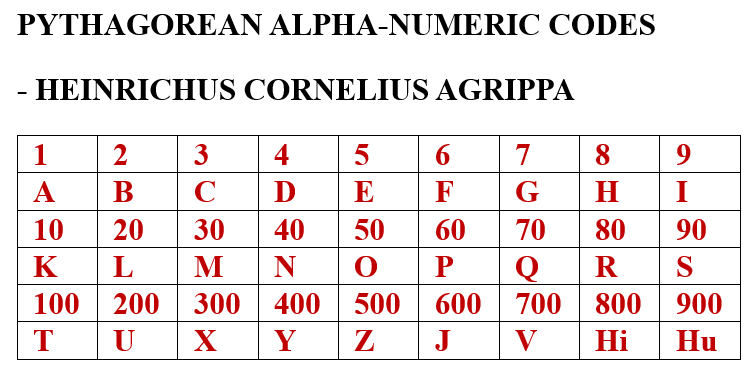
The original Pythagoreans numbered the Greek alphabet, but later they also began to study the sequence of letters in the Latin alphabet. Sometimes they assigned ones to the first nine letters, tens to the next nine, and hundreds to the rest. At other times, ordinal values were used, where a number in the sequence was assigned to the letter. By the beginning of the 20th century, reduced values from 1 to 9 prevailed. We can see some historical alpha-numeric codes in Pythagorean numerology, shown with reduced values for ease of comparison with modern coding:
Modern Pythagorean numerology as an occult or metaphysical science about the influence of numbers on people’s destiny was developed in the 16th century by Heinrich Cornelius Agrippa. His coding was used by some numerologists until the beginning of the 20th century. Interestingly, between 1870 and 1908, Pythagorean numerologists mainly used the system first traced by Louisa Lawford (1870). Her descriptions of numbers are quite different from the ancient Pythagorean school and are in some places influenced by Chaldean numerology, or at least the numerology of the Tarot. From the total name number (TNN) it was necessary to subtract the highest number described that could be subtracted. Then we use the next highest possible number… The numbers we have used are supposed to have a special meaning. This approach is not very convincing; Sepharial claimed that such list of numbers was an expanded version of another text, and that not all numbers should be considered.
In 1908, Luo Clement and L. Dow Balliett each published a book. Both used modern alphabet numbering and different meanings of numbers than Lawford’s. This gave birth to the modern Pythagorean school. Luo Clement used the system of tryads (1&5&7; 3&6&9; 2&4&8) and the day-of-the-month analysis. L. Dow Balliett, on the other hand, used the Life Path number and attributed to the numbers 9 and 11 meanings like those in the symbolism of the tarot and arcana IX (the Hermit) and 11 (the Force) respectively. The mastery of the lion in the symbolism of arcana 11 represents a force. The English word MASTER has the value 4+1+1+2+5+9= 22. The concept of master numbers 11 and 22 is a complete innovation which has no connection with the older Pythagorean tradition.
The approach of L. Dow Balliett prevailed over all others, as Balliett managed to gather several enthusiastic students (Julia Seton, Roy Page Walton, etc.) around her. In addition to Life Path and vowels, they soon began to analyze consonants, universal and personal years, months and days, and the four pinnacles. They also developed predictive techniques with transits of letters. In this method, the distinctions between odd and even numbers are often of great value. The first manual to present this new numerological trend in a comprehensive way was Florence Campbell‘s Your Days are Numbered (1930). This school of numerology was so successful that it almost completely superseded Chaldean numerology after the Second World War. Until a few years ago, up to 95% (and perhaps even more) of all numerology books belonged to this approach.
It was also the L. Dow Balliett school that some Chaldean numerologists (Strayhorn) began to include in their analyses. Some Chaldean numerologists, however, have stuck to the Chaldean alpha-numeric coding, but then follow the Pythagorean approach when analyzing the results. The first Chaldean numerologist to do this was Montrose, followed by Mykian.
In 1870, Louisa Lawford described a specific system of Pythagorean numerology (Lawford, Louisa (1870): The Dream Book and Fortune -Teller. London, George Routledge and Sons. Pages 103-107). The descriptions of the numbers are quite different from the ancient Pythagorean school and are in some places influenced by Chaldean numerology or at least Tarot numerology. From the total name number (TNN) it was necessary to subtract the highest number described that could be subtracted. Then we use the next highest possible number… The numbers we have used are supposed to have a special meaning. This approach is not very convincing; Sepharial was convinced that her list of numbers was an expanded version of another text, and that not all numbers should be considered.
1. Passion, ambition, design.
2. Destruction, death, catastrophe.
3. Religion, destiny, the soul, charms.
4. Solidity, wisdom, power.
5. The stars, happiness, graces, marriage.
6. Perfection, labour.
7. Course of life, repose, liberty, perfect happiness.
The way we interpret the numbers is to first add all the numbers to TNN, according to the system of Great Values. Jean Jacques Rousseau has 616+ 969+ 716= 2331. From his TNN with value of 2331, we first eliminate the number 2000 (which has no special meaning) and we are left with 331. From this number, we first take away 300, which has the meaning “Safety, belief, faith, philosophy,” and we are left with 31, which has the meaning “Love of glory.”
 became established, which, due to its connection with the letter waw and the sound “w,” has the value of 6.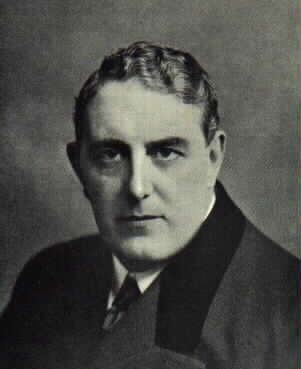






 The Mystery of Numbers, Luck, Worlds and Planets